Showing posts with label reform of the reform. Show all posts

Wednesday, February 14, 2018

UPDATE: Massive liturgical changes - Benedict XVI's reaction

A weak Pope Emeritus fights for the liturgy he loves so much.

 
Four months ago, this Blog had revealed that this year the Novus Ordo Lectionary and Calendar are to be imposed upon the Extraordinary Form of the Roman Mass. However, there is increasing opposition within the Roman Curia to such changes - led by Pope Emeritus Benedict XVI. A man of integrity and a towering intellect whose theological writings will endure, Benedict XVI, albeit very frail, does not want the dismantling of the work done that culminated in Summorum Pontificum.
 
Benedict XVI's letter to the Italian daily Corriere della Sera, published on 7 February 2018, gives a hint of where the Pope Emeritus' heart lies.
 
“Dear Dott. Franco, 
I was moved that so many readers of your newspaper would like to know how I am spending this last period of my life. I can only say that with the slow decline of my physical forces, interiorly, I am on a pilgrimage towards Home. It is a great grace for me to be surrounded in this last, sometimes a little tiring, piece of road, by such love and goodness that I could not have imagined. In this sense, I also consider the question of your readers as an accompaniment along a stretch. This is why I cannot but be grateful, assuring all of you of my prayers. Best regards.” (Emphasis ours)
However, the modernist wing continues the implementation of its task unabated. The so-called 'reform of the reform' will be further weakened, at the expense of the pre-Conciliar liturgy as much as possible. More on this to follow...

Monday, January 18, 2016

Hall of Honour (7): Fr Marc Andrè Camilleri


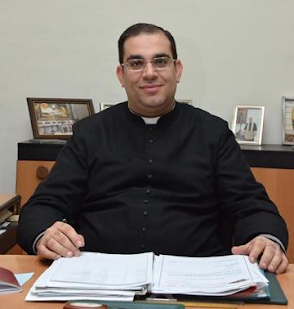
The seventh recipient of this virtual award is Fr Marc Andrè Camilleri, who was appointed parish priest of Christ the King parish in Paola by Archbishop Paul Cremona in August 2014.

Fr Camilleri, from Lija, was born on 15 August 1984 and ordained priest on 23 June 2010. He served as deputy parish priest at St Sebastian parish in Qormi and - since 2010 - is a member of Missjoni ż-Żgħira. The latter was established in Malta in 1884 by Canon Francesco Bonnici. The Canon was inspired by the activities of the Mission founded by St. Gaspare del Bufalo in Rome. with the primary aim of instructing children through missionary preaching. Today, the Missjoni ż-Żgħira preaches missions not only to children but also to adults, and especially to youths.

Fr Camilleri has celebrated Mass in the Extraordinary Form of the Roman Rite in several localities, including Valletta, St. Paul's Bay, Bengħisa and Ta' l-Ibraġ. Some of these were celebrated with the aid of Pro Tridentina (Malta).

Fr Marc Andrè has also contributed to the debate on the so-called reform of the reform. Below is his article (when he was a deacon) published in the Sunday Times of Malta.

The reform of the reform

It seems very unfair to say that any discussion about the implementation of the post-Vatican II liturgical reform would lead to its deformation.

It was Pope Benedict himself, while still Cardinal, who pointed out that "the reform of the liturgy in its concrete realisation... resulted not in reanimation but in devastation. We have a liturgy that has degenerated into a show, in which attempts are made to make religion appear interesting with the help of idiotic fashions..." (Preface in Klaus Gamber: La reforme liturgique en question, 1992.)

He himself called for a reform of the reform many times, not, as others would have us believe, that this younger generation is "nostalgic for turning back the clock".

Would the Pope accuse the younger generations of "nostalgia" or "Lefebvrian fundamentalism"? I doubt it. When asked about this in 2001, Cardinal Joseph Ratzinger answered very clearly to those who wish "to make us believe that if we did not adhere to their schemas we will be nostalgically returning to the past. Such things do not go like that. It is an attitude of a past faction. It is important to reflect in an open manner and not to kill instantly all this reflection, we are accused of being partisans of St Pius V. We need to outride this way of thinking. I'm evidently for Vatican II, which has given us a lot of beautiful things. But declaring that it is impossible, and to judge unacceptable all the reflection on what we can elicit from the Church's history, for me is sectarianism which I don't accept any more."

While reflecting on the use of the 1962 Roman Missal, Pope Benedict pointed out that the fact "that young people too have discovered this liturgical form, felt its attraction and found in it a form of encounter with the mystery of the Most Holy Eucharist, particularly suited to them."

What a far cry from the accusation Fr Joe Inguanez levelled at the younger generations for "returning the practices and rituals that belong to another era are nothing less than a manifestation of wanderlust, of romantic utopia, symbolised in the sacred rather than the religious." (Excerpts from the '2005 Mass census report', Malta, p. 28)

In the words of the Pope, "what earlier generations held as sacred, remains sacred and great for us too, and it cannot be all of a sudden entirely forbidden or even considered harmful. It behooves all of us to preserve the riches which have developed in the Church's faith and prayer, and to give them their proper place." (July 7, 2007)

The Pope has made it clear that he is attempting even to reform the Papal liturgies according to the principles he so vociferously spoke about before his election. The first reform was the change of the master of ceremonies after which the Papal liturgies took on a different style; that of "a wise joining of the ancient with the new, to actuate in spirit and letter, as much as possible, the indications of the Second Vatican Council, and to do this in such a way that the pontifical celebrations are exemplary in all aspects."

Benedict has given us a direction to aim for; a Church which does not look for uniformity but for unity in diversity; a Church in which two forms of the same rite if celebrated well can exist together, a Church in which the Roman rite can exist together with different Eastern rites and now even with an Anglican rite. Not a Church that accuses these reformers of "Lefebvrian fundamentalism", or of trying to turn the clock back. Had this attitude of mistrust and hostility guided the Church's authorities during the centuries, no reform would have ever taken place.

Fr. Joe Inguanez, who holds a diametrically opposite view, replied a month later. The letter can be found below:

The Church: a reform or a counter-reform?

My attention has been drawn to a letter written by Rev. Deacon Marc Andre' Camilleri, published on February 28.

I read his letter with all the attention it merits. Ironically, I was both amused and amazed.

I was amused because the letter speaks more about its author than about my pastoral commentary which introduced the Malta Sunday Mass Attendance Census 2005.

I was amazed because Fr Camilleri is reaching the end of his degree course in theology and I could hardly find any theological argument in his missive.

This was also a disappointment, since I am aware of the effort of most of my colleagues, who are doing their best to teach theology and resisting turning their lectures into glorified Catechism lessons.

Not that I do not accept the Catechism, but its teachings alone do not constitute theology. The problem with Fr Camilleri - and with those of a similar mindset - is that he ignored the serious pastoral problems which I tried to tackle in my commentary.

The reason people are leaving the Church are not the "so-called" aberrations in the liturgy that followed Vatican II, but what Cardinal Ratzinger, on Good Friday 2005, referred to as the "filth [that] there is in the Church, and even among those who, in the priesthood, ought to belong entirely to Him!

How much pride, how much self-complacency!"

Fr Camilleri praised Mgr Guido Marini, the present Papal Master of Ceremonies, without letting readers know these words were uttered by a certain Father Gagliardi, a member of the staff of the same Mgr Marini. (see Zenit, January 8, 2010).

May I suggest he reads the book by Archbishop Piero Marini (the former Master of Ceremonies to His Holiness), Challenging Reform: Realizing the Vision of the Liturgical Renewal, 1963-1975 (2007).

He will learn that "with the change of the Consilium into a Congregation in 1969 and the transformation of the Congregation for Divine Worship to a subsection of another Congregation in 1975 (Congregation for Divine Worship and the Discipline of the Sacraments), the distinctive style of the Consilium was gradually absorbed into the more traditional style proper to the Roman Curia.

This was probably one of the first signs of a tendency to return to a pre-conciliar mindset that has for years now characterised the Curia's approach.

As more and more time passes since the Second Vatican Council, an event charged with such hope and desire for renewal, its distinctive contributions seem to be increasingly questioned."

Fr Camilleri does not seem perturbed by the fact that 49 per cent are not attending Sunday Mass.

Or perhaps he believes these can be brought back by the widening of clerical phylacteries and lengthening of tassels, a style definitely not promoted by Jesus (Matthew 23: 5).

He seems to be unaware of the Lord's pastoral injunction to leave the 51 per cent and go out in search of those who have left, or have never been in.

In line with people of ultra-conservative mindset, he takes critique to be an accusation. Ironically, he quotes Pope Benedict to make his point; ironically, I can use the same quote in support of my argument: "We need to outride this way of thinking. I'm evidently for Vatican II, which has given us a lot of beautiful things. But declaring that it is impossible, and to judge unacceptable all the reflection on what we can elicit from the Church's history, for me is sectarianism which I don't accept any more".

It is his lack of knowledge of the Church's history, history of theology and human thought that is Fr Camilleri's achilles' heel.

I am really sad he has really proved one of the points made in my commentary - that we are faced with a number of clerics who seem to be more interested in custom than tradition; in one's attire more than in the way one lives; in building and decorating the Temple of our Jerusalems rather than in nurturting the Body of Christ.

What our Church needs is not the reform of a reform, but constant reform on the lines started by Vatican II and perhaps, as Cardinal Martini and others have suggested, by means of a Vatican III.

Wednesday, November 11, 2015

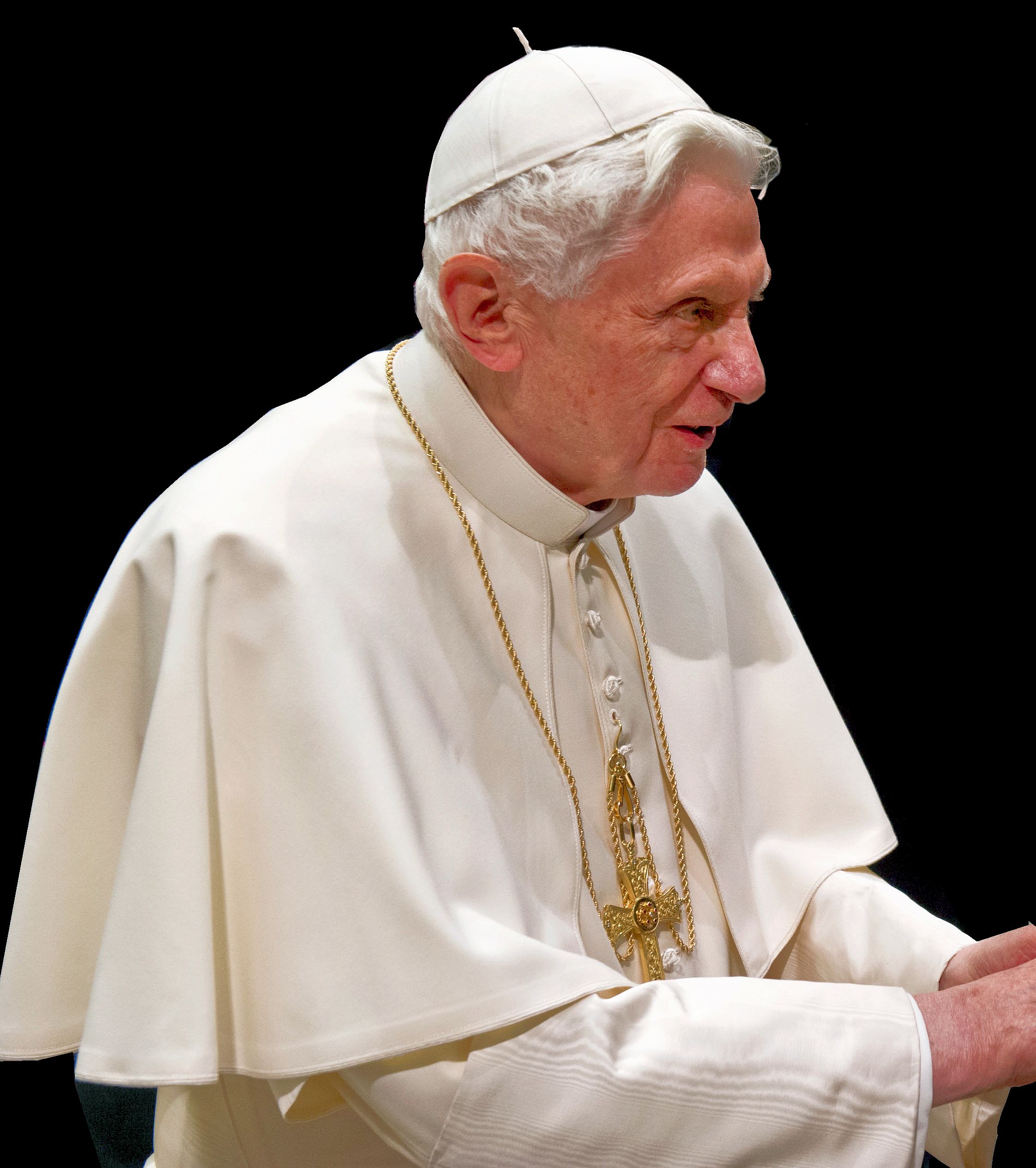
EXCLUSIVE: Benedict XVI to celebrate Tridentine Mass?

https://upload.wikimedia.org/wikipedia/commons/8/8d/Benedictus_XVI_-_General_audience_-_Vatican_-_Jan_16,_2013.jpg

He may do so during this Holy Year of Mercy. One has to admit that if a celebration of the Tridentine Mass by Pope Emeritus Benedict XVI indeed takes place, this would raise the question, once again, of what is Pope Benedict's true position on the Tridentine Mass.

A number of distinct personalities (including Dr Alice von Hildebrand) have asked him, over the years, his opinion on this Mass, but Benedict XVI never gave a full, unambiguous answer. 

Prior to his election as Pope, Cardinal Ratzinger celebrated at 07:00 each Thursday in the Teutonic College church inside the Vatican walls, and those Masses were always of the Novus Ordo, celebrated in a very simple, solemn way.

Cardinal Ratzinger repeatedly expressed a certain sorrow, even indignation, over the way the conciliar liturgical reform took place, saying that the liturgy was developed in a non-organic way by professors sitting around a table and that, as the new liturgy was introduced, without sufficient explanation, the ordinary faithful were often confused, and sometimes scandalized. This is the position that Ratzinger took quite explicitly in his book The Spirit of the Liturgy.

At the same time, Benedict XVI personally does in some ways favor at least certain aspects of the conciliar liturgical reform as an improvement over the traditional liturgy.

The German writer Martin Mosebach once stated that Pope Saint John Paul II celebrated the Tridentine Mass on several occasions privately. Bishop Bernard Fellay of the Society of St. Pius X (SSPX) also had said that someone in the Roman Curia told him that Pope Benedict, too, has celebrated the Tridentine Mass on several occasions privately. It is, in any case, a known secret that when he was a Cardinal, Benedict XVI celebrated on a number of occasions the Tridentine Mass, including for the Fraternity of Saint Peter (FSSP).

But why would Benedict XVI celebrate Mass in the Extraordinary Form of the Roman Rite? 

One can here attempt a number of reasons:
  • The traditional Latin Mass was, and is, the organic expression of the faith of Catholics in the Risen Lord, from the first generation to the present time. 
  • This Mass was never intended to be the Mass of any political or cultural regime. And that it came to be seen as the expression of a certain political or social culture is one of the unfortunate reasons that the Council Fathers felt they had to approve a reform of the liturgy. 
  • However the reform that was produced was not the reform that the Council Fathers called for.
  • This has meant almost two generations of liturgical confusion, and the consequent crisis of belief which inevitable follows liturgical confusion, for it is true that lex credendi lex orandi
  • Worse still, some overzealous people stripped our churches of statues, broke stained-glass windows, and turned against our heritage.

Saturday, June 22, 2013

Benedict XVI vs Francis - the smear campaign continues

http://abcnews.go.com/images/International/gty_pope_benedict_xiv_pope_francis_lpl_130313_mn.jpg
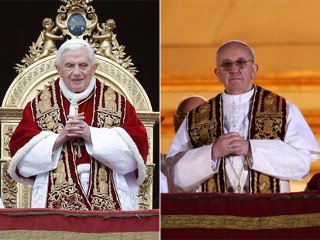
Benedict XVI and Francis: two pontificates with different priorities.

Soon after the election of Pope Francis, some notable Catholic journals started odious comparisons between the current Pontiff and the Pope Emeritus, aimed at putting into a bad light the ‘reform of the reform’ championed by Benedict XVI. One of the latest is the article Francis looks to the Future by The Tablet, a British Catholic weekly journal that stresses that: "It is committed to the teaching of the Second Vatican Council."

Although this journal prides itself as having had as contributor Cardinal Joseph Ratzinger, it nevertheless regularly attacks him, as the quote from the above-mentioned confirms:

"Benedict XVI’s ecumenical priorities were more to do with resolving issues from the Church’s own past. He put great store by the possibility of reconciliation with the Vatican II-denying Society of St Pius X, and encouraged long and tortuous conversations which seemed to be going nowhere from the start, given the non-negotiables on both sides. He reversed decades of church policy by re-authorising the celebration of the Tridentine Rite, which seemed not just a gesture towards the Lefebvrists but a reactionary move in liturgical policy generally, as did the imposition of a severely inadequate, if linguistically more accurate, translation of the Mass into English."

What The Tablet seems unable to understand is that:
  • the pontificates of Benedict XVI and Francis have different priorities but both are at the service of Our Lord Jesus Christ and His Church;
  • attempts at creating friction between the two will simply backfire, case in point being the first encyclical by Francis that will have a huge contribution from Benedict XVI himself.
Further comments at this stage are superfluous.


Saturday, December 15, 2012

FIUV Position Papers Published


FIUV Position Papers
The book's cover
FIUV's book of the Position Papers, edited by Dr Joseph Shaw, Chairman of the Latin Mass Society of England and Wales, has been finalised and is now available.This book is very useful to all those interested in the Roman Missal of 1962. It can be bought from this site.

The review below, by Archbishop Thomas Gullickson, Apostolic Nuncio to the Ukraine, says it all:

I think I would have enjoyed writing additional reviews [on my blog] and could have weighed in much more heavily on behalf of a project which has enjoyed my favour since I first became acquainted with it, namely The FIUV Papers on the Liturgy, which discuss specific issues concerning the 1962 Missal. The Papers have become one of the pillars of the internet presence of the Foederatio Internationalis Una Voce. The genius of the 13 papers, to my mind, is that they do indeed teach and quite comprehensively, offering important lessons about why we need to focus more or better on the very real issue of what to do about the rupture in the continuity of our liturgical tradition which has come to be and not through the inspiration of the Holy Spirit. 

As important as it may be to get about the business of repairing, I find the work done by these papers to be of a prior importance to any decision about "reforming the reform" or "rebooting" after choosing a restoration point and establishing principles for the organic development of a restored Roman Rite. The FIUV Papers on the Liturgy really grapple with what the Holy Father calls the mutual enrichment of the two forms of the Roman Rite. Without wanting to be a reductionist about assessing their worth, let me say simply that reading and ruminating over the FIUV Papers on the Liturgy could serve as a marvellous primer for anyone, clergy or laity, on how to address what often ends up being controversial, doing so in a very different and respectful manner.

Sunday, February 20, 2011

A homily which is so relevant to the situation in Malta


Extracts from a homily by Archbishop Thomas Gullickson, Apostolic Nuncio, Trinidad and Tobago.


Why, even three years after the issuance of Summorum Pontificum (just to name one example), are well-meaning lay folk still treated with such great disdain by no less than bishops, bishops in communion (of heart, soul, mind and strength?) with the Successor of St. Peter when they ask for Mass in Latin? Is this anything other than blind hypocrisy (the plank!)? You tolerate no small amount of bad taste, bad music and caprice, while begrudging some few a port in the storm of liturgical abuse which seems not to want to subside? Can we be after His own Heart and not just claim to be members of Christ’s Body while still acting so at odds with the example set by the Holy One of God, meek and humble of heart? Such prelates are at counter or cross purposes to the sense in which the Church wants to go; they are ignoring what the Spirit is saying to the Churches and doing so with a backhand to some who are branded common and contemptible, but certainly not in the eyes of Christ... Let me say it more clearly! My issue is with the contempt shown for an outstretched hand, contempt such as would not be shown toward someone asking for some other benefit.


When the Holy Father speaks of his will to see these two forms of the Roman Rite (ordinary and extraordinary) enrich each other, when he and others express eagerness for a recovery of the sense of the sacred in our churches and in how we worship, I am convinced that he has indicated the true nature of the rupture which has indeed occurred and needs to be mended or healed.


You would think that those in communion with the Pope would seek to understand him and embrace his point of view. There is too much room for caprice and hence the need to reform contemporary Catholic worship. This is evidenced time and again, by way of one example, in the sense of helplessness many priests experience when confronted by musical groups moving into church with inappropriate repertoires, not to mention the dance and puppet troupes which should have been banished long ago. If a bishop does not want to discipline at least he can respect and foster those seeking good order.

St. Charles Borromeo advised his priests to fight distractions and foster devotion the same way that you keep a stove lit with only a flicker of flame inside, and that is, by keeping that stove closed up tight until you get the fire going strong. I think that has to be the aim of the reform of the reformed liturgy. That was the genius over centuries of the old Latin Low Mass, tamper-proof and self-contained throughout the vicissitudes of time. The pendulum swing to the other extreme, which has swept away everything that was popular devotion and religious expression, while at the same time opening up that stove to nearly anything and everything, has had little more effect than to have diminished the liturgy’s capacity for providing heat and light.


Contemporary worship is too often held hostage by caprice (tasteful or tasteless is not the point), by creativity, if you will, but still something not foreseen by legitimate authority.

Among the things which contribute to the crisis of faith among our youth, among those things which contribute to their dismissal of the Sunday obligation to assist at Mass (see the statistics for Mass attendance by young Catholics!) is the absence in what they experience in their parishes and Catholic school settings of an approach to Divine Worship marked by the healthy fear and trembling which time and again brought His disciples to their knees before the Son of Man. Just the other day in an airport waiting lounge I caught a conversation, in the row of seats back to back with me, between two elderly Catholic couples who were miffed at Father for having admonished them to go to confession for having failed to fulfill their Sunday obligation on the day after Christmas! The grounds for their dismissal of Father’s well-meant admonition were that such rules are man-made anyway. This is to my mind a logical conclusion to be drawn from a Sunday service as free-flowing and de-sacralized as they probably experience, as anything on cable TV or to be found in a passing revival tent meeting.

“The human race has nothing to boast about to God, but you, God has made members of Christ Jesus and by God’s doing he has become our wisdom, and our virtue, and our holiness, and our freedom.”

Apart from this intolerance, I’ve been confronted again and again recently with the reality of how oblivious many priests, religious and laity are to the de-sacralized character of their liturgizing. Jeff Tucker at “The Chant Café” is swarming about all he sees as progress toward the reform of the reform. I wish I could see what he sees. The promotion of the extraordinary form is an encouragement to reforming vernacular liturgy. The hunger of many of the laity for a reformed vernacular liturgy marked by noble simplicity has been and continues to be fostered by encounters with the extraordinary form. My guess is that a more positive attitude by more bishops toward the extraordinary form would go a long way to moving some of the priests toward an examination of conscience concerning their approach to celebration.

Why do some successors to the Apostles seem so unaware of the injustice of the double standard they apply in reacting negatively to requests for Mass in the extraordinary form? If they are unwilling to restore decorum to vernacular worship “cold turkey” for lack of courage or whatever, then the least they could do is recognize and support those among them who seek better.

Saturday, January 9, 2010

Papal liturgist sees need for 'reform of the reform'


January 07, 2010

Msgr. Guido Marini, the master of ceremonies for papal ceremonies, called for a liturgical “reform of the reform” in a January 6 address to a conference organized by the Confraternity of Catholic Clergy. Msgr. Marini explained that this movement should “move one more step ahead in understanding the authentic spirit of the liturgy.”

The Vatican’s chief liturgist said that a renewal of the liturgy must reflect “the uninterrupted tradition of the Church,” incorporating the suggestions of Vatican II into that tradition. The conciliar reforms, he insisted, must be understood as being in continuity with the traditions of previous centuries. “The only disposition which permits us to attain the authentic spirit of the liturgy,” he said, “is to regard both the present and the past liturgy of the Church as one patrimony in continuous development.”

Msgr. Marini lamented that the need for renewal is evident in the widespread abuses of the liturgical. He observed that “it is not difficult to realize how far distant some modes of conduct are from the authentic spirit of the liturgy.” He added: “For this, we priests are largely responsible.”

Citing the works of then-Cardinal Ratzinger, from before his election as Benedict XVI, the Italian cleric emphasized that the form of the liturgy is established by the whole Church, and should not be altered arbitrarily by an individual priest-celebrant. He decried the “despotic behavior” of priests who disregard liturgical rules, and emphasized that the liturgy “is not made available to us in order to be subjected to our personal interpretation; rather, the liturgy is made available so as to be fully at the disposal of all, yesterday just as today and also tomorrow.”

Msgr. Marini continued:

What casual folly it is indeed, to claim for ourselves the right to change in a subjective way the holy signs which time has sifted, through which the Church speaks about herself, her identity and her faith!

Offering a few reflections on means of renewing the sense of the sacred in the liturgy, the Vatican official spoke first about the traditional ad orientem posture, “a traditiona which goes back to the origins of Christianity.” He argued that when priest and congregation alike face toward the east, it is “a characteristic expression of the authentic spirit of the liturgy.” He went on:


In our time, the expression “celebrating facing the people” has entered our common vocabulary. If one’s intention in using this expression is to describe the location of the priest, who, due to the fact that today he often finds himself facing the congregation because of the placement of the altar, in this case such an expression is acceptable. Yet such an expression would be categorically unacceptable the moment it comes to express a theological proposition. Theologically speaking, the holy Mass, as a matter of fact, is always addressed to God through Christ our Lord, and it would be a grievous error to imagine that the principal orientation of the sacrificial action is the community.


Msgr. Marini said that every aspect of the liturgy should be designed to encourage adoration. He pointed out that Pope Benedict has begun the practice of having the faithful, at papal liturgies, receive Communion kneeling, on the tongue, as a way to “render visible the proper attitude of adoration before the greatness of the mystery of the Eucharistic presence of our Lord.” While he wholeheartedly endorsed the call for active participation in the liturgy, the papal liturgist said that the participation of the laity would not be “truthfully active if it did not lead to adoration of the mystery of salvation in Christ Jesus, who for our sake died and is risen.”

Tuesday, September 1, 2009

Bishop of Tulsa Abandons "Mass Facing the People"


Bishop Slattery on Mass Ad Orientem

By John Vennari


The September 2009 issue of Eastern Oklahoma Catholic featured a brief article by Bishop Edward J. Slattery, Ordinary of the Diocese of Tulsa, Oklahoma. The Bishop explains why he has ceased the practice of Mass facing the people, and now celebrates Mass facing the altar (ad orientem).


Though the article does not specify whether the Bishop will celebrate Old Latin Mass or the Novus Ordo ad orientem, it is said Bishop Slattery is well disposed toward the Tridentine Mass. The fact that a United States Bishop displays a clear understanding of why Mass should be celebrated ad orientem is one of the few rays of hope in the Church in America. His words deserve to be widely known.

Bishop Slattery opens by explaining the Mass as "Christ's sacrifice under the sacramental signs of bread and wine", and goes on to explain that the people share in this offering, which is done through the priest.

"From ancient times, the position of the priest and the people reflected this understanding of the Mass," writes Bishop Slattery, "since the people prayed, standing or kneeling, in the place that visibly corresponded to Our Lord's Body, while the priest at the altar stood at the head as the Head, We formed the whole Christ – Head and members – both sacramentally by Baptism and visibly by our position and posture. Just as importantly, everyone – celebrant and congregation – faced the same direction, since they were united with Christ in offering to the Father Christ's unique, unrepeatable and acceptable sacrifice."

He points out that when we study the most ancient liturgical practices of the Church, "we find that the priest and the people faced in the same direction, toward the east, in the expectation that when Christ returns, He will return `from the East'. At Mass, the Church keeps vigil, waiting for that return. This single position is called ad orientem, which simply means `toward the East'."

He then speaks of the multiple advantages of Mass ad orientem:

The Bishop says, "Having the priest and people celebrate Mass ad orientem was the liturgical norm for nearly 18 centuries. There must have been solid reasons for the Church to have held on to this posture for so long. And there were! First of all, the Catholic liturgy has always maintained a marvelous adherence to the Apostolic Tradition. We see the Mass, indeed the whole liturgical expression of the Church's life, as something which we have received from the Apostles and which we, in turn, are expected to hand on intact. (1 Corinthians 11:23)."

Secondly, the Bishop continues, "the Church held on to this single eastward position because of the sublime way it reveals the nature of the Mass. Even someone unfamiliar with the Mass who reflected upon the celebrant and the faithful being oriented in the same direction would recognize that the priest stands at the head of the people, sharing in one and the same action, which was – he would note with a moment's longer reflection – an act of worship."

He then makes the point: "In the last 40 years, however, this shared orientation was lost; now the priest and the people have become accustomed to facing in opposite directions. The priest faces the people while the people face the priest, even though the Eucharistic Prayer is directed to the Father and not to the people."

Bishop Slattery never refers to Mass facing the people as some sort of recovery of an ancient tradition, but clearly speaks of it as an "innovation" that took place after Vatican II – an innovation with negative consequences.

The introduction of this novelty, he says, was "partly to help the people understand the liturgical action of the Mass by allowing them to see what was going on, and partly as an accommodation to contemporary culture where people who exercise authority are expected to face directly the people they serve, like a teacher sitting behind her desk."

He then sums up in three quick points the negative consequences of this innovation: "First of all, it was a serious rupture with the Church's ancient tradition. Secondly, it can give the appearance that the priest and the people were engaged in a conversation about God, rather than the worship of God. Thirdly, it places an inordinate importance on the personality of the celebrant by placing him on a kind of liturgical stage."

The Bishop goes on to note that Pope Benedict, even as Cardinal Ratzinger, urged a recovery of more authentic Catholic worship based on the ancient liturgical practice, "For that reason," says Bishop Slattery, "I have restored the venerable ad orientem position when I celebrate Mass at the Cathedral. This change ought not to be misconstrued as the Bishop `turning his back on the faithful,' as if I am being inconsiderate or hostile. Such an interpretation misses the point that, by facing in the same direction, the posture of the celebrant and the congregation make explicit the fact that we journey together to God."

We may hope the Bishop's words and example help to lead not simply to a "reform of the reform" of the Novus Ordo, but ultimately to greater numbers of priests abandoning the New Rite, and celebrating exclusively the Latin Tridentine Mass. May more priests and prelates come to realize what Cardinal Ottaviani recognized, and what he wrote to Pope Paul VI on September 25, 1969: "The Novus Ordo Missae … represents, both as a whole and in its details, a striking departure from the Catholic theology of the Mass as it was formulated in Session 22 of the Council of Trent."

Godwin Xuereb, President, Pro Tridentina (Malta)'s comment: A very interesting article, although I am not totally in favour of what the author stated in the last paragraph. It is interesting to note that in Malta too, some priests are celebrating Mass ad orientem.