Showing posts with label St. Peter's Basilica. Show all posts

Friday, September 19, 2025

Leo XIV on the Tridentine Mass


Last April this Blog had commented on the future of the Tridentine Mass in Malta, and whether Traditionis custodes would still apply. 

Some days ago, it was announced that Tridentine Mass will be celebrated by Cardinal Raymond Burke at the Altar of the Chair in St. Peter's Basilica on 25 October, 2025. This represents an important return of this rite to the Basilica after it was suspended in 2022 due to restrictions issued by Pope Francis' 2021. 

Yesterday, Rorate Coeli published the text being reproduced below:

From an excerpt of the new book-interview with Elise Ann Allen, of Crux, released today -- a direct quote from the Pope's response:


[Elise Ann Allen]: Regarding the study group on liturgy, what is being studied? How much of the reason for establishing this was related to divisions surrounding the Traditional Latin Mass, for example, or issues such as the new Amazonian rite?


[Leo XIV]: My understanding of what the group came out of is primarily from issues that have to do with the inculturation of the liturgy. How to continue the process of making the liturgy more meaningful within a different culture, within a specific culture, in a specific place at any given time. I think that was the primary issue.


There is another issue, which is also another hot-button issue, which I have already received a number of requests and letters [about]: The question about, people always say ‘the Latin Mass.’ Well, you can say Mass in Latin right now. If it’s the Vatican II rite there’s no problem. Obviously, between the Tridentine Mass and the Vatican II Mass, the Mass of Paul VI, I’m not sure where that’s going to go. It’s obviously very complicated.


I do know that part of that issue, unfortunately, has become – again, part of a process of polarization – people have used the liturgy as an excuse for advancing other topics. It’s become a political tool, and that’s very unfortunate. I think sometimes the, say, ‘abuse’ of the liturgy from what we call the Vatican II Mass, was not helpful for people who were looking for a deeper experience of prayer, of contact with the mystery of faith that they seemed to find in the celebration of the Tridentine Mass. Again, we’ve become polarized, so that instead of being able to say, well, if we celebrate the Vatican II liturgy in a proper way, do you really find that much difference between this experience and that experience?


I have not had the chance to really sit down with a group of people who are advocating for the Tridentine rite. There’s an opportunity coming up soon, and I’m sure there will be occasions for that. But that is an issue that I think also, maybe with synodality, we have to sit down and talk about. It’s become the kind of issue that’s so polarized that people aren’t willing to listen to one another, oftentimes. I’ve heard bishops talk to me, they’ve talked to me about that, where they say, ‘we invited them to this and that and they just won’t even hear it’. They don’t even want to talk about it. That’s a problem in itself. It means we’re into ideology now, we’re no longer into the experience of church communion. That’s one of the issues on the agenda.

Friday, January 26, 2024

Biblical Concept of Time by Prof. Goswin N. M. Habets


I. The Hebrew Concept of Time and HistoryA. Israel had a concept of time very different from ours.The Western concept of time and history cannot be applied adequately to Israel.1. Our concept is linear: past - present - futureThe Western concept is also absolute and abstract.This is an a priori to every event; there is already time before the events.We can put any events on the time line.


Israel’s concept of time was not linear, absolute, abstract. No word exists in the Bible to express this. Some examples follow:

  • Jer. 50:16 time of harvest
  • Jer. 8:15 time of healing
  • Gen. 38:27, Mic. 5:2 time of giving birth
  • Gen. 29:7 time to gather animals
  • Ruth 2:14 time of a meal
  • Ps. 1:3 time for giving fruit
  • Ps. 104:27 time to give food
‘et = “time” - not a line, but punctum temporis, a point of time that is a determinate moment, a period of time. It is relative, always in connection with other words which always indicate an event. The event is not possible without its time; time is not without its event. Time in Israel is not abstract, but concrete. Time is identified with its content. Time is never empty time, but concrete, filled time.


'yom = “day” - from dawn to sunset (as distinct from 'laylah, “night”); unity of the calendar; same value as ‘et.

  • Gen. 2:4 day in sense of occasion, event of creation
  • Dt. 4:32 day that God created man on the earth
  • Dt. 9:7 the day when you came from Egypt - the occasion of Exodus.

This coincidence of time and event was not only valid for events of nature, but also for all human events, even internal movements of the soul.


  • Qoheleth 3:1-8 time imposed on every circumstance. Every event is determined by the time assigned to this event.
  • Ps. 31:16 “My times are in Your hands.”

Western concept of time is eschatological. Humanity is directed toward a final fulfillment.

  • Gen. 8:22 “all the times of the earth.”

Contrasts - two contrary concepts indicate totality. Succession of times rhythmic - cyclical vision of time. This conception of cyclical, anti-eschatological time of Archaic Yahwism did not remain so. Israel gradually elaborated an eschatological concept of time. The point of departure was the Feasts: Sabbath, Passover, Unleavened Bread, In gathering.

  • Passover: pastoral origin; rite practiced by nomadic or semi-nomadic shepherds.
  • Sacrifice of first fruits of the flock. Rite known before stay in Egypt.
  • Unleavened Bread: feast of sedentary people, Canaanite origin; an agricultural feast.
  • Periodic cycle of nature; beginning of Spring. Thanksgiving.

The Hebrew Concept of Time and History SummaryWestern Biblical1. Linear Punctum temporisAbsolute RelativeAbstract Concrete
2. Eschatological Non-eschatological in Archaic YahwismCyclical (Gen. 8:22)(Feasts) LinearEschatological (Dt. 16:1)


Passover given historical meaning: journey of Exodus a definitive journey.

Ex. 23:15 Feast of Unleavened Bread: symbolized Birth of People of Israel.


Passover and Unleavened Bread joined
a. Chronological coincidence:Nomads (1st full moon of Spring);
Unleavened Bread - (1st Gathering of grain)
b. Eating Unleavened Bread part of both rites.
c. Symbolism: strictly related
Passover - 1st event of Exodus
Unleavened Bread - Last event
Together - whole event

Israel’s Feasts:

Gilgal - conquest of the Promised LandSchechem - Covenant on SinaiFeast of Booths - Providence in the desertPassover - Exodus celebrated in familiesBethel - Patriarchs


Israel recognized these events as successive, as a “becoming” as history that was intelligible. Gestalt: each part takes its significance from being in relation with each other part and the whole.
Short biography: Born in the Netherlands in 1938, Fr. Goswin N.M. Habets became lecturer (professore incaricato) of Biblical theology within the Faculty of Theology at the Pontifical Athenaeum Regina Apostolorum (APRA) in 1977. He was highly esteemed by his students. One of his most interesting courses was the one on prophets. For decades, Fr. Goswin would go to the back entrance of the sacristy at 07:00 to celebrate Mass on the Altar of St. Pius X in St. Peter’s Basilica, Rome. The Dutch priest travelled a lot and Malta was one of his favourite places. Here he had several friends, including former altar boys who had served at St. Peter's Basilica over the years.

When he fell ill, Fr. Goswin asked a young American priest if he would be able to keep the Altar of St. Pius X “warm” for him. Afterwards, one morning, Fr. Goswin came by the sacristy to ask the sacristan and some of the senior altar servers to be ready for the American priest with vestments and cruets as soon as he entered — the trick that the more experienced priests in and around the Vatican had perfected.

Fr. Goswin died on 7 March 2005. A few hours after his death, a person who had attended his lectures stated that, after teaching the Old Testament throughout his life, Fr. Goswin was now ready to be examined on the New Testament. 

Tuesday, August 14, 2018

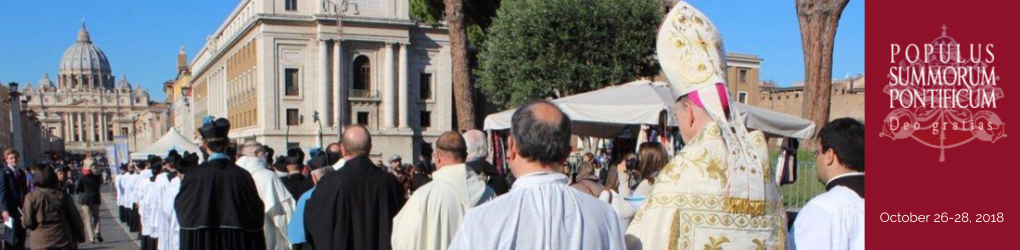
Summorum Pontificum Pilgrimage 2018


In 2018, the international pilgrimage of the Summorum Pontificum groups to Rome will be held from Friday 26 to Sunday 28 October, on the weekend of Christ the King. A delegation from Pro Tridentina (Malta) will be attending.
 
The pilgrimage will be led by Mgr. Czeslaw Kozon, Bishop of Copenhagen. The provisional progamme is as follows:
 
Friday 26 October  
 
11:00 - 17:00 - Meetings Populus Summorum Pontificum  at the invitation of Paix Liturgique, the FIUV and Juventutem at the Pontifical University of Saint Thomas Aquinas (Angelicum).
 
18:00 - Mass at the Church of the SS. Trinity of the Pilgrims.
 
Saturday 27 October
 
09:30 - Eucharistic Adoration (confessions).  
10:30 - Solemn procession to the Basilica of St. Peter, presided by Msr. Kozon.
12:00 - Solemn Pontifical Mass in St. Peter's Basilica (Altar of the Chair), celebrated by Mgr. Czeslaw Kozon, Bishop of Copenhagen, choir conducted by Maestro Aurelio Porfiri. 
14:00 - Buffet for the Clergy. 
18:00 - Vespers of Christ the King in the church of the SS. Trinity of the Pilgrims.
 
Sunday, 28 October
 
09:30 - Mass of Christ the King for pilgrims who wish to participate in the Angelus of the Holy Father, Church of Jesus and Mary (ICRSS)
11:00 - Pontifical Mass of Christ the King celebrated by Mgr. Kozon at the Church of the SS. Trinity of the Pilgrims (FSSP).

Wednesday, March 13, 2013

Habemus Papam!


The Conclave Of Cardinals Have Elected A New Pope To Lead The World's Catholics
Pope Francis in his first public appearance.
"Tu es Petrus, et super hanc petram aedificabo ecclesiam meam, et portae inferi non praevalebunt adversus eam" (Matt. 16, 18)


The new Pope of the Roman Catholic Church was elected today. He is Cardinal Jorge Mario Bergoglio of Argentina and he has taken the name of Pope Francis. He stepped onto the balcony of St. Peter's Basilica for the first time to address the roaring crowd in St. Peter's Square. 

Bergoglio, aged 76, is a Jesuit from Buenos Aires and is the first pope from South America. Pope Francis humbly and calmly asked for the people's prayers.

"Let's pray always for each other. Let's pray for the whole world. May there be a great brotherhood," the new pope said in Italian. He wished that the "voyage with the church that we begin today" be "successful in spreading the gospel."

"Let us pray silently in this prayer for me," he said before bowing his head for a moment of silent prayer with a silent crowd. Pope Francis received a bishop's blessing and then made the sign of the cross to bless the people.

"Brothers and sisters, I leave you. Thank you so much for the warm welcome. Pray for me and we'll see each other soon. Tomorrow I want to go pray to the Madonna. And I want to wish to all of Rome goodnight and good rest," Pope Francis said with a laugh and a wave before leaving the balcony among cheers and bells ringing.

Thursday, February 14, 2013

The qualities of a new Pope - according to Benedict XVI

Pope Benedict XVI in his last public Mass during Ash Wednesday ceremony yesterday (Getty Images)

In this hectic week since Benedict XVI announced his resignation, Pope Benedict XVI has indicated what qualities the new Pontiff should have.
Pope Benedict XVI made his first public appearance since Monday's resignation announcement to a packed audience hall in Vatican City on Tuesday.
Benedict XVI  during this week's Audience
They are:
a)  both strength of mind and body are necessary (text of Benedict XVI's resignation);

b) a unifying figure - “I am thinking in particular of the sins against the unity of the church, of the divisions in the body of the church.” (Ash Wednesday Mass);

c) has to overcome “individualism” and “rivalry,” saying they were only for those “who have distanced themselves from the faith.” (Ash Wednesday Mass).

V: Oremus pro Pontifice nostro Benedicto.

R: Dominus conservet eum, et vivificet eum, et beatum faciat eum in terra, et non tradat eum in animam inimicorum eius.

V: Fiat manus tua super virum dexterae tuae

R: Et super filium hominis quem confirmasti tibi

Oremus. Deus, ómnium fidélium pastor et rector, fámulum tuum Benedíctum, quem pastórem Ecclésiæ tuæ præésse voluísti, propítius réspice: da ei, quæesumus, verbo et exémplo, quibus præest, profícere: ut ad vitam, una cum grege sibi crédito, pervéniat sempitérnam. Per Christum, Dóminum nostrum. Amen.

Friday, August 31, 2012

Important Event - not to be missed

 
On Saturday, 3 November 2012, Mass in the Extraordinary Form of the Roman Rite will be celebrated in St. Peter's Basilica, Rome, as the culmination of the International Pilgrimage organised by the Coetus Internationalis pro Summorum Pontificum (CISP). 
This event aims to bring together all those who support Summorum Pontificum in a public gesture of support for Pope Benedict XVI during the Holy Year of Faith and also to commemorate the fifth anniversary of Summorum Pontificum. 
Thomas Murphy, FIUV's Secretary is the official spokesman for the International Pilgrimage and the CISP. He recently gave the following interview that may be found in the FIUV's website here.

Friday, April 6, 2012

The Pope's Via Crucis (Made in Austria)

...and Pope Benedict faces yet another challenge
Dark clouds are gathering in Austria...

Yesterday Pope Benedict XVI celebrated a Chrism Mass in St. Peter's Basilica. His Holiness took the occasion to criticise last year's call (Appeal to Disobedience) by a group of priests in Austria to oppose a number of traditional Church teachings, including the liturgy. 

Most mainstream media are emphasising the issues of celibacy and women priests, however their first point targets the liturgy - a more than a veiled attack against the Pope's efforts in this area (read Summorum Pontificum and Universae Ecclesiae). 
 
Below are key excerpts from Benedict XVI's homily, followed by the text of the rebel Austrian priests:

Benedict XVI: “Recently a group of priests from a European country issued a summons to disobedience, and at the same time gave concrete examples of the forms this disobedience might take.”
 
“But is disobedience really a way to do this? Do we sense here anything of that configuration to Christ which is the precondition for true renewal, or do we merely sense a desperate push to do something to change the Church in accordance with one’s own preferences and ideas?”

“The saints show us how renewal works and how we can place ourselves at its service. And they help us realize that God is not concerned so much with great numbers and with outward successes, but achieves his victories under the humble sign of the mustard seed.”

“We preach not private theories and opinions, but the faith of the Church, of which we are servants.”

++++++++++++++++++++++++++++++++++++++++++++++++++++++++++
Appeal to Disobedience
The Roman refusal to take up long needed reforms and the inaction of the bishops, not only permits but demands that we follow our conscience and act independently:

We priests want to set a mark for the future:

1. WE WILL include a petition for church reform in every liturgy.

2. WE WILL not deny Communion to faithful of good will, especially remarried people, members of other Christian churches, and in some cases those who have officially left the Catholic Church.*

3. WE WILL avoid as much as possible celebrating multiple times on Sundays and feast days, and avoid scheduling priests travelling around or priests unknown to the community. A locally-planned Liturgy of the Word is preferable to providing guest performances.

4. WE WILL use the term “Priestless Eucharistic Celebration” for a Liturgy of the Word with distribution of Communion. This is how the Sunday Mass obligation is fulfilled when priests are in short supply.

5. WE WILL ignore the prohibition of preaching by competently trained laity, including female religion teachers. In difficult times, the Word of God must be proclaimed.

6. WE WILL advocate that every parish has a presiding leader – man or woman, married or unmarried, full-time or part time. Rather than consolidating parishes, We call for a new image of the priest.

7. WE WILL take every opportunity to speak up publicly for the admission of women and married people to the priesthood. These would be welcome colleagues in ministry.

We express solidarity with colleagues no longer permitted to exercise their ministry because we have married, and also with those in ministry who live in a permanent relationship. Both groups live in accordance with their conscience – as we do with our protest. We see in them as we do in our bishops and the pope our brothers. **

* Here we refer to those who officially leave the Church; some to avoid Church Tax as a means of protest

** This is a reference to the German Word "Mitbruder" instead of "Bruder" (brother) which is sometimes used by clerics and excludes the laity.
Trinity Sunday, 19 June, 2011

Tuesday, January 31, 2012

Malta's next Cardinal

Fr. Prospero Grech OSA with Pope Benedict XVI (Photo by courtesy of the Order of Saint Augustine)

Before the Angelus Prayer offered on the Feast of the Epiphany, Pope Benedict XVI announced the creation of 22 new Cardinals. Among them was our own Fr Prospero Grech OSA, presently and for decades a member of the community of Collegio Santa Monica, Rome. Father Grech, age 86, a well-known and highly respected Scripture Scholar will become the second Maltese Cardinal.

Letter of the Augustinians' Prior General

Dear Brothers and Sisters:

It is with great joy that I send this communication, to share with you the news that the Holy Father, Pope Benedict XVI, announced today that our brother, Fr Prosper Grech, of the Province of Malta and long-time resident at the International College of St. Monica in Rome, has been chosen to become a Cardinal.

Today, January 6th, the Pope announced his decision to celebrate a Concistory on February 18th, with the intention of creating 22 new cardinals. Among the names of those chosen, is our brother Fr Grech. Fr Prosper, 86 years of age, entered the Order in Malta in 1943, and was ordained to the priesthood in 1950. He has served for many years in Rome, almost all of them as a member of the community at St. Monica’s. He is a well known professor of Sacred Scripture, and has been a professor at various universities in Rome, especially the Biblicum, but also the Lateran and Gregorian Universities. He is the co-founder and first President of our Patristic Institute, the Augustinianum. He has also collaborated with numerous dicasteries of the Holy See, especially the Congregation for the Doctrine of the Faith.

In his proclamation made today, the Holy Father announced with great joy the Concistory for creating new Cardinals, among whom he has chosen outstanding churchmen who are especially distinguished for their service to the Church. Our brother Fr Prosper Grech was one of those chosen.

For this we are deeply grateful to God and to our Holy Father Pope Benedict. We express our congratulations to Fr Grech and we rejoice in this recognition of his many years of service, especially in his dedication to the study and teaching of the Word of God.

Fr Robert F. Prevost OSA
Prior General

Episcopal Ordination

Fr Grech will be ordained bishop in the Co-Cathedral of Saint John, Valletta, Malta, on Wednesday, 8 February, 2012. His episcopal coat of arms is diagonally divided into two equal parts with the Maltese cross on a red background on one side and the coat of arms of the Order of St Augustine on a dark blue background on the other. The motto chosen is In te Domine speravi.

Concistory

The Concistory during which the future Fr Prospero will become Cardinal is to be held on the morning of Saturday, 18 February, in Saint Peter's Basilica. The following day the new Cardinals will concelebrate Mass with the Holy Father also in Saint Peter's.

Highlights from his Biography

Born 1925 in Birgu, Malta, Grech studied at the Lyceum and served as gunner of the University Home Guard during the Second World War.

Grech joined the Augustinian Order in 1943 and seven years later was ordained at San Giovanni Laterano in Rome. After graduating Doctor of Theology from the Gregorian University, Rome (1953), Grech conducted research in Semitic languages at Oxford (1957-58) and Cambridge (1958-59) Universities.

Fr Prospero Grech served as professor at the Augustine Institute, Rome and founded the Istituto Patristico Augostinianum, Rome in 1970. He is a member of the Societas Studiorum Novi Testamenti (SNTS) and member of the Pontifical Biblical Commission. He has lectured for over thirty years at the Pontifical Biblical Institute in Rome on hermeneutics.

Fr Grech was professor of Biblical Theology at the Lateran University, Rome, Counsellor to the Sacred Congregation for the Doctrine of Faith and Secretary of the Maltese Augustinian province. He was also nominated Apostolic Visitor for seminaries in India.

Fr Grech and the Popes

During the time of the conclave that elected Paul VI in 1963, just two hours before the Pope was elected, Cardinal Montini asked Fr Grech to hear his confession.

Fr Grech was a great personal friend of Cardinal Albino Luciani when the latter was still Patriarch of Venice. The cardinal used to take up residence at the Augustinian College in Rome whenever he was in the capital to attend meetings of the Italian Bishops’ Conference. Fr Grech used to celebrate Mass and have lunch together with Cardinal Luciani.

The very first letter Pope John Paul I wrote soon after he was elected in August 1978 was one of thanks to Fr Grech for the hospitality and friendship he had always received at St Monica’s Augustinian College.

Pope John Paul II occasionally invited Cardinal Ratzinger, who was then Secretary of the Congregation of the Faith, to lunch. Fr Grech would also be invited.

Political 'involvement'

Fr Grech was also involved in negotiations between the Malta Labour Party (MLP) and the Vatican when attempts were made to solve Malta’s politico-religious dispute of the 1960s. Dom Mintoff, then Labour leader, wanted to start discussions with the Vatican about pending issues and asked Fr Grech to intervene so that negotiations could start.

Fr Grech accepted the invitation and immediately informed the Vatican’s Secretariat of State about this request. He was asked to tell Mr Mintoff to put down in writing what the MLP leader was proposing. Subsequently Fr Grech met Mr Mintoff and returned to the Vatican with the proposals.

After examining them, the Secretariat of State told Fr Grech that the proposals could be a basis for discussion. He was then instructed to inform Malta's Archbishop Michael Gonzi what had happened so that negotiations could start. However, when Fr Grech informed the Archbishop in writing and explained what had happened, Gonzi was furious.

Mr Mintoff was no less infuriated when he learned of the Maltese bishops’ reactions to his plans which had been made public. Both the Archbishop and Mr Mintoff were less than grateful to Fr Grech. According to reliable sources Fr Grech’s involvement in the whole matter could have cost the prominent Biblical scholar his chance to be nominated auxiliary bishop of Malta.

On 13 December 2011, Fr Grech received the honour of Companion of the National Order of Merit by President George Abela, in the name of the government and people of Malta. This honour and especially his nomination to the College of Cardinals more than make up for the unfair treatment he received decades ago.


Saturday, November 12, 2011

FIUV XX General Assembly: a brief report

(Address by Leo Darroch, FIUV President. Photo: courtesy St. Conleth's Catholic Heritage Association)

Saturday 5 November 2011

On Saturday morning, delegates and a number of distinguished guests (including Suor Margherita Marchione, MPF and Princess von Thurn und Taxis) attended the Tridentine Mass in St. Peter's Basilica. This was celebrated by Cardinal Dario Castrillón Hoyos (President Emeritus of the Pontifical Commission Ecclesia Dei) in the Blessed Sacrament Chapel. The text of his sermon can be found in the previous post (in Italian). Mons. Pablo Collino, Maestro Emeritus of the Julian Chapel Choir was in choir.

Just after Mass, I held private talks in the Apostolic Palace.

Cardinal Raymond Leo Burke (Prefect of the Supreme Tribunal of the Apostolic Signature) joined the FIUV delegates for lunch. After lunch, His Eminence gave his benediction to those present.

In the afternoon, the XX General Assembly of the Foederatio Internationalis Una Voce started with the Address by its President, Leo Darroch. The 7 new member organisations were presented, they are:

  • Ecclesia Dei Society of St. Joseph (Philippines),
  • Una Voce Japan,
  • Una Voce Portugal,
  • Una Voce Natal (Brazil),
  • Una Voce Cuba,
  • Una Voce Albaruthenia (Belarus), and
  • Una Voce Ucraina (Ukraine).

Leo Darroch was reconfirmed for a further term as President by acclamation.

The newly elected Council (including Pro Tridentina (Malta)'s representative) then proceeded to select the following officials:

  • Vice-Presidents: Jack Oostveen (the Netherlands), Jason King (USA) and Patrick Banken (France).
  • Treasurer: Monika Rheinschmitt (Germany).
  • Secretary: Thomas Murphy (Ireland).

Rodolfo Vargas Rubio (Spain) had earlier renounced his post as Secretary due to health reasons. He however remains as a Councillor. I would like to take this occasion to thank Rodolfo for the hard work he devoted to our cause and the assistance he gave Pro Tridentina (Malta) in the past years.

Sunday 6 November 2011

In the morning, delegates assisted at a solemn Tridentine Mass celebrated by Fr. Joseph Kramer, FSSP at the Personal Parish of Santissima Trinita' dei Pellegrini.

In the afternoon, the FIUV General Assembly held an open forum at which a number of speakers delivered papers. They were:

  • Fr. Joseph Valluari, FDP, who read a paper on the “private prayers” that the Priest says during Mass.
  • Don Stefano Carusi, IBP, about the spirit and progress of the Institute of the Good Shepherd.
  • Dr. Helmut Ruckriegel, a founder member of FIUV, gave a brief history of our organisation.
  • Rev. Dr. José-Apeles Santolaria de Puey y Cruells, JCD (ABD), HistL, SMOM, on the value of Romanitas in the Traditional movement and the Roman Rite as a factor of Civilisation in the Western World.
  • Mons. Valentín Miserachs, President of the Pontifical Institute for Sacred Music, on Sacred Music and the Centenary of the Pontifical Institute.
  • Fr. Joseph Kramer, FSSP, gave statistics regarding the Priestly Fraternity.
  • Canon Joseph Luzuy of the Institute of Christ the King, Sovereign Priest, about the progress of the Institute.


The XX General Assembly ended with the chant of the Salve Regina and the benediction by the priests present.

Godwin Xuereb
President, Pro Tridentina (Malta)
Councillor, Foederatio Internationalis Una Voce

Thursday, September 1, 2011

My worries as a Maltese Catholic

In this fourth article of the series about the Tridentine Mass, I want to share some of my experiences. I grew up without the Tridentine Mass and was therefore surprised when - during the time as an altar boy in St. Peter's Basilica in the Vatican 30 years ago - I served the Novus Ordo Missae in Latin with the priest facing the altar and his back towards the congregation. I dismissed it as simply a necessity because of the way altars are in this Basilica.

I loved the Latin liturgy back then (altar boys at the Vatican had to learn the Novus Ordo Missae in Latin and Italian, it is my understanding that nowadays they learn it in English and Italian) and did not like the continuous changes that I experienced in many masses in Malta. Not to speak about laxity in a number of churches.

What amazes me nowadays in Malta is the real hostility that any expression of a desire for the Tridentine Mass raises. The mere mention of Latin seems to mark the speaker as a subversive weirdo. The Bishops’ response to Pope Benedict XVI’s Moto Proprio Summorum Pontificum and the Instruction Universae Ecclesiae has been less than enthusiastic at best. It almost seems that the Church in Malta is afraid that the people will create a schism! Still you hear in various Masses music coming directly from so-called Christian groups that in some cases use subtle language against the Catholic Church. So much for lex orandi, lex credendi!

The propaganda that the Tridentine Mass was unintelligible to the people has been sold to such an extent that even people who should remember it will claim that they did not know what was being said. Well, I still remember and understand most of the Novus Ordo Missae in Latin and I haven't attended one since 1981. Please note, that means when I was 11 years old.

Hebrew, Sanskrit, Classic Arabic, Old Church Slavonic, etc., are all used as sacred languages by their respective religions. They have the advantage of adding solemnity, authority and consistency to the rites in which they are used. We used to have a sacred Language for Holy Mass too. I wish that it will be revived in Malta once again. If not out of conviction, at least out of respect for His Holiness.

(Note: the photo is not taken in Malta)

Friday, December 25, 2009

Solidarity with Pope Benedict XVI

https://blogger.googleusercontent.com/img/b/R29vZ2xl/AVvXsEi55I-CvVzbIj1HZQY7l22ChEjrgIdUJAyWp2j-XgdaSSgE-BsmSN-TM3a6cKo_Yzs4skzxy0gXlHLctl-q8BAzOIhK483NeoiQYXumsWpdLIFUyHzcONUYW8Gzjb17D_TSkwUzb-kkxiU/s320/Pope_Benedict22.jpg
The dramatic moment when Benedict XVI was knocked down by a woman.


Oremus pro pontifice nostro Benedicto. Dominus conservet eum et vivificet eum et beatum faciat eum in terra et non tradat eum in animam inimicorum eius.