Showing posts with label Paul Cremona. Show all posts

Wednesday, December 11, 2024

Abuses in the Novus Ordo Mass - sacrifice needed?


A member of Pro Tridentina (Malta) wanted to share a correspondence he had with Bro. John-Paul Ignatius Mary, OMSM several years ago. Although Brother Ignatius passed away 5 years ago (this Friday), we thought fitting to publish said correspondence to honour his memory. Obviously some information is now outdated.

+++++++++++++++++++++++++++++++++++++++++++++++++++++++++++++++

Dear Bro. Ignatius Mary,

In Malta, in recent years, the Ordinary Rite of Mass is being abused in various ways, such as: priests behaving irreverently during Mass or cracking jokes, indecent attire (both males and females), no respect for Jesus in the Tabernacle, and awful music (a case in point is a parish that uses erotic music from the Eurovision Song Contest).


In the past, I've spoken to the Archbishop and other priests about this situation but the reaction was from lukewarm to outright derision.

I've stopped attending Mass since last year because it's so irreverent and I feel guilty if I attend as I would be an accomplice in all this. At least, that is how I feel.

What can I do to help in having reverent masses (whether Ordinary or eventually Extraordinary Rite if it will available). I feel at a loss and guilty.

Thank you for your patience.

Konrad (surname withheld for privacy)

Answer below

Dear Konrad,

No matter how irreverent the Mass may be said, there is no justification to stop going to Mass. You are risking your soul to hell by avoiding Mass like this.

You need to get to the Sacrament of Confession to confess your sin and return to the Mass this next weekend. There is no excuse.

These things do not invalidate the Mass. As long as the Mass is valid, Jesus is there. Why do you leave Jesus alone with the abusers?

You need to mortify your pride and instead accept the suffering of having to endure priests who abuse the liturgy and offer that suffering up to God for the conversion of those priests and for your Archbishop.

You are not an accomplice to the abuse for attending Mass. You are not the priest, you are not an altar server, you are a man sitting in the pew who has expressed his concern to the authorities. There is no complicity.

But, you disobey God to stop going to Mass over this and it is grave sin.

In terms of what to do about this situation, you need to offer up your suffering, pray, write a letter (not verbal communications) to the bishop, and if no response or inadequate response then you can write the Congregation on the Discipline of the Sacraments. In doing these things your responsibility is finished, There is nothing else you can do except to continue to offer up your suffering and to pray.

You do have a right under Canon Law to address these issues with them (Canon 212.2). In that regard Canon Law 214 says that you have a right to participate in the liturgy in accordance with legitimate norms.

When you write the bishop be business-like and factual. Detail the specific things that you believe are in violation of liturgical law and ask that these things be resolved.

If there is no resolution, if you wish, write (sending a copy of letters to and from the Bishop):

Antonio Cañizares Llovera, Cardinal, Prefect
Congregatio de Cultu Divino et Disciplina Sacramentorum
Palazzo delle Congregazioni
Piazza Pio XII, 10
00120 CITTÀ DEL VATICANO

(Vatican City)

  • Bro. John-Paul Ignatius Mary

Brief biography: Bro. Ignatius Mary, OMSM(r)+ DALC, LTh, DD, CDCP. was born  in October 1955. He was a writer, poet, Deliverance Counselor, Nouthetic Counselor, Catholic Apologist, Theologian, Professor, and Spiritual Director. He held the posts of:

  • Dean and Senior Professor, St. Michael Academy for Spiritual Warfare and Deliverance Counseling;
  • Provost and Superior, Oblates and Missioners of St. Michael;
  • Director, St. Padre Pio Center for Deliverance Counseling;
  • Lord Knight of the Cross, Military Fraternity of the Legionnaires of St. Michael.
He lived a monastic life in a hermitage. Brother Ignatius Mary passed peacefully from this life to his eternal reward on 13 December 2019.

Sunday, October 25, 2020

Malta's Third Cardinal in history

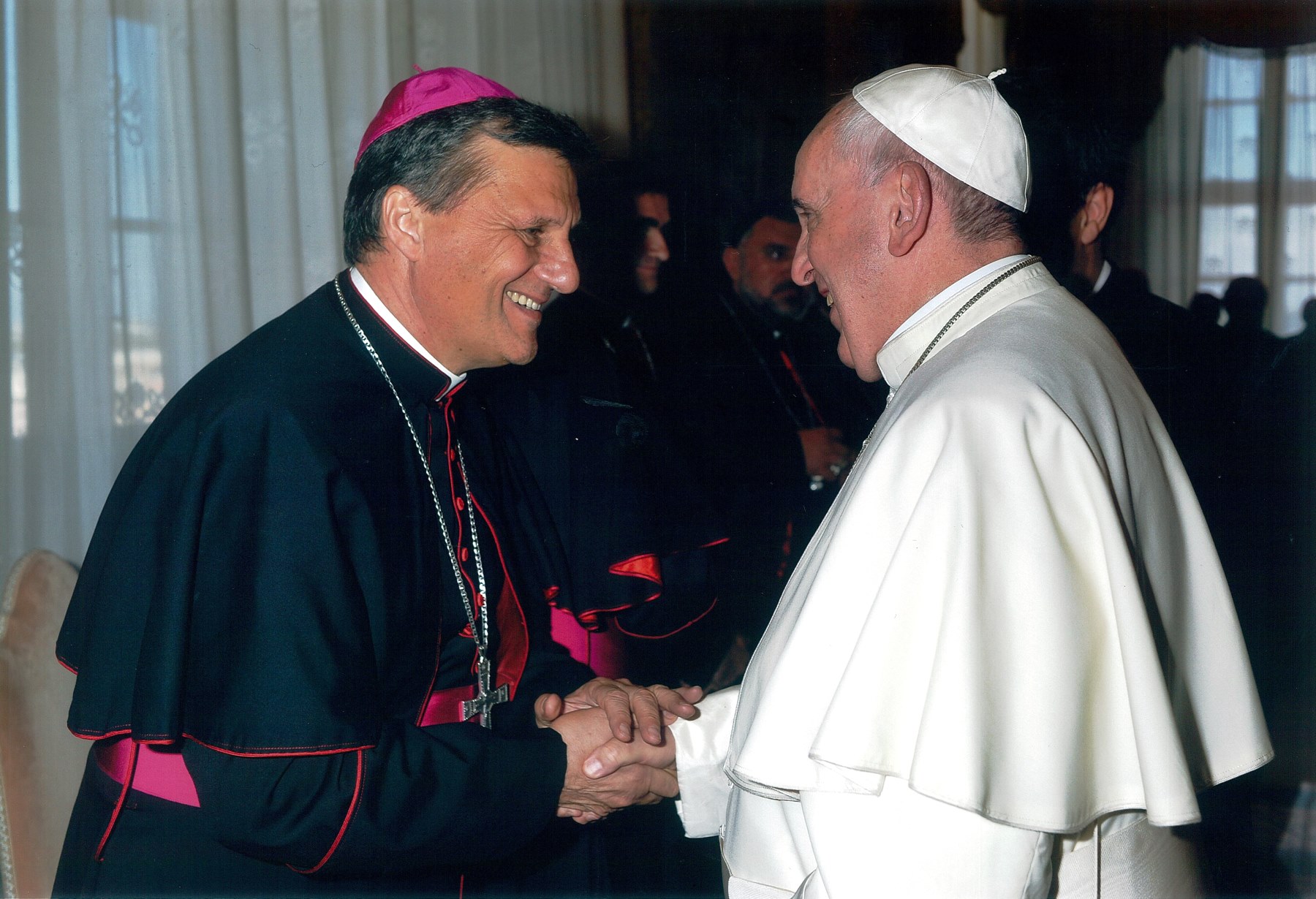
Mario Grech (20 February 1957) is a Maltese prelate who was Bishop of Gozo from 2005 to 2019. He was Pro-Secretary General of the Synod of Bishops from October 2019 until he became Secretary General in September 2020. On 25 October 2020, Pope Francis announced he would raise him to the rank of cardinal at a consistory scheduled for 28 November 2020. Mario Grech was born in Qala, Gozo, on 20 February 1957. His family moved to Ta' Kerċem when he was a young boy. He attended the Victoria high school and then studied philosophy and theology at the Gozo diocesan seminary. He was ordained a priest on 26 May 1984. He then obtained a licenciate in civil and canon at the Pontifical Lateran University and a doctorate in canon law at the Pontifical University of Saint Thomas Aquinas. He then fulfilled pastoral assignments at the Cathedral of Gozo, in the National Shrine of Ta' Pinu, and the parish of Kerċem. His responsibilities for the Diocese of Gozo included service as Judicial Vicar of the diocese, a member of the Metropolitan Court of Malta, teacher of canon law at the seminary, and a member of the College of Consultors, of the Presbyteral Council and of other diocesan commissions. On 26 November 2005, Pope Benedict XVI named him Bishop of Gozo. He received his episcopal consecration on 22 January 2006 from his predecessor in Gozo, Bishop Nikol Joseph Cauchi. In 2011, he joined other Maltese bishops in advising Catholics to defeat a referendum that would allow the legislature to consider legalizing divorce. He was famous for prohibiting any Tridentine Masses from being held in Gozo, unlike the position taken by the Maltese Archbishop, Paul Cremona O.P. As president of the Episcopal Conference of Malta, he participated in the Synod of Bishops on the Family in 2014 and 2015. Speaking to the Synod in October 2014, Grech said that
"the doctrine of the faith is capable of progressively acquiring a greater depth"
and that addressing people in complex familial relations, or homosexuals or parents of homosexuals, "It is necessary to learn to speak that language which is known to contemporary human beings and who acknowledge it as a way of conveying the truth and the charity of the Gospel."
With Archbishop Charles J. Scicluna, Grech co-authored the Maltese bishops' pastoral guidelines on Amoris Laetitia, released in January 2017, which stated that in certain cases a divorced Catholic who remarried might receive communion after "honest discernment". The guidelines were republished in L'Osservatore Romano. The guidelines infamously said that:
"If, as a result of the process of discernment, a separated or divorced person who is living in a new relationship manages, with an informed and enlightened conscience, to acknowledge and believe that he or she is at peace with God, he or she cannot be precluded from participating in the sacraments of Reconciliation and the Eucharist."
In a December 2018 interview, he said he enjoyed discussions with atheists that sharpened his own beliefs and preferred dialogue to the confrontation his critics preferred. When asked about family and sexual issues he said:
If someone comes to me, asking me for help to discover Jesus Christ... he or she could be homosexual, and even in a homosexual relationship. It doesn’t matter. I will not impede that person; on the contrary I would help. The last thing I would do is take up a position against that person.... Before, we would say: 'put your life in order first, and then we’ll begin the journey towards God'. Today, on the other hand, we would say: 'Let us approach Jesus Christ... and Christ will help us put our lives in order.' ... 'Black' and 'white' still exist; but the grey area in-between has grown. It is in the grey areas that we must search. That’s why I said that I am wary of those priests, or Christians, who feel they already know all the answers. No one can make that claim. We all have to continue searching.
On 2 October 2019, Pope Francis named him Pro-Secretary General of the Synod of Bishops, in anticipation of succeeding Cardinal Lorenzo Baldisseri when he retired as Secretary General. Grech worked alongside Baldisseri and participated as a member in the Synod of Bishops for the Pan-Amazon region. Grech was also the Apostolic Administrator of the Diocese of Gozo until 2020. He was one of five Synod officials who served ex offico on the fifteen-person commission that was responsible for drafting the final document of the Amazon Synod. In his first interview after his appointment he stated that
"there is a movement toward which the Church can acquire a greater feminine face that would also reflect Mary’s face"
. On 4 July 2020, Pope Francis named Grech a member of the Pontifical Council for Promoting Christian Unity, with the exception of reconciliation with traditional Catholic communities. On 25 October 2020, Pope Francis announced he would raise him to the rank of cardinal at a consistory scheduled for 28 November 2020. The previous Maltese cardinals were: Fabrizio Sceberras Testaferrata and Prospero Grech OSA .

Thursday, October 5, 2017

What went wrong in the traditional Catholic movement in Malta (Part 5)


Immediately after Pro Tridentina (Malta) was founded, its archivist
Anthony Mangion, nearly secured the possibility to have the Oratory of the Congregation of the Onorati in Valletta available to the organisation for the regular celebration of the Tridentine Mass. At this stage, it is useful to give some information about this place.
 
The Oratory annexed to the Church of the Jesuits belongs to the Congregation of the Onorati founded in 1600 by the Knights of St John. The chapel is dedicated to the Blessed Virgin Mary and the relics of St. Onorata are kept under the Main Altar. This present oratory was built at the expense of the Congregation in 1658 and replaces a previous one.
 
The Servant of God Fr. Giuseppe De Piro (1877 - 1933), founder of the once traditional Catholic M.S.S.P. (to see how much it has deviated, refer to this and this article) was once a member of the Congregazione degli Onorati.
 
Back to present times, there was opposition to this idea from the local church authorities, although it never became clear whether the then Archbishop of Malta, Paul Cremona, was himself against this initiative.
 
Unfortunately, nowadays the oratory is being used most of the year as a warehouse, as can be seen in the photos above. The first test for the Catholic Church in Malta to show its filial obedience to Pope Benedict XVI's Summorum Pontificum failed miserably.

Monday, January 18, 2016

Hall of Honour (7): Fr Marc Andrè Camilleri


The seventh recipient of this virtual award is Fr Marc Andrè Camilleri, who was appointed parish priest of Christ the King parish in Paola by Archbishop Paul Cremona in August 2014.

Fr Camilleri, from Lija, was born on 15 August 1984 and ordained priest on 23 June 2010. He served as deputy parish priest at St Sebastian parish in Qormi and - since 2010 - is a member of Missjoni ż-Żgħira. The latter was established in Malta in 1884 by Canon Francesco Bonnici. The Canon was inspired by the activities of the Mission founded by St. Gaspare del Bufalo in Rome. with the primary aim of instructing children through missionary preaching. Today, the Missjoni ż-Żgħira preaches missions not only to children but also to adults, and especially to youths.

Fr Camilleri has celebrated Mass in the Extraordinary Form of the Roman Rite in several localities, including Valletta, St. Paul's Bay, Bengħisa and Ta' l-Ibraġ. Some of these were celebrated with the aid of Pro Tridentina (Malta).

Fr Marc Andrè has also contributed to the debate on the so-called reform of the reform. Below is his article (when he was a deacon) published in the Sunday Times of Malta.

The reform of the reform

It seems very unfair to say that any discussion about the implementation of the post-Vatican II liturgical reform would lead to its deformation.

It was Pope Benedict himself, while still Cardinal, who pointed out that "the reform of the liturgy in its concrete realisation... resulted not in reanimation but in devastation. We have a liturgy that has degenerated into a show, in which attempts are made to make religion appear interesting with the help of idiotic fashions..." (Preface in Klaus Gamber: La reforme liturgique en question, 1992.)

He himself called for a reform of the reform many times, not, as others would have us believe, that this younger generation is "nostalgic for turning back the clock".

Would the Pope accuse the younger generations of "nostalgia" or "Lefebvrian fundamentalism"? I doubt it. When asked about this in 2001, Cardinal Joseph Ratzinger answered very clearly to those who wish "to make us believe that if we did not adhere to their schemas we will be nostalgically returning to the past. Such things do not go like that. It is an attitude of a past faction. It is important to reflect in an open manner and not to kill instantly all this reflection, we are accused of being partisans of St Pius V. We need to outride this way of thinking. I'm evidently for Vatican II, which has given us a lot of beautiful things. But declaring that it is impossible, and to judge unacceptable all the reflection on what we can elicit from the Church's history, for me is sectarianism which I don't accept any more."

While reflecting on the use of the 1962 Roman Missal, Pope Benedict pointed out that the fact "that young people too have discovered this liturgical form, felt its attraction and found in it a form of encounter with the mystery of the Most Holy Eucharist, particularly suited to them."

What a far cry from the accusation Fr Joe Inguanez levelled at the younger generations for "returning the practices and rituals that belong to another era are nothing less than a manifestation of wanderlust, of romantic utopia, symbolised in the sacred rather than the religious." (Excerpts from the '2005 Mass census report', Malta, p. 28)

In the words of the Pope, "what earlier generations held as sacred, remains sacred and great for us too, and it cannot be all of a sudden entirely forbidden or even considered harmful. It behooves all of us to preserve the riches which have developed in the Church's faith and prayer, and to give them their proper place." (July 7, 2007)

The Pope has made it clear that he is attempting even to reform the Papal liturgies according to the principles he so vociferously spoke about before his election. The first reform was the change of the master of ceremonies after which the Papal liturgies took on a different style; that of "a wise joining of the ancient with the new, to actuate in spirit and letter, as much as possible, the indications of the Second Vatican Council, and to do this in such a way that the pontifical celebrations are exemplary in all aspects."

Benedict has given us a direction to aim for; a Church which does not look for uniformity but for unity in diversity; a Church in which two forms of the same rite if celebrated well can exist together, a Church in which the Roman rite can exist together with different Eastern rites and now even with an Anglican rite. Not a Church that accuses these reformers of "Lefebvrian fundamentalism", or of trying to turn the clock back. Had this attitude of mistrust and hostility guided the Church's authorities during the centuries, no reform would have ever taken place.

Fr. Joe Inguanez, who holds a diametrically opposite view, replied a month later. The letter can be found below:

The Church: a reform or a counter-reform?

My attention has been drawn to a letter written by Rev. Deacon Marc Andre' Camilleri, published on February 28.

I read his letter with all the attention it merits. Ironically, I was both amused and amazed.

I was amused because the letter speaks more about its author than about my pastoral commentary which introduced the Malta Sunday Mass Attendance Census 2005.

I was amazed because Fr Camilleri is reaching the end of his degree course in theology and I could hardly find any theological argument in his missive.

This was also a disappointment, since I am aware of the effort of most of my colleagues, who are doing their best to teach theology and resisting turning their lectures into glorified Catechism lessons.

Not that I do not accept the Catechism, but its teachings alone do not constitute theology. The problem with Fr Camilleri - and with those of a similar mindset - is that he ignored the serious pastoral problems which I tried to tackle in my commentary.

The reason people are leaving the Church are not the "so-called" aberrations in the liturgy that followed Vatican II, but what Cardinal Ratzinger, on Good Friday 2005, referred to as the "filth [that] there is in the Church, and even among those who, in the priesthood, ought to belong entirely to Him!

How much pride, how much self-complacency!"

Fr Camilleri praised Mgr Guido Marini, the present Papal Master of Ceremonies, without letting readers know these words were uttered by a certain Father Gagliardi, a member of the staff of the same Mgr Marini. (see Zenit, January 8, 2010).

May I suggest he reads the book by Archbishop Piero Marini (the former Master of Ceremonies to His Holiness), Challenging Reform: Realizing the Vision of the Liturgical Renewal, 1963-1975 (2007).

He will learn that "with the change of the Consilium into a Congregation in 1969 and the transformation of the Congregation for Divine Worship to a subsection of another Congregation in 1975 (Congregation for Divine Worship and the Discipline of the Sacraments), the distinctive style of the Consilium was gradually absorbed into the more traditional style proper to the Roman Curia.

This was probably one of the first signs of a tendency to return to a pre-conciliar mindset that has for years now characterised the Curia's approach.

As more and more time passes since the Second Vatican Council, an event charged with such hope and desire for renewal, its distinctive contributions seem to be increasingly questioned."

Fr Camilleri does not seem perturbed by the fact that 49 per cent are not attending Sunday Mass.

Or perhaps he believes these can be brought back by the widening of clerical phylacteries and lengthening of tassels, a style definitely not promoted by Jesus (Matthew 23: 5).

He seems to be unaware of the Lord's pastoral injunction to leave the 51 per cent and go out in search of those who have left, or have never been in.

In line with people of ultra-conservative mindset, he takes critique to be an accusation. Ironically, he quotes Pope Benedict to make his point; ironically, I can use the same quote in support of my argument: "We need to outride this way of thinking. I'm evidently for Vatican II, which has given us a lot of beautiful things. But declaring that it is impossible, and to judge unacceptable all the reflection on what we can elicit from the Church's history, for me is sectarianism which I don't accept any more".

It is his lack of knowledge of the Church's history, history of theology and human thought that is Fr Camilleri's achilles' heel.

I am really sad he has really proved one of the points made in my commentary - that we are faced with a number of clerics who seem to be more interested in custom than tradition; in one's attire more than in the way one lives; in building and decorating the Temple of our Jerusalems rather than in nurturting the Body of Christ.

What our Church needs is not the reform of a reform, but constant reform on the lines started by Vatican II and perhaps, as Cardinal Martini and others have suggested, by means of a Vatican III.

Thursday, December 25, 2014

The Knights of Malta and the Tridentine Mass

  1. http://www.wseas.us/reports/malta_files/john.jpe
     
    In recent days, a controversy erupted online about this article.
     
    According to one of the Knights who attended:
     
    "The Mass was not "granted subject to a number of restrictions." The question I asked was whether or not there was a Tridentine Mass on Malta and if so who could we contact about our priest saying a Mass when we arrived. As there was not an existing Mass and for several logistical reasons we did not pursue trying to have a publicly celebrated EF Mass. When we came to visit we were kindly given permission to celebrate Mass at St. Catherine's and since it was a private Mass our priest celebrated the TLM for us."
     
    However, according to reliable sources from S.M.O.M. in Malta, a Tridentine Mass had been blocked by then Archbishop Cremona. The group had to petition again the Archbishop and finally, almost at the last minute, was allowed one. This notwithstanding that Pro Tridentina (Malta) had managed to put in place some arrangements, following a request by the group coming to Malta itself.
     
    So what is the real position of the S.M.O.M. as far as the Extraordinary Form of the Mass is concerned?
     
    The situation varies from country to country.
     
    The current Cardinal Patron, Raymond Leo Burke, is very much in favour of  the Tridentine Mass and regularly celebrates it. Cardinal Burke is likely therefore to support and encourage the Tridentine Mass within the Order but there are also a number of Cardinals - who are chaplains of the Order -  that oppose and / or barely tolerate the Tridentine Mass in their own Dioceses.
     
    Within the Grand Priory of England the Tridentine Mass has been prevalent and there are many strong supporters of the Mass there. Some of them were willing to help Pro Tridentina (Malta) but things were halted as described here.

    Two FIUV Presidents, the late Fra Freddy Crichton-Stuart and James Bogle are Knights of the Order of Saint John.

    In Malta, whereas the S.M.O.M. has never expressed (as far as is known) a position for or against the Tridentine Mass, one of its Knights, the Marquis Nicholas de Piro, is very much in favour.
     
    The Russian Grand Priory of Malta (not to be confused with S.M.O.M.) is faithful to the Order’s nearly 1000-year-old motto: Pro Fide, Pro Utilitate Hominum (For faith, for service to humanity) and is therefore open to having the Tridentine Mass celebrated in its headquarters in Valletta.

Sunday, August 7, 2011

Sentire cum Ecclesia


Although imbued with fresh ideas, Pro Tridentina (Malta) forges its whole outlook on traditional Catholic principles.


Like all the founders of similar lay movements, we are innovatory rather than revolutionary. The distinction has to be made clear. The revolutionary tries to pull down the present order of things to set up a new one, having nothing to do with the past. The innovatory loves tradition and wants to ruminate its past in order to renew the present order.

Our whole mission can be summarised by a "sentire cum Ecclesia", an empathy with the Church, currently under Pope Benedict XVI and our shepherds Archbishop Paul Cremona and Bishop Mario Grech.

Godwin Xuereb

President

Pro Tridentina (Malta)

Sunday, August 29, 2010

Viva t-“Tridentiżmu”!


Fr. Mark Montebello O.P.

It-Torċa tal-Ħadd, 2 ta’ Settembru 2007


Id-digriet tal-Papa Benedittu XVI li reġa’ qala’ minn taħt it-trab il-quddiesa Tridentina aktarx ħoloq ferment sħiħ fit-“Tridentisti” Kattoliċi! F’daqqa waħda, jidher li splodiet il-kaċċa għal kull ħaġa qadima u skaduta li kienet marbuta mal-quddiesa Tridentina u beda kummerċ sħiħ ta’ kull xorta ta’ ċekċik ma’ l-antikalji tal-Knisja Kattolika! F’diversi pajjiżi, inkluż Franza, l-Italja, l-Ingilterra u Spanja, bdew isiru korsijiet ta’ malajr għas-saċerdoti li jridu jitgħallmu l-Latin u d-dettalji ritwalistiċi kollha tal-quddiesa Tridentina!

Merħba lir-Rinaxximent tat-Tridentiżmu!

Ferneżija tridentina

Jekk wieħed jidħol fis-sit www.tridentinum.com jieħu idea tajba ta’ dan il-ġenn għall-affarijiet il-qodma li kienu jikkaratterizzaw il-liturġija Kattolika sa erbgħin sena ilu. Xi wħud minna ħasbu li dawn l-antikalji kienu ntrefgħu fil-kexxun għal dejjem ta’ dejjem. Imma marru mqarrqa. Siti bħal dan li semmejt qed iħabbru rinaxximent sħiħ għall-antikalji li kienu spiċċaw u reġgħu ġew irxoxtati ... u anki prezzijiet imġedda skond l-ispirtu taz-zmien!

Websajt oħra, din id-darba f’Oxford, l-Ingilterra, qiegħda toffri helpline, DVDs u saħansitra kors ta’ tħejjija għal dawk is-saċerdoti li jridu jitgħallmu r-rit il-qadim tal-quddiesa. Toffri wkoll lil dawk li huma interessati li jirrepetu r-riti tal-quddiesa Tridentina, instruzzjonijiet ta’ meta għandek tagħmel reverenza u meta le; kemm pulzieri għandek tnizzel rasek meta tinkina u kemm iddewwimha inklinata, meta tgħaqqad idejk u kif; u elf miljun ritwal ċkejkuni ieħor. Jgħallmuk ukoll x’għandek tilbes u ma tilbisx għall-quddiesa, minfejn tixtri l-antikalji kollha u anki ta’ liema drapp u tessut huwa permess li dawn ikunu. Bil-helpline tista’ ċċempel u tistaqsi li trid dwar it-tridentiżmu kollu.

Ix-xahar li ghadda, il-Latin Mass Society ta’ l-Ingilterra u Wales offrew tliet ijiem kraxx-kors f’Merton College ta’ Oxford University. Is-Soċjetà San Piju X fi Franza ħarġu DVD fi tmien ilsna dwar kif saċerdot jista’ jqaddes bir-rit il-qadim Tridentin. Id-DVD għandu kummentarju għaddej li fih jgħidlek liema hi l-pożizzjoni eżatta (biċ-ċentimetri, jekk jogħġbok!) li saċerdot għandu jieħu f’dan il-mument u l-ieħor, kif għandhom ikunu preċiżament ħwejġu, fejn għandhom ikunu bl-eżatt il-gandlieri u l-kalċi u elf tentufa oħra bħal dawn. Meta ċ-ċelebrant jagħmel xi ħaġa li mhux suppost, tidher “LE” kbira fuq l-iskrin!

Fl-Italja, ġie ppubblikat dak li qed jissejjaħ il-“Gwida Trimelloni”. Dan hu kompendju ta’ 850 paġna li jgħidlek u jispjegalek bl-eżatt u l-preċiż ir-regoli liturġiċi kollha tar-rit Tridentin, li ma tmurx tieħu xi żball xi mkien. Għal min irid, l-Ingilterra anki ppubblikaw malajr ktieb “teach yourself” ħalli s-saċerdoti Tridentisti jitgħallmu malajr bl-amment il-Latin tal-quddiesa Tridentina.

Idea tajba?

Quddiem dan kollu, wieħed ma jistax ma jistaqsix jekk din tal-quddies Tridentina kinetx, wara kollox, idea xierqa. Wieħed m’għandux jiddubita mill-intenzjonijiet tajba tal-papa, imma naħseb li ma kienx diffiċli ħafna li wieħed jobsor x’kien se jiġri ma’ xi wħud bl-introduzzjoni mill-ġdid tar-rit Tridentin b’mod universali. Għal żewġ ġrieden, biżibilju qtates qed jitħallew jagħmlu xalata! U x-xalata tagħhom tista’ tiswa lill-Knisja qares ħafna.

Li jissaħħaħ is-sens tas-sagru fil-ħajja liturġika tal-Knisja ċertament mhijiex idea ħażina. Anzi, hi idea sublimi, mixtieqa u meħtieġa. Imma forsi l-Indult Universali tal-quddiesa Tridentina ma kienx l-aħjar mod kif seta’ jintlaħaq dan l-iskop. Milli jidher, aktar se jservi sabiex isaħħaħ ir-ritwaliżmu milli s-sagralità; aktar se jiftaħ il-bibien għall-artifiċjalità u s-superfiċjalità u jagħlaqhom għall-ġenwini, milli jġedded il-ħajja tat-talb.

X’għandna nistennew minn dan kollu? Jaqaw mhux aktar ċerimonjaliżmu u liturġiżmu? Jaqaw mhux tijonf akbar ta’ min iħobb jilgħab bl-altari, jixxaħxaħ fis-sagramentaliżmu u jħalli n-nagħġa l-mitlufa tmur għal riħha? Jaqaw mhux it-tisħiħ ta’ ċentraliżmu paternalistiku u puwerili? Jaqaw mhux aktar distorzjoni ta’ l-immaġini tal-Kattoliċiżmu u dak li l-Kattoliċiżmu jirrappreżenta?

Siegħa mudlama

Meta wieħed jaħseb kemm ġid twettaq bil-liturġija mġedda mill-Konċilju Vatikan II, wiehed jistagħġeb kif xi wħud jistgħu jikkunsidraw li jreġġgħu l-arloġġ lura. Li s-saċerdot ġie meħlus minn ritwaliżmu ristrettiv u kważi pervers mhuwiex forsi benefiċċju kbir? U li l-fidili ġew ħafna u ħafna eqreb tal-Kelma ta’ Alla u tat-talb tal-Knisja waqt il-quddies kollu mhuwiex benefiċċju li ma jixraqx li jintilef?

Minkejja dan, huwa proprju dan li xi wħud iridu jerġgħu jtellfu lill-Knisja. Huma dawn il-benefiċċji li jridu jikkanċellaw billi jreġġgħu l-arloġġ għal qabel il-Konċilju Vatikan II. Aktarx iridu jaraw li l-Knisja titrażżan mill-missjonijiet tagħha ta’ ġustizzja u paċi fid-dinja u terġa’ tingħalaq f’ritwaliżmu sterili u pervers.

Forsi dan ma jasal biex iseħħ qatt. Forsi kien meħtieġ li l-aħħar Tridentisti jingħataw il-ħabel ħalli jitgħallqu bih. Forsi dan kollu hu parti minn pjan misterjuż ta’ Alla. Min jaf? Hu x’inhu, hi siegħa mudlama.

Godwin Xuereb, Pro Tridentina (Malta) President's note: This article, written 3 years ago by Maltese Dominican friar Mark Montebello (in the photo above in "typical" attire) was very negative and in fact he tried to ridicule all the efforts being done by traditional Catholics around the world. So much for ecumenism, the spirit of Vatican II, etc. As long as traditional Catholics are concerned, every insult is acceptable and legitimate. 

This article is still very relevant because the controversial priest has been summoned to Rome recently for a meeting with the head of the Dominican Order, Fr Carlos Aspiroz Costa, in the wake of other comments he wrote in the newspapers. It had been reported that Maltese Archbishop Paul Cremona insisted that the Dominican Order take steps against Fr Montebello, following articles he wrote about divorce and paedophilia as well as the priest's defence of a Nigerian person, who was charged with resisting arrest.