Showing posts with label Sacrosanctum Concilium. Show all posts

Wednesday, September 27, 2023

Traditionis custodes & Desiderio desideravi - the soon-to-be abolished Tridentine Mass in Malta


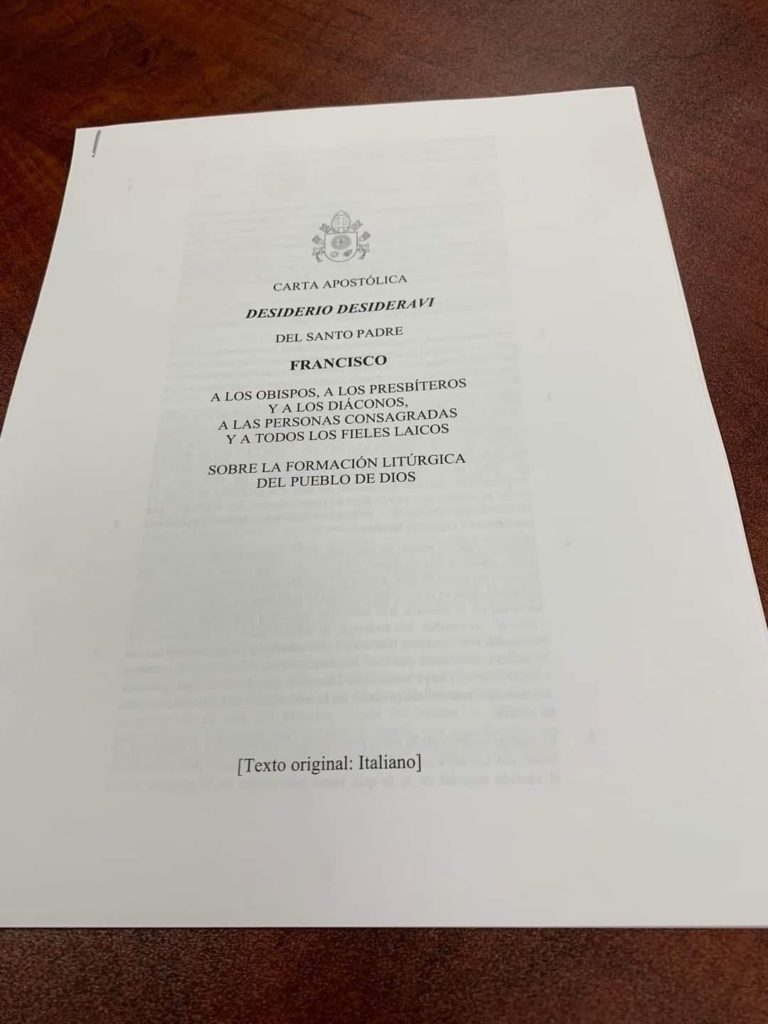
With the death of Benedict XVI at the end of 2022, it became known how painful it was for the late Pope the publication of Traditionis custodes (16 July 2021) as well as Desiderio desideravi (29 June 2022). In the latter document, Pope Francis called on Catholics to overcome forms of aestheticism that appreciate only outward formality or allow sloppiness in liturgy, noting that “a celebration that does not evangelize is not authentic.”

The Pope’s Apostolic Letter reaffirms the importance of ecclesial communion around the Novus Ordo Missae to the detriment of other valid Catholic rites. Below are some pertinent points from it:

  • Recalling the importance of Vatican II’s constitution Sacrosanctum Concilium  the Pope adds, ”I want the beauty of the Christian celebration and its necessary consequences for the life of the Church not to be spoiled by a superficial and foreshortened understanding of its value or, worse yet, by its being exploited in service of some ideological vision, no matter what the hue” (16).
  • After warning against “spiritual worldliness” and the Gnosticism and neo-Pelagianism that fuel it, Pope Francis explains that “Participating in the Eucharistic sacrifice is not our own achievement, as if because of it we could boast before God or before our brothers and sisters” and that “the Liturgy has nothing to do with an ascetical moralism. It is the gift of the Paschal Mystery of the Lord which, received with docility, makes our life new. The cenacle is not entered except through the power of attraction of his desire to eat the Passover with us” (20).
  • To heal from spiritual worldliness, we need to rediscover the beauty of the liturgy, but this rediscovery “is not the search for a ritual aesthetic which is content by only a careful exterior observance of a rite or is satisfied by a scrupulous observance of the rubrics. Obviously, what I am saying here does not wish in any way to approve the opposite attitude, which confuses simplicity with a careless banality, or what is essential with an ignorant superficiality, or the concreteness of ritual action with an exasperating practical functionalism” (22).
  • He writes that “it would be trivial to read the tensions, unfortunately present around the celebration, as a simple divergence between different tastes concerning a particular ritual form. The problematic is primarily ecclesiological.” (31) 
  • The Pope points out he does not see how it is possible to say that one recognizes the validity of the Council, and at the same time not accept the liturgical reform born out of Sacrosanctum Concilium.
  • A liturgical-sapiential plan of studies in the theological formation of seminaries would certainly have positive effects in pastoral action. There is no aspect of ecclesial life that does not find its summit and its source in the Liturgy. More than being the result of elaborate programs, a comprehensive, organic, and integrated pastoral practice is the consequence of placing the Sunday Eucharist, the foundation of communion, at the centre of the life of the community. The theological understanding of the Liturgy does not in any way permit that these words be understood to mean to reduce everything to the aspect of worship. A celebration that does not evangelize is not authentic, just as a proclamation that does not lead to an encounter with the risen Lord in the celebration is not authentic. And then both of these, without the testimony of charity, are like sounding a noisy gong or a clanging cymbal” (37).
  • Among the ritual acts that belong to the whole assembly, silence occupies a place of absolute importance” which “moves to sorrow for sin and the desire for conversion. It awakens a readiness to hear the Word and awakens prayer. It disposes us to adore the Body and Blood of Christ” (52).
  • Pope Francis asks “all bishops, priests, and deacons, the formators in seminaries, the instructors in theological faculties and schools of theology, and all catechists to help the holy people of God to draw from what is the first wellspring of Christian spirituality,” reaffirming what is established in Traditionis custodes so that “the Church may lift up, in the variety of so many languages, one and the same prayer capable of expressing her unity,” and this single prayer is the Roman Rite that resulted from the conciliar reform and was established by the saintly pontiffs Paul VI and John Paul II.   
  • Let us recall that in an interview a couple of days after Benedict XVI's death, Archbishop Gänswein admitted the following:

Interviewer: So, Pope Benedict’s lifting of restrictions on celebrating the Extraordinary Form of the Roman Rite according to the 1962 Missal did not last as long as he intended. As Pope Emeritus, he was around to see the promulgation of Pope Francis’ motu proprio Traditionis Custodes. Was he disappointed?

Archbishop Gänswein: It hit him pretty hard. I believe it broke Pope Benedict’s heart to read the new motu proprio, because his intention had been to help those who simply found a home in the Missale Vetustum — to find inner peace, to find liturgical peace — in order to draw them away from Marcel Lefebvre. And if you think about how many centuries the old Mass was the source of spiritual life and nourishment for many people including many saints, it’s impossible to imagine that it no longer has anything to offer. And let’s not forget that many young people — who were born long after the Second Vatican Council, and who don’t really grasp all the drama surrounding that council — that these young people, knowing the new Mass, have nevertheless found a spiritual home, a spiritual treasure in the old Mass as well. To take this treasure away from people … well, I can’t say that I’m comfortable with that.

Sunday, July 3, 2022

The end of Tridentine Mass in Malta? (Apostolic Letter Desiderio Desideravi)


An urgent meeting of the newly-elected Committee of Pro Tridentina (Malta) discussed the latest document issued by Pope Francis, namely Desiderio Desideravi. It is our understanding that based upon p. 61 of this document, the Tridentine Mass currently being celebrated at the Jesuit Church in Valletta  / St. Paul Church, Valletta might soon not be allowed anymore. The reason being that it is a Diocesan Mass. Thankfully, the previous Committee of Pro Tridentina (Malta) has ensured that Tridentine Mass can continue to be celebrated by Fr Anthony, outside diocesan restrictions. still, it is painful for us to read such a document, the latest in a series of attacks targeting Pope Emeritus Benedict XVI.

Following is the afore-mentioned p. 61 of Desiderio Desideravi:

61. In this letter I have wanted simply to share some reflections which most certainly do not exhaust the immense treasure of the celebration of the holy mysteries. I ask all the bishops, priests, and deacons, the formators in seminaries, the instructors in theological faculties and schools of theology, and all catechists to help the holy people of God to draw from what is the first wellspring of Christian spirituality. We are called continually to rediscover the richness of the general principles exposed in the first numbers of Sacrosanctum Conciliumgrasping the intimate bond between this first of the Council’s constitutions and all the others For this reason we cannot go back to that ritual form which the Council fathers, cum Petro et sub Petro, felt the need to reform, approving, under the guidance of the Holy Spirit and following their conscience as pastors, the principles from which was born the reform. The holy pontiffs St. Paul VI and St. John Paul II, approving the reformed liturgical books ex decreto Sacrosancti OEcumenici Concilii Vaticani II, have guaranteed the fidelity of the reform of the Council For this reason I wrote Traditionis custodes, so that the Church may lift up, in the variety of so many languages, one and the same prayer capable of expressing her unity.[23 Cf. Paulus VI, Constitutio apostolica Missale Romanum (3 Aprilis 1969) in AAS 61 (1969) 222.] 

Sunday, December 26, 2021

Responsia ad dubia on certain provisions of Traditionis Custodes


ONGREGATION FOR DIVINE WORSHIP AND THE DISCIPLINE OF THE SACRAMENTS


RESPONSA AD DUBIA

on certain provisions of the

Apostolic Letter

TRADITIONIS CUSTODES

issued “Motu Proprio” by the Supreme Pontiff

FRANCIS


TO THE PRESIDENTS
OF THE CONFERENCES OF BISHOPS


Your Eminence / Your Excellency,

Following the publication by Pope Francis of the Apostolic Letter “Motu Proprio data” Traditionis custodes on the use of the liturgical books from prior to the reform of the Second Vatican Council, the Congregation for Divine Worship and the Discipline of the Sacraments, which exercises the authority of the Apostolic See for material within its competence (cf. Traditionis custodes, n. 7), received several requests for clarification on its correct application. Some questions have been raised from several quarters and with greater frequency. Therefore, after having carefully considered them, having informed the Holy Father and having received his assent, the responses to the most recurrent questions are published herewith.

The text of the Motu Proprio and the accompanying Letter to the Bishops of the whole world clearly express the reasons for the decisions taken by Pope Francis. The first aim is to continue “in the constant search for ecclesial communion” (Traditionis custodes, Preamble) which is expressed by recognising in the liturgical books promulgated by the Popes Saint Paul VI and Saint John Paul II, in conformity with the decrees of the Second Vatican Council, the unique expression of the lex orandi of the Roman Rite (cf. Traditionis custodes, n. 1). This is the direction in which we wish to move, and this is the meaning of the responses we publish here. Every prescribed norm has always the sole purpose of preserving the gift of ecclesial communion by walking together, with conviction of mind and heart, in the direction indicated by the Holy Father.

It is sad to see how the deepest bond of unity, the sharing in the one Bread broken which is His Body offered so that all may be one (cf. Jhn 17:21), becomes a cause for division. It is the duty of the Bishops, cum Petro et sub Petro, to safeguard communion, which, as the Apostle Paul reminds us (cf. 1 Cor 11:17-34), is a necessary condition for being able to participate at the Eucharistic table.

One fact is undeniable: The Council Fathers perceived the urgent need for a reform so that the truth of the faith as celebrated might appear ever more in all its beauty, and the People of God might grow in full, active, conscious participation in the liturgical celebration (cf. Sacrosanctum Concilium n. 14), which is the present moment in the history of salvation, the memorial of the Lord’s Passover, our one and only hope.

As pastors we must not lend ourselves to sterile polemics, capable only of creating division, in which the ritual itself is often exploited by ideological viewpoints. Rather, we are all called to rediscover the value of the liturgical reform by preserving the truth and beauty of the Rite that it has given us. For this to happen, we are aware that a renewed and continuous liturgical formation is necessary both for Priests and for the lay faithful.

At the solemn closing of the second session of the Council (4 December 1963), St Paul VI said (n. 11):

“The difficult, complex debates have had rich results. They have brought one topic to a conclusion, the sacred liturgy. Treated before all others, in a sense it has priority over all others for its intrinsic dignity and importance to the life of the Church and today we will solemnly promulgate the document on the liturgy. Our spirit, therefore, exults with true joy, for in the way things have gone we note respect for a right scale of values and duties. God must hold first place; prayer to him is our first duty. The liturgy is the first source of the divine communion in which God shares his own life with us. It is also the first school of the spiritual life. The liturgy is the first gift we must make to the Christian people united to us by faith and the fervour of their prayers. It is also a primary invitation to the human race, so that all may lift their now mute voices in blessed and genuine prayer and thus may experience that indescribable, regenerative power to be found when they join us in proclaiming the praises of God and the hopes of the human heart through Christ and the Holy Spirit”.

When Pope Francis (Address to the participants in the 68th National Liturgical Week, Rome, 24 August 2017) reminds us that “after this magisterium, after this long journey, We can affirm with certainty and with magisterial authority that the liturgical reform is irreversible” he wants to point us to the only direction in which we are joyfully called to turn our commitment as pastors.

Let us entrust our service “to maintain the unity of the Spirit in the bond of peace” (Eph 4,3), to Mary, Mother of the Church.

From the offices of the Congregation for Divine Worship and the Discipline of the Sacraments, 4 December 2021, on the 58th anniversary of the promulgation of the Constitution on the Scared Liturgy Sacrosanctum Concilium.

✠ Arthur Roche
Prefect


The Supreme Pontiff Francis, in the course of an Audience granted to the Prefect of this Congregation on 18 November 2021, was informed of and gave his consent to the publication of these RESPONSA AD DUBIA with attached EXPLANATORY NOTES.


Traditionis custodes 

Art. 3.  Episcopus, in dioecesibus ubi adhuc unus vel plures coetus celebrant secundum Missale antecedens instaurationem anni 1970:

[…]

§ 2.      statuat unum vel plures locos ubi fideles, qui his coetibus adhaerent, convenire possint ad Eucharistiam celebrandam (nec autem in ecclesiis paroecialibus nec novas paroecias personales erigens);


To the proposed question:

When it is not possible to find a church, oratory or chapel which is available to accommodate the faithful who celebrate using the Missale Romanum (Editio typica 1962), can the diocesan Bishop ask the Congregation for Divine Worship and the Discipline of the Sacraments for a dispensation from the provision of the Motu Proprio Traditionis custodes (Art. 3 § 2), and thus allow such a celebration in the parish church?

The answer is:

Affirmative.

Explanatory note.

The Motu Proprio Traditionis custodes in art. 3 § 2 requests that the Bishop, in dioceses where up to now there has been the presence of one or more groups celebrating according to the Missal prior to the reform of 1970, “designate one or more locations where the faithful adherents of these groups may gather for the Eucharistic celebration (not however in the parochial churches and without the erection of new personal parishes)”. The exclusion of the parish church is intended to affirm that the celebration of the Eucharist according to the previous rite, being a concession limited to these groups, is not part of the ordinary life of the parish community.

This Congregation, exercising the authority of the Holy See in matters within its competence (cf. Traditionis custodes, n. 7), can grant, at the request of the diocesan Bishop, that the parish church be used to celebrate according to the Missale Romanum of 1962 only if it is established that it is impossible to use another church, oratory or chapel. The assessment of this impossibility must be made with the utmost care.

Moreover, such a celebration should not be included in the parish Mass schedule, since it is attended only by the faithful who are members of the said group. Finally, it should not be held at the same time as the pastoral activities of the parish community. It is to be understood that when another venue becomes available, this permission will be withdrawn.

There is no intention in these provisions to marginalise the faithful who are rooted in the previous form of celebration: they are only meant to remind them that this is a concession to provide for their good (in view of the common use of the one lex orandi of the Roman Rite) and not an opportunity to promote the previous rite.


Traditionis custodes

 Art. 1.  Libri liturgici a sanctis Pontificibus Paulo VI et Ioanne Paulo II promulgati, iuxta decreta Concilii Vaticani II, unica expressio “legis orandi” Ritus Romani sunt.

Art. 8.  Normae, dispositiones, concessiones et consuetudines antecedentes, quae conformes non sint cum harum Litterarum Apostolicarum Motu Proprio datarum praescriptis, abrogantur.


To the proposed question:

Is it possible, according to the provisions of the Motu Proprio Traditionis custodes, to celebrate the sacraments with the Rituale Romanum and the Pontificale Romanum which predate the liturgical reform of the Second Vatican Council?

The answer is:

Negative.

The diocesan Bishop is authorised to grant permission to use only the Rituale Romanum (last editio typica 1952) and not the Pontificale Romanum which predate the liturgical reform of the Second Vatican Council. He may grant this permission only to those canonically erected personal parishes which, according to the provisions of the Motu Proprio Traditionis custodes, celebrate using the Missale Romanum of 1962.

Explanatory note.

The Motu Proprio Traditionis custodes intends to re-establish in the whole Church of the Roman Rite a single and identical prayer expressing its unity, according to the liturgical books promulgated by the Popes Saint Paul VI and Saint John Paul II, in conformity with the decrees of the Second Vatican Council and in line with the tradition of the Church.

The diocesan Bishop, as the moderator, promoter and guardian of all liturgical life, must work to ensure that his diocese returns to a unitary form of celebration (cf. Pope Francis, Letter to the Bishops of the whole world that accompanies the Apostolic Letter Motu Proprio data Traditionis custodes).

This Congregation, exercising the authority of the Holy See in matters within its competence (cf. Traditionis custodes, n. 7), affirms that, in order to make progress in the direction indicated by the Motu Proprio, it should not grant permission to use the Rituale Romanum and the Pontificale Romanum which predate the liturgical reform, these are liturgical books which, like all previous norms, instructions, concessions and customs, have been abrogated (cf. Traditionis custodes, n. 8).

After discernment the diocesan Bishop is authorised to grant permission to use only the Rituale Romanum (last editio typica 1952) and not the Pontificale Romanum which predate the liturgical reform of the Second Vatican Council. This permission is to be granted only to canonically erected personal parishes which, according to the provisions of the Motu Proprio Traditionis custodes, celebrate with the Missale Romanum of 1962. It should be remembered that the formula for the Sacrament of Confirmation was changed for the entire Latin Church by Saint Paul VI with the Apostolic Constitution Divinæ consortium naturæ (15 August 1971).

This provision is intended to underline the need to clearly affirm the direction indicated by the Motu Proprio which sees in the liturgical books promulgated by the Saints Pope Paul VI and Pope John Paul II, in conformity with the decrees of the Second Vatican Council, the unique expression of the lex orandi of the Roman Rite (cf. Traditionis custodes, n. 1).

In implementing these provisions, care should be taken to accompany all those rooted in the previous form of celebration towards a full understanding of the value of the celebration in the ritual form given to us by the reform of the Second Vatican Council. This should take place through an appropriate formation that makes it possible to discover how the reformed liturgy is the witness to an unchanged faith, the expression of a renewed ecclesiology, and the primary source of spirituality for Christian life.


Traditionis custodes

Art. 3.  Episcopus, in dioecesibus ubi adhuc unus vel plures coetus celebrant secundum Missale antecedens instaurationem anni 1970:

§ 1.      certior fiat coetus illos auctoritatem ac legitimam naturam instaurationis liturgicae, normarum Concilii Vaticani II Magisteriique Summorum Pontificum non excludere;


To the proposed question:

If a Priest who has been granted the use of the Missale Romanum of 1962 does not recognise the validity and legitimacy of concelebration – refusing to concelebrate, in particular, at the Chrism Mass – can he continue to benefit from this concession?

The answer is:

Negative.

However, before revoking the concession to use the Missale Romanum of 1962, the Bishop should take care to establish a fraternal dialogue with the Priest, to ascertain that this attitude does not exclude the validity and legitimacy of the liturgical reform, the teaching of the Second Vatican Council and the Magisterium of the Supreme Pontiffs, and to accompany him towards an understanding of the value of concelebration, particularly at the Chrism Mass.

Explanatory note.

Art. 3 § 1 of the Motu Proprio Traditionis custodes requires the diocesan Bishop to ascertain that the groups requesting to celebrate with the Missale Romanum of 1962 “do not deny the validity and the legitimacy of the liturgical reform, dictated by Vatican Council II and the Magisterium of the Supreme Pontiffs”.

St Paul forcefully reminds the community of Corinth to live in unity as a necessary condition to be able to participate at the Eucharistic table (cf. 1 Cor 11,17-34).

In the Letter sent to the Bishops of the whole world to accompany the text of the Motu Proprio Traditionis custodes, the Holy Father says: “Because ‘liturgical celebrations are not private actions, but celebrations of the Church, which is the sacrament of unity’ (cf. Sacrosanctum Concilium, n. 26), they must be carried out in communion with the Church. Vatican Council II, while it reaffirmed the external bonds of incorporation in the Church — the profession of faith, the sacraments, of communion — affirmed with St. Augustine that to remain in the Church not only ‘with the body’ but also ‘with the heart’ is a condition for salvation (cf. Lumen Gentium, n. 14)”.

The explicit refusal not to take part in concelebration, particularly at the Chrism Mass, seems to express a lack of acceptance of the liturgical reform and a lack of ecclesial communion with the Bishop, both of which are necessary requirements in order to benefit from the concession to celebrate with the Missale Romanum of 1962.

However, before revoking the concession to use the Missale Romanum of 1962, the Bishop should offer the Priest the necessary time for a sincere discussion on the deeper motivations that lead him not to recognise the value of concelebration, in particular in the Mass presided over by the Bishop. He should invite him to express, in the eloquent gesture of concelebration, that ecclesial communion which is a necessary condition for being able to participate at the table of the Eucharistic sacrifice.

Traditionis custodes 

Art. 3.  Episcopus, in dioecesibus ubi adhuc unus vel plures coetus celebrant secundum Missale antecedens instaurationem anni 1970:

[…]

§ 3.      constituat, in loco statuto, dies quibus celebrationes eucharisticae secundum Missale Romanum a sancto Ioanne XXIII anno 1962 promulgatum permittuntur. His in celebrationibus, lectiones proclamentur lingua vernacula, adhibitis Sacrae Scripturae translationibus ad usum liturgicum ab unaquaque Conferentia Episcoporum approbatis;


To the proposed question:

In Eucharistic celebrations using the Missale Romanum of 1962, is it possible to use the full text of the Bible for the readings, choosing the pericopes indicated in the Missal??

The answer is:

Affirmative.

Explanatory note.

Art. 3 § 3 of the Motu Proprio Traditionis custodes states that the readings are to be proclaimed in the vernacular language, using translations of Sacred Scripture for liturgical use, approved by the respective Episcopal Conferences.

Since the texts of the readings are contained in the Missal itself, and therefore there is no separate Lectionary, and in order to observe the provisions of the Motu Proprio, one must necessarily resort to the translation of the Bible approved by the individual Bishops’ Conferences for liturgical use, choosing the pericopes indicated in the Missale Romanum of 1962.

No vernacular lectionaries may be published that reproduce the cycle of readings of the previous rite.

It should be remembered that the present Lectionary is one of the most precious fruits of the liturgical reform of the Second Vatican Council. The publication of the Lectionary, in addition to overcoming the “plenary” form of the Missale Romanum of 1962 and returning to the ancient tradition of individual books corresponding to individual ministries, fulfils the wish of Sacrosanctum Concilium, n. 51: “The treasures of the Bible are to be opened up more lavishly, so that richer fare may be provided for the faithful at the table of God’s word. In this way a more representative portion of the holy scriptures will be read to the people in the course of a prescribed number of years”.


Traditionis custodes

Art. 4.  Presbyteri ordinati post has Litteras Apostolicas Motu Proprio datas promulgatas, celebrare volentes iuxta Missale Romanum anno 1962 editum, petitionem formalem Episcopo dioecesano mittere debent, qui, ante concessionem, a Sede Apostolica licentiam rogabit.


To the proposed question:

Does the diocesan Bishop have to be authorised by the Apostolic See to allow priests ordained after the publication of the Motu Proprio Traditionis custodes to celebrate with the Missale Romanum of 1962 (cf. Traditionis custodes, n. 4)?

The answer is:

Affirmative.

Explanatory note.

Article 4 of the Latin text (which is the official text to be referenced) reads as follows: «Presbyteri ordinati post has Litteras Apostolicas Motu Proprio datas promulgatas, celebrare volentes iuxta Missale Romanum anno 1962 editum, petitionem formalem Episcopo dioecesano mittere debent, qui, ante concessionem, a Sede Apostolica licentiam rogabit».

This is not merely a consultative opinion, but a necessary authorisation given to the diocesan Bishop by the Congregation for Divine Worship and the Discipline of the Sacraments, which exercises the authority of the Holy See over matters within its competence. (cf. Traditionis custodes, n. 7).

Only after receiving this permission will the diocesan Bishop be able to authorise Priests ordained after the publication of the Motu Proprio (16 July 2021) to celebrate with the Missale Romanum of 1962.

This rule is intended to assist the diocesan Bishop in evaluating such a request: his discernment will be duly taken into account by the Congregation for Divine Worship and the Discipline of the Sacraments.

The Motu Proprio clearly expresses the desire that what is contained in the liturgical books promulgated by Popes Saint Paul VI and Saint John Paul II, in conformity with the decrees of the Second Vatican Council, be recognised as the unique expression of the lex orandi of the Roman Rite: it is therefore absolutely essential that Priests ordained after the publication of the Motu Proprio share this desire of the Holy Father.

All seminary formators, seeking to walk with solicitude in the direction indicated by Pope Francis, are encouraged to accompany future Deacons and Priests to an understanding and experience of the richness of the liturgical reform called for by the Second Vatican Council. This reform has enhanced every element of the Roman Rite and has fostered - as hoped for by the Council Fathers - the full, conscious and active participation of the entire People of God in the liturgy (cf. Sacrosanctum Concilium no. 14), the primary source of authentic Christian spirituality.


Traditionis custodes

Art. 5.  Presbyteri, qui iam secundum Missale Romanum anno 1962 editum celebrant, ab Episcopo dioecesano licentiam rogabunt ad hanc facultatem servandam.


To the proposed question:

Can the faculty to celebrate using the Missale Romanum of 1962 be granted ad tempus?

The answer is:

Affirmative.

Explanatory note.

The possibility of granting the use of the Missale Romanum of 1962 for a defined period of time - the duration of which the diocesan Bishop will consider appropriate - is not only possible but also recommended: the end of the defined period offers the possibility of ascertaining that everything is in harmony with the direction established by the Motu Proprio. The outcome of this assessment can provide grounds for prolonging or suspending the permission.


To the proposed question:

Does the faculty granted by the diocesan Bishop to celebrate using the Missale Romanum of 1962 only apply to the territory of his own diocese?

The answer is:

Affirmative.


To the proposed question:

If the authorised Priest is absent or unable to attend, must the person replacing him also have formal authorisation?

The answer is:

Affirmative.


To the proposed question:

Do Deacons and instituted ministers participating in celebrations using the Missale Romanum of 1962 have to be authorised by the diocesan Bishop?

The answer is:

Affermative.


To the proposed question:

Can a Priest who is authorised to celebrate with the Missale Romanum of 1962 and who, because of his office (Parish Priest, chaplain, etc.), also celebrates on weekdays with the Missale Romanum of the reform of the Second Vatican Council, binate using the Missale Romanum of 1962?

The answer is:

Negative.

Explanatory note.

The Parish Priest or chaplain who - in the fulfilment of his office - celebrates on weekdays with the current Missale Romanum, which is the unique expression of the lex orandi of the Roman Rite, cannot binate by celebrating with the Missale Romanum of 1962, either with a group or privately.

It is not possible to grant bination on the grounds that there is no “just cause” or “pastoral necessity” as required by canon 905 §2: the right of the faithful to the celebration of the Eucharist is in no way denied, since they are offered the possibility of participating in the Eucharist in its current ritual form.


To the proposed question:

Can a Priest who is authorised to celebrate using the Missale Romanum of 1962 celebrate on the same day with the same Missal for another group of faithful who have received authorisation?

The answer is:

Negative.

Explanatory note.

It is not possible to grant bination on the grounds that there is no “just cause” or “pastoral necessity” as required by canon 905 §2: the right of the faithful to the celebration of the Eucharist is in no way denied, since they are offered the possibility of participating in the Eucharist in its current ritual form.

Tuesday, July 20, 2021

Cardinal Mueller on the New TLM Restrictions

Pope Francis celebrates Mass ad orientem for the feast of the Baptism of the Lord in 2016

The pope’s intention with his motu proprio, Traditionis Custodes, is to secure or restore the unity of the Church. The proposed means for this is the total unification of the Roman Rite in the form of the Missal of Paul VI (including its subsequent variations). Therefore, the celebration of Mass in the Extraordinary Form of the Roman Rite, as introduced by Pope Benedict XVI with Summorum pontificum (2007) on the basis of the Missal that existed from Pius V (1570) to John XXIII (1962), has been drastically restricted. The clear intent is to condemn the Extraordinary Form to extinction in the long run. 

In his Letter to the Bishops of the Whole World, which accompanies the motu proprio, Pope Francis tries to explain the motives that have caused him, as the bearer of the supreme authority of the Church, to limit the liturgy in the extraordinary form. Beyond the presentation of his subjective reactions, however, a stringent and logically comprehensible theological argumentation would also have been appropriate. For papal authority does not consist in superficially demanding from the faithful mere obedience, i.e., a formal submission of the will, but, much more essentially, in enabling the faithful also to be convinced with consent of the mind. As St. Paul, courteous towards his often quite unruly Corinthians, said, “in the church I would rather speak five words with my mind, so as to instruct others also, than ten thousand words in tongues.” (1 Cor 14:19) This dichotomy between good intention and poor execution always arises where the objections of competent employees are perceived as an obstruction of their superiors’ intentions, and which are, therefore, not even offered. 

As welcome as the references to Vatican II may be, care must be taken to ensure that the Council’s statements are used precisely and in context. The quotation from St. Augustine about membership in the Church “according to the body” and “according to the heart” (Lumen Gentium 14) refers to the full Church membership of the Catholic faith. It consists in the visible incorporation into the body of Christ (creedal, sacramental, ecclesiastical-hierarchical communion) as well as in the union of the heart, i.e. in the Holy Spirit. What this means, however, is not obedience to the pope and the bishops in the discipline of the sacraments, but sanctifying grace, which fully involves us in the invisible Church as communion with the Triune God. 

For the unity in the confession of the revealed faith and the celebration of the mysteries of grace in the seven sacraments by no means require sterile uniformity in the external liturgical form, as if the Church were like one of the international hotel chains with their homogenous design. The unity of believers with one another is rooted in unity in God through faith, hope, and love and has nothing to do with uniformity in appearance, the lockstep of a military formation, or the groupthink of the big-tech age. Even after the Council of Trent, there always was a certain diversity (musical, celebratory, regional) in the liturgical organization of Masses. The intention of Pope Pius V was not to suppress the variety of rites, but rather to curb the abuses that had led to a devastating lack of understanding among the Protestant Reformers regarding the substance of the sacrifice of the Mass (its Sacrificial character and Real Presence). 

In the Missal of Paul VI, ritualistic (rubricist) homogenization is broken up, precisely in order to overcome a mechanical execution in favour of an inner and outer active participation of all believers in their respective languages and cultures. The unity of the Latin rite, however, should be preserved through the same basic liturgical structure and the precise orientation of the translations to the Latin original. The Roman Church must not pass on its responsibility for unity in cult to the Bishops’ Conferences. Rome must oversee translation of the normative texts of the Missal of Paul VI, and even of the biblical texts, that might obscure the contents of the faith. Presumptions that one may “improve” the verba domini (e.g. pro multis – “for many” – at the consecration, the et ne nos inducas in tentationem – “and lead us not into temptation” – in the Our Father), contradict the truth of the faith and the unity of the Church much more than celebrating Mass according to the Missal of John XXIII. 

The key to a Catholic understanding of the liturgy lies in the insight that the substance of the sacraments is given to the Church as a visible sign and means of the invisible grace by virtue of divine law, but that it is up to the Apostolic See and, in accordance with the law, to the bishops to order the external form of the liturgy (insofar as it has not already existed since apostolic times). (Sacrosanctum Concilium, 22 § 1) The provisions of Traditionis Custodes are of a disciplinary, not dogmatic nature and can be modified again by any future pope. Naturally, the pope, in his concern for the unity of the Church in the revealed faith, is to be fully supported when the celebration of Holy Mass according to the Missal of 1962 is an expression of resistance to the authority of Vatican II, which is to say, when the doctrine of the faith and the Church’s ethics are relativized or even denied in the liturgical and pastoral order. 

In Traditionis Custodes, the pope rightly insists on the unconditional recognition of Vatican II. Nobody can call himself a Catholic who either wants to go back behind Vatican II (or any other council recognized by the pope) as the time of the “true” Church or wants to leave that Church behind as an intermediate step towards a “new Church.” One may measure Pope Francis’ will to return to unity the deplored so-called “traditionalists” (i.e., those opposed to the Missal of Paul VI) against the degree of his determination to put an end to the innumerable “progressivist” abuses of the liturgy (renewed in accordance with Vatican II) that are tantamount to blasphemy. The paganization of the Catholic liturgy – which is in its essence nothing other than the worship of the One and Triune God – through the mythologization of nature, the idolatry of environment and climate, as well as the Pachamama spectacle, were rather counterproductive for the restoration and renewal of a dignified and orthodox liturgy reflective of the fulness of the Catholic faith. 

Nobody can turn a blind eye to the fact that even those priests and laypeople who celebrate Mass according to the order of the Missal of St. Paul VI are now being widely decried as traditionalist. The teachings of Vatican II on the uniqueness of redemption in Christ, the full realization of the Church of Christ in the Catholic Church, the inner essence of the Catholic liturgy as adoration of God and mediation of grace, Revelation and its presence in Scripture and Apostolic Tradition, the infallibility of the magisterium, the primacy of the pope, the sacramentality of the Church, the dignity of the priesthood, the holiness and indissolubility of marriage – all these are being heretically denied in open contradiction to Vatican II by a majority of German bishops and lay functionaries (even if disguised under pastoral phrases). And despite all the apparent enthusiasm they express for Pope Francis, they are flatly denying the authority conferred on him by Christ as the successor of Peter. 

The Congregation for the Doctrine of the Faith’s document about the impossibility of legitimizing same-sex and extramarital sexual contacts through a blessing is ridiculed by German (and not only German) bishops, priests, and theologians as merely the opinion of under-qualified curial officials. Here we have a threat to the unity of the Church in revealed faith, reminiscent of the size of the Protestant secession from Rome in the sixteenth century. Given the disproportion between the relatively modest response to the massive attacks on the unity of the church in the German “Synodal Way” (as well as in other pseudo-reforms) and the harsh disciplining of the old ritual minority, the image of the misguided fire brigade comes to mind, which – instead of saving the blazing house – instead first saves the small barn next to it. Without the slightest empathy, one ignores the religious feelings of the (often young) participants in the Masses according to the Missal John XXIII. (1962) Instead of appreciating the smell of the sheep, the shepherd here hits them hard with his crook. 

It also seems simply unjust to abolish celebrations of the “old” rite just because it attracts some problematic people: abusus non tollit usum. What deserves special attention in Traditionis Custodes is the use of the axiom lex orandi-lex credendi (“Rule of prayer – rule of faith”). This phrase appears first in the anti-Pelagian Indiculus (“Against superstitions and paganism”) which spoke about “the sacraments of priestly prayers, handed down by the apostles to be celebrated uniformly all over the world and in the entire Catholic Church, so that the rule of prayer is the rule of faith.” (Denzinger Hünermann, Enchiridion symbolorum 3) This refers to the substance of the sacraments (in signs and words) but not the liturgical rite, of which there were several (with different variants) in the patristic era. 

One cannot simply declare the latest missal to be the only valid norm of the Catholic faith without distinguishing between the “part that is unchangeable by virtue of divine institution and the parts that are subject to change.” (Sacrosanctum Concilium 21). The changing liturgical rites do not represent a different faith, but rather testify to the one and the same Apostolic Faith of the Church in its different expressions. The pope’s letter confirms that he allows the celebration according to the older form under certain conditions. He rightly points to the centrality of the Roman canon in the more recent Missal as the heart of the Roman rite. This guarantees the crucial continuity of the Roman liturgy in its essence, organic development, and inner unity. To be sure, one expects the lovers of the ancient liturgy to recognize the renewed liturgy; just as the followers of the Paul VI Missal also have to confess that the Mass according to the Missal of John XXIII is a true and valid Catholic liturgy, that is, it contains the substance of the Eucharist instituted by Christ and, therefore, there is and can only be “the one Mass of all times.” 

A little more knowledge of Catholic dogmatics and the history of the liturgy could counteract the unfortunate formation of opposing parties and also save the bishops from the temptation to act in an authoritarian, loveless, and narrow-minded manner against the supporters of the “old” Mass. The bishops are appointed as shepherds by the Holy Spirit: “Keep watch over yourselves and all the flock of which the Holy Spirit has made you overseers. Be shepherds of the church of God, which he bought with his own blood.” (Acts 20, 28) They are not merely representatives of a central office – with opportunities for advancement. The good shepherd can be recognized by the fact that he worries more about the salvation of souls than recommending himself to a higher authority by subservient “good behaviour.” (1 Peter 5, 1-4) 

If the law of non-contradiction still applies, one cannot logically castigate careerism in the Church and at the same time promote careerists. Let us hope that the Congregations for Religious and for Divine Worship, with their new authority, do not become inebriated by power and think they have to wage a campaign of destruction against the communities of the old rite – in the foolish belief that by doing so they are rendering a service to the Church and promoting Vatican II. If Traditionis Custodes is to serve the unity of the church, that can only mean a unity in faith, which enables us to “come to the perfect knowledge of the Son of God,” which is to say unity in truth and love. (cf. Eph 4, 12-15). 

Translated from the German by Robert Royal with Msgr. Hans Feichtinger. Original article appeared on "The Catholic Thing".

Thursday, February 1, 2018

Profession of the immutable truths about sacramental marriage


After the publication of the Apostolic Exhortation "Amoris Laetitia" (2016) various bishops issued at local, regional, and national levels applicable norms regarding the sacramental discipline of those faithful, called "divorced and remarried," who having still a living spouse to whom they are united with a valid sacramental matrimonial bond, have nevertheless begun a stable cohabitation more uxorio with a person who is not their legitimate spouse.

The aforementioned rules provide inter alia that in individual cases the persons, called "divorced and remarried," may receive the sacrament of Penance and Holy Communion, while continuing to live habitually and intentionally more uxorio with a person who is not their legitimate spouse. These pastoral norms have received approval from various hierarchical authorities. Some of these norms have received approval even from the supreme authority of the Church.
The spread of these ecclesiastically approved pastoral norms has caused a considerable and ever increasing confusion among the faithful and the clergy, a confusion that touches the central manifestations of the life of the Church, such as sacramental marriage with the family, the domestic church, and the sacrament of the Most Holy Eucharist.

According to the doctrine of the Church, only the sacramental matrimonial bond constitutes a domestic church (see Second Vatican Council, Lumen Gentium, 11). The admission of so-called "divorced and remarried" faithful to Holy Communion, which is the highest expression of the unity of Christ the Spouse with His Church, means in practice a way of approving or legitimizing divorce, and in this meaning a kind of introduction of divorce in the life of the Church.

The mentioned pastoral norms are revealed in practice and in time as a means of spreading the "plague of divorce" (an expression used by the Second Vatican Council, see Gaudium et spes, 47). It is a matter of spreading the "plague of divorce" even in the life of the Church, when the Church, instead, because of her unconditional fidelity to the doctrine of Christ, should be a bulwark and an unmistakable sign of contradiction against the plague of divorce which is every day more rampant in civil society.
Unequivocally and without admitting any exception Our Lord and Redeemer Jesus Christ solemnly reaffirmed God's will regarding the absolute prohibition of divorce. An approval or legitimation of the violation of the sacredness of the marriage bond, even indirectly through the mentioned new sacramental discipline, seriously contradicts God's express will and His commandment. This practice therefore represents a substantial alteration of the two thousand-year-old sacramental discipline of the Church. Furthermore, a substantially altered discipline will eventually lead to an alteration in the corresponding doctrine.

The constant Magisterium of the Church, beginning with the teachings of the Apostles and of all the Supreme Pontiffs, has preserved and faithfully transmitted both in the doctrine (in theory) and in the sacramental discipline (in practice) in an unequivocal way, without any shadow of doubt and always in the same sense and in the same meaning (eodem sensu eademque sententia), the crystalline teaching of Christ concerning the indissolubility of marriage.
Because of its Divinely established nature, the discipline of the sacraments must never contradict the revealed word of God and the faith of the Church in the absolute indissolubility of a ratified and consummated marriage. "The sacraments not only presuppose faith, but by words and objects they also nourish, strengthen, and express it; that is why they are called "sacraments of faith." (Second Vatican Council, Sacrosanctum Concilium, 59). "Even the supreme authority in the Church may not change the liturgy arbitrarily, but only in the obedience of faith and with religious respect for the mystery of the liturgy" (Catechism of the Catholic Church, 1125).

The Catholic faith by its nature excludes a formal contradiction between the faith professed on the one hand and the life and practice of the sacraments on the other. In this sense we can also understand the following affirmation of the Magisterium: "This split between the faith which many profess and their daily lives deserves to be counted among the more serious errors of our age." (Second Vatican Council, Gaudium et Spes, 43) and "Accordingly, the concrete pedagogy of the Church must always remain linked with her doctrine and never be separated from it" (John Paul II, Apostolic Exhortation Familiaris Consortio, 33).
In view of the vital importance that the doctrine and discipline of marriage and the Eucharist constitute, the Church is obliged to speak with the same voice. The pastoral norms regarding the indissolubility of marriage must not, therefore, be contradicted between one diocese and another, between one country and another. Since the time of the Apostles, the Church has observed this principle as St. Irenaeus of Lyons testifies: "The Church, though spread throughout the world to the ends of the earth, having received the faith from the Apostles and their disciples, preserves this preaching and this faith with care and, as if she inhabits a single house, believes in the same identical way, as if she had only one soul and only one heart, and preaches the truth of the faith, teaches it and transmits it in a unanimous voice, as if she had only one mouth"(Adversus haereses, I, 10, 2). Saint Thomas Aquinas transmits to us the same perennial principle of the life of the Church: "There is one and the same faith of the ancients and the moderns, otherwise there would not be one and the same Church" (Questiones Disputatae de Veritate, q. 14, a. 12c).

The following warning from Pope John Paul II remains current and valid: "The confusion, created in the conscience of many faithful by the differences of opinions and teachings in theology, in preaching, in catechesis, in spiritual direction, about serious and delicate questions of Christian morals, ends up by diminishing the true sense of sin almost to the point of eliminating it" (Apostolic Exhortation Reconciliatio et Paenitenia, 18).
The meaning of the following statements of the Magisterium of the Church is fully applicable to the doctrine and sacramental discipline concerning the indissolubility of a ratified and consummated marriage:

• "For the Church of Christ, watchful guardian that she is, and defender of the dogmas deposited with her, never changes anything, never diminishes anything, never adds anything to them; but with all diligence she treats the ancient doctrines faithfully and wisely, which the faith of the Fathers has transmitted. She strives to investigate and explain them in such a way that the ancient dogmas of heavenly doctrine will be made evident and clear, but will retain their full, integral, and proper nature, and will grow only within their own genus — that is, within the same dogma, in the same sense and the same meaning” (Pius IX, Dogmatic Bull Ineffabilis Deus)
• "With regard to the very substance of truth, the Church has before God and men the sacred duty to announce it, to teach it without any attenuation, as Christ revealed it, and there is no condition of time that can reduce the rigor of this obligation. It binds in conscience every priest who is entrusted with the care of teaching, admonishing, and guiding the faithful "(Pius XII, Discourse to parish priests and Lenten preachers, March 23, 1949).

• "The Church does not historicize, does not relativize to the metamorphoses of profane culture the nature of the Church that is always equal and faithful to itself, as Christ wanted it and authentic tradition perfected it" (Paul VI, Homily from October 28, 1965).
• "Now it is an outstanding manifestation of charity toward souls to omit nothing from the saving doctrine of Christ" (Paul VI, Encyclical Humanae Vitae, 29).

• "Any conjugal difficulties are resolved without ever falsifying and compromising the truth" (John Paul II, Apostolic Exhortation Familiaris Consortio, 33).
• "The Church is in no way the author or the arbiter of this norm [of the Divine moral law]. In obedience to the truth which is Christ, whose image is reflected in the nature and dignity of the human person, the Church interprets the moral norm and proposes it to all people of good will, without concealing its demands of radicalness and perfection" (John Paul II, Apostolic Exhortation Familiaris Consortio, 33).

• “The other principle is that of truth and consistency, whereby the church does not agree to call good evil and evil good. Basing herself on these two complementary principles, the church can only invite her children who find themselves in these painful situations to approach the divine mercy by other ways, not however through the sacraments of penance and the eucharist until such time as they have attained the required dispositions” (John Paul II, Apostolic Exhortation Reconciliatio et Paenitentia, 34).
• "The Church's firmness in defending the universal and unchanging moral norms is not demeaning at all. Its only purpose is to serve man's true freedom. Because there can be no freedom apart from or in opposition to the truth"(John Paul II, Encyclical Veritatis Splendor, 96).

• “When it is a matter of the moral norms prohibiting intrinsic evil, there are no privileges or exceptions for anyone. It makes no difference whether one is the master of the world or the "poorest of the poor" on the face of the earth. Before the demands of morality we are all absolutely equal" (emphasis in original) (John Paul II, Encyclical Veritatis Splendor, 96).
• "The obligation of reiterating this impossibility of admission to the Eucharist is required for genuine pastoral care and for an authentic concern for the well-being of these faithful and of the whole Church, as it indicates the conditions necessary for the fullness of that conversion to which all are always invited by the Lord“ (Pontifical Council for Legislative Texts, Declaration on the admissibility to the Holy Communion of the divorced and remarried, 24 June 2000, n. 5).

As Catholic bishops, who - according to the teaching of the Second Vatican Council - must defend the unity of faith and the common discipline of the Church, and take care that the light of the full truth should arise for all men (see Lumen Gentium, 23) we are forced in conscience to profess in the face of the current rampant confusion the unchanging truth and the equally immutable sacramental discipline regarding the indissolubility of marriage according to the bimillennial and unaltered teaching of the Magisterium of the Church. In this spirit we reiterate:


• Sexual relationships between people who are not in the bond to one another of a valid marriage - which occurs in the case of the so-called "divorced and remarried" - are always contrary to God's will and constitute a grave offense against God.
• No circumstance or finality, not even a possible imputability or diminished guilt, can make such sexual relations a positive moral reality and pleasing to God. The same applies to the other negative precepts of the Ten Commandments of God. Since “there exist acts which, per se and in themselves, independently of circumstances, are always seriously wrong by reason of their object" (John Paul II, Apostolic Exhortation Reconciliatio et Paenitentia, 17).

• The Church does not possess the infallible charism of judging the internal state of grace of a member of the faithful (see Council of Trent, session 24, chapter 1). The non-admission to Holy Communion of the so-called "divorced and remarried" does not therefore mean a judgment on their state of grace before God, but a judgment on the visible, public, and objective character of their situation. Because of the visible nature of the sacraments and of the Church herself, the reception of the sacraments necessarily depends on the corresponding visible and objective situation of the faithful.
• It is not morally licit to engage in sexual relations with a person who is not one’s legitimate spouse supposedly to avoid another sin. Since the Word of God teaches us, it is not lawful "to do evil so that good may come" (Romans 3, 8).

• The admission of such persons to Holy Communion may be permitted only when they with the help of God's grace and a patient and individual pastoral accompaniment make a sincere intention to cease from now on the habit of such sexual relations and to avoid scandal. It is in this way that true discernment and authentic pastoral accompaniment were always expressed in the Church.
• People who have habitual non-marital sexual relations violate their indissoluble sacramental nuptial bond with their life style in relation to their legitimate spouse. For this reason they are not able to participate "in Spirit and in Truth" (see John 4, 23) at the Eucharistic wedding supper of Christ, also taking into account the words of the rite of Holy Communion: "Blessed are the guests at the wedding supper of the Lamb!" (Revelation 19, 9).

• The fulfillment of God's will, revealed in His Ten Commandments and in His explicit and absolute prohibition of divorce, constitutes the true spiritual good of the people here on earth and will lead them to the true joy of love in the salvation of eternal life.
Being bishops in the pastoral office those, who promote the Catholic and Apostolic faith ("cultores catholicae et apostolicae fidei", see Missale Romanum, Canon Romanus), we are aware of this grave responsibility and our duty before the faithful who await from us a public and unequivocal profession of the truth and the immutable discipline of the Church regarding the indissolubility of marriage. For this reason we are not allowed to be silent.

We affirm therefore in the spirit of St. John the Baptist, of St. John Fisher, of St. Thomas More, of Blessed Laura Vicuña and of numerous known and unknown confessors and martyrs of the indissolubility of marriage:
It is not licit (non licet) to justify, approve, or legitimize either directly or indirectly divorce and a non-conjugal stable sexual relationship through the sacramental discipline of the admission of so-called "divorced and remarried" to Holy Communion, in this case a discipline alien to the entire Tradition of the Catholic and Apostolic faith.

By making this public profession before our conscience and before God who will judge us, we are sincerely convinced that we have provided a service of charity in truth to the Church of our day and to the Supreme Pontiff, Successor of Saint Peter and Vicar of Christ on earth .
31 December 2017, the Feast of the Holy Family, in the year of the centenary of the apparitions of Our Lady at Fatima.

+ Tomash Peta, Archbishop Metropolitan of the Archdiocese of Saint Mary in Astana

+ Jan Pawel Lenga, Archbishop-Bishop of Karaganda

+ Athanasius Schneider, Auxiliary Bishop of the Archdiocese of Saint Mary in Astana