For the promotion and dissemination of the Extraordinary Form of the Mass in the Archdiocese of Malta and the Diocese of Gozo, as endorsed by the motu proprio Summorum Pontificum promulgated by Pope Benedict XVI (2007) and in the Instruction Universae Ecclesiae (2011). We adhere to the traditional Catholic motto: We are what you once were. We believe what you once believed. We worship as you once worshipped. If you were right then, we are right now. If we are wrong now, you were wrong then.
Dear members and friends of Pro Tridentina (Malta),
We kindly ask you to pray for Bishop Richard Williamson, formerly of SSPX.
Although His Excellency Bishop Williamson reportedly passed away yesterday, after suffering a brain haemorrhage, we have yet to confirm this report. A former official of the organisation is currently in touch with the Bishop's entourage. This person knew the Bishop and was involved in the organisation of the Bishop's visit to Malta in 2013.
Disagreements notwithstanding, he is a man of great faith and intellect and was always more than charitable in his approach, even to those with whom he disagreed. He has devoted his life to the service of Christ's Church, was ordained by Archbishop Marcel Lefebvre, and has fought tirelessly for the restoration of Christ's Church and the proclamation of the social Kingship of Jesus Christ. He is a loyal son of the Church.
In your charity, please pray for His Excellency, and if it is true that he has passed away, let us pray for the repose of his soul.
A Dec. 31 statement from the Holy See press office said: “With sorrow I inform you that the Pope Emeritus, Benedict XVI, passed away today at 9:34 in the Mater Ecclesiae Monastery in the Vatican. Further information will be provided as soon as possible.”
Benedict XVI helped to shape the Catholic Church’s trajectory long before he was elected to the papacy, first as a young theological adviser at the Second Vatican Council and then as head of the Vatican’s doctrinal office.
Benedict influenced generations of Catholics with his writings, including his 1968 book “Introduction to Christianity,” his treatise “The Spirit of the Liturgy,” and his trilogy “Jesus of Nazareth,” composed while he was pope.
He reflected deeply on the tensions between secular modernity and the Church, introducing phrases such as “the dictatorship of relativism” into Catholic discourse and popularizing the concept of Catholics serving as a “creative minority” within secularized societies.
As pope from 2005 to 2013, he led the Church’s response to the clerical abuse crisis, dismissing hundreds of perpetrators from the clerical state. But he later personally asked forgiveness from abuse survivors amid criticism of his handling of cases as archbishop of Munich, southern Germany, from 1977 to 1982.
Awaiting Easter
He was born Joseph Aloisius Ratzinger on April 16, 1927, in Marktl am Inn, a village in the German state of Bavaria. In his 1998 memoir Milestones, he noted that he emerged into the world on Holy Saturday.
“I have always been filled with thanksgiving for having had my life immersed in this way in the Easter mystery, since this could only be a sign of blessing,” he wrote. “To be sure, it was not Easter Sunday but Holy Saturday, but, the more I reflect on it, the more this seems to be fitting for the nature of our human life: We are still awaiting Easter; we are still not standing in the full light, but walking toward it in full trust.”
He was the third child after his sister Maria and brother Georg, who went on to become a priest and conductor of the renowned Regensburger Domspatzen choir. His mother was a cook and his father a police officer who was disciplined after criticizing the Nazis.
An intellectually precocious child who disliked school sports, he entered a minor seminary in 1939, at the age of 12. That year, German youngsters were legally required to join the Hitler Youth. He was enrolled but avoided attending meetings of the Nazi organization.
After the Second World War broke out, the seminary was shuttered and he was drafted into the military, serving in an anti-aircraft unit and helping to prepare anti-tank defenses. He abandoned his post in 1945 as the Allies swept into Germany, although the penalty for desertion was death.
In “Milestones,” he described how he attempted to reach home on foot without being detected. “But, as I walked out of a railroad underpass, two soldiers were standing at their posts, and for a moment the situation was extremely critical for me,” he wrote. “Thank God that they, too, had had their fill of war and did not want to become murderers.”
He was reunited briefly with his family, but then seized by U.S. forces and interned in a prisoner-of-war camp near the city of Ulm. He slept outdoors, but was consoled by the sight of the spire of Ulm cathedral. “Day after day the sight of it was for me like a consoling proclamation of the indestructible humaneness of faith,” he later wrote.
When he was finally released, the driver of a milk truck gave him a lift back to his hometown. He reached it before sunset, recalling that “the heavenly Jerusalem itself could not have appeared more beautiful to me at that moment.”
He returned to his seminary studies and was ordained a priest of the Archdiocese of Munich and Freising on June 29, 1951, at the age of 24. When the archbishop placed his hands on him during the rite, a bird flew up from the high altar and began to sing, which he took to be “a reassurance from on high” that he was on the right path.
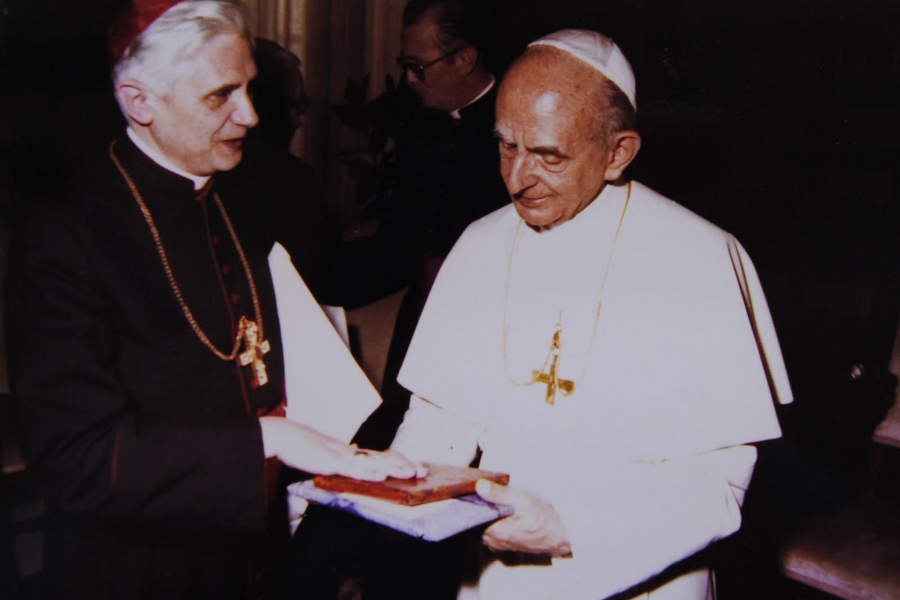
Cardinal Joseph Ratzinger with Pope Paul VI. Jornal O Bom Católico via Wikimedia (CC BY 2.0).
Coworker of the truth
After earning a doctorate, Ratzinger began teaching, and his reputation as a theologian grew. Cologne’s Cardinal Joseph Frings asked him to serve as a peritus, or adviser, at Vatican II, one of the major Catholic events of the 20th century.
He supported the reforming current at the ecumenical council and afterward received an invitation from the prominent progressive theologian Hans Küng to teach at the renowned University of Tübingen. But there he concluded that the Council’s reforms were being distorted by activists imbued with the revolutionary spirit of the late 1960s. “Anyone who wanted to remain a progressive in this context had to give up his integrity,” he said decades later.
He left Tübingen in 1969 to teach at the less prestigious University of Regensburg in his Bavarian homeland. That year, he made a radio broadcast in which he pondered the Church’s future.
“From the crisis of today,” he said, “the Church of tomorrow will emerge — a Church that has lost much. She will become small and will have to start afresh more or less from the beginning.”
But in the end, he predicted, “the church of faith” would remain. “It may well no longer be the dominant social power to the extent that she was until recently; but it will enjoy a fresh blossoming and be seen as Man’s home, where he will find life and hope beyond death,” he said.
In 1972, Ratzinger helped to found the influential theological journal Communio, with fellow theological luminaries Hans Urs von Balthasar and Henri de Lubac.
He was appointed Archbishop of Munich and Freising on May 28, 1977, at the relatively young age of 49. He took the motto “Cooperatores veritatis” (“Coworkers of the truth”), drawn from 3 John 8. He was made a cardinal a month after his episcopal ordination.
His tenure in Munich was overshadowed decades later by a report that accused him of mishandling four abuse cases. He denied claims that he had sought to cover up wrongdoing, but in a letter issued in 2022, he said: “I have had great responsibilities in the Catholic Church. All the greater is my pain for the abuses and the errors that occurred in those different places during the time of my mandate.”
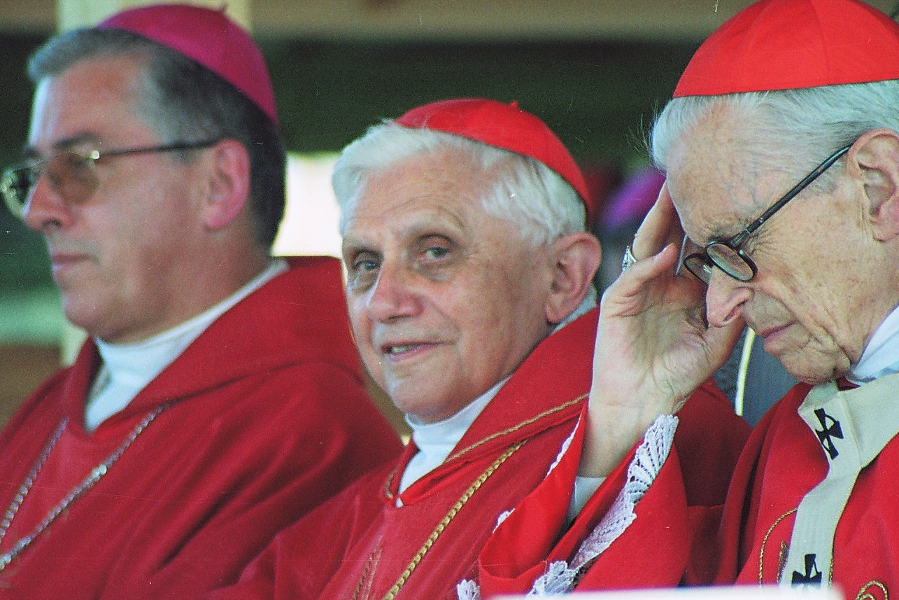
Cardinal Joseph Ratzinger in Szczepanów, Poland, on May 10, 2003. Muu-karhu via Wikimedia (CC BY 2.0).
Doctrinal defender
Pope John Paul II summoned Ratzinger to Rome in 1981 to serve as prefect of the Congregation for the Doctrine of the Faith. The Polish pope believed that the decades after Vatican II were marred by a theological free-for-all and encouraged the cardinal to help restore a sense of balance.
Ratzinger took action against prominent theologians he believed had departed from Catholic teaching, including the Brazilian liberation theologian Leonardo Boff, the Sri Lankan priest Tissa Balasuriya, and the Belgian Jesuit Jacques Dupuis.
These actions made him a controversial figure among Catholics on the Church’s progressive wing, who referred to him as the “Panzer Cardinal” and “God’s Rottweiler.” He complained that he was being cast as a bogeyman when he was only seeking to help simple believers recognize misleading accounts of the faith.
With John Paul II’s unflagging support, he tackled the Church’s most contested topics, from women priests to homosexuality. He also sought to present Catholic teaching in a positive light in his personal theological works and through his labor on the 1992 Catechism of the Catholic Church, a monumental guide to the faith.
After the turn of the millennium, he continued to serve as a theological lightning rod. In the year 2000, he signed the declaration Dominus Iesus, which affirmed that there is “a single Church of Christ, which subsists in the Catholic Church” — prompting criticism from Protestant leaders.
In 2001, Ratzinger convinced John Paul II to allow his Vatican congregation to investigate cases of clerical abuse worldwide. Once a week, he would read through dossiers on accused priests, a practice he referred to as “our Friday penance.” Between 2004 and 2014, 848 priests were laicized and 2,572 given other penalties.
In a 2004 lecture on Europe’s Christian roots, Ratzinger invoked the historian Arnold Toynbee’s idea of “creative minorities” who help to revitalize civilizations. “Christian believers should look upon themselves as just such a creative minority, and help Europe to reclaim what is best in its heritage and to therefore place itself at the service of all humankind,” he said.
In light of his age and bouts of ill health, he tried to resign several times, but continued to work as the Vatican’s doctrinal enforcer until John Paul II’s death in 2005.
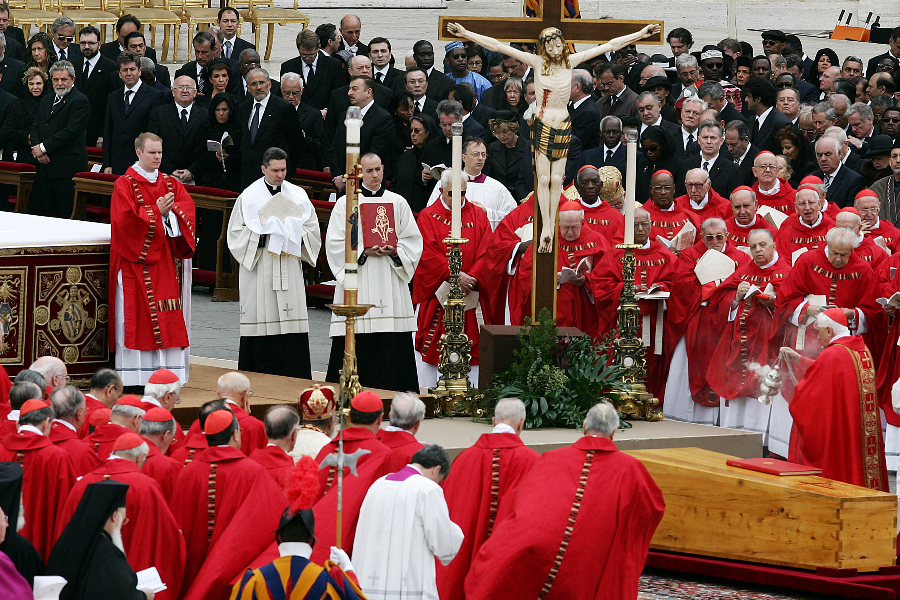
Ratzinger presided at the Polish pope’s funeral, before a television audience of more than 2 billion. In his role as dean of the College of Cardinals, he preached to the world’s cardinals before they entered the conclave to elect John Paul II’s successor. He warned them that “having a clear faith based on the Creed of the Church is often labeled as fundamentalism,” while a “dictatorship of relativism” was being built “that does not recognize anything as definitive and whose ultimate goal consists solely of one’s own ego and desires.”
Cardinal Joseph Ratzinger presides at the funeral of Pope John Paul II on April 8, 2005. Ricardo Stuckert/PR - Agência Brasil via Wikimedia (CC BY 3.0 br).
The Church is alive
After four ballots, he was elected pope on April 19, 2005, at the age of 78. He chose the name Benedict XVI in honor of Benedict XV, who “guided the Church through the turbulent times of the First World War,” and St. Benedict, “a fundamental point of reference for the unity of Europe.”
At his installation Mass, he appeared to acknowledge the forces arrayed against him, asking for prayers “that I may not flee for fear of the wolves.” But he also struck a hopeful note, saying that in his predecessor’s last days, “it became wonderfully evident to us that the Church is alive. And the Church is young.”
“She holds within herself the future of the world and therefore shows each of us the way towards the future,” he said.
His almost eight-year pontificate was marked by a series of crises.
The most challenging and extended was the abuse crisis. Just two months after his election, he imposed restrictions on Fr. Marcial Maciel, the powerful founder of the Legionaries of Christ, who appeared to have been protected by figures at the Vatican despite evidence of his depravity.
The global media repeatedly accused Benedict XVI of having covered up abuse as an archbishop in Germany and a prefect in Rome — claims firmly rejected by his supporters.
He met abuse survivors during his foreign visits and sent a landmark letter to Irish Catholics in 2010, acknowledging that some abuse survivors “find it difficult even to enter the doors of a church after all that has occurred.”
Another crisis occurred in 2006, when he gave an address at the University of Regensberg in Germany in which he cited a Byzantine emperor who told a Muslim interlocutor that Mohammed had brought into the world “things only evil and inhuman, such as his command to spread by the sword the faith he preached.”
Benedict noted that the emperor delivered the words with “a brusqueness that we find unacceptable,” but his speech was reported around the world as if he had endorsed the remark. Muslims erupted in protest from Jordan to Indonesia.
Two months later, he made a conciliatory visit to Turkey, pausing for a moment of reflection alongside an Islamic cleric in Istanbul’s Blue Mosque.
In 2009, he sparked a another crisis when he lifted the excommunications of four bishops belonging to the Society of St. Pius (SSPX), the breakaway group founded by Archbishop Marcel Lefebvre. The move coincided with an interview in which one of the four, Bishop Richard Williamson, denied the Holocaust. Benedict wrote an apologetic letter to the world’s bishops, noting that he had been told “that consulting the information available on the internet would have made it possible to perceive the problem early on.”
As pope, he made far-reaching decisions on the liturgy, ecumenism, and Vatican finances.
His 2007 motu proprio Summorum Pontificum acknowledged priests’ right to offer Mass using the Roman Missal of 1962, which is in Latin. He defined the new and old versions of the Roman Missal as the “ordinary” and “extraordinary” forms of the Roman Rite, expressing the hope that they would be “mutually enriching.”
In his 2009 apostolic constitution Anglicanorum coetibus, he established personal ordinariates enabling groups of Anglicans to enter into full communion with Rome while preserving elements of their patrimony.
In 2010, he attempted to shed light on the Vatican’s notoriously opaque finances with the creation of a watchdog body, the Financial Information Authority. His efforts at reform were undermined by a series of leaked documents in what came to be known as the “Vati-Leaks” scandal, which led to the jailing of his butler.
Despite his advanced age, he made trips to countries including Australia, Brazil, and Benin. In 2008, he undertook a six-day visit to the United States, addressing the United Nations General Assembly, praying at Ground Zero, and visiting the White House.
He beatified more than 800 people, including Cardinal John Henry Newman, canonized 45 others, and proclaimed St. Hildegard of Bingen and St. John of Avila Doctors of the Church.
He published three encyclicals: Deus caritas est, on love; Spe salvi, on hope; and Caritas in Veritate, on charity. His fourth, Lumen fidei, was left unfinished and completed by his successor Pope Francis.
Throughout his pontificate, he stressed the continuity of the Catholic faith. Speaking to Vatican officials in 2005, he criticized those who interpreted Vatican II in terms of “discontinuity and rupture,” arguing that it should be understood instead with a “hermeneutic of reform” that did not imply “a split between the pre-conciliar Church and the post-conciliar Church.”
Benedict XVI resigned on Feb. 11, 2013, announcing the dramatic break with centuries of tradition in Latin to an audience of shocked cardinals. He told them that “both strength of mind and body” were necessary to govern the Church, but that strength had “deteriorated in me to the extent that I have had to recognize my incapacity to adequately fulfill the ministry entrusted to me.”
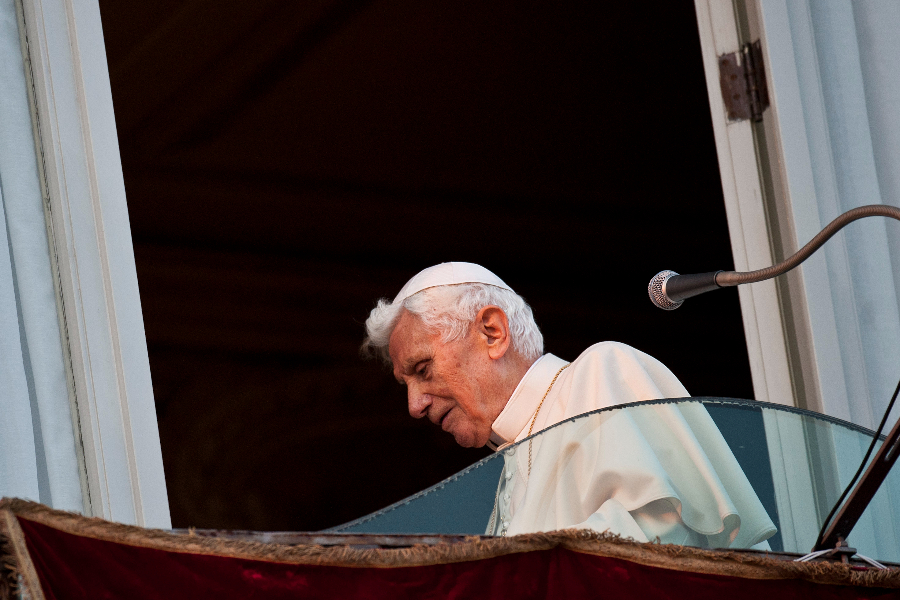
His resignation took effect on Feb. 28, 2013, when he departed Vatican City by helicopter. Arriving at the papal summer residence of Castel Gandolfo, he described himself as “simply a pilgrim who is starting the last stage of his pilgrimage on Earth.”
“Let us go ahead together with the Lord for the good of the Church and of the world,” he said, before departing into retirement.
Benedict XVI adopted the title “pope emeritus” and continued to wear white — choices that critics said might lead Catholics to think he was still pope. He settled in a new home, the Mater Ecclesiae Monastery in the Vatican Gardens. He was 85 years old and not expected to live long, though the Vatican had not indicated a terminal illness. But over the next 10 years, he remained active.
His first public appearance after his resignation came in February 2014, at Pope Francis’ first consistory for the creation of new cardinals. Months later, he was present at the canonization of John Paul II and John XXIII.
In retirement, he continued his long collaboration with the journalist Peter Seewald. Together, they produced the 2016 book-length interview “Last Testament,” their fourth after “Salt of the Earth” (1997), “God and the World” (2002), and “Light of the World” (2010). They also worked together on a multi-volume biography “Benedict XVI: A Life,” published in German in 2020.
He occasionally generated controversy in retirement, contributing in 2019 to a book supporting clerical celibacy amid a debate about a relaxation of the discipline in the Amazon region. In an essay published in the same year, he was accused of blaming clerical abuse on the sexual revolution of the 1960s. But he insisted that his point was that the crisis was caused by a turning away from God.
Catholics around the world continued to cherish the German pope in his retirement. On his 95th birthday, thousands of people sent messages via a website dedicated to his work.
His longtime personal secretary Archbishop Georg Gänswein confided that Benedict himself was surprised by his longevity, recalling that he once said: “I would never have believed that the last stretch of the journey that would take me from the Mater Ecclesiae Monastery to the gates of heaven with St. Peter would be so long.”
Benedict XVI was born on April 16, 1927. He died on Dec. 31, 2022, aged 95.
I 6 pastori protestanti che aiutarono a inventare la nuova Messa: fotografati in Vaticano il 10 aprile 1970, accanto a Paolo VI (a destra); da sinistra: Dott. George; Canon Jasper; Dott. Shephard; Dott. Konneth; Dott. Eugene Brand e Padre Max Thurian; in rappresentanza del Consiglio Mondiale delle Chiese, della chiesa d'Inghilterra, della chiesa luterana e della comunità di Taize.
Il solo motivo che può autorizzare un cattolico a resistere all’autorità nella Chiesa è la fede. In particolare, per quel che riguarda la liturgia, solo la fede può motivare il rifiuto del nuovo rito della messa ed il motivo fondamentale per cui ogni sacerdote e fedele non può accettare il Novus ordo è proprio perché «rappresenta, sia nel suo insieme come nei particolari, un impressionante allontanamento dalla teologia cattolica» [1]
Tale allontanamento dalla teologia cattolica è conseguenze di un avvicinamento, voluto e consentito, alla dottrina ed alla liturgia protestante come ha dichiarato lo stesso Paolo VI stesso che ha introdotto il nuovo rito: «Allo sforzo richiesto ai fratelli separati perché si riuniscano, deve corrispondere lo sforzo, altrettanto mortificante per noi, di purificare la Chiesa romana nei suoi riti, perché diventi desiderabile e abitabile» [2].
Di fatto, come è risaputo, Paolo VI domandò a sei pastori protestanti di prendere parte alla commissione incaricata di realizzare la nuova Messa. Uno di essi, Max Thurian, della comunità di Taizé, in occasione della pubblicazione del nuovo messale, potrà dichiarare: «In questa Messa rinnovata, non c’è niente che possa veramente disturbare i protestanti evangelici» [3].
Padre Bugnini non ha mai nascosto le sue intenzioni ecumeniche. Sulle colonne dell’ Osservatore Romano, dichiarò che la riforma liturgica è stata improntata al «desiderio di scartare ogni pietra che potesse costituire anche solo l’ombra di un rischio di inciampo o di dispiacere per i fratelli separati» [4]. Per questo ha ammesso riguardo alla nuova messa che si tratta «in certi punti, di una vera nuova creazione, dato che l’immagine della liturgia data dal Concilio Vaticano II è completamente differente da quella che la Chiesa cattolica ha avuto finora» [5].
Molti esponenti di rilievo del mondo protestante – che naturalmente avevano sempre rifiutato la Messa tradizionale – hanno affermato che vi è più nessuna difficoltà nell’utilizzare il nuovo rito per celebrare la cena protestante. Oltre al già citato Max Thurian, si possono menzionare, tra gli altri, G. Siegwalt (in Le Monde del 22 novembre 1970); O. Jordahn (conferenza del 15 giugno 1975 nell’abbazia di santa Maria Laach); infine, la Dichiarazione ufficiale del «Concistoro superiore della Chiesa della Confessione di Augusta, di Alsazia e di Lorena» dell’8 dicembre 1973 [6].
A nuova liturgia corrisponde una nuova fede per il rapporto intimo che vi è fra la lex orandi e la lex credendi [7] e la nuova architettura delle Chiese post-conciliari, ispirate e volute da questo cambiamento lo manifestano in maniera eclatante. Per questo la nuova messa è pericolosa per la fede e induce i fedeli che vi assistono a una professione esterna contraria alla fede.
La nostra fedeltà al rito tradizionale quindi non è motivata da un attaccamento nostalgico al latino, all’incenso, ai pizzi e merletti e neppure ad un certo rituale ma essenzialmente dal dovere di conservare la fede ed aiutare i fedeli a fare altrettanto.
Per questo non accetteremo mai il nuovo rito riformato, così vicino alla “messa” di Lutero, e per questo incoraggiamo i fedeli a fare tutti i sacrifici per assistere alla Messa di sempre e fuggire le nuove celebrazioni, incoraggiando i sacerdoti a celebrare unicamente secondo il rito tradizionale.
4 - Cfr. La Documentation Catholique, n. 1445 (1965), col. 604. In questo quadro appare del tutto verosimile, anche se non verificabile con assoluta certezza, l’informazione che mons. Bugnini (divenuto vescovo nel 1972) appartenesse alla massoneria: la massoneria, infatti, ha sempre predicato la parità di tutte le religioni, e dunque per un massone il nuovo rito della Messa si presenta molto meno sgradevole, sotto questo profilo, rispetto a quello tradizionale. I fatti sarebbero questi: nel 1975 mons. Bugnini fu denunciato come massone a Paolo VI; l’ecclesiastico che lo accusava forniva delle prove e minacciava di rendere la cosa pubblica. Paolo VI prese la cosa molto sul serio: per evitare lo scandalo sollevò immediatamente mons. Bugnini dalle sue funzioni di segretario della Congregazione per il culto divino e, nel gennaio 1976, lo nominò pronunzio a Teheran. Successivamente il nome di Annibale Bugnini è comparso nelle liste di prelati massoni pubblicate dalla stampa (liste pubblicate da Panorama, n. 538 del 10 agosto 1976, e poi nell’Osservatore Politico di Mino Pecorelli il 12 settembre 1978). Su questo caso, si può consultare l’inchiesta del dott. C. A. Agnoli, La massoneria alla conquista della Chiesa, ed. Eiles, Roma 1996.
5 - A. Bugnini, Dichiarazione alla stampa (4 gennaio 1967), in La Documentation Catholique, n. 1491 (1967), col. 824.
6 - Catéchisme catholique de la crise dans l’Eglise, Mathias Gaudron, Le Sel 2007 p. 178
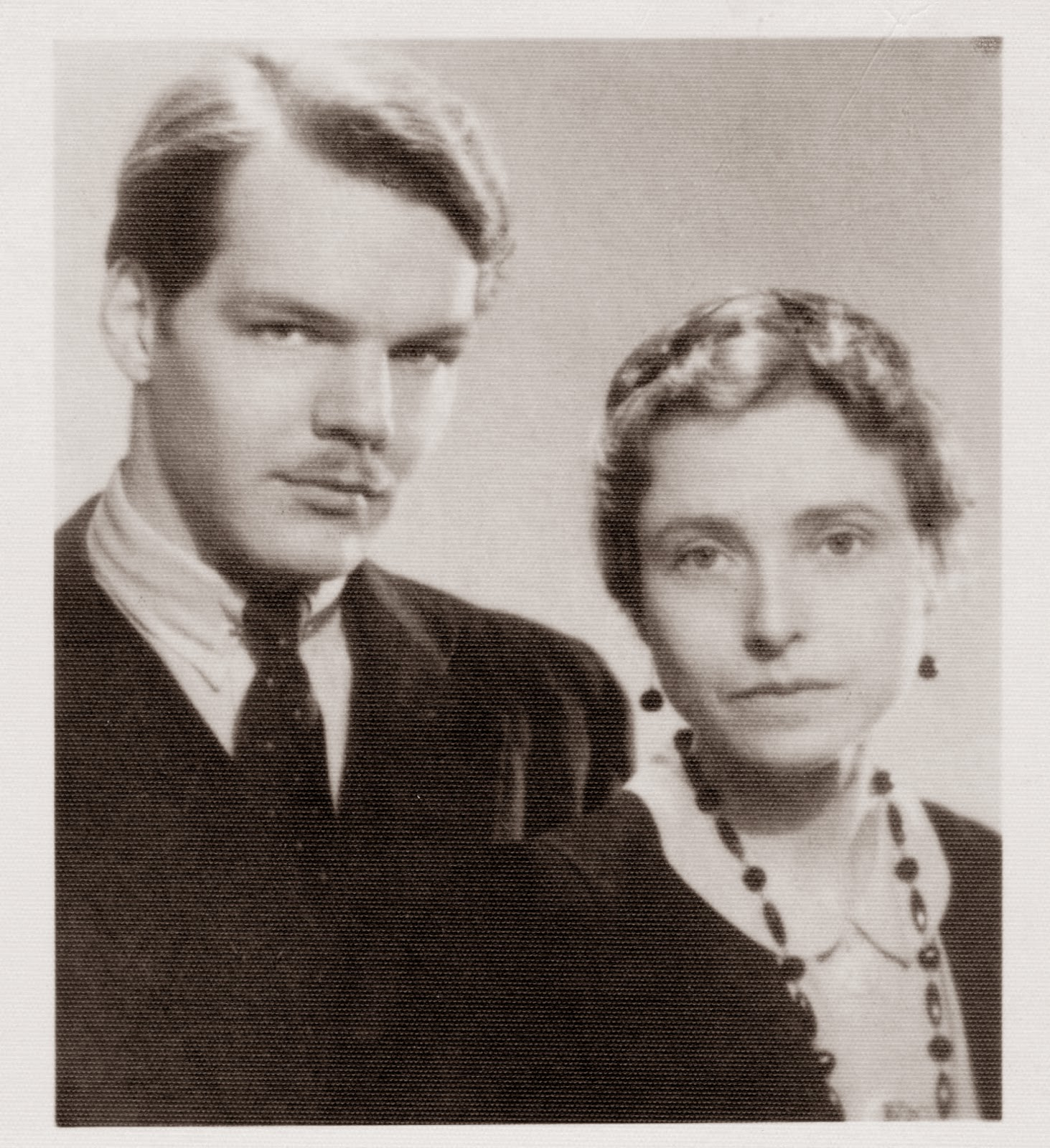
We intend to start a series of laypeople who contributed a lot to the aims of the Traditional Latin Mass. We start with an article about Elisabeth de Saventhem who died 22 years ago this month. She was the wife of the first President of FIUV. The article was written some time after her death by the second President of FIUV, the late Michael Davies.
(We are most grateful to all those who contributed to the completion and translation of this text)
Elisabeth de Saventhem was born in Bremen in 1911 as the eldest of seven children, five daughters and two sons, to Walther Clemens, Reichsgraf von Plettenberg-Lenhausen and his wife, Carmen Guillermina. Her spiritual formation was strongly influenced by an aunt, and her father's cousin was Blessèd Maria Droste zu Vischering of the Divine Heart, who had entered the Order of the Good Shepherd in Munster in 1885.
The economic crisis in Germany forced Elisabeth to give up her language studies (French and Russian) in Leipzig and she found work in an office in Berlin, quickly being promoted to senior secretary and purchasing manager (the company produced silk for parachutes).
The publication, in March 1937, of Pius XI's Encyclica Mit brennender Sorge saw the first public confrontations between the National-socialist regime and the Catholic Church. Contrary to the concordat which had been signed four years before, the government forbade any distribution of the Pope's text. Nevertheless it was copied and circulated by the Plettenberg family and Elisabeth's parents were arrested and imprisoned in Bremen, accused of "malicious gossip endangering the State". Elisabeth, as eldest child, undertook successfully the defence of her parents before the minions of the Gestapo, so that they were released three weeks later. The Gestapo in Berlin continued to keep an eye on this courageous daughter and shortly afterwards, following a series of anonymous letters accusing Elisabeth herself of spying, they tried to incriminate her - after more than 20 cross-examinations. The efforts came to nothing of course, for the whole scandal had come from the unfounded, sickly jealousy of the wife of Elisabeth's employer. The affair reached the highest levels of the Gestapo and came to a conclusion only in December 1938 with Elisabeth's brilliant rehabilitation by the regular courts.
During these years Elisabeth was much sought after in Berlin society. She impressed those who met her not only by her beauty, her great intelligence, her natural charm and her "Catholic at its best" humour, but also because of her extraordinary ability to listen. She understood especially how to recognise the problems lying deeper than the questions actually raised, and would then reply with great conceptual precision. Behind this unusual ability lay a faith matured by interior struggles, paired with the fruit of superb religious teaching which Elisabeth had received at school from a gifted priest, Pastor Franz Moschner. Later, at his request, she translated Moschner's most important book "Christliches Gebetsleben" into English. The MS was published in 1962 as "Christian Prayer" by Herder Book Co in the USA.
Elisabeth's knowledge of doctrine and theology was so extensive and sound that her bishop authorised her to instruct and prepare converts for reception. The time that she devoted to this instruction, and she had many pupils, was never less than a year. She once remarked that although God had not blessed her with children of her own, she considered these converts to be her children.
The fact that Elisabeth believed in God as the "iustus iudex" (the « just judge ») , to whom, throughout her life, she would address the question of the meaning or unavoidability of suffering and death, lent to her own witness that convincing, many-layered depth which rendered silent every sceptic.
It was during the Berlin years that the momentous meeting with Isa Vermehren and her younger brother Eric took place, as they sought the Truth, which led to their conversions in 1938 and 1939 respectively. Early in 1939 Elisabeth returned to Bremen to help look after her youngest brother and sister, and in March 1941 she became engaged to Eric Vermehren. A few weeks later, Elisabeth's eldest brother was killed in Russia whilst carrying a badly-injured soldier from his company back to their trenches. Elisabeth's parents persuaded the young couple not to wait until the year of mourning was over and so, in October 1941, they were married quietly in the presence of the closest family members, at Schloss Hovestadt, the Plettenberg family seat.
Because of a childhood injury, Eric was exempt from frontline service and served at first as a "Welfare Officer" in several camps for English and French prisoners of war. In 1942 he was transferred to the Intelligence Service and sent to Istanbul as aide to the German military attaché there. In this position he became aware, through freely available neutral reports, of the true extent of the dreadful deeds being done, especially in the occupied areas about which scarcely anything was known back in Germany. This knowledge made him realise that,even as a subordinate, his conscience would not allow him to serve the régime any longer. During his first home leave in December 1943, Eric informed Elisabeth of his decision, She was immediately ready to follow him into foreign exile. In January 1944 they were "kidnapped" by the English Secret Services, in an action organised in the hope of protecting their families back in Germany. English officers accompanied them via Izmir and Aleppo to Cairo and thence, via Gibraltar, to England.
The British Foreign Office had at that time adopted the Morgenthau-Plan. Eric and Elisabeth tried, in many letters and interviews, to impress on the Foreign Office the advisability of allowing leading members of the inner German Opposition to help with the rebuilding of their ruined country, but to no avail. They then asked that their status as "Guests of the Foreign Office" be annulled and they began to earn an independent living as assistant teachers in Worth Priory, a Benedictine preparatory school. Elisabeth straightaway won the hearts of her pupils, despite, or perhaps precisely because of her original strictness in questions of discipline. Among the anecdotes that she would relate of her time at Worth was that of finding one of her eight year old pupils crying bitterly one day. She asked him the reason and he explained that it was because he liked her very much, so much in fact that he felt that she deserved to be English, and it was unfair that she was not.
For an "ex-enemy alien" it was well-nigh impossible to find a decent job in post-war England. Eric founded a small export company and Elisabeth helped in this effort despite her delicate health. The early (unfortunately not long-lasting) success of the company allowed them to leave Worth and move to the shadow of Brompton Oratory and a flat which was furnished with articles donated by friends. Some five years passed before Eric found regular employment with a firm of Lloyds brokers. He had by then adopted the surname Vermeeren de Saventhem, mainly for genealogical reasons. In 1964 Eric became Director for Europe of the London firm. The couple spent two years in Paris and in 1966 moved back to Switzerland, to settle in Clarens by Montreux.
From the moment that Pope John XXIII's announced that he was con]vening a General Council of the Church, all eyes were fixed upon that spectacular event - those of the de Saventhems with growing concern. Elisabeth's religious life had always had its focus in Holy Mass which she attended daily with her husband. In the accomplishment of the Sacrifice of the Mass she saw the definitive identity of the true Church of Christ and at the same time the reason for and the justification of the Catholic priesthood. She knew - with all the Tradition of the Church - of the essential connexion between the Faith of the Church and its prayers: as the Church prays, so it believes. Thus it seemed to her presumptuous, nay dangerous, to question, even in Council, those forms of liturgy which have grown and proved themselves over the centuries. The maintenance of the Mass as codified by St Pius V "with equal rights and equal honour" alongside any new forms became the main theme of her prayer, her thought and her actions, in close co-operation with her husband, long-time President of the international Una Voce movement.
A first meeting with Monseigneur Lefebvre in Rome in 1962 sowed the seeds for over 25 years of cooperation, particularly vis-à-vis the Holy See. This became intensified after the foundation of the Archbishop’s International Seminary in Ecône, an hour's drive away from Clarens. The Archbishop appreciated more than anything Elisabeth's ever acute sensus fidei et ecclesiae and her moral courage. For over ten years the de Saventhems daily made the long drive from Clarens to Ecône to attend early Mass. Later they were able to continue daily Mass attendance at a chapel in Lausanne and at the tiny Carmel of Marie Reine des Anges, both served by priests from Ecône priests. The latter was situated on the slopes of the aptly-named Mont-Pèlerin just a short drive from home.
Elisabeth's life was filled with conscious and radiant gratitude towards the Church for the gift of faith. It was however permanently overshadowed by a never-ending chain of physical suffering. She accepted this with admirable discipline from her iron will which seemed to gain new strength at Mass each morning.
The end was not easy. As the petals begin to curl inwards when a precious flower fades, so Elisabeth's mental elasticity, which had always been admired by all who met her, slowly diminished. The interest was there, but ever more frequently the helpful replies did not come. Her physical frailty increased visibly, and for her last journey from Switzerland to Bonn (the newly-chosen home, to be near the family again) a flying ambulance was necessary. Elisabeth died a few weeks later in Cologne, in her sister's house, surrounded and comforted by the deep love of her husband and the devoted care of her sister and family. R.I.P.
2011: Instruction Universae Ecclesiae. Its main effect: overrides the bishops, who are the main problem. But this and the motu proprio re-taken back by the current holder of the Office.
The example of St. Basil of Caesarea shows that, even in a doctrinal crisis of the Church, the steadfast profession and defense of the Faith is not incompatible with a prudential attitude, seeking an accommodation with those who are in error—a practical, realistic approach, aimed at bringing them back to orthodoxy, while preserving the souls entrusted to us.
This article by Fr. Juan-Carlos Iscara (a professor of history at St. Thomas Aquinas Seminary in Winona, Minnesota) first appeared on sspx.org on March 9, 2012.
In the face of heresy: St. Basil's "economy of silence"
In the fourth century, St. Basil, bishop of Caesarea in Cappadocia, confronted a hornets’ nest of theological controversy. The Pneumatomachian heresy, an offshoot of Arianism, denied the consubstantiality (homoousia) of the Holy Ghost. The Arians themselves held that the Son was a creature of the Father and the creator of all other things, and so it was only logical for them to consider the Holy Ghost as a creature of the Son. At the same time, some “conservative” semi-Arians, who believed the Son was of a similar nature (homoiousios) to the Father, and the Anomoeans, who denied any such similarity in nature, began explicitly teaching that the Holy Ghost was simply a higher-ranking angel. Even among orthodox Catholics, some considered the term “consubstantial” to be suspect, because not of biblical origin, and opposed its use by the Council of Nicaea on these grounds.
Faced with this situation, St. Basil, while never yielding to error or denying the orthodox belief, carefully avoided the use of the term “consubstantial” (homoousios) in his discussions with heretics. Simply employing this word aroused immediate opposition and effectively ended any effort at discussion or proselytism. Therefore, in order not to burn down the bridges, Basil approached the question of the Holy Ghost’s divinity obliquely. He made use of the terms “community of nature” (physike koinonia) and especially “equality of honor” (homotimia). Each amount to the same meaning as “consubstantial,” since equal dignity and honor with the Father and the Son necessarily presupposes identity of substance. Thus, the traditional doxology implies the Holy Ghost’s divinity; one who is not God cannot be equal to God in dignity. Though his tactic avoided direct controversy, Basil made every effort to answer even insignificant objections with meticulous exactitude. He wanted not only to oppose the error, but also to bring as many heretics as possible back to orthodoxy.
In a letter addressed to the clergy of Tarsus, Basil explained the motives and general attitude that guided his discussions with heretics. In it, he shows his doctrinal orthodoxy, his realistic understanding of the concrete situation, both his own and that of his church of Caesarea, and his zeal and prudence in seeking a solution for the greater good of souls and the preservation of his church:
The present time shows a great inclination toward the destruction of the churches […]. Further, as to the building up of the Church, the correction of errors, compassion toward the weak among the brethren, and protection for those who are sound—not one of these things exists.[…]
Therefore, there is need of great zeal and great care in such a time, so that the churches may receive some benefit. And it is a benefit to those hitherto separated to be united. Moreover, there would be union, if we would be willing to accommodate ourselves to the weaker in whatever matters do not harm to souls.
[…] We ask you to receive in communion those who do not say that the Holy Ghost is a creature, in order that blasphemers may be left alone, and that either being ashamed they may return to the truth, or continuing in their sin may be held unworthy of credit because of their small number.
Therefore, let us seek for nothing more, but hold out to the brethren who wish to be united with us the Creed of Nicaea; and, if they agree with it, let us require further that they must not say that the Holy Ghost is a creature, nor be in communion with those who say it.
But I think that we should demand nothing beyond this. In fact, I am convinced that by a longer association and an experience together without strife, even if it should be necessary to add more for the purpose of explanation, the Lord who makes all things work together unto good for those who love Him will grant it."[1]
This is what St. Athanasius and St. Gregory of Nazianzus called the “economy” of St. Basil. Nonetheless, this method met with fierce opposition from many who otherwise shared Basil’s orthodox belief, as it is clear from his own description of the situation.
What storm at sea was ever so fierce and wild as this tempest of the churches? [...] Every foundation, every bulwark of opinion has been shaken […]. We attack one another. We are overthrown by one another, [and] if our enemy is not the first to strike us, we are wounded by the comrade at our side."
For, in spite of his explanations, St. Basil’s attitude led to the questioning of his orthodoxy by some firebrands who, disregarding his pastoral approach and themselves risking much less than he, demanded a total, uncompromising exposition of the truth—that is, a more outspoken declaration of his belief in the divinity of the Holy Ghost. As his friend St. Gregory of Nazianzus reported in a letter:
Many people have accused us of not being firm in matters of faith—people who sincerely share our concerns. Some accuse us openly of sacrilegious opinions, others of cowardice: of sacrilege, those who think we are no longer in a healthy state of mind; of cowardice, those who charge us with concealing our real thoughts. […] I shall tell you what recently happened.
There was a party, and among the guests present were not a few distinguished people who are our friends; one of them belongs to those who bear both the name and the garb of piety.[2] […] The conversation turned to you and me, as often happens […]. But while everyone admired your way of governing, and spoke, in addition, of our having shared a philosophic life—spoke of our friendship and of Athens, and of our agreement and like-mindedness on every subject — the so-called philosopher became indignant. “What is all this, my friends?” he said, crying out in an insolent way.
You are such liars and flatterers! Let these gentlemen be praised for their other qualities, if you like, and I will make no objection; but I will not grant the most important quality. Basil is wrongly praised for orthodoxy—and Gregory wrongly, as well! The one betrays the faith by the public discourses he holds, the other is an accomplice in the betrayal by not objecting! […] I heard the great Basil speaking excellent and perfect things about the divinity of the Father and the Son, as no one else could easily do, but gliding past the Spirit […].
Then he said, turning to me, 'And why on earth do you, my friend, speak so openly of the Spirit as God […] while he [St. Basil] plays down the fact in murky expressions, and only lays out doctrine in a sketchy way. He will not speak the truth frankly, but bathes our ears in language more political than pious, concealing the ambiguity in the power of his words.” “Since I live in obscurity,” I said, "and am unknown to most people, and since both what I do say and the fact that I say anything at all is hardly noticed, I can be a philosopher without risk. But his pronouncements are more important, since he is better known both on his own account and on account of his Church. Everything he says is public, and a great war is going on about him; the heretics are eager to criticize a simple word, let alone Basil himself, so that he might be expelled from the Church—he who remains virtually the only spark of truth, the force of life, while everyone around him is tainted with heresy—and that this evil might take root in the city, and then, using this Church as a kind of base of operations, overrun the whole world.'
The better path, then, for us is that the truth be managed prudently, that we yield a bit to our times as one would to a cloud, rather than let the truth be destroyed by the bright clarity of our proclamation.[3] For us, after all, there is no harm in recognizing the Spirit as God through other expressions that lead in that direction—for truth is found less in sounds than in the understanding; but for the Church, there will be a great loss if truth is put to flight through the defeat of a single man!"[4]
Although many objected to this idea of “prudent management” of the truth, to his “economy” of silence, “which seemed to them a vapid way of playing with words” and “cowardice rather than doctrine,”[5] St. Basil felt that answering these charges against him was beneath his dignity.
Nonetheless, many of his friends took up his defense. For example, St. Athanasius wrote to the presbyter Palladius, encouraging obedience and suggesting that God should be praised on account of St. Basil’s great goal and his “economy.”[6]
[…] I have learned from our beloved Dianius that [the monks at Caesarea] are vexed, and are opposing our beloved bishop Basil […]. I have pointed out to them what is fitting, namely that as children they should obey their father, and not oppose what he approves.
For if he were suspected as touching the truth, they would do well to combat him. But if they are confident, as we all are, that he is a glory to the Church, contending rather on behalf of the truth and teaching those who require it, it is not right to combat such a man, but rather to accept with thanks his good conscience. For from what the beloved Dianius has related, they appear to be vexed without cause. For he, as I am confident, to the weak becomes weak to gain the weak.
But let our beloved friends look at the scope of his truth, and at his special purpose, and glorify the Lord Who has given such a bishop to Cappadocia as any district must pray to have. And do you, beloved, be good enough to point out to them the duty of obeying, as I write. For this is at once calculated to render them well disposed toward their father, and will preserve peace to the churches […]”[7]
It is beyond any doubt that St. Basil’s hesitation and “economy” with the truth were dictated by prudential reasons, pastoral and canonical, and not by theological ones.
His reticence to call the Holy Ghost “God” in his treatise De Spiritu Sancto is based on the fact that the Council of Nicaea itself didn’t use the term—and St. Basil considered that he had to loyally submit to the canonical function and superiority of the ecumenical council:
We are not able to add anything at all to the Nicene Creed, not the slightest thing, except the glorification of the Holy Spirit, because our Fathers made mention of this part cursorily, since at that time no inquiry had yet been stirred up regarding it [...]."[8]
Moreover, he never called the Holy Ghost homoousion because the terms homoousios and ousia, of philosophical and not biblical origin, were used primarily for material and created substance. The heretics even used these words to support their theory of the subordinate status of the Holy Ghost. In addition, a more open declaration of doctrine would have only poured oil on the fire.
The Second Ecumenical Council of Constantinople at last decided the controversy. It adjourned in 381, two years after Basil’s death, having made some important additions to the third article of the Nicene Creed:
We believe… in the Holy Ghost, the Lord and life-giver, Who proceeds from the Father, Who with the Father and the Son is together worshipped and together glorified, Who spoke through the prophets..."[9]
Although not using St. Basil’s exact words, the Council effectively expressed his conceptions, affirming the belief in divine nature of the Holy Ghost, who must be worshiped and glorified together with the Father and the Son, and, without explicitly calling Him “God,” emphasized His divine operations as the giver of life and the one who reveals through the prophets.
Thus, St. Basil’s teaching and “economic” attitude—both prudent and patient—opened the way for the final resolution of the theological uncertainties and the end of the heresy.
Bibliography
Daley, Brian, SJ. Gregory of Nazianzus. London: Routledge, 2006.
Rousseau, Philip. Basil of Caesarea. Berkeley: University of California Press, 1994.
Tsirpanlis, Constantine N. Some reflections on St. Basil’s pneumatology: The “economy” of silence. in: Kleronomia, 13. Thessaloniki: 1981.
Young, Frances M. From Nicaea to Chalcedon: A guide to the literature and its background. Grand Rapids, MI: Baker Academic, 2010.
Footnotes
1 Basil of Caesarea, Letter 113. FC (Fathers of the Church), vol. 13, pp. 239-240.
2 I.e., a monk.
3 Patrologia Graeca (Migne) 37, col. 115: “Praestat, itaque oeconomiam quandam ad veritatem adhibitam fuisse, nobis videlicet tempori, quasi nebulae quidam, nonnihil cedentibus, quam u tea ob praedicationis perspicuitatem opprimeretur.”
4 Gregory of Nazianzus, Letter 58, in Daley, pp. 179-180.
5 The same letter, in ibidem.
6 Cf. Tsirpanlis.
7 Athanasius, Letter 53, to Palladius.
8 Basil, Letter 258, to Epiphanius, bishop of Cyprus. FC, vol.28, II, pp.218-219. Cf. also Tsirpanlis.
9 Kelly, J. N. D. Early Christian Creeds. New York: McKay, 1972. p.298.