Showing posts with label Pentecost. Show all posts

Wednesday, August 14, 2024

How Old Was the Theotokos When She Reposed?


How Old Was the Theotokos When She Reposed?


By Professor Dr. Spyridon Kontoyiannes,
Professor of Theology at the University of Athens

As the tradition of our Church teaches, the Falling Asleep of the Theotokos took place at the house of John the Evangelist, where the All Holy Virgin stayed, together with his brother James and their mother Salome who was related to the Theotokos, according to the known consignment of Christ from the Cross (John 19:26-27). The Theotokos was informed about her imminent falling asleep by an angel three days before the event, and so she was able to prepare herself and to give her two garments to two widowed neighbors.

When the All-holy Virgin fell asleep and her eyes were closed, the Apostles, who had been miraculously gathered together in Jerusalem from the “ends of the earth,” raised her bier and carried it to the garden of her family in Gethsemane, where her parents, Joachim and Anna, had been buried, and buried it there. During the transportation of the bier, fanatical Jews tried to overturn it, but they were miraculously blinded. Only one of them was able to touch the bier, but an invisible sword cut his two hands.

Many of the faithful, however, on many occasions have raised the question: how old was our All-holy Lady when she fell asleep? To find the age of the Theotokos at the time of her falling asleep we need to take the events of her life one by one, as they are delivered by the New Testament and the tradition of our Church.

1. As regards the date of the birth of the Theotokos, the Menaia of the Church record according to the tradition the 8th of September of the year 16 BC.

2. Her betrothal by Zachariah her relative (Luke 1:36) to Joseph who was also her relative (Luke 1:27 3:23ff), occurred when the All-holy Virgin was 14 years old.

3. Her Annunciation that she would give birth to the Son and Word of God by the Archangel Gabriel occurred in the year 1 BC, i.e. when the All-holy Virgin had completed her 15th year.

4. Therefore, when she gave birth to our Lord Jesus Christ she was 16 years old.

5. At the outpouring of the Holy Spirit on the day of Pentecost, in May of the year AD 33, the All-holy Virgin had completed her 48th year and was present together with the Apostles at the Upper Room in Jerusalem (Acts 1:14, 2:1ff).

All the above-mentioned pieces of information concerning the life of the All-holy Theotokos are supplied by Luke the Evangelist in his Gospel and in his book the Acts of the Apostles, in combination with the great and sacred events of the Church, because the All-holy Virgin was the most venerable person in the early Church as the Mother of our Savior and God.

So, when in the year AD 48/49, another great and sacred event took place in the Church, the Apostolic Synod, Luke does not say whether our All-holy Lady was present. He does so, not out of contempt or irreverence towards her holy person but simply because by his silence he indicates that she had fallen asleep a little earlier than the summoning of the Apostolic Synod in AD 47 or 48/49. It would have been unthinkable and irrational if the first historian of the Church willfully ignored the person who gave birth to the Redeemer of the world; the person to whom human beings for over two thousand years “have been turning, after God” and regard her as their “indissoluble fortress and protection.” The silence of Luke the Evangelist in this case means nothing else than that our All-holy Lady had fallen asleep. She fell asleep and was transported to heaven as the Mother of our God and our Mother to Life at the age of 62/63.

The only Apostle who was absent from the funeral of the Theotokos was Thomas. However, when he arrived three days later and went to grave of the Theotokos, he did not find her body there but only her sepulcher clothes. At the grave of the Theotokos a magnificent temple was erected which is attributed to St. Helen. After the destruction of this temple the Byzantine emperors Marcian (450-457) and Pulcheria erected the temple which still exists today.

It was at this temple in Gethsemane that Saint John Damascene delivered his celebrated Orations on the Falling Asleep of the Theotokos. It is with him that we too sing today: “Let us praise her today with sacred songs… Let us honor her with an all-night vigil… Let us thank her with purity of soul and body… Let us cry with Gabriel, the first leader of the angels… Rejoice, you through whom death is being pushed aside and life has been brought in” (Oration II on the Dormition of the Theotokos, 16).

(Original: https://www.johnsanidopoulos.com/2015/08/how-old-was-theotokos-when-she-reposed.html )

Thursday, November 14, 2019

Padre Pio: on spirituality, Vatican II and the Novus Ordo Missae


By Fr. Jean, OFMcap and printed originally in the May 1999 issue of The Angelus magazine.

Padre Pio (May 25, 1887-September 23, 1968) was beatified on May 2, 1999, by Pope John Paul II. He is the only priest known to have received the full stigmata. He never celebrated the Novus Ordo Missae.

The final year of this dying, decaying century will see the beatification of Padre Pio, the holy monk whom God sent as a sign for our age. For, while everyone wants to make us believe in a new "charismatic" Church, strangely we do not find there any wonderworking saints like the ones we meet throughout the Church’s history starting with Pentecost. Padre Pio seems to close the procession of their number, doing so magnificently, being the only priest to have borne the stigmata of our Lord Jesus Christ.

Much has been written about Padre Pio—more than 600 works, it seems—and the authors always stress the extraordinary side of his life: not only his particular charisms (reading souls, healing, raising people from the dead, bilocating, ecstasies, exuding perfume, prophesying, etc.), but also the incredible sufferings which he endured from his earliest childhood, the persecutions undergone from some churchmen and even brothers in religion, as well as his two great charitable works: the founding of the House of Suffering, and prayer groups.

In short, they present him to us as a "saint" more to be admired than imitated, so that, ultimately, we miss the most interesting lessons to be learned from this life, and the practical applications that could transform our own. We shall try, therefore, however imperfectly, to set forth a few of these lessons, hoping that we shall all be able to profit from them, and that the Padre, from high heaven, will himself succor us, as he has promised to all those who would like to become his "spiritual children."

At the dawn of this life totally sacrificed to God and to souls, there is to be found a pious, poor and numerous family, where the abnegation of each member softens and transforms the harsh realities of daily life. Here we see confirmed the saying of Bishop de Segur that it is in families where the spirit of sacrifice is lacking that vocations are most at risk. Baptized the day after his birth—a grace for which he was grateful all his life—Padre Pio was christened Francesco, presage of his Franciscan vocation, which was to be discovered on the occasion of a visit from a Capuchin monk begging food for the convent. Even so, his vocation was not decided without struggle:
"I felt two forces clashing within me, tearing my heart: the world wanted me for itself, and God called me to a new life.  It would be impossible to describe this martyrdom. The mere memory of the battle that took place within me freezes the very blood in my veins..."
He was not yet 16 years old when he entered the novitiate. Above the door of the cloister, as a welcome, he read the sign: "Do penance or perish." The daily rule of life included very many prayers, enough work, and little reading, being restricted especially to the study of the Rule and the Constitutions.

Brother Pio made himself conspicuous by the abundance of the tears he shed during the morning period of mental prayer, which in Capuchin houses is consecrated to the meditation of the Passion; tears so abundant that it was necessary to spread a towel in front of him on the floor of the choir. As with St. Francis, it was to this loving and compassionate contemplation of Jesus crucified that he was to owe the grace to receive later on the painful stigmata in his body. Even so, as he confided to his spiritual director, Fr. Agostino: "In comparison to what I suffer in my flesh, the spiritual combats that I endure are much worse."
 

Atoning for sinners: interior trials

It would seem that God expects the just to expiate in a special way, by means of temptation, the public sins of their contemporaries. At a time when psychoanalysis, with its knack for explaining away guilt and sin, was gaining sway, Padre Pio—like the little Theresa—had to undergo an almost unbearable crisis of scruples, which tormented him for three long years. Then after the storm came the night, a night of the soul which lasted for dozens of years, with only occasional glimmers of light:
"I live in a perpetual night... I find myself troubled by everything, and I do not know if I act well or ill. I can see that it is not a scruple: but the doubt I feel about whether or not I am pleasing the Lord crushes me. And this anxiety recurs to me everywhere: at the altar, in the confessional, everywhere!"
It is with the thought of his mystical experiences in mind that his maxims should be meditated:
"Love is more beautiful in the company of fear, because it is in this way that it becomes stronger. The more one loves God, the less one feels it!"
St. Theresa of the Child Jesus opposed to the proud rationalism of her day the little way of spiritual childhood, but she also expiated it by terrible temptations against faith. Her cry, "I will believe!" is well known. Padre Pio also experience violent and prolonged temptations against faith, as his letters to Fr. Agostino testify:
"Blasphemies cross my mind incessantly, and even more so false ideas, ideas of infidelity and unbelief. I feel my soul transfixed at every instant of my life, it kills me... My faith is upheld only by a constant effort of my will against every kind of human persuasion. My faith is only the fruit of the continual efforts that I exact of myself. And all of this, Father, is not something that happens a few times a day, but it is continuous... Father, how difficult it is to believe!"
What precious lessons for us, should we, for example, be surprised at finding ourselves tempted to such a degree.
 

Spiritual director

Padre Pio overcame these terrible trials by following what had been taught him in the novitiate: perseverance in prayer, mortification of the senses, unshakable fidelity to the demands of one’s duty of state, and, finally, perfect obedience to the priest in charge of his soul. His painfully acquired experience allowed him to draw to himself souls desirous of perfection, and to be demanding.

To the souls he directed, he gave a five-point rule: weekly confession, daily communion and spiritual reading, examination of conscience each evening and mental prayer twice a day. As for the recitation of the rosary, it is so necessary it goes without saying....
"Confession is the soul’s bath. You must go at least once a week. I do not want souls to stay away from confession more than a week. Even a clean and unoccupied room gathers dust; return after a week and you will see that it needs dusting again!"
To those who declare themselves unworthy to receive Holy Communion, he answers:
"It is quite true, we are not worthy of such a gift. However, to approach the Blessed Sacrament in a state of mortal sin is one thing, and to be unworthy, quite another. All of us are unworthy, but it is He who invites us. It is He who desires it. Let us humble ourselves and receive Him with a heart contrite and full of love."
To another, who told him that the daily examination of conscience seemed useless, since his conscience showed him clearly at each action whether it was good or bad, he replied:
"That is true enough. But every experienced merchant in this world not only keeps track throughout the day of whether he has lost or gained on each sale. In the evening, he does the bookkeeping for the day to determine what he should do on the morrow. It follows that it is indispensable to make a rigorous examination of conscience, brief but lucid, every night. The harm that comes to souls from the lack of reading holy books makes me shudder... What power spiritual reading has to lead to a change of course, and to make even worldly people enter into the way of perfection."
When Padre Pio was condemned to not exercise any ministry, he spent his free time, not in reading newspapers—"the Devil’s gospel"—but in reading books of doctrine, history and spirituality. Despite this, he would still say: "One looks for God in books, but finds Him in prayer."
His counsels for mental prayer are simple:
"If you do not succeed in meditating well, do not give up doing your duty. If the distractions are numerous, do not be discouraged; do the meditation of patience, and you will still profit. Decide upon the length of your meditation, and do not leave your place before finishing, even if you have to be crucified... Why do you worry so much because you do not know how to meditate as you would like? Meditation is a means to attaining God, but it is not a goal in itself. Meditation aims at the love of God and neighbor. Love God with all your soul without reserve, and love your neighbor as yourself, and you will have accomplished half of your meditation."
The same holds for assisting at the Holy Sacrifice of the Mass: it is more concerned with making acts (of contrition, faith, love...) than with intellectual reflections or considerations. To someone asking whether it is necessary to follow the Mass in a missal, Padre Pio answered that only the priest needs a missal. According to him, the best way to attend the Holy Sacrifice is by uniting oneself to the Virgin of Sorrows at the foot of the cross, in compassion and love. It is only in paradise, he assures his interlocutor, that we will learn of all the benefits that we received by assisting at Holy Mass.

Padre Pio, who was so affable and pleasant in his relations with people, could become severe and inflexible when the honor of God was at stake, especially in church.
"The whispering of the faithful would be authoritatively cut off by the Father, who would openly glare at anyone who failed to maintain a prayerful posture... If someone remained standing, even if it was because there were no places left in the pews, he would peremptorily invite him to kneel in order to participate worthily in the Holy Sacrifice of the Mass."
Not even an inattentive choirboy would be spared: "My child, if you want to go to Hell, you don’t need my signature."

The post-war fashions fell under the same censure:
"Padre Pio, seated in his open confessional, all year round would ascertain that the women and girls who confessed to him were wearing skirts not too short. He would even cause tears to be shed when someone who had been waiting in line for hours would be turned away because of an offending hemline... Then some kind souls would step forward and offer help. In a corner, they would unsew the hem, or else lend the penitent a coat. Finally, sometimes the Father would allow the humiliated penitent to go to confession."
One day his spiritual director reproached him for his harsh conduct. He replied: "I could obey you, but each time it is Jesus who tells me how I am to deal with people." His severe manner, then, was inspired from above, uniquely for the honor of God and the salvation of souls.
"Women who satisfy their vanity in their dress can never put on the life of Jesus Christ; moreover they even lose the ornaments of their soul as soon as this idol enters into their heart."
And let no one reproach him for lack of charity:
"I beg you not to criticize me by invoking charity, because the greatest charity is to deliver souls held fast by Satan in order to win them over to Christ."


Padre Pio and the Novus Ordo Missae

He was a model of respect and submission towards his religious and ecclesiastical superiors, especially during the time when he was persecuted. Nonetheless, he could not remain silent over a deviation that was baneful to the Church. Even before the end of the Council, in February 1965, someone announced to him that soon he would have to celebrate the Mass according to a new rite, ad experimentum, in the vernacular, which had been devised by a conciliar liturgical commission in order to respond to the aspirations of modern man. Immediately, even before seeing the text, he wrote to Paul VI to ask him to be dispensed from the liturgical experiment, and to be able to continue to celebrate the Mass of St. Pius V. When Cardinal Bacci came to see him in order to bring the authorization, Padre Pio let a complaint escape in the presence of the pope’s messenger: "For pity sake, end the Council quickly."

The same year, during the conciliar euphoria that was promising a new springtime to the Church, he confided to one of his spiritual sons: "In this time of darkness, let us pray. Let us do penance for the elect"; and especially for the one who has to be their shepherd here below: All his life, he immolated himself for the reigning pope, whose photograph was among the rare images that decorated his cell.
 

Renewal of religious life?

There are other scenes from his life that are full of meaning, for example, his reactions to the aggiornamento the religious orders concocted in the wake of Vatican II. (The citations here are taken from a book bearing an imprimatur):
"In 1966, the Father General [of the Franciscans] came to Rome prior to the special Chapter on the Constitutions in order to ask Padre Pio for his prayers and benedictions. He met Padre Pio in the cloister. 'Padre, I came to recommend to your prayers the special chapter for the new Constitutions...' He had scarcely gotten the words 'special Chapter'... 'new Constitutions' out of his mouth when Padre Pio made a violent gesture and cried out: 'That is all nothing but destructive nonsense.' 'But Padre, after all, there is the younger generation to take into account... the youth evolve after their own fashion... there are new demands...' 'The only thing missing is mind and heart, that’s all, understanding and love.' Then he proceeded to his cell, did a half-turn, and pointed his finger, saying: 'We must not denature ourselves, we must not denature ourselves! At the Lord’s judgment, St. Francis will not recognize us as his sons!'"
A year later, the same scene was repeated for the aggiornamento of the Capuchins:
"One day, some confreres were discussing with the Father Definiteur General [The counselor or adviser to the general or provincial of a religious order—Ed.] the problems in the Order, when Padre Pio, taking a shocked attitude, cried out, with a distant look in his eye: 'What in the world are you up to in Rome? What are you scheming? You even want to change the Rule of St. Francis! ' The Definiteur replied: 'Padre, changes are being proposed because the youth don’t want to have anything to do with the tonsure, the habit, bare feet....
'Chase them out! Chase them out! What can you be saying? Is it they who are doing St. Francis a favor by taking the habit and following his way of life, or rather, isn’t it St. Francis who is offering them a great gift?'"
If we consider that Padre Pio was a veritable alter Christus, that his entire person, body and soul, was as perfectly conformed as possible to that of Jesus Christ, his stark refusal to accept the Novus Ordo and the aggiornamento should be for us a lesson to learn. It is also noteworthy that the good Lord desired to recall His faithful servant just before they were implacably imposed on the Church and the Capuchin Order. Noteworthy, too, is the fact that Katarina Tangari, one of Padre Pio’s most privileged spiritual daughters, so admirably supported the [SSPX] priests of Econe until her death, one year after the episcopal consecrations of 1988. [as was Don Francesco Putti, founder of the Disciples of the Cenacle and the international publication, SiSiNoNo].
 

Final lesson: Fatima

Padre Pio was even less obliging towards the prevailing social and political order, or rather, disorder (in 1966): "the confusion of ideas and the reign of thieves." He prophesied that the Communists would come to power, "by surprise, without firing a shot... It will happen overnight."

This should not surprise us, since the requests of Our Lady of Fatima have not been listened to. He even told Bishop Piccinelli, that the red flag will fly over the Vatican, "but that will pass." Here again, his conclusion rejoins that of the Queen of Prophets: "But in the end, my Immaculate Heart will triumph." The means by which this prophesy will come to pass, we know: by the divine power; but it must be prompted by the two great powers in man’s hands: prayer and penance. This is the lesson which our Lady wanted to remind us of at the beginning of this century: God wants to save the world by devotion to the Immaculate Heart of Mary, and there is no problem, material or spiritual, national or international, that cannot be solved by the holy rosary and our sacrifices.

This is also the last lesson that Padre Pio wanted to leave us by his example, and especially by his "prayer groups," which he established throughout the world. "He was never without a rosary, there was even one under his pillow. During the day he recited several dozens of rosaries." A few hours before he died, as those around him urged him to speak a few more words, all he could say was: "Love the Blessed Virgin and make her loved. Always say the rosary!"

The imminent elevation of Venerable Padre Pio is certainly going to arouse in many souls both curiosity and admiration. We could take advantage of the opportunity to remind them of these few lessons, if indeed we know how to put them into practice ourselves, in the merciful love of the Most Holy Hearts of Jesus and Mary.


Sunday, May 19, 2013

Veni creator Spiritus

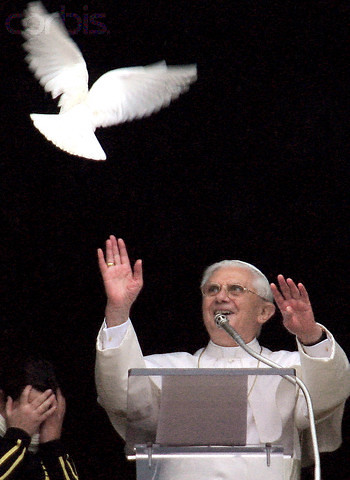
Pentecost, the Church's birthday, is something to celebrate! The below words by Benedict XVI should help us reflect whether we i.e. priests and laity, are celebrating it in a worthy manner.

“The Church is most truly itself in the liturgy, as it is the place where God comes to us and enters our lives.  Let us remember that the liturgy is celebrated for God, not for us; it is His work; He is its subject.”   
Benedict XVI, General Audience, 3 October 2012.


Veni creator Spiritus

This is a famous Catholic Gregorian chant hymn, actually the Vespers hymn for the feast of Pentecost. It is traditionally sung during ordinations to the priesthood, while the Bishop imposes his hands on each of the ordinands and actually imprints the priestly character on their souls. It is also usually sung on the occasion of Confirmation. Veni creator Spiritus was written by Rabanus Maurus (776-856).


1. Veni, creator Spiritus
mentes tuorum visita,
imple superna gratia,
quae tu creasti pectora.

2. Qui diceris Paraclitus,
altissimi donum Dei,
fons vivus, ignis, caritas
et spiritalis unctio.

3. Tu septiformis munere,
digitus paternae dexterae
tu rite promissum Patris
sermone ditans guttura.

4. Accende lumen sensibus,
infunde amorem cordibus,
infirma nostri corporis,
virtute firmans perpeti.

5. Hostem repellas longius
pacemque dones protinus;
ductore sic te praevio
vitemus omne noxium.

6. Per te sciamus da Patrem
noscamus atque Filium,
te utriusque Spiritum
credamus omni tempore.

7. Deo Patri sit gloria,
et Filio qui a mortuis
Surrexit, ac Paraclito,
in saeculorum saecula.
Amen.

V. Emitte Spiritum tuum, et creabuntur:
R. Et renovabis faciem terrae.

Oremus
Deus qui corda fidelium Sancti Spiritus illustratione docuisti: da nobis in eodem Spiritu recta sapere, et de eius semper consolatione gaudere. Per Dominum nostrum Jesum Christum, Filium tuum, qui tecum vivit et regnat in unitate eiusdem Spiritus Sancti Deus. Per omnia saecula saeculorum. Amen.