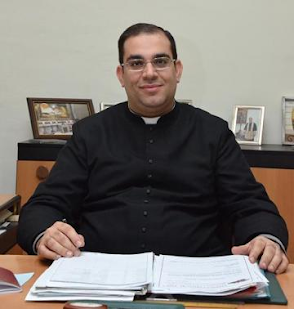
The seventh recipient of this virtual award is Fr Marc Andrè Camilleri, who was appointed parish priest of Christ the King parish in Paola by Archbishop Paul Cremona in August 2014.
Fr Camilleri, from Lija, was born on 15 August 1984 and ordained priest on 23 June 2010. He served as deputy parish priest at St Sebastian parish in Qormi and - since 2010 - is a member of Missjoni ż-Żgħira. The latter was established in Malta in 1884 by Canon Francesco Bonnici. The Canon was inspired by the activities of
the Mission founded by St. Gaspare del Bufalo in Rome. with the primary aim of instructing
children through missionary preaching. Today, the Missjoni ż-Żgħira preaches missions not only to children but also
to adults, and especially to youths.
Fr Camilleri has celebrated Mass in the Extraordinary Form of the Roman Rite in several localities, including Valletta, St. Paul's Bay, Bengħisa and Ta' l-Ibraġ. Some of these were celebrated with the aid of Pro Tridentina (Malta).
The reform of the reform
It seems very unfair to say that any discussion about the
implementation of the post-Vatican II liturgical reform would lead to
its deformation.
It was Pope Benedict himself, while still Cardinal, who pointed out
that "the reform of the liturgy in its concrete realisation... resulted
not in reanimation but in devastation. We have a liturgy that has
degenerated into a show, in which attempts are made to make religion
appear interesting with the help of idiotic fashions..." (Preface in
Klaus Gamber: La reforme liturgique en question, 1992.)
He himself called for a reform of the reform many times, not, as
others would have us believe, that this younger generation is "nostalgic
for turning back the clock".
Would the Pope accuse the younger generations of "nostalgia" or
"Lefebvrian fundamentalism"? I doubt it. When asked about this in 2001,
Cardinal Joseph Ratzinger answered very clearly to those who wish "to
make us believe that if we did not adhere to their schemas we will be
nostalgically returning to the past. Such things do not go like that. It
is an attitude of a past faction. It is important to reflect in an open
manner and not to kill instantly all this reflection, we are accused of
being partisans of St Pius V. We need to outride this way of thinking.
I'm evidently for Vatican II, which has given us a lot of beautiful
things. But declaring that it is impossible, and to judge unacceptable
all the reflection on what we can elicit from the Church's history, for
me is sectarianism which I don't accept any more."
While reflecting on the use of the 1962 Roman Missal, Pope Benedict
pointed out that the fact "that young people too have discovered this
liturgical form, felt its attraction and found in it a form of encounter
with the mystery of the Most Holy Eucharist, particularly suited to
them."
What a far cry from the accusation Fr Joe Inguanez levelled at the
younger generations for "returning the practices and rituals that belong
to another era are nothing less than a manifestation of wanderlust, of
romantic utopia, symbolised in the sacred rather than the religious."
(Excerpts from the '2005 Mass census report', Malta, p. 28)
In the words of the Pope, "what earlier generations held as sacred,
remains sacred and great for us too, and it cannot be all of a sudden
entirely forbidden or even considered harmful. It behooves all of us to
preserve the riches which have developed in the Church's faith and
prayer, and to give them their proper place." (July 7, 2007)
The Pope has made it clear that he is attempting even to reform the
Papal liturgies according to the principles he so vociferously spoke
about before his election. The first reform was the change of the master
of ceremonies after which the Papal liturgies took on a different
style; that of "a wise joining of the ancient with the new, to actuate
in spirit and letter, as much as possible, the indications of the Second
Vatican Council, and to do this in such a way that the pontifical
celebrations are exemplary in all aspects."
Benedict has given us a direction to aim for; a Church which does not
look for uniformity but for unity in diversity; a Church in which two
forms of the same rite if celebrated well can exist together, a Church
in which the Roman rite can exist together with different Eastern rites
and now even with an Anglican rite. Not a Church that accuses these
reformers of "Lefebvrian fundamentalism", or of trying to turn the clock
back. Had this attitude of mistrust and hostility guided the Church's
authorities during the centuries, no reform would have ever taken place.
Fr. Joe Inguanez, who holds a diametrically opposite view, replied a month later. The letter can be found below:
The Church: a reform or a counter-reform?
My attention has been drawn to a letter written by Rev. Deacon Marc Andre' Camilleri, published on February 28.
I read his letter with all the attention it merits. Ironically, I was both amused and amazed.
I was amused because the letter speaks more about its author than about my pastoral commentary which introduced the Malta Sunday Mass Attendance Census 2005.
I was amazed because Fr Camilleri is reaching the end of his degree course in theology and I could hardly find any theological argument in his missive.
This was also a disappointment, since I am aware of the effort of most of my colleagues, who are doing their best to teach theology and resisting turning their lectures into glorified Catechism lessons.
Not that I do not accept the Catechism, but its teachings alone do not constitute theology. The problem with Fr Camilleri - and with those of a similar mindset - is that he ignored the serious pastoral problems which I tried to tackle in my commentary.
The reason people are leaving the Church are not the "so-called" aberrations in the liturgy that followed Vatican II, but what Cardinal Ratzinger, on Good Friday 2005, referred to as the "filth [that] there is in the Church, and even among those who, in the priesthood, ought to belong entirely to Him!
How much pride, how much self-complacency!"
Fr Camilleri praised Mgr Guido Marini, the present Papal Master of Ceremonies, without letting readers know these words were uttered by a certain Father Gagliardi, a member of the staff of the same Mgr Marini. (see Zenit, January 8, 2010).
May I suggest he reads the book by Archbishop Piero Marini (the former Master of Ceremonies to His Holiness), Challenging Reform: Realizing the Vision of the Liturgical Renewal, 1963-1975 (2007).
He will learn that "with the change of the Consilium into a Congregation in 1969 and the transformation of the Congregation for Divine Worship to a subsection of another Congregation in 1975 (Congregation for Divine Worship and the Discipline of the Sacraments), the distinctive style of the Consilium was gradually absorbed into the more traditional style proper to the Roman Curia.
This was probably one of the first signs of a tendency to return to a pre-conciliar mindset that has for years now characterised the Curia's approach.
As more and more time passes since the Second Vatican Council, an event charged with such hope and desire for renewal, its distinctive contributions seem to be increasingly questioned."
Fr Camilleri does not seem perturbed by the fact that 49 per cent are not attending Sunday Mass.
Or perhaps he believes these can be brought back by the widening of clerical phylacteries and lengthening of tassels, a style definitely not promoted by Jesus (Matthew 23: 5).
He seems to be unaware of the Lord's pastoral injunction to leave the 51 per cent and go out in search of those who have left, or have never been in.
In line with people of ultra-conservative mindset, he takes critique to be an accusation. Ironically, he quotes Pope Benedict to make his point; ironically, I can use the same quote in support of my argument: "We need to outride this way of thinking. I'm evidently for Vatican II, which has given us a lot of beautiful things. But declaring that it is impossible, and to judge unacceptable all the reflection on what we can elicit from the Church's history, for me is sectarianism which I don't accept any more".
It is his lack of knowledge of the Church's history, history of theology and human thought that is Fr Camilleri's achilles' heel.
I am really sad he has really proved one of the points made in my commentary - that we are faced with a number of clerics who seem to be more interested in custom than tradition; in one's attire more than in the way one lives; in building and decorating the Temple of our Jerusalems rather than in nurturting the Body of Christ.
What our Church needs is not the reform of a reform, but constant reform on the lines started by Vatican II and perhaps, as Cardinal Martini and others have suggested, by means of a Vatican III.


