For the promotion and dissemination of the Extraordinary Form of the Mass in the Archdiocese of Malta and the Diocese of Gozo, as endorsed by the motu proprio Summorum Pontificum promulgated by Pope Benedict XVI (2007) and in the Instruction Universae Ecclesiae (2011). We adhere to the traditional Catholic motto: We are what you once were. We believe what you once believed. We worship as you once worshipped. If you were right then, we are right now. If we are wrong now, you were wrong then.
Last April this Blog had commented on the future of the Tridentine Mass in Malta, and whether Traditionis custodes would still apply.
Some days ago, it was announced that Tridentine Mass will be celebrated by Cardinal Raymond Burke at the Altar of the Chair in St. Peter's Basilica on 25 October, 2025. This represents an important return of this rite to the Basilica after it was suspended in 2022 due to restrictions issued by Pope Francis' 2021.
Yesterday, Rorate Coeli published the text being reproduced below:
From an excerpt of the new book-interview with Elise Ann Allen, of Crux, released today -- a direct quote from the Pope's response:
[Elise Ann Allen]: Regarding the study group on liturgy, what is being studied? How much of the reason for establishing this was related to divisions surrounding the Traditional Latin Mass, for example, or issues such as the new Amazonian rite?
[Leo XIV]: My understanding of what the group came out of is primarily from issues that have to do with the inculturation of the liturgy. How to continue the process of making the liturgy more meaningful within a different culture, within a specific culture, in a specific place at any given time. I think that was the primary issue.
There is another issue, which is also another hot-button issue, which I have already received a number of requests and letters [about]: The question about, people always say ‘the Latin Mass.’ Well, you can say Mass in Latin right now. If it’s the Vatican II rite there’s no problem. Obviously, between the Tridentine Mass and the Vatican II Mass, the Mass of Paul VI, I’m not sure where that’s going to go. It’s obviously very complicated.
I do know that part of that issue, unfortunately, has become – again, part of a process of polarization – people have used the liturgy as an excuse for advancing other topics. It’s become a political tool, and that’s very unfortunate. I think sometimes the, say, ‘abuse’ of the liturgy from what we call the Vatican II Mass, was not helpful for people who were looking for a deeper experience of prayer, of contact with the mystery of faith that they seemed to find in the celebration of the Tridentine Mass. Again, we’ve become polarized, so that instead of being able to say, well, if we celebrate the Vatican II liturgy in a proper way, do you really find that much difference between this experience and that experience?
I have not had the chance to really sit down with a group of people who are advocating for the Tridentine rite. There’s an opportunity coming up soon, and I’m sure there will be occasions for that. But that is an issue that I think also, maybe with synodality, we have to sit down and talk about. It’s become the kind of issue that’s so polarized that people aren’t willing to listen to one another, oftentimes. I’ve heard bishops talk to me, they’ve talked to me about that, where they say, ‘we invited them to this and that and they just won’t even hear it’. They don’t even want to talk about it. That’s a problem in itself. It means we’re into ideology now, we’re no longer into the experience of church communion. That’s one of the issues on the agenda.
Cardinal Robert Sarah's retirement as Prefect of the Congregation for Divine Worship has been postponed. This has been interpreted by sources close to this Blog as implying that next month the first in a series of liturgical changes that this Blog had mentioned more than 2 years ago will start being implemented.
Seven Saints will be added to the Tridentine Mass of 1962. The typical practice is to add new saints to the calendar and then incorporate them into the next edition of the Missal. This practice implies that a new version of the 1962 Missal is coming soon, with possibly additional changes.
Rorate Coeli has given credit to this news to an Italian website Messa in Latino. We are happy that they have given positive feedback to this Italian website. However, lest we forget, when we had published the afore-mentioned breaking news, which was widely reported, Rorate Coeli tried to denigrate this Blog as this and this articles amply show.
A year after, we published another article showing that the changes had been merely postponed. All of the above shows that this Blog disseminates facts and not fiction. Maybe, in due course, Rorate Coeli will acknowledge that this Blog was right after all.
Last year, this Blog broke the news that massive liturgical changes were expected later this year. Soon afterwards, unexpectedly, controversy with traditional groups followed (read here, here and here), notwithstanding the fact that Pope Francis himself had invoked ‘magisterial authority’ to declare liturgy changes ‘irreversible’.
However, following Archbishop Carlo Maria Viganò's revelations in the past weeks, sources in the Holy See indicated that pressure was mounted on Pope Francis to delay the liturgical changes to sometime in 2019, or even later, in order to avoid more controversy within the Vatican. There is a real fear that if liturgical changes are introduced in the coming weeks, they could lead to a schism that would hit the heart of the Church. The names of two Cardinals, both deemed to be close to Pope Francis, were mentioned. Allegedly, Pope Francis has agreed to this postponement. Since this Blog has been unable to contact any of the Cardinals, we prudently are avoiding to mention them.
Still, this Blog will continue to update its readers whenever news on this matter close to our hearts is made available to us.
Following our scoop on liturgical changes expected in 2018, the post was given a wide publicity, most of which agreed that the possibility exits. Others, in particular Rorate Caeli (see here and here) and Fr Z tried to mock this Blog.
We do not recall any outcry to this article that is being reproduced hereunder. This shows that 'preparation' has been already in the pipeline for some months, at least. We all know the way things are done ... first an innocuous article appears and afterwards, provided there are no reactions the reform starts taking place...
How the ordinary form of the Mass can “enrich” the extraordinary form
In Summorum Pontificum, Pope Benedict hoped the celebration of the extraordinary and ordinary forms of the Mass would be “mutually enriching.” So what healthier elements of the ordinary form might benefit the extraordinary?
In 2007, Pope Benedict XVI issued his motu proprio Summorum Pontificum (SP), in which he gave broader scope to the earlier permissions of Pope John Paul II regarding the celebration of Holy Mass according to the Missale Romanum of 1962. In the Pope’s accompanying letter to the bishops of the Catholic world, he expressed the conviction that the availability of the older rite (now to be called the “extraordinary form”) would be “mutually enriching” for the extraordinary form and for the “ordinary” form of the Mass. It would appear that the Pontiff was looking toward an organic process, whereby a “new and improved” form of the Roman Mass would result. Many priests and liturgists have identified various elements of the extraordinary form (EF) which would be helpful in shoring up the “sacrality” of the ordinary form (OF). When the conversation turns to how the OF could provide a positive influence on the EF, it is not uncommon to hear serious doubts raised that this could be the case. That response puts me in mind of the famous rhetorical (and probably sarcastic) question of Tertullian when pressed to consider the value of philosophy to theology: “What has Athens to do with Jerusalem?”
Since the promulgation of SP, when I celebrate according to the EF, thoughts about useful adaptations surface. I suspect that many of these thoughts of mine were likewise in the minds of the Fathers of Vatican II, whose very first document was their Constitution on the Sacred Liturgy, Sacrosanctum Concilium (SC). That document provided a theological framework for liturgical renewal, born of the liturgical movement spanning almost a century in the lead-up to Vatican II. In addition to the theological basis, the bishops also identified areas where modification and development were needed; it should be noted that SC obtained near-unanimous approval (including that of Archbishop Marcel Lefebvre). To be sure, much of what emerged in 1970 (and beyond) was not in the least envisioned by the Council Fathers.
With all that said, how might the EF benefit from some of the healthier aspects of the OF?
Adoption of the revised lectionary
Many people do not realize that prior to Vatican II, not only did we have only a one-year Sunday cycle of readings, but we did not have any lectionary for weekdays at all! As a result, either the Sunday readings were repeated or those from the “commons” of the saints were employed. Hence, SC clearly calls for an expansion of the lectionary, putting it in the context of providing the People of God with a greater exposure to the Word of God.
The proclamation of most of the New Testament and vast segments of the Old Testament in the current lectionary is one of the most positive achievements of the post-conciliar liturgical reform—so much so that most mainline Protestant denominations have adopted our lectionary.
Incorporation of additional Mass formularies
The Missal of 1970 (and subsequent editions) contains a rich collection of euchological texts, culled from the vast liturgical storehouse of the Church. Many of the orations have pedigrees dating to the fourth century. Pope Benedict in SP actually suggested the possibility of integrating those prayers into the 1962 Missal, highlighting in particular the array of beautiful prefaces that comprise the OF Missal (in contrast to the very limited number in the EF Missal).
Expand possibilities for solemnity
The EF has clearly defined categories for the celebration of Mass: Low Mass, Missa Cantata, Solemn Mass. The normative form is the Solemn Mass, wherein a full complement of ministers functions, along with incense and chant. The Low Mass (which, in the United States, unfortunately, was the most familiar and common liturgical experience) had none of those components. The Missa Cantata is an attempt to have at least some of the solemnity, even without all the desired ministers.
The OF does not have such mutually exclusive categories, thus allowing for as much solemnity to be incorporated as possible. And so, even at a daily Mass with a single priest-celebrant, one can chant any and all the prayers and use incense. Regrettably, that opening is not taken advantage of very often—even on Sundays. However, it would be a good element to add to the liturgical menu of the EF.
Elimination of duplicate recitations
In sung Masses of the EF, the celebrant is required to recite quietly texts which are chanted by the choir and/or congregation (e.g., Introit, Gloria, Credo, Sanctus). In the celebration of Holy Mass, the priest moves in and out of various modes: at times, he prays as one of the faithful; at other times, he prays in persona Christi Capitis (“in the person of Christ the Head”). When he operates in the former mode, there is no theological reason for him not to pray the text in union with the whole assembly. Those who attend the EF will know the awkwardness of the current rubrical practice, especially when a text calls for a gesture on the part of the priest (e.g., the Sign of the Cross to end the Gloria or the genuflection during the Credo) which is not “in sync” with what is being sung because the schola/congregation have not gotten there yet.
Restoration of Offertory Procession and Prayer of the Faithful
Both of these rituals were specifically identified by SC as elements to be restored. The emphasis here is on “restored”; unlike some other rites introduced into the post-Vatican II liturgy, these two have a venerable tradition to them. Indeed, the intercessory prayers of the Good Friday liturgy are a witness to the antiquity of the Prayer of the Faithful. Justin Martyr is an even more ancient witness to the offertory procession.
Re-order the dismissal rite
The EF dismissal rite is anti-climactic, inasmuch as the priest dismisses the congregation and then bestows the blessing, followed by the Last Gospel. The OF has a more logical conclusion, in that the “Ite, missa est” is truly the last word. Perhaps the Last Gospel could be retained as an optional text, given its historical value.
Move the “fractio”
In the OF, the “breaking of the bread” occurs during the Agnus Dei, which is the quintessential hymn to the “Lamb who was slain.” The action and the text for this rite in the EF do not correspond to each other as well.
Make clear that the homily is a true part of the Sacred Liturgy
Removing the maniple and donning the biretta during the homily (along with the opening and closing Sign of the Cross) declare that the homily does not form part of the Mass; indeed, that is an “interrupter.” On the contrary, the homily is an essential part of the Sacred Liturgy. Furthermore, if it is not such, then any baptized Christian should be able to deliver it!
Maintain the integrity of the Sanctus
When polyphonic Masses are sung, it is not unusual for the Benedictus to be separated from the rest of the Sanctus, being sung after the Consecration. This is an obvious accommodation to the problem of a musical offering that so overshadows the liturgy itself that it cannot be performed without creating an undue delay in the celebration. If a musical composition would have that effect, it certainly comes under the condemnation of Pope Pius X’s Tra le Sollecitudini. Beyond that, if it is being used as a “filler” for the silence after the Consecration, it flies in the face of the whole rationale for an inaudible Canon, evoking a deeper sense of mystery.
Adopt the rubrics of the OF for the Communion Rite
If the Pater Noster is the prayer of the family of the Church to her heavenly Father, why should not the entire congregation pray it together? Of course, Pope Benedict’s norms in SP already allow for that, however, I have rarely seen the option taken. It would also make sense to have the other prayers of the Communion Rite recited audibly or chanted aloud (as in the OF), with the priest’s private preparation prayers done sotto voce (again, as in the OF).
Face the people when addressing the people; face God when addressing God.
We have used this formula to justify celebrating Mass ad orientem in the OF, that is, to face liturgical east from the Liturgy of the Eucharist forward. The converse is also true: when proclaiming the Scripture readings, face those to whom those texts are addressed. Whatever the historical origins of facing east for the Epistle and facing north for the Gospel at Solemn Mass, they are not truly communicative of the significance of the rite being celebrated.
Unite the calendars of the OF and EF
For the EF to be unable to commemorate the saints canonized since 1962 is an impoverishment—a point also raised by Pope Benedict in SP. Certain calendar changes were good (e.g., making the Solemnity of Christ the King the last Sunday of the liturgical year), while others were destructive of long-standing traditions (e.g., Epiphany, Ascension). Regardless of what one thinks of either calendar (and no calendar will ever be perfect), operating with a dual-calendar system bespeaks division, the very antithesis of what good liturgy should be.
Modify the rubrics
SC calls for the modification of signs and symbols that are duplicative or arcane. One thinks immediately of the multiple Signs of the Cross during the Canon. Just as the OF admits of a certain laxity, the EF can lean toward an unhealthy rigidity or rubricism. In medio stat virtus! (“Virtue stands in the middle”).
Rename the two principal parts of the Mass
To continue to call the first part of the Mass the “Mass of the Catechumens” is a form of the antiquarianism pilloried by Pope Pius XII in Mediator Dei. We have not been dismissing catechumens (or penitents) for centuries (except in silly parishes where baptized Christians preparing for reception into full communion are “dismissed”). The post-conciliar nomenclature is quite accurate: Liturgy of the Word/Liturgy of the Eucharist.
These are my recommendations for “mutual enrichment” as gifts of the ordinary form to the extraordinary form. I hope this helps answer the contemporary liturgical version of Tertullian’s question.
"Ok, checked with our main Roman sources, and our suspicions were founded -- the best called it "hogwash" and "not true at all"."
Our sources are reliable and Rorate Caeli should know better before trying to denigrate what is after all true. The funny thing is that one of their "main sources" contacted us this morning, telling us that he was surprised by Rorate's message and his paternalistic tone. Apparently this person from Rorate is a British national.
But, on one thing we agree with Rorate, check your sources in Rome and you will get confirmation, sooner or later. It would be better if traditional Catholics co-operate together, rather than trying to denigrate other websites, just because sometimes news are published before they obtain them.
"Ok, checked with our main Roman sources, and our suspicions were founded -- the best called it "hogwash" and "not true at all"."
Our sources are reliable and Rorate Caeli should know better before trying to denigrate what is after all true. The funny thing is that one of their "main sources" contacted us this morning, telling us that he was surprised by Rorate's message and his paternalistic tone. Apparently this person from Rorate is a British national.
But, on one thing we agree with Rorate, check your sources in Rome and you will get confirmation, sooner or later. It would be better if traditional Catholics co-operate together, rather than trying to denigrate other websites, just because sometimes news are published before they obtain them.
And all that our friends at Rorate had to do was contact this Blog.
An apparent reference to the SSPX which has a strong presence in Buenos Aires, but also to traditional Catholics in general. The original article can be found here.
The Pope had an audience with the presiding board of the CLAR (the Latin
American and Caribbean Confederation of Religious Men and Women - Confederación Latinoamericana y Caribeña de Religiosos y Religiosas)
on June 6, 2013 (image above, with three sisters and three male
religious). It was a private audience, so no transcript was provided,
but those who were present were kind enough to provide the words of His
Holiness, made available at the Chilean ultra-progressive website Reflexión y Liberación (Reflection and Liberation). The excerpt that mentions Traditional Catholic groups is the one below
(the ellipses are part of the original long transcript, as provided by
CLAR):
I share with you two concerns. One is the
Pelagian current that there is in the Church at this moment. There are
some restorationist groups. I know some, it fell upon me to receive
them in Buenos Aires. And one feels as if one goes back 60 years! Before
the Council... One feels in 1940... An anecdote, just to illustrate
this, it is not to laugh at it, I took it with respect, but it concerns
me; when I was elected, I received a letter from one of these groups,
and they said: "Your Holiness, we offer you this spiritual treasure:
3,525 rosaries." Why don't they say, 'we pray for you, we ask...', but
this thing of counting... And these groups return to practices and to
disciplines that I lived through - not you, because you are not old - to
disciplines, to things that in that moment took place, but not now,
they do not exist today...
The second [concern] is for a Gnostic
current. Those Pantheisms... Both are elite currents, but this one is of
a more educated elite... I heard of a superior general that prompted
the sisters of her congregation to not pray in the morning, but to
spiritually bathe in the cosmos, things like that... They concern me
because they ignore the incarnation! And the Son of God became our
flesh, the Word was made flesh, and in Latin America we have flesh
abundantly [de tirar al techo]! What happens to the poor, their pains, this is our flesh...
In traditional Catholic websites and blogs, a lot is being said about Pope Francis' position on the Tridentine Mass. Some say that he promoted the Tridentine Mass while the majority are saying that the former Cardinal Bergoglio restricted (to put it mildly) celebration of this Mass in the Archdiocese of Buenos Aires.
In this article (in Spanish) written from a third party perspective on 17 September 2007 i.e. just three days after the entry into force of Summorum Pontificum it is stated that:
The very first thing Bergoglio did after the publishing of Summorum Pontificum of Pope Benedict XVI was to promote the Traditional Latin Mass, the Extraordinary Form, in his Archdiocese, immediately directing that a chapel, to start with, be set up for this end.
Whatever the case about how things developed in Buenos Aires (bearing also in mind the strong presence of SSPX there), Bergoglio certainly tried to do the right thing from the beginning.
A good strategy, in our opinion, is to continue to use the provisions of Summorum Pontificum. If no provision is made for those who ask, the matter can always be brought to the Pontifical Commission Ecclesia Dei (PCED).
Five years into the era of Summorum Pontificum, no less than 30 European countries offer the Extraordinary Form of the Mass on a regular basis together with around 50 other countries around the globe. And Malta and Gozo? As usual we are the know-it-all, more Catholics than the Pope and notwithstanding various petitions and personal requests made to the local Church authorities, the situation remains stuck as it was in the pre-Summorum Pontificum days. So much for obedience to the hierarchy, in this case to Pope Benedict XVI...
Tridentine Masses have been cancelled and those that were given 'permission' (because in Malta you have to obtain a permit from the local Curia to have a Tridentine Mass celebrated) are usually given at strange hours in non-central locations.The few that were celebrated according to the provisions of Summorum Pontificum were reminiscent of the catacombs' days...
There can be no denying that there are more Tridentine Masses being offered in more places with each passing year around the world. To that end, I recommend that people check the siteWikkimissa endorsed by Rorate Coeli every now and then. And perhaps, next time round the Maltese Islands will feature too.
I encourage the Committee of Pro Tridentina (Malta) to continue piling pressure, locally with the Church authorities and abroad with the PCED and the FIUV. The Tridentine Mass is a reality and delaying tactics (cunctando regitur mundus) from those who should know better will serve nothing.
The FIUV ... is presenting papers on matters of current concern in the light of possible changes to the Missal of 1962. In furtherance of this objective we welcome intelligent debate.
We know for a fact that the PCED has commenced work on this project so what do we do? Do we wait until a revised Missal is published and then register futile complaints, or do we do what the FIUV has done for more than 40 years and defend the integrity of this Missal with vigour on behalf of the laity (and many priests) who, individually, have no voice. (From a comment submitted to Rorate Coeli website earlier this month)
I am reproducing below an announcement from FIUV. It is important that we Maltese follow closely and contribute where possible. Godwin Xuereb
Dossier Liturgy
FIUV launches discussion papers on the 1962 Missal The Foederatio Internationalis Una Voce (FIUV) is launching a series of short 'position papers' on aspects of the 1962 Missal, with a view to stimulating debate on aspects of the 'Extraordinary Form' which have been criticised in the past, and might be subject to change in the future.
We have a two-fold goal. First, to contribute to a debate, which has been on-going since at least the mid 20th Century, about the theological appropriateness and pastoral effectiveness of (what is now, in the Holy Father's phrase) 'the former liturgical tradition'. We wish to equip those attached to this tradition with the best possible arguments, backed by the best authorities, for maintaining the organic integrity of this tradition, expressed as succinctly as possible but, we hope, comprehensible to a wide audience. We hope in this way to raise the standard of debate which takes place no longer only in the seminar room, but wherever Catholics meet, particularly on the internet.
Secondly, we do this in light of the Holy Father's letter to Bishops accompanying the Motu Proprio Summorum Pontificum:
For that matter, the two Forms of the usage of the Roman Rite can be mutually enriching: new Saints and some of the new Prefaces can and should be inserted in the old Missal. The "Ecclesia Dei" Commission, in contact with various bodies devoted to the usus antiquior, will study the practical possibilities in this regard.
The FIUV is not merely one among many 'bodies devoted to the EF', but is the only international body able to speak for the laity attached to this form of the liturgy. We were established in 1965, at the very beginning of the 'Traditional Movement', and represent a large and growing number of lay associations in North and South America, Europe, Africa and Asia. We have been representing the views and needs of our member associations in Rome, and to the wider world, for nearly half a century.
Accordingly, we have set up a 'Liturgy and Spirituality Subcommittee' to coordinate the development and publication of these position papers. I (Joseph Shaw, coincidentally Chairman of the Latin Mass Society) am the Moderator of that Subcommittee, and in that capacity I am presenting these papers to the public, on Rorate Caeli, thanks to New Catholic's great hospitality.
Mass celebrated by Cardinal Castrillón Hoyos, St Peter's, Rome, for the FIUV General Assembly, Nov 2011
While the Holy Father makes reference to two areas of possible change to the 1962 books, new Saints and Prefaces, debate about the future of these liturgical books is not limited to those matters. For that reason, and also because of the first mentioned purpose of these papers, we will be addressing topics on a wide range of issues. As well as an introductory paper, giving something of a disclaimer about our remit, the first six topics planned are:
The Service of Men and Boys at the Altar Liturgical Piety and Participation The Method of Receiving Communion The Vulgate and Gallican Psalter Liturgical Orientation Holy Week
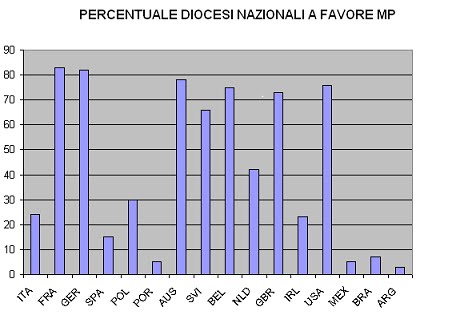
Da Rorate caeli (e relativi commenti) prendiamo questo conteggio redatto da Peter Karl Perkins inerente l'estensione delle Messe tridentine per effetto del motu proprio. Sono computate a parte quelle della Fraternità San Pio X, per meglio enucleare l'avanzata tradizionale per il solo effetto del motu proprio (la FSSPX, ovviamente, non aveva bisogno di attendere la liberalizzazione, che pur ha nobilmente richiesto a vantaggio di tutta l'ecumene, per impiantare nuovi centri di Messa).
Il primo numero accanto al nome di ogni paese si riferisce al 2005, all'inizio di questo pontificato, ed indica le diocesi che a quella data avevano una Messa tridentina almeno ogni domenica e festa di precetto. Si tratta quindi delle messe concesse in applicazione dei vecchi indulti del 1984 e 1988, quando l'arbitrio episcopale era sovrano (oggi lo è ancora, ma non più di diritto, solo di fatto). La seconda cifra recensisce invece la situazione delle diocesi 'virtuose' al 2010 (eventualmente tra parentesi con la specificazione di dati intermedi).
Si ripete: i numeri che seguono indicano il numero di diocesi (con almeno una, a volte più, Messe ogni domenica e festa di precetto), non il numero totale di Messe, che è ovviamente superiore (sia perché in molte diocesi vi sono più Messe, sia perché non si considerano ai fini del computo le Messe con intervallo maggiore di quello settimanale o tenute solo in giorni feriali). Indichiamo quando possibile anche il totale delle Messe 'regolari' e quelle della FSSPX (sempre considerando solo quelle che si celebrano almeno ogni domenica e festa di precetto).
Italia: 15, (41 nel 2008), 52 diocesi (più che triplicate, ma pur sempre meno di un quarto del totale). Totale diocesi esistenti: 214.
Totale Messe: 81 + Totale Messe FSSPX: 15.
Francia: 65 (74 nel 2008), 78 diocesi. Totale diocesi esistenti: 93.
Totale Messe: 201 + Totale Messe FSSPX: 215
Germania: 10, 23 diocesi. Totale diocesi esistenti: 28.
Totale Messe: 54 + Totale Messe FSSPX: 64
Spagna: 3, 11 diocesi. Totale diocesi: 69
Totale Messe: 16 + Totale Messe FSSPX: 4
Polonia: 6, 12 diocesi. Totale diocesi: 40
Totale Messe: 16 + Totale Messe FSSPX: 12
Portogallo: 0, 1 diocesi. Totale diocesi: 20
Totale Messe: 2 + Totale Messe FSSPX: 2
Austria: 5, 7 diocesi. Totale diocesi: 9
Totale Messe: 13 + Totale Messe FSSPX: 11
Svizzera: 3, 4 diocesi. Totale diocesi: 6
Totale Messe: 29 + Totale Messe FSSPX: 40
Belgio: 5, 6 diocesi. Totale diocesi: 8
Totale Messe: 15 + Totale Messe FSSPX: 6
Olanda: 1, 3 (incremento ma con perdita di Rotterdam, l'unica del 2005). Totale diocesi: 7
Totale Messe: 5 + Totale Messe FSSPX: 2.
Lussemburgo: 0, 1. Totale diocesi: 1
Totale Messe: 1. Totale Messe FSSPX: 0
Liechtenstein: 0, 1. Totale diocesi: 1
Totale Messe: 1. Totale Messe FSSPX: 0
Inghilterra e Galles: 9, 19. Totale diocesi: 22
Totale Messe: 38 + Totale Messe FSSPX: 18.
Scozia: 2, 3 diocesi. Totale diocesi: 8.
Totale Messe: 3 + Totale Messe FSSPX: 3
Irlanda: 4, 6 diocesi. Totale diocesi: 26
Totale Messe: 6 + Totale Messe FSSPX: 6
Filippine: 5, 7. Totale diocesi 86.
Australia: 10, 11 diocesi.
Nuova Zelanda: 2, 5. Totale diocesi: 6
U.S.A.: 112, 149 (significativo il numero di Messe già concesso dai vescovi ai tempi dell'indulto, segno dell'assenza in molti presuli americani della chiusura ideologica che affligge la maggior parte dei loro colleghi nel resto del mondo). Totale diocesi: 195
Totale Messe: 358 + Totale Messe FSSPX: 116.
Canada: 11, 14 diocesi. Totale diocesi: 71.
Totale Messe: 28 + Totale Messe FSSPX: 18
Messico: 1, 5 diocesi. Totale diocesi: 94.
Totale Messe: 11 + Totale Messe FSSPX: 11
Brasile: 7, 21 diocesi (triplicazione non comparabile con alcun altro paese latinoamericano). Totale diocesi: 272
Argentina: 2, 2 (accanita ostruzione del card. Bergoglio e complici) diocesi. Totale diocesi: 72
Colombia: 1, 2 diocesi
Peru: 1, 2 diocesi
Sud Africa: 0, 1 diocesi
Gabon: 1, 2 (grazie all'I.C.R.S.S.) diocesi
Ungheria: 1, 3 diocesi. Totale diocesi: 12.
Totale Messe: 3. Totale Messe FSSPX: 0
Repubblica Ceca: 1, 4 diocesi (Olomouc aggiunta questa settimana). Totale diocesi: 8