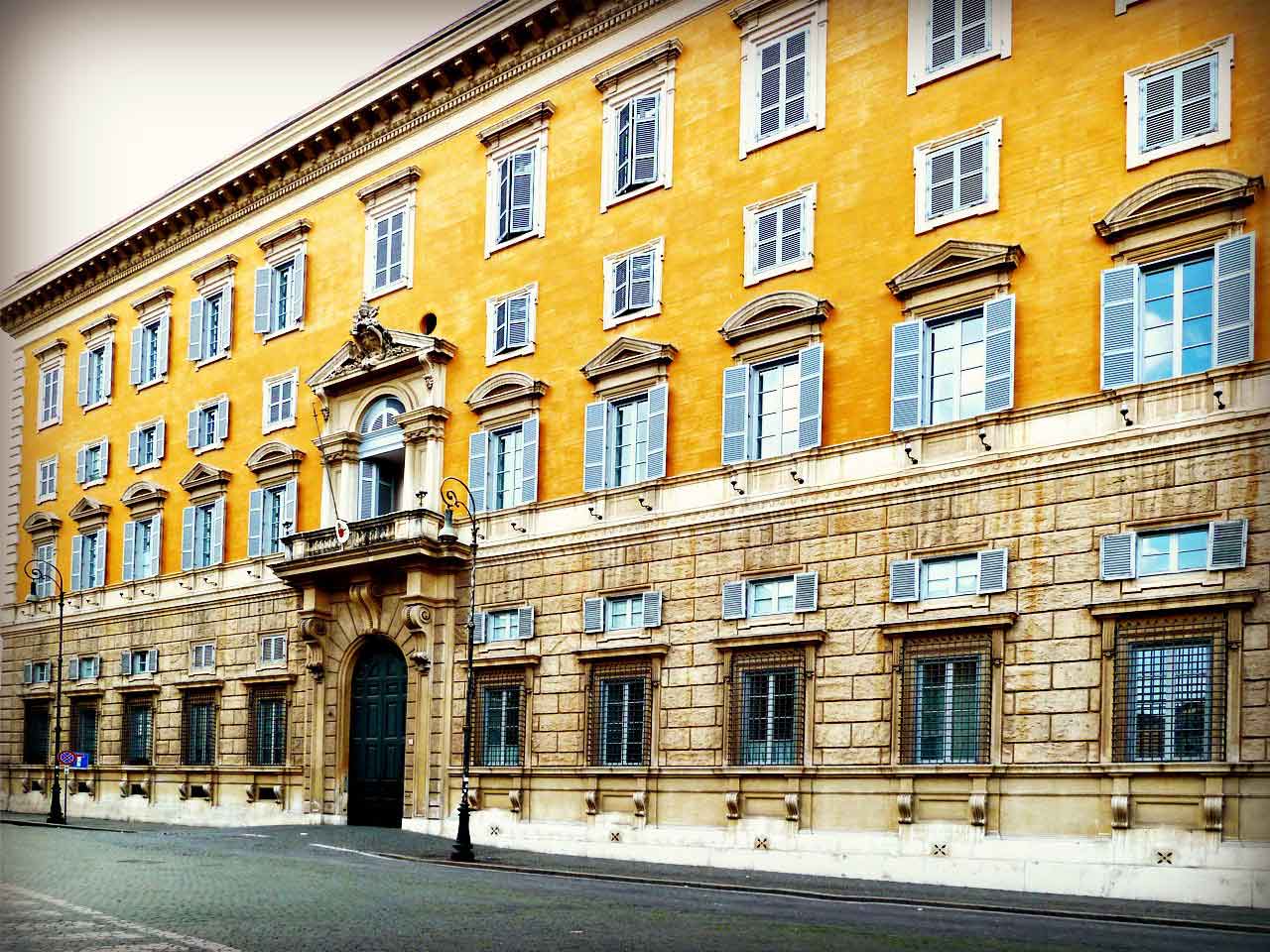
For the promotion and dissemination of the Extraordinary Form of the Mass in the Archdiocese of Malta and the Diocese of Gozo, as endorsed by the motu proprio Summorum Pontificum promulgated by Pope Benedict XVI (2007) and in the Instruction Universae Ecclesiae (2011). We adhere to the traditional Catholic motto: We are what you once were. We believe what you once believed. We worship as you once worshipped. If you were right then, we are right now. If we are wrong now, you were wrong then.
Showing posts with label Summorum Pontificum. Show all posts
Showing posts with label Summorum Pontificum. Show all posts
The regulations set out in Traditionis custodes and as applied in Malta and Gozo provide that (comments in bold by this Blog):
1. The bishop of the diocese is the sole authority to decide whether the celebration of Mass according to the 1962 Roman Missal may take place in his diocese. - only one Sunday Mass is allowed in Malta, none in Gozo.
2. The bishop must decide the locations and times when Mass according to the 1962 rubrics may take place. This cannot occur within parochial churches, nor can the bishop erect new personal parishes dedicated to the celebration of Mass according to the 1962 Missal. - in fact the Mass is only held in the Jesuits Church in Valletta. Other, few Tridentine Masses that are held from time to time are celebrated by so-called 'independent priests'.
3. The bishop must ensure that the existing communities that celebrate Mass according to the 1962 rubrics are effective for the spiritual growth of his people, and he has the option to revoke the permissions given to these communities. He may not authorize the establishment of new groups that gather for celebration according to the 1962 Roman Missal. - this has affected Pro Tridentina (Malta) directly, also because some persons had decided to spread lies about this organisation, for their personal ambitions.
4. The bishop should appoint a priest to act as a delegate for the pastoral care of the groups of the faithful attached to the 1962 liturgical rites. The priest must understand the Missal of 1962 well, must be well-versed in ecclesial Latin, and must exhibit pastoral charity and a desire for ecclesial communion. - this has been done with the appointment of Canon Doublet.
5. Priests ordained before the publication of Traditionis custodes (16 July 2021) who celebrated Mass according to the 1962 Missal before the publication of Traditionis custodes should request permission from the bishop of the diocese to continue to celebrate Mass according to the 1962 rubrics. - it's unclear whether these priests, some of whom appear in the section Hall of Honour did this or not.
6. Priests ordained after the publication of Traditionis custodes must submit a formal request to the bishop of the diocese in order to gain permission to celebrate Mass according to the 1962 Roman Missal. The bishop must then consult the Holy See before the bishop grants permission to the priest. - as far as is known, no priest did this.
In December 2021, additional restrictions and guidelines (some of which are reproduced below) were issued by the Congregation for Divine Worship and the Discipline of the Sacraments in the form of a Responsa ad dubia:
1. if a non-parish church, oratory or chapel cannot be found for a group to gather to celebrate the Mass according to the 1962 Missal, the diocesan bishop can ask the Holy See for permission to use a parish church; however, the Mass should not be listed in the parish schedule and when a non-parish church, oratory or chapel becomes available, the permission to celebrate the Mass in the parish church will be withdrawn. - none was asked. If such a group grows in the number of attendees, permission to use the 1962 Missal may be withdrawn because it can be considered that the group is promoting the previous rite.
2. The diocesan bishop is not authorized to grant permission for the use of the Pontificale Romanum (the Pontifical Missal) issued in 1962. This also means that the sacraments of Holy Orders and Confirmation may only be celebrated in the post-Vatican II form. The only exception is for personal parishes to use the Roman Ritual. But these very few exceptions must be monitored in order to ensure that the priests are accepting the liturgical reforms coming from the Council. - this eliminates all previous permissions to celebrate the Mass and the Sacraments according to the Roman Pontifical and the Roman Ritual which are the two main directories that regulated ceremonies in the Catholic Church for more than 1,000 years.
3. In order for a priest to be granted permission to celebrate the Mass according to the Missal of 1962, he must recognize the validity and legitimacy of concelebration and is not to refuse to concelebrate at the diocesan Chrism Mass. - this is being applied in Malta.
4. The faculty to celebrate according to the 1962 missal, granted by a diocesan bishop to a priest, is restricted to the territory of that diocese. - therefore priests who celebrate in Malta cannot celebrate the Tridentine Mass in Gozo. The same would apply to any Maltese priest who was incardinated in another diocese. From testimonies gathered by some faithful who attend the different Tridentine Masses in Malta (whether authorised or not), this has been the case with at least 1 priest who attended a seminary abroad.
5. A priest who has been granted faculties to celebrate the 1962 missal is not permitted to celebrate both the Mass according to the 1962 missal and the post-Vatican II missal on the same day. - it is unclear whether an exemption was made in Malta, based on testimonies made by faithful who attend Mass in Valletta.
6. Not only the priest but the deacons and acolytes must also be authorized to serve at the Mass.- if one considers High Masses, the solemnities of the Holy Week, Easter and Christmas in which deacons and acolytes play a very precise role, we see that this demand for authorisation is intended to discourage their participation in such ceremonies. This necessarily leads to a diminishing of such ceremonies.
7.A priest who is authorised to say the Mass according to the1962 Missal cannot say two such Masses even if the group of faithful is approved by the Bishop. - this harms the faithful and puts pressure on them to attend the Novus Ordo Missae. Again, it is clear why groups such as the ASPM are not allowed to expand their attendance at Tridentine Mass while other groups, like Pro Tridentina (Malta), when possible, have to resort to independent priests.
As if this was not enough, a Rescriptum ex audientia was issued in early 2023. The latest documentclearly demands that permission for the groups who received parishes to say the 1962 Mass has to be confirmed by the Vatican. This is directly aimed at the Fraternity of St. Peter, the Institute of Christ the King, the Institute of the Good Shepherd, the Apostolic Administration of St. John Mary Vianney and other such priestly organizations. - but, what about those priests who do not belong to these organizations and say the Latin Mass in churches where both the Novus Ordo Mass and the Tridentine Mass are said once in a while?
The goal of these documents is to entirely abrogate the permissions given by both John Paul II and Benedict XVI to celebrate the Tridentine Mass according to the 1962 Missal. The documents pretend also to abolish the celebration of Mass according to the Missals prior to 1955. They affirm that from now on the only approved expression of the Latin Rite is the Novus OrdoMissae, in which the faithful must have an active participation. Using his "magisterial authority" Francis declared that "the Liturgical Reform is irreversible."
Now that the sede vacante period has begun, one can expect the current situation in Malta to remain the same, for the time being. After a new pope is elected, one needs probably to wait for some time to see whether the current legislation continues, more restrictions are made or, perhaps, the Church reverts back to the motu proprio Summorum Pontificum.
Being a Catholic in 2024 is no easy endeavor. The West is undergoing a massive de-Christianization, so much so that Catholicism appears to be vanishing from the public sphere. Elsewhere, the number of Christians being persecuted for their faith is on the rise. What’s more, the Church has been struck by an internal crisis that manifests itself in a decline in religious practice, a downswing in priestly and religious vocations, a decrease in sacramental practice, and even a growing dissension between priests, bishops and cardinals which, until very recently, was utterly unthinkable. Yet, among all the things that can contribute to the internal revival of the Church and to the renewal of her missionary zeal, there is, above all, the worthy and reverent celebration of her liturgy, which can be greatly fostered thanks to the example and the presence of the traditional Roman liturgy.
Despite all the attempts that have been made to suppress it, especially during the present pontificate, it lives on, continuing to spread and to sanctify the Christian people who are blessed to be able to benefit from it. It bears abundant fruits of piety, as well as an increase of vocations and of conversions. It attracts young people and is the fount of many flourishing works, especially in schools, and is accompanied by a solid catechesis. No one can deny that it is a vector for the preservation and transmission of the faith and religious practice in the midst of a waning of religious belief and a dwindling number of believers. This Mass, due to its venerable antiquity, can boast of having sanctified countless souls over the centuries. Among other vital forces still active in the Church, this form of liturgical life stands out because of the stability given to it by an uninterrupted lex orandi.
Certainly, some places of worship have been granted, or rather tolerated, where this liturgy can be celebrated, but too often what has been given by one hand is taken back by the other, without, however, ever managing to make it vanish.
Since the massive decline during the period immediately following the Second Vatican Council, every attempt has been made on numerous occasions to revive religious practice, to increase the number of priestly and religious vocations, and to preserve the faith of the Christian people. Everything, except letting the people experience the traditional liturgy, by giving the Tridentine liturgy a fair chance. Today, however, common sense urgently demands that all the vital forces in the Church be allowed to live and prosper, and in particular the one which enjoys a right dating back to over a millennium.
Let there be no mistake: the present appeal is not a petition to obtain a new tolerance as in 1984 and 1988, nor even a restoration of the status granted in 2007 by the motu proprio Summorum Pontificum, which, recognizing in principle a right, has in fact been reduced to a regime of meagerly granted permissions.
As lay people, it is not for us to pass judgment on the Second Vatican Council, its continuity or discontinuity with the previous teaching of the Church, the merits, or not, of the reforms that resulted from it, and so on. On the other hand, it is necessary to defend and transmit the means that Providence has employed to enable a growing number of Catholics to preserve the faith, to grow in it, or to discover it. The traditional liturgy plays an essential role in this process, thanks to its transcendence, its beauty, its timelessness and its doctrinal certainty.
For this reason, we simply ask, for the sake of the true freedom of the children of God in the Church, that the full freedom of the traditional liturgy, with the free use of all its liturgical books, be granted, so that, without hindrance, in the Latin rite, all the faithful may benefit from it and all clerics may celebrate it.
Jean-Pierre Maugendre, Managing Director of Renaissance Catholique, Paris, France (Original article here). Pro Tridentina (Malta) supports this initiative.
This appeal is not a petition to be signed, but a message to be disseminated, possibly to be taken up again in any form that may seem appropriate, and to be brought and explained to the cardinals, bishops and prelates of the universal Church.
A Dec. 31 statement from the Holy See press office said: “With sorrow I inform you that the Pope Emeritus, Benedict XVI, passed away today at 9:34 in the Mater Ecclesiae Monastery in the Vatican. Further information will be provided as soon as possible.”
Benedict XVI helped to shape the Catholic Church’s trajectory long before he was elected to the papacy, first as a young theological adviser at the Second Vatican Council and then as head of the Vatican’s doctrinal office.
Benedict influenced generations of Catholics with his writings, including his 1968 book “Introduction to Christianity,” his treatise “The Spirit of the Liturgy,” and his trilogy “Jesus of Nazareth,” composed while he was pope.
He reflected deeply on the tensions between secular modernity and the Church, introducing phrases such as “the dictatorship of relativism” into Catholic discourse and popularizing the concept of Catholics serving as a “creative minority” within secularized societies.
As pope from 2005 to 2013, he led the Church’s response to the clerical abuse crisis, dismissing hundreds of perpetrators from the clerical state. But he later personally asked forgiveness from abuse survivors amid criticism of his handling of cases as archbishop of Munich, southern Germany, from 1977 to 1982.
Awaiting Easter
He was born Joseph Aloisius Ratzinger on April 16, 1927, in Marktl am Inn, a village in the German state of Bavaria. In his 1998 memoir Milestones, he noted that he emerged into the world on Holy Saturday.
“I have always been filled with thanksgiving for having had my life immersed in this way in the Easter mystery, since this could only be a sign of blessing,” he wrote. “To be sure, it was not Easter Sunday but Holy Saturday, but, the more I reflect on it, the more this seems to be fitting for the nature of our human life: We are still awaiting Easter; we are still not standing in the full light, but walking toward it in full trust.”
He was the third child after his sister Maria and brother Georg, who went on to become a priest and conductor of the renowned Regensburger Domspatzen choir. His mother was a cook and his father a police officer who was disciplined after criticizing the Nazis.
An intellectually precocious child who disliked school sports, he entered a minor seminary in 1939, at the age of 12. That year, German youngsters were legally required to join the Hitler Youth. He was enrolled but avoided attending meetings of the Nazi organization.
After the Second World War broke out, the seminary was shuttered and he was drafted into the military, serving in an anti-aircraft unit and helping to prepare anti-tank defenses. He abandoned his post in 1945 as the Allies swept into Germany, although the penalty for desertion was death.
In “Milestones,” he described how he attempted to reach home on foot without being detected. “But, as I walked out of a railroad underpass, two soldiers were standing at their posts, and for a moment the situation was extremely critical for me,” he wrote. “Thank God that they, too, had had their fill of war and did not want to become murderers.”
He was reunited briefly with his family, but then seized by U.S. forces and interned in a prisoner-of-war camp near the city of Ulm. He slept outdoors, but was consoled by the sight of the spire of Ulm cathedral. “Day after day the sight of it was for me like a consoling proclamation of the indestructible humaneness of faith,” he later wrote.
When he was finally released, the driver of a milk truck gave him a lift back to his hometown. He reached it before sunset, recalling that “the heavenly Jerusalem itself could not have appeared more beautiful to me at that moment.”
He returned to his seminary studies and was ordained a priest of the Archdiocese of Munich and Freising on June 29, 1951, at the age of 24. When the archbishop placed his hands on him during the rite, a bird flew up from the high altar and began to sing, which he took to be “a reassurance from on high” that he was on the right path.
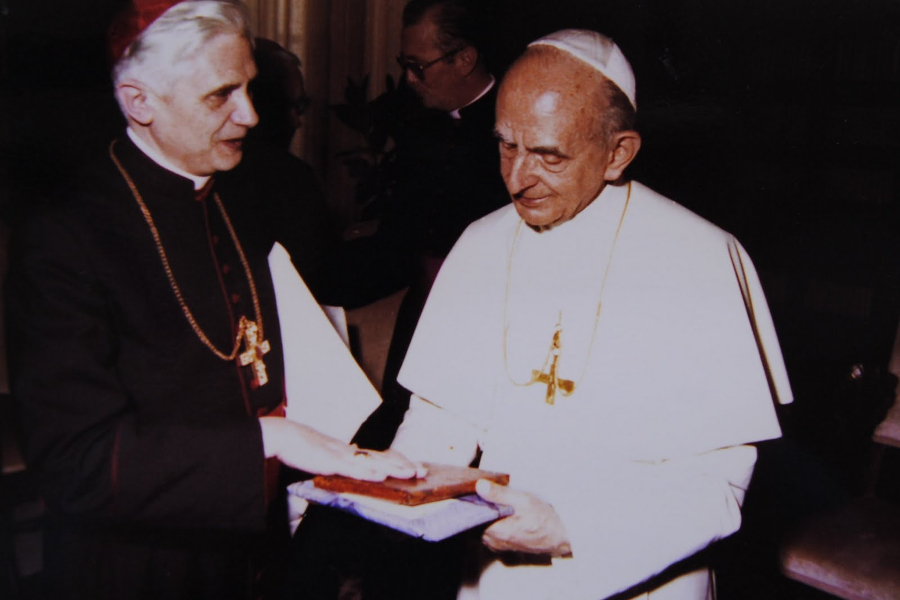
Cardinal Joseph Ratzinger with Pope Paul VI. Jornal O Bom Católico via Wikimedia (CC BY 2.0).
Coworker of the truth
After earning a doctorate, Ratzinger began teaching, and his reputation as a theologian grew. Cologne’s Cardinal Joseph Frings asked him to serve as a peritus, or adviser, at Vatican II, one of the major Catholic events of the 20th century.
He supported the reforming current at the ecumenical council and afterward received an invitation from the prominent progressive theologian Hans Küng to teach at the renowned University of Tübingen. But there he concluded that the Council’s reforms were being distorted by activists imbued with the revolutionary spirit of the late 1960s. “Anyone who wanted to remain a progressive in this context had to give up his integrity,” he said decades later.
He left Tübingen in 1969 to teach at the less prestigious University of Regensburg in his Bavarian homeland. That year, he made a radio broadcast in which he pondered the Church’s future.
“From the crisis of today,” he said, “the Church of tomorrow will emerge — a Church that has lost much. She will become small and will have to start afresh more or less from the beginning.”
But in the end, he predicted, “the church of faith” would remain. “It may well no longer be the dominant social power to the extent that she was until recently; but it will enjoy a fresh blossoming and be seen as Man’s home, where he will find life and hope beyond death,” he said.
In 1972, Ratzinger helped to found the influential theological journal Communio, with fellow theological luminaries Hans Urs von Balthasar and Henri de Lubac.
He was appointed Archbishop of Munich and Freising on May 28, 1977, at the relatively young age of 49. He took the motto “Cooperatores veritatis” (“Coworkers of the truth”), drawn from 3 John 8. He was made a cardinal a month after his episcopal ordination.
His tenure in Munich was overshadowed decades later by a report that accused him of mishandling four abuse cases. He denied claims that he had sought to cover up wrongdoing, but in a letter issued in 2022, he said: “I have had great responsibilities in the Catholic Church. All the greater is my pain for the abuses and the errors that occurred in those different places during the time of my mandate.”
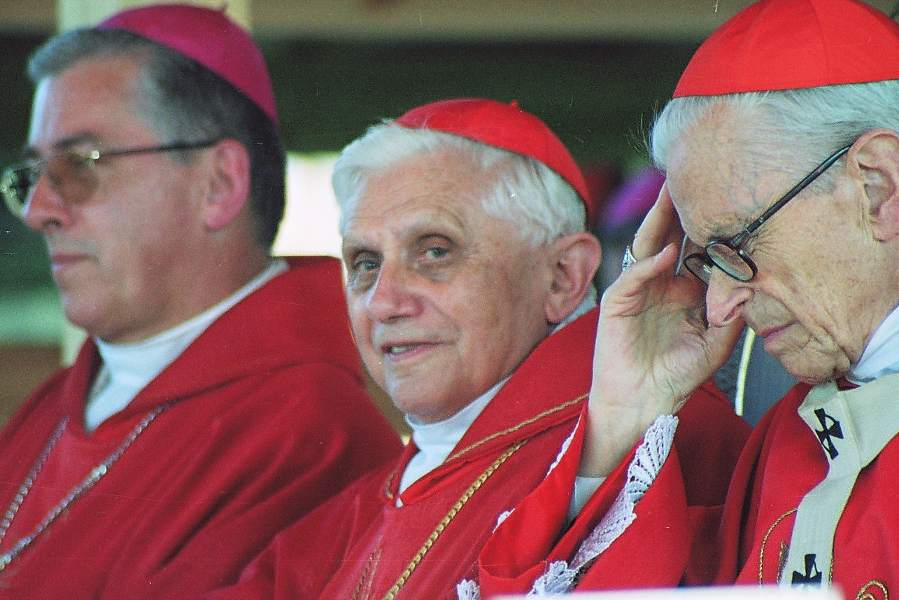
Cardinal Joseph Ratzinger in Szczepanów, Poland, on May 10, 2003. Muu-karhu via Wikimedia (CC BY 2.0).
Doctrinal defender
Pope John Paul II summoned Ratzinger to Rome in 1981 to serve as prefect of the Congregation for the Doctrine of the Faith. The Polish pope believed that the decades after Vatican II were marred by a theological free-for-all and encouraged the cardinal to help restore a sense of balance.
Ratzinger took action against prominent theologians he believed had departed from Catholic teaching, including the Brazilian liberation theologian Leonardo Boff, the Sri Lankan priest Tissa Balasuriya, and the Belgian Jesuit Jacques Dupuis.
These actions made him a controversial figure among Catholics on the Church’s progressive wing, who referred to him as the “Panzer Cardinal” and “God’s Rottweiler.” He complained that he was being cast as a bogeyman when he was only seeking to help simple believers recognize misleading accounts of the faith.
With John Paul II’s unflagging support, he tackled the Church’s most contested topics, from women priests to homosexuality. He also sought to present Catholic teaching in a positive light in his personal theological works and through his labor on the 1992 Catechism of the Catholic Church, a monumental guide to the faith.
After the turn of the millennium, he continued to serve as a theological lightning rod. In the year 2000, he signed the declaration Dominus Iesus, which affirmed that there is “a single Church of Christ, which subsists in the Catholic Church” — prompting criticism from Protestant leaders.
In 2001, Ratzinger convinced John Paul II to allow his Vatican congregation to investigate cases of clerical abuse worldwide. Once a week, he would read through dossiers on accused priests, a practice he referred to as “our Friday penance.” Between 2004 and 2014, 848 priests were laicized and 2,572 given other penalties.
In a 2004 lecture on Europe’s Christian roots, Ratzinger invoked the historian Arnold Toynbee’s idea of “creative minorities” who help to revitalize civilizations. “Christian believers should look upon themselves as just such a creative minority, and help Europe to reclaim what is best in its heritage and to therefore place itself at the service of all humankind,” he said.
In light of his age and bouts of ill health, he tried to resign several times, but continued to work as the Vatican’s doctrinal enforcer until John Paul II’s death in 2005.
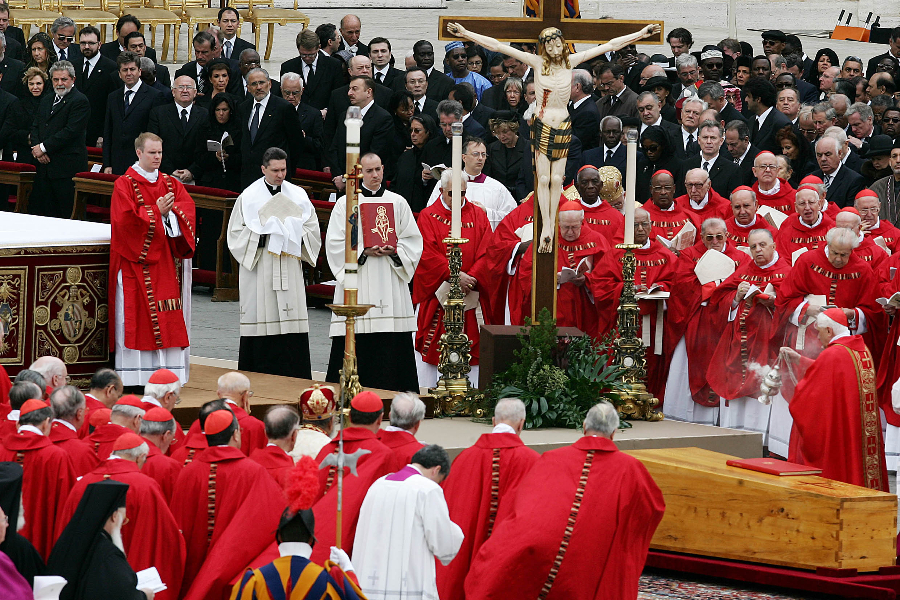
Ratzinger presided at the Polish pope’s funeral, before a television audience of more than 2 billion. In his role as dean of the College of Cardinals, he preached to the world’s cardinals before they entered the conclave to elect John Paul II’s successor. He warned them that “having a clear faith based on the Creed of the Church is often labeled as fundamentalism,” while a “dictatorship of relativism” was being built “that does not recognize anything as definitive and whose ultimate goal consists solely of one’s own ego and desires.”
Cardinal Joseph Ratzinger presides at the funeral of Pope John Paul II on April 8, 2005. Ricardo Stuckert/PR - Agência Brasil via Wikimedia (CC BY 3.0 br).
The Church is alive
After four ballots, he was elected pope on April 19, 2005, at the age of 78. He chose the name Benedict XVI in honor of Benedict XV, who “guided the Church through the turbulent times of the First World War,” and St. Benedict, “a fundamental point of reference for the unity of Europe.”
At his installation Mass, he appeared to acknowledge the forces arrayed against him, asking for prayers “that I may not flee for fear of the wolves.” But he also struck a hopeful note, saying that in his predecessor’s last days, “it became wonderfully evident to us that the Church is alive. And the Church is young.”
“She holds within herself the future of the world and therefore shows each of us the way towards the future,” he said.
His almost eight-year pontificate was marked by a series of crises.
The most challenging and extended was the abuse crisis. Just two months after his election, he imposed restrictions on Fr. Marcial Maciel, the powerful founder of the Legionaries of Christ, who appeared to have been protected by figures at the Vatican despite evidence of his depravity.
The global media repeatedly accused Benedict XVI of having covered up abuse as an archbishop in Germany and a prefect in Rome — claims firmly rejected by his supporters.
He met abuse survivors during his foreign visits and sent a landmark letter to Irish Catholics in 2010, acknowledging that some abuse survivors “find it difficult even to enter the doors of a church after all that has occurred.”
Another crisis occurred in 2006, when he gave an address at the University of Regensberg in Germany in which he cited a Byzantine emperor who told a Muslim interlocutor that Mohammed had brought into the world “things only evil and inhuman, such as his command to spread by the sword the faith he preached.”
Benedict noted that the emperor delivered the words with “a brusqueness that we find unacceptable,” but his speech was reported around the world as if he had endorsed the remark. Muslims erupted in protest from Jordan to Indonesia.
Two months later, he made a conciliatory visit to Turkey, pausing for a moment of reflection alongside an Islamic cleric in Istanbul’s Blue Mosque.
In 2009, he sparked a another crisis when he lifted the excommunications of four bishops belonging to the Society of St. Pius (SSPX), the breakaway group founded by Archbishop Marcel Lefebvre. The move coincided with an interview in which one of the four, Bishop Richard Williamson, denied the Holocaust. Benedict wrote an apologetic letter to the world’s bishops, noting that he had been told “that consulting the information available on the internet would have made it possible to perceive the problem early on.”
As pope, he made far-reaching decisions on the liturgy, ecumenism, and Vatican finances.
His 2007 motu proprio Summorum Pontificum acknowledged priests’ right to offer Mass using the Roman Missal of 1962, which is in Latin. He defined the new and old versions of the Roman Missal as the “ordinary” and “extraordinary” forms of the Roman Rite, expressing the hope that they would be “mutually enriching.”
In his 2009 apostolic constitution Anglicanorum coetibus, he established personal ordinariates enabling groups of Anglicans to enter into full communion with Rome while preserving elements of their patrimony.
In 2010, he attempted to shed light on the Vatican’s notoriously opaque finances with the creation of a watchdog body, the Financial Information Authority. His efforts at reform were undermined by a series of leaked documents in what came to be known as the “Vati-Leaks” scandal, which led to the jailing of his butler.
Despite his advanced age, he made trips to countries including Australia, Brazil, and Benin. In 2008, he undertook a six-day visit to the United States, addressing the United Nations General Assembly, praying at Ground Zero, and visiting the White House.
He beatified more than 800 people, including Cardinal John Henry Newman, canonized 45 others, and proclaimed St. Hildegard of Bingen and St. John of Avila Doctors of the Church.
He published three encyclicals: Deus caritas est, on love; Spe salvi, on hope; and Caritas in Veritate, on charity. His fourth, Lumen fidei, was left unfinished and completed by his successor Pope Francis.
Throughout his pontificate, he stressed the continuity of the Catholic faith. Speaking to Vatican officials in 2005, he criticized those who interpreted Vatican II in terms of “discontinuity and rupture,” arguing that it should be understood instead with a “hermeneutic of reform” that did not imply “a split between the pre-conciliar Church and the post-conciliar Church.”
Benedict XVI resigned on Feb. 11, 2013, announcing the dramatic break with centuries of tradition in Latin to an audience of shocked cardinals. He told them that “both strength of mind and body” were necessary to govern the Church, but that strength had “deteriorated in me to the extent that I have had to recognize my incapacity to adequately fulfill the ministry entrusted to me.”
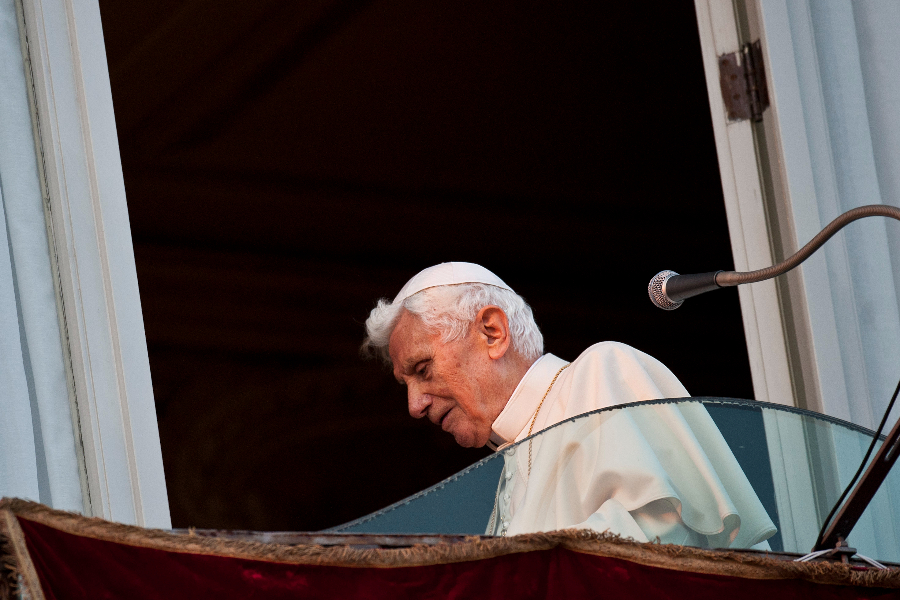
His resignation took effect on Feb. 28, 2013, when he departed Vatican City by helicopter. Arriving at the papal summer residence of Castel Gandolfo, he described himself as “simply a pilgrim who is starting the last stage of his pilgrimage on Earth.”
“Let us go ahead together with the Lord for the good of the Church and of the world,” he said, before departing into retirement.
Benedict XVI adopted the title “pope emeritus” and continued to wear white — choices that critics said might lead Catholics to think he was still pope. He settled in a new home, the Mater Ecclesiae Monastery in the Vatican Gardens. He was 85 years old and not expected to live long, though the Vatican had not indicated a terminal illness. But over the next 10 years, he remained active.
His first public appearance after his resignation came in February 2014, at Pope Francis’ first consistory for the creation of new cardinals. Months later, he was present at the canonization of John Paul II and John XXIII.
In retirement, he continued his long collaboration with the journalist Peter Seewald. Together, they produced the 2016 book-length interview “Last Testament,” their fourth after “Salt of the Earth” (1997), “God and the World” (2002), and “Light of the World” (2010). They also worked together on a multi-volume biography “Benedict XVI: A Life,” published in German in 2020.
He occasionally generated controversy in retirement, contributing in 2019 to a book supporting clerical celibacy amid a debate about a relaxation of the discipline in the Amazon region. In an essay published in the same year, he was accused of blaming clerical abuse on the sexual revolution of the 1960s. But he insisted that his point was that the crisis was caused by a turning away from God.
Catholics around the world continued to cherish the German pope in his retirement. On his 95th birthday, thousands of people sent messages via a website dedicated to his work.
His longtime personal secretary Archbishop Georg Gänswein confided that Benedict himself was surprised by his longevity, recalling that he once said: “I would never have believed that the last stretch of the journey that would take me from the Mater Ecclesiae Monastery to the gates of heaven with St. Peter would be so long.”
Benedict XVI was born on April 16, 1927. He died on Dec. 31, 2022, aged 95.
2011: Instruction Universae Ecclesiae. Its main effect: overrides the bishops, who are the main problem. But this and the motu proprio re-taken back by the current holder of the Office.
Pope Francis celebrates Mass ad orientem for the feast of the Baptism of the Lord in 2016
The pope’s intention with his motu proprio, Traditionis Custodes, is to secure or restore the unity of the Church. The proposed means for this is the total unification of the Roman Rite in the form of the Missal of Paul VI (including its subsequent variations). Therefore, the celebration of Mass in the Extraordinary Form of the Roman Rite, as introduced by Pope Benedict XVI with Summorum pontificum (2007) on the basis of the Missal that existed from Pius V (1570) to John XXIII (1962), has been drastically restricted. The clear intent is to condemn the Extraordinary Form to extinction in the long run.
In his Letter to the Bishops of the Whole World, which accompanies the motu proprio, Pope Francis tries to explain the motives that have caused him, as the bearer of the supreme authority of the Church, to limit the liturgy in the extraordinary form. Beyond the presentation of his subjective reactions, however, a stringent and logically comprehensible theological argumentation would also have been appropriate. For papal authority does not consist in superficially demanding from the faithful mere obedience, i.e., a formal submission of the will, but, much more essentially, in enabling the faithful also to be convinced with consent of the mind. As St. Paul, courteous towards his often quite unruly Corinthians, said, “in the church I would rather speak five words with my mind, so as to instruct others also, than ten thousand words in tongues.” (1 Cor 14:19)
This dichotomy between good intention and poor execution always arises where the objections of competent employees are perceived as an obstruction of their superiors’ intentions, and which are, therefore, not even offered.
As welcome as the references to Vatican II may be, care must be taken to ensure that the Council’s statements are used precisely and in context. The quotation from St. Augustine about membership in the Church “according to the body” and “according to the heart” (Lumen Gentium 14) refers to the full Church membership of the Catholic faith. It consists in the visible incorporation into the body of Christ (creedal, sacramental, ecclesiastical-hierarchical communion) as well as in the union of the heart, i.e. in the Holy Spirit. What this means, however, is not obedience to the pope and the bishops in the discipline of the sacraments, but sanctifying grace, which fully involves us in the invisible Church as communion with the Triune God.
For the unity in the confession of the revealed faith and the celebration of the mysteries of grace in the seven sacraments by no means require sterile uniformity in the external liturgical form, as if the Church were like one of the international hotel chains with their homogenous design. The unity of believers with one another is rooted in unity in God through faith, hope, and love and has nothing to do with uniformity in appearance, the lockstep of a military formation, or the groupthink of the big-tech age.
Even after the Council of Trent, there always was a certain diversity (musical, celebratory, regional) in the liturgical organization of Masses. The intention of Pope Pius V was not to suppress the variety of rites, but rather to curb the abuses that had led to a devastating lack of understanding among the Protestant Reformers regarding the substance of the sacrifice of the Mass (its Sacrificial character and Real Presence).
In the Missal of Paul VI, ritualistic (rubricist) homogenization is broken up, precisely in order to overcome a mechanical execution in favour of an inner and outer active participation of all believers in their respective languages and cultures. The unity of the Latin rite, however, should be preserved through the same basic liturgical structure and the precise orientation of the translations to the Latin original.
The Roman Church must not pass on its responsibility for unity in cult to the Bishops’ Conferences. Rome must oversee translation of the normative texts of the Missal of Paul VI, and even of the biblical texts, that might obscure the contents of the faith. Presumptions that one may “improve” the verba domini (e.g. pro multis – “for many” – at the consecration, the et ne nos inducas in tentationem – “and lead us not into temptation” – in the Our Father), contradict the truth of the faith and the unity of the Church much more than celebrating Mass according to the Missal of John XXIII.
The key to a Catholic understanding of the liturgy lies in the insight that the substance of the sacraments is given to the Church as a visible sign and means of the invisible grace by virtue of divine law, but that it is up to the Apostolic See and, in accordance with the law, to the bishops to order the external form of the liturgy (insofar as it has not already existed since apostolic times). (Sacrosanctum Concilium, 22 § 1)
The provisions of Traditionis Custodes are of a disciplinary, not dogmatic nature and can be modified again by any future pope. Naturally, the pope, in his concern for the unity of the Church in the revealed faith, is to be fully supported when the celebration of Holy Mass according to the Missal of 1962 is an expression of resistance to the authority of Vatican II, which is to say, when the doctrine of the faith and the Church’s ethics are relativized or even denied in the liturgical and pastoral order.
In Traditionis Custodes, the pope rightly insists on the unconditional recognition of Vatican II. Nobody can call himself a Catholic who either wants to go back behind Vatican II (or any other council recognized by the pope) as the time of the “true” Church or wants to leave that Church behind as an intermediate step towards a “new Church.” One may measure Pope Francis’ will to return to unity the deplored so-called “traditionalists” (i.e., those opposed to the Missal of Paul VI) against the degree of his determination to put an end to the innumerable “progressivist” abuses of the liturgy (renewed in accordance with Vatican II) that are tantamount to blasphemy. The paganization of the Catholic liturgy – which is in its essence nothing other than the worship of the One and Triune God – through the mythologization of nature, the idolatry of environment and climate, as well as the Pachamama spectacle, were rather counterproductive for the restoration and renewal of a dignified and orthodox liturgy reflective of the fulness of the Catholic faith.
Nobody can turn a blind eye to the fact that even those priests and laypeople who celebrate Mass according to the order of the Missal of St. Paul VI are now being widely decried as traditionalist. The teachings of Vatican II on the uniqueness of redemption in Christ, the full realization of the Church of Christ in the Catholic Church, the inner essence of the Catholic liturgy as adoration of God and mediation of grace, Revelation and its presence in Scripture and Apostolic Tradition, the infallibility of the magisterium, the primacy of the pope, the sacramentality of the Church, the dignity of the priesthood, the holiness and indissolubility of marriage – all these are being heretically denied in open contradiction to Vatican II by a majority of German bishops and lay functionaries (even if disguised under pastoral phrases).
And despite all the apparent enthusiasm they express for Pope Francis, they are flatly denying the authority conferred on him by Christ as the successor of Peter.
The Congregation for the Doctrine of the Faith’s document about the impossibility of legitimizing same-sex and extramarital sexual contacts through a blessing is ridiculed by German (and not only German) bishops, priests, and theologians as merely the opinion of under-qualified curial officials. Here we have a threat to the unity of the Church in revealed faith, reminiscent of the size of the Protestant secession from Rome in the sixteenth century. Given the disproportion between the relatively modest response to the massive attacks on the unity of the church in the German “Synodal Way” (as well as in other pseudo-reforms) and the harsh disciplining of the old ritual minority, the image of the misguided fire brigade comes to mind, which – instead of saving the blazing house – instead first saves the small barn next to it.
Without the slightest empathy, one ignores the religious feelings of the (often young) participants in the Masses according to the Missal John XXIII. (1962) Instead of appreciating the smell of the sheep, the shepherd here hits them hard with his crook.
It also seems simply unjust to abolish celebrations of the “old” rite just because it attracts some problematic people: abusus non tollit usum.
What deserves special attention in Traditionis Custodes is the use of the axiom lex orandi-lex credendi (“Rule of prayer – rule of faith”). This phrase appears first in the anti-Pelagian Indiculus (“Against superstitions and paganism”) which spoke about “the sacraments of priestly prayers, handed down by the apostles to be celebrated uniformly all over the world and in the entire Catholic Church, so that the rule of prayer is the rule of faith.” (Denzinger Hünermann, Enchiridion symbolorum 3) This refers to the substance of the sacraments (in signs and words) but not the liturgical rite, of which there were several (with different variants) in the patristic era.
One cannot simply declare the latest missal to be the only valid norm of the Catholic faith without distinguishing between the “part that is unchangeable by virtue of divine institution and the parts that are subject to change.” (Sacrosanctum Concilium 21). The changing liturgical rites do not represent a different faith, but rather testify to the one and the same Apostolic Faith of the Church in its different expressions.
The pope’s letter confirms that he allows the celebration according to the older form under certain conditions. He rightly points to the centrality of the Roman canon in the more recent Missal as the heart of the Roman rite. This guarantees the crucial continuity of the Roman liturgy in its essence, organic development, and inner unity. To be sure, one expects the lovers of the ancient liturgy to recognize the renewed liturgy; just as the followers of the Paul VI Missal also have to confess that the Mass according to the Missal of John XXIII is a true and valid Catholic liturgy, that is, it contains the substance of the Eucharist instituted by Christ and, therefore, there is and can only be “the one Mass of all times.”
A little more knowledge of Catholic dogmatics and the history of the liturgy could counteract the unfortunate formation of opposing parties and also save the bishops from the temptation to act in an authoritarian, loveless, and narrow-minded manner against the supporters of the “old” Mass. The bishops are appointed as shepherds by the Holy Spirit: “Keep watch over yourselves and all the flock of which the Holy Spirit has made you overseers. Be shepherds of the church of God, which he bought with his own blood.” (Acts 20, 28) They are not merely representatives of a central office – with opportunities for advancement. The good shepherd can be recognized by the fact that he worries more about the salvation of souls than recommending himself to a higher authority by subservient “good behaviour.” (1 Peter 5, 1-4)
If the law of non-contradiction still applies, one cannot logically castigate careerism in the Church and at the same time promote careerists.
Let us hope that the Congregations for Religious and for Divine Worship, with their new authority, do not become inebriated by power and think they have to wage a campaign of destruction against the communities of the old rite – in the foolish belief that by doing so they are rendering a service to the Church and promoting Vatican II.
If Traditionis Custodes is to serve the unity of the church, that can only mean a unity in faith, which enables us to “come to the perfect knowledge of the Son of God,” which is to say unity in truth and love. (cf. Eph 4, 12-15).
Translated from the German by Robert Royal with Msgr. Hans Feichtinger. Original article appeared on "The Catholic Thing".
Pope Francis took a significant step toward putting the Roman Catholic Church’s liturgy solidly on the side of modernization on 16 July by cracking down on the use of the Tridentine Mass, essentially reversing a decision by his predecessor, Benedict XVI. This reverses Summorum Pontificum, which acknowledged the right of all priests to say Mass using the Roman Missal of 1962, which is in Latin.
The move to restrict the use of the Tridentine rite dealt a blow to traditional Catholics, who have long complained that the current pope is diluting the traditions of the church.
Francis placed new restrictions on where and by whom the traditional Latin Mass can be celebrated and required new permissions from local bishops for its use.
In the motu proprio, the pope made sweeping changes to his predecessor Benedict XVI’s 2007 apostolic letter
The new document is dedicated to “the use of the Roman Liturgy prior to the reform of 1970” and contains eight articles that go into immediate effect.
Pro Tridentina (Malta) has asked the reaction of 2 priests: Canadian Fr N.E.D. Doublet and Fr Tony. The latter celebrates Tridentine Mass in Malta.
Fr Doublet expects that restrictions will be applied to the Canadian priests that currently celebrate Tridentine Mass in his country. There are currently around 45 churches where the Tridentine Mass is held in Canada. Some bishops have already suspended the Latin Mass due on Sunday 18 July. So, worse can be expected. Fr Doublet added that the publication of the motu proprio so soon after Pope Francis left hospital can only be considered as being a vengeful act. One now has to see whether Benedict XVI will react, though it is unlikely. Fr Doublet concluded that the Church now has a suffering Pope - Benedict XVI, victim of hatred unleashed on him by Francis.
On the other hand, Fr Tony said that the situation in Malta is likely to remain the same. The Diocese of Gozo will probably do nothing, after all no known Tridentine Masses have been celebrated there since 2007. This was due to the hardline policy adopted by then Bishop (now Cardinal) Mario Grech. There are rumours circulating in the Vatican that the Gozitan Cardinal showed his appreciation of the new mtou proprio Traditionis custodes, especially Articles 3 and 5. The situation in Malta is more complicated. According to Fr Tony, it is hoped that the structure of the Apostolate of St. Paul Malta will remain. Albeit the irony being having a Tridentine Mass held in a Jesuit Church during the Jesuit's Pope hardline attitude, added Fr Tony. Regarding himself personally, Fr Tony stressed that he will continue to celebrate Tridentine Mass regularly, as long as people want it. He concluded by reminding us that Benedict XVI had said:
What earlier generations held as sacred, remains sacred and great for us too, and it cannot be all of a sudden entirely forbidden or even considered harmful
As a service to its readers, Pro Tridentina (Malta)has added 2 pages on this topic:
a) the text of Traditionis custodes https://pro-tridentina-malta.blogspot.com/p/traditionis-custodes.html and
b) the letter written by Pope Francis to bishops about this motu proprio https://pro-tridentina-malta.blogspot.com/p/pope-francis-letter-accompamying.html
The FIUV has taken out an advert in the mass-circulation Italian newspaperLa Repubblica, that appeared on Sunday 4th July 2021. This newspaper is Pope Francis' favourite.
The English text is below:
Living the faith, living the future:
The Extraordinary Form of the Roman Rite
Declaration of the International Federation Una Voce
The International Federation Una Voce (FIUV), founded in 1965, brings together associations of the lay faithful attached to the Extraordinary Form of the Roman rite (the Traditional Latin Mass).
In 2007, the Apostolic Letter Summorum Pontificum recognised the vitality of the traditional liturgy, the freedom of priests to celebrate it, and of the faithful to request it. This has led to an ongoing increase in the number of celebrations of the ancient Latin Mass, and of its spiritual fruits.
During 2020 the FIUV conducted a worldwide survey of the faithful on the implementation of Summorum Pontificum. From this survey, which included results from 364 dioceses in 52 countries, we found:
•The ancient Latin Mass is deeply appreciated by groups of faithful of all ages, especially families with children, young people and converts, found in all social and cultural environments, on all continents and in an ever increasing number of countries.
• In many areas the increased availability of this Mass has favoured the normalisation of relations between the faithful attached to it and their bishops, relations increasingly characterised by mutual understanding and respect.
Nevertheless, we have noticed that, contrary to the previous policy of the Holy See, there are still people within the Church, including some bishops, who would like to see the Extraordinary Form of the Roman rite explicitly suppressed, or subject to further restrictions. For this reason, the FIUV, in view of the faithful who adhere to the Latin Mass, feels the duty to express its opinion, encouraged by Pope Francis' exhortations to the members of the Church to use parrhesia with the necessary humility.
The growth of interest in the traditional liturgy is not due to nostalgia for a time we do not remember, or a desire for rigidity: it is rather a matter of opening ourselves to the value of something that for most of us is new, and inspires hope. Pope Francis has characterised the ancient liturgy in terms of a "sense of adoration" (Press conference of 28 July 2013), we can also apply his words to it: a "living history that welcomes us and pushes us forward" (Evangelii Gaudium 13).
Today we only wish to be part of that "great orchestra" of "unity in variety" which, as Pope Francis said (General Audience of 9 October 2013), reflects the true catholicity of the Church. The Apostolic Letter Summorum Pontificum continues to transform the conflicts of the past into harmony: long may it to continue to do so.
Felipe Alanis Suarez, President
www.fiuv.org
Ends
The worldwide survey referred to above was presented to the Congregation for the Doctrine of the Faith, to complement reports sent by bishops around the world on the same subject, which had been requested by the CDF at the request of Pope Francis. Gregorius Magnus 10 has an account of the motivation, methodology, results, and conclusions of the reports. Pro Tridentina (Malta)'s contribution is found on pp. 11 - 12.
Note for the presentation of the Decree Cum sanctissima on the liturgical celebration in honour of Saints in the forma extraordinaria of the Roman Rite
With the Decree Cum sanctissima of 22 February 2020, the Congregation for the Doctrine of the Faith, which since January 2019 deals with those matters formerly assigned to the Pontifical Commission “Ecclesia Dei”[1], completed the work initiated several years earlier by that Commission in order to fulfill the mandate given by Pope Benedict XVI to facilitate the celebration of more recently canonized Saints according to the forma extraordinaria of the Roman Rite[2]. Indeed, since the Sanctoral of the forma extraordinaria is determined by the liturgical books in force in 1962, Saints canonized thereafter were not included therein.
The studies carried out in order to develop a practical solution for the liturgical celebration of more recent Saints in the Usus Antiquior provided an opportunity to address the many issues that this matter raises, such as the density of the existing calendar (particularly as regards III class feasts), the consideration of all the repercussions of any potential changes, the always preferable consistency between Mass and the Divine Office, and the matter of the liturgical texts to be used.
In this context, it appeared that rather than dealing with this or that more recent Saint, it would be more appropriate to lay down a general principle that would enable, within the general rubrical context of the forma extraordinaria, and when the liturgical day permits, the celebration of any Saint canonized after the 1960s, on the date of their proper feast.
Specifically, the Decree broadens the scope of missæ festivæ latiore sensu referred to in n. 302-c of the Rubricæ Generales Missalis Romani (which hitherto only applied to IV class days), to a number of III class feasts and to III class vigils[3] (cf. Decree, n. 1). It is therefore clear that the new provisions will not in any way affect other celebrations, and in particular those of the I or II classes. In addition, the Decree specifies that missæ festivæ latiore sensu may be celebrated in honour of Saints canonized after 26 July 1960 (which is the date of the last amendment to the Martyrology of the forma extraordinaria), on their respective liturgical feast day (n. 2).
With this principle in mind, the other provisions of the Decree give the necessary indications that derive therefrom, such as the applicability to the Divine Office, which in such a case is to be celebrated in full in honour of the Saint (n. 3), the requirement to make a commemoration of potentially occurring III class feasts, as the case may be (n. 4), and the rules relating to the selection of the liturgical texts to be used (n. 5). Regarding this particular point, one should note the three successive sources from which texts are to be drawn, namely in the first place the Proprium Sanctorumpro aliquibus locis which already exists in the Missal of the forma extraordinaria, secondly a special Supplement to be published by the Holy See in the future, and finally, should the two former sources be lacking, the existing Commune Sanctorum.
It is noteworthy that the celebration of more recent Saints pursuant to the new provisions is a mere possibility, and therefore it remains optional. Accordingly, those who wish to continue to celebrate the Saints according to the existing calendar of the forma extraordinaria as it appears in the liturgical books, remain free to do so. In relation to this, one should be reminded that the existence of optional feasts in honour of the Saints is not a complete novelty in the Roman Rite, given that throughout the post-tridentine period, and up till the rubrical reform carried out by Pope St. Pius X, the calendar included no less that twenty-five such so-called ad libitum feasts.
The new Decree also opens a further possibility for cases in which whilst following the existing calendar, one wishes at the same time to honour eventual other occurring Saints. Specifically, according to n. 6 of the Decree, an ad libitum commemoration of an occurring Saint may be made, if said Saint appears in the Proprium pro aliquibus locis or in the future special Supplement.
In choosing whether or not to make use of the provisions of the Decree in liturgical celebrations in honour of the Saints, the celebrant is expected to make use of good pastoral common sense. As regards the particular case of celebrations in Religious Institutes and Societies of Apostolic Life, n. 7 of the Decree provides some useful clarification.
The Decree concludes (n. 8) with reference to a list of seventy III class feasts that may never be impeded by its provisions. This list, which is provided as an annex, reflects the particular importance of the feasts in question, on the basis of precise criteria, e.g. the importance of these respective Saints in the Plan of Salvation or in the history of the Church, their importance in terms of either the devotion they have generated or their writings, or the antiquity of their worship in Rome.
[3] In fact there is only one such III class vigil in the calendar of the forma extraordinaria, namely that of St. Lawrence on 9 August. On this subject one may be reminded that from 1568 until the Codex Rubricarum of 1960, non-privileged vigils such as that of St. Lawrence were of the simplex rite, and accordingly, when they fell in occurrence with a semiduplex or duplex feast of a Saint, that feast would prevail over the vigil. With the reform enacted under St. Pius X in 1911-1914, in non-conventual Masses the celebrant could, in certain cases, choose between the Mass of the occurring Saint or the Mass of the vigil (cr. Additiones et variationes in rubricis Missalis, n. 1).