Showing posts with label ecumenism. Show all posts

Monday, March 6, 2017

Venerable Fulton Sheen: a prophecy for our times?

http://cdn.quotesgram.com/img/63/70/1171605421-Sheen_Private_Chapel_ii.jpg 

[Satan] will set up a Counter-church, which will be the ape of the Church. It will have all the notes and characteristics of the Church, but in reverse and emptied of its divine content. We are living in the days of the Apocalypse, the last days of our era. The two great forces - the Mystical Body of Christ and the Mystical Body of the Antichrist - are beginning to draw battle lines for the catastrophic contest.

The False Prophet will have a religion without a cross. A religion without a world to come. A religion to destroy religions. There will be a Counterfeit Church. Christ's Church, the Catholic Church will be one, and the False Prophet will create the other. The False Church will be worldly, ecumenical, and global. It will be a loose federation of churches and religions, forming some type of global association, a world parliament of Churches. It will be emptied of all Divine content; it will be the mystical body of the Antichrist.

The Mystical Body on earth today will have its Judas Iscariot, and he will be the False Prophet. Satan will recruit him from our bishops. The Antichrist will not be so called; otherwise, he would have no followers. He will not wear red tights nor vomit sulphur nor carry a trident nor wave an arrowed tail as Mephistopheles in Faust. This masquerade has helped the Devil convince men that he does not exist. When no man recognizes, the more power he exercises. God has defined Himself as "I am Who Am," and the Devil as "I Am Who Am Not."

Nowhere in Sacred Scripture do we find warrant for the popular myth of the Devil as a buffoon who is dressed like the first "red." Rather is he described as an angel fallen from heaven, as "the Prince of This World," whose business it is to tell us that there is no other world. His logic is simple: if there is no Heaven, there is no Hell; if there is no Hell, then there is no sin; if there is no sin, then there is no judge; and if there is no judgment, then evil is good, and good is evil. But above all these descriptions, Our Lord tells us that he will be so much like Himself that he would deceive even the elect - and certainly no Devil ever seen in picture books could deceive even the elect.

How will he come in this new age to win followers to his religion? The pre-Communist Russian belief is that he will come disguised as the Great Humanitarian; he will talk peace, prosperity and plenty, not as means to lead us to God, but as ends in themselves. The third temptation, in which Satan asked Christ to adore Him and all the kingdoms of the world would be His, will become the temptation to have a new religion without a Cross, a liturgy without a world to come, a religion to destroy a religion, or a politics which is a religion - one that renders unto Caesar even the things that are God's.

In the midst of all his seeming love for humanity and his glib talk of freedom and equality, he will have one great secret which he will tell to no one: he will not believe in God. Because his religion will be brotherhood without the fatherhood of God, he will deceive even the elect. He will set up a Counter-church which will be the ape of the Church, because he, the Devil, is the ape of God. It will have all the notes and characteristics of the Church, but in reverse and emptied of its divine content. It will be a mystical body of the Antichrist that will in all externals resemble the mystical body of Christ. But the twentieth century will join the Counter-church because it claims to be infallible when its visible head speaks ex cathedra from Moscow on the subject of economics and politics, and as chief shepherd of world Communism.  

Fulton J. Sheen, Communism and the Conscience of the West, Bobbs-Merrill Company, Indianapolis, (1948), pp. 24-25.

Saturday, June 22, 2013

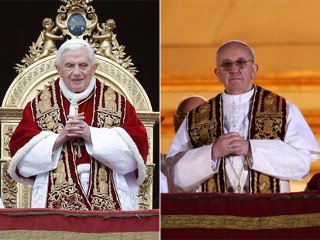
Benedict XVI vs Francis - the smear campaign continues

http://abcnews.go.com/images/International/gty_pope_benedict_xiv_pope_francis_lpl_130313_mn.jpg
Benedict XVI and Francis: two pontificates with different priorities.

Soon after the election of Pope Francis, some notable Catholic journals started odious comparisons between the current Pontiff and the Pope Emeritus, aimed at putting into a bad light the ‘reform of the reform’ championed by Benedict XVI. One of the latest is the article Francis looks to the Future by The Tablet, a British Catholic weekly journal that stresses that: "It is committed to the teaching of the Second Vatican Council."

Although this journal prides itself as having had as contributor Cardinal Joseph Ratzinger, it nevertheless regularly attacks him, as the quote from the above-mentioned confirms:

"Benedict XVI’s ecumenical priorities were more to do with resolving issues from the Church’s own past. He put great store by the possibility of reconciliation with the Vatican II-denying Society of St Pius X, and encouraged long and tortuous conversations which seemed to be going nowhere from the start, given the non-negotiables on both sides. He reversed decades of church policy by re-authorising the celebration of the Tridentine Rite, which seemed not just a gesture towards the Lefebvrists but a reactionary move in liturgical policy generally, as did the imposition of a severely inadequate, if linguistically more accurate, translation of the Mass into English."

What The Tablet seems unable to understand is that:
  • the pontificates of Benedict XVI and Francis have different priorities but both are at the service of Our Lord Jesus Christ and His Church;
  • attempts at creating friction between the two will simply backfire, case in point being the first encyclical by Francis that will have a huge contribution from Benedict XVI himself.
Further comments at this stage are superfluous.


Saturday, February 23, 2013

The Orthodox Church and Summorum Pontificum

Similarly, it must not be forgotten that from the beginning the Churches of the East have had a treasury from which the Western Church has drawn extensively in liturgical practice, spiritual tradition, and law. - Unitatis Redintegratio

A number of critics have argued that Benedict XVI's motu proprio Summorum Pontificum has created obstacles, as far as ecumenism is concerned. Is this true? Is the Tridentine Mass such a stumbling block? 

In the opinion of Cardinal Burke:  

"I wouldn't think that the Holy Father would be doing this simply as a strategy, but I do think it will be an effect of a restoration or in the 'reform of the reform' of the liturgy. It seems to me for the Eastern rites, and for those of the Orthodox Churches, the reform of the liturgy after the council and the concrete expression is so stripped of the transcendent, of the sacral elements, it is difficult for them to recognize its relationship with their Eucharistic Liturgies. It would be easier for them to see the unity, the oneness in the Eucharistic Sacrifice, by a rite of the Mass, just limiting ourselves now to talking about the Holy Mass, that it was richer in those dimensions — the elements of the transcendent — the symbols of the transcendent element of Christ — Christ in action in the Mass — the unbloody renewal of the Sacrifice of Calvary". 

A few months before the promulgation of Summorum Pontificum, Eastern Orthodoxy's Patriarch Bartholomew I of Constantinople quoted the phrase lex orandi, lex credendi. This was on the occasion of Benedict XVI's visit to Istanbul in 2006. Bartholomew I argued that "in liturgy we are reminded of the need to reach unity in faith as well as in prayer".

An interesting episode occurred in the same period, when the French episcopate (with an open letter to Benedict XVI) urged the Pope not to issue Summorum Pontificum. Hearing this Bartholomew I of Constantinople supported the Pope, denounced the decay of Catholic liturgy and stressed that the Novus Ordo Missae had in fact hampered relations between the Western and the Eastern branches of Christianity.

The Orthodox in fact were disturbed not only by abuses in the post-Vatican II liturgy, but also by approved practices such as female altar servers, Mass 'facing the people' and Communion in the hand. The Tridentine liturgy therefore bodes well ecumenically, because these problematic practices are simply not standard features of the Classical Roman rite. 

Bartholomew I later on declared that with Summorum Pontificum ​​a huge step forward in reconciliation had been made.

It appears therefore that the Pope's intention to make it easier for the laity to have Mass in the Extraordinary Form was also intended to help prepare the reunion of the two great divided branches of Christianity: Catholicism and Orthodoxy. The Orthodox interpreted Summorum Pontificum as evidence of a renewed seriousness in the Roman Catholic Church of lex orandi, lex credendi.

During the pontificate that is in its final days, Pope Benedict XVI tried ceaselessly to teach that the Catholic tradition has not been lost, that it remains to be discovered and lived. How this will all work out, under the soon-to-be-elected Pope, is yet to be seen.

Thursday, September 1, 2011

Archbishop Annibale Bugnini on the Novus Ordo Missae


Msgr. Annibale Bugnini, (14 June 1912 – 3 July 1982) was a Roman Catholic prelate and the main person behind the introduction of the Novus Ordo Missae. One of his most famous quotes (L’Osservatore Romano, 19 March 1965) is the following:
"We must strip from our Catholic prayers and from the Catholic liturgy everything which can be the shadow of a stumbling block for our separated brethren that is for the Protestants.”

However, it must be said, for the record that these are not the exact words of Bugnini.What follows are the actual words in bold (the clear ecumenical goals aimed for in the liturgical reform of the liturgical prayers on Good Friday are evident):

The 7th prayer [of the new rite for Good Friday] bears the title: 'For the Unity of Christians' (not 'of the Church', which was always one.) No longer used is the pariah 'heretics' and 'schismatics' but 'all brethren who believe in Christ...' Scholars think to shed light on biblical and liturgical sources from which the new texts are derived or inspired, which the Study Groups of the "Council" accomplished by using a chisel. And let's say that often the work proceeded 'with fear and trembling' by sacrificing terms and concepts so dear, and now part of the long family tradition. How not to regret that 'Mother Church - Holy, Catholic and Apostolic - deigned to revoke' the seventh prayer? And yet it is the love of souls and the desire to help in any way the road to union of the separated brethren, by removing every stone that could even remotely constitute an obstacle or difficulty, that has driven the Church to make even these painful sacrifices."