Showing posts with label Pope emeritus. Show all posts

Saturday, December 31, 2022

Breaking: Pope emeritus Benedict XVI dies at 95


Benedict XVI, one of the world’s foremost theologians and the first pope to retire in almost 600 years, died on Dec. 31 at the age of 95. 

(adapted from The Pillar)

A Dec. 31 statement from the Holy See press office said: “With sorrow I inform you that the Pope Emeritus, Benedict XVI, passed away today at 9:34 in the Mater Ecclesiae Monastery in the Vatican. Further information will be provided as soon as possible.”

Benedict XVI helped to shape the Catholic Church’s trajectory long before he was elected to the papacy, first as a young theological adviser at the Second Vatican Council and then as head of the Vatican’s doctrinal office.

Benedict influenced generations of Catholics with his writings, including his 1968 book “Introduction to Christianity,” his treatise “The Spirit of the Liturgy,” and his trilogy “Jesus of Nazareth,” composed while he was pope.

He reflected deeply on the tensions between secular modernity and the Church, introducing phrases such as “the dictatorship of relativism” into Catholic discourse and popularizing the concept of Catholics serving as a “creative minority” within secularized societies.

As pope from 2005 to 2013, he led the Church’s response to the clerical abuse crisis, dismissing hundreds of perpetrators from the clerical state. But he later personally asked forgiveness from abuse survivors amid criticism of his handling of cases as archbishop of Munich, southern Germany, from 1977 to 1982.

Awaiting Easter

He was born Joseph Aloisius Ratzinger on April 16, 1927, in Marktl am Inn, a village in the German state of Bavaria. In his 1998 memoir Milestones, he noted that he emerged into the world on Holy Saturday.

“I have always been filled with thanksgiving for having had my life immersed in this way in the Easter mystery, since this could only be a sign of blessing,” he wrote. “To be sure, it was not Easter Sunday but Holy Saturday, but, the more I reflect on it, the more this seems to be fitting for the nature of our human life: We are still awaiting Easter; we are still not standing in the full light, but walking toward it in full trust.”

He was the third child after his sister Maria and brother Georg, who went on to become a priest and conductor of the renowned Regensburger Domspatzen choir. His mother was a cook and his father a police officer who was disciplined after criticizing the Nazis.

An intellectually precocious child who disliked school sports, he entered a minor seminary in 1939, at the age of 12. That year, German youngsters were legally required to join the Hitler Youth. He was enrolled but avoided attending meetings of the Nazi organization.

After the Second World War broke out, the seminary was shuttered and he was drafted into the military, serving in an anti-aircraft unit and helping to prepare anti-tank defenses. He abandoned his post in 1945 as the Allies swept into Germany, although the penalty for desertion was death.

In “Milestones,” he described how he attempted to reach home on foot without being detected. “But, as I walked out of a railroad underpass, two soldiers were standing at their posts, and for a moment the situation was extremely critical for me,” he wrote. “Thank God that they, too, had had their fill of war and did not want to become murderers.”

He was reunited briefly with his family, but then seized by U.S. forces and interned in a prisoner-of-war camp near the city of Ulm. He slept outdoors, but was consoled by the sight of the spire of Ulm cathedral. “Day after day the sight of it was for me like a consoling proclamation of the indestructible humaneness of faith,” he later wrote.

When he was finally released, the driver of a milk truck gave him a lift back to his hometown. He reached it before sunset, recalling that “the heavenly Jerusalem itself could not have appeared more beautiful to me at that moment.”

He returned to his seminary studies and was ordained a priest of the Archdiocese of Munich and Freising on June 29, 1951, at the age of 24. When the archbishop placed his hands on him during the rite, a bird flew up from the high altar and began to sing, which he took to be “a reassurance from on high” that he was on the right path.
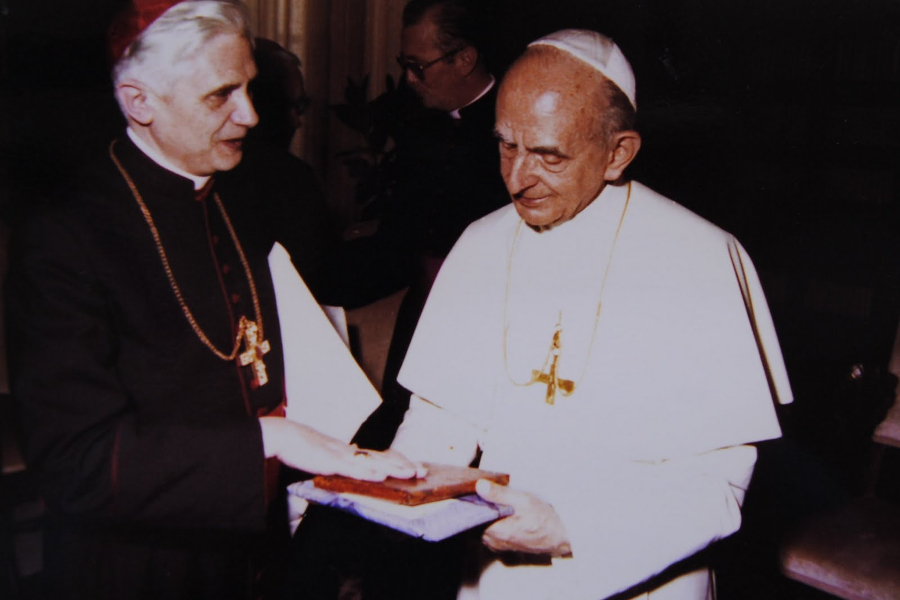
Cardinal Joseph Ratzinger with Pope Paul VI. Jornal O Bom Católico via Wikimedia (CC BY 2.0).

Coworker of the truth

After earning a doctorate, Ratzinger began teaching, and his reputation as a theologian grew. Cologne’s Cardinal Joseph Frings asked him to serve as a peritus, or adviser, at Vatican II, one of the major Catholic events of the 20th century.

He supported the reforming current at the ecumenical council and afterward received an invitation from the prominent progressive theologian Hans Küng to teach at the renowned University of Tübingen. But there he concluded that the Council’s reforms were being distorted by activists imbued with the revolutionary spirit of the late 1960s. “Anyone who wanted to remain a progressive in this context had to give up his integrity,” he said decades later.

He left Tübingen in 1969 to teach at the less prestigious University of Regensburg in his Bavarian homeland. That year, he made a radio broadcast in which he pondered the Church’s future.

“From the crisis of today,” he said, “the Church of tomorrow will emerge — a Church that has lost much. She will become small and will have to start afresh more or less from the beginning.”

But in the end, he predicted, “the church of faith” would remain. “It may well no longer be the dominant social power to the extent that she was until recently; but it will enjoy a fresh blossoming and be seen as Man’s home, where he will find life and hope beyond death,” he said.

In 1972, Ratzinger helped to found the influential theological journal Communio, with fellow theological luminaries Hans Urs von Balthasar and Henri de Lubac.

He was appointed Archbishop of Munich and Freising on May 28, 1977, at the relatively young age of 49. He took the motto “Cooperatores veritatis” (“Coworkers of the truth”), drawn from 3 John 8. He was made a cardinal a month after his episcopal ordination.

His tenure in Munich was overshadowed decades later by a report that accused him of mishandling four abuse cases. He denied claims that he had sought to cover up wrongdoing, but in a letter issued in 2022, he said: “I have had great responsibilities in the Catholic Church. All the greater is my pain for the abuses and the errors that occurred in those different places during the time of my mandate.”
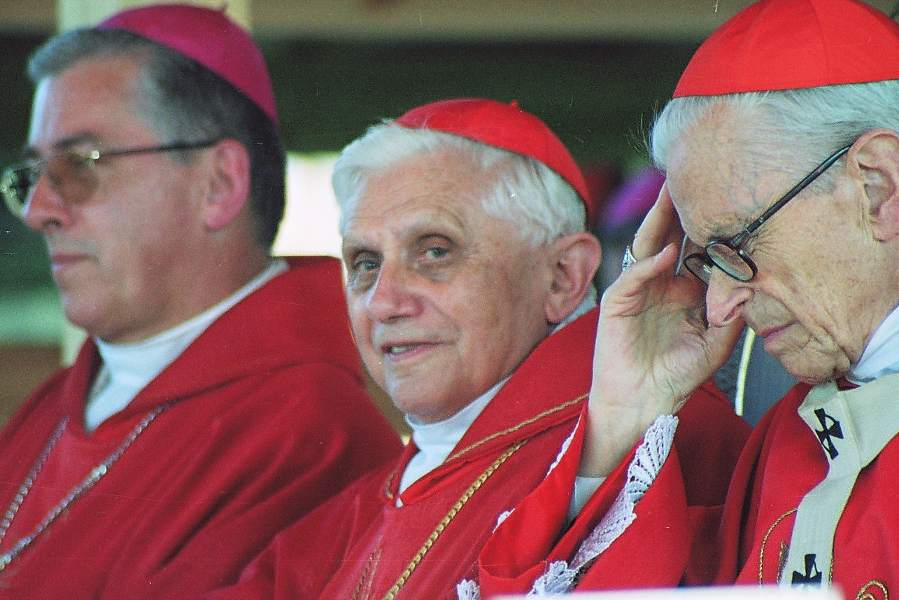
Cardinal Joseph Ratzinger in Szczepanów, Poland, on May 10, 2003. Muu-karhu via Wikimedia (CC BY 2.0).

Doctrinal defender

Pope John Paul II summoned Ratzinger to Rome in 1981 to serve as prefect of the Congregation for the Doctrine of the Faith. The Polish pope believed that the decades after Vatican II were marred by a theological free-for-all and encouraged the cardinal to help restore a sense of balance.

Ratzinger took action against prominent theologians he believed had departed from Catholic teaching, including the Brazilian liberation theologian Leonardo Boff, the Sri Lankan priest Tissa Balasuriya, and the Belgian Jesuit Jacques Dupuis.

These actions made him a controversial figure among Catholics on the Church’s progressive wing, who referred to him as the “Panzer Cardinal” and “God’s Rottweiler.” He complained that he was being cast as a bogeyman when he was only seeking to help simple believers recognize misleading accounts of the faith.

With John Paul II’s unflagging support, he tackled the Church’s most contested topics, from women priests to homosexuality. He also sought to present Catholic teaching in a positive light in his personal theological works and through his labor on the 1992 Catechism of the Catholic Church, a monumental guide to the faith.

After the turn of the millennium, he continued to serve as a theological lightning rod. In the year 2000, he signed the declaration Dominus Iesus, which affirmed that there is “a single Church of Christ, which subsists in the Catholic Church” — prompting criticism from Protestant leaders.

In 2001, Ratzinger convinced John Paul II to allow his Vatican congregation to investigate cases of clerical abuse worldwide. Once a week, he would read through dossiers on accused priests, a practice he referred to as “our Friday penance.” Between 2004 and 2014, 848 priests were laicized and 2,572 given other penalties.

In a 2004 lecture on Europe’s Christian roots, Ratzinger invoked the historian Arnold Toynbee’s idea of “creative minorities” who help to revitalize civilizations. “Christian believers should look upon themselves as just such a creative minority, and help Europe to reclaim what is best in its heritage and to therefore place itself at the service of all humankind,” he said.

In light of his age and bouts of ill health, he tried to resign several times, but continued to work as the Vatican’s doctrinal enforcer until John Paul II’s death in 2005.

Ratzinger presided at the Polish pope’s funeral, before a television audience of more than 2 billion. In his role as dean of the College of Cardinals, he preached to the world’s cardinals before they entered the conclave to elect John Paul II’s successor. He warned them that “having a clear faith based on the Creed of the Church is often labeled as fundamentalism,” while a “dictatorship of relativism” was being built “that does not recognize anything as definitive and whose ultimate goal consists solely of one’s own ego and desires.”
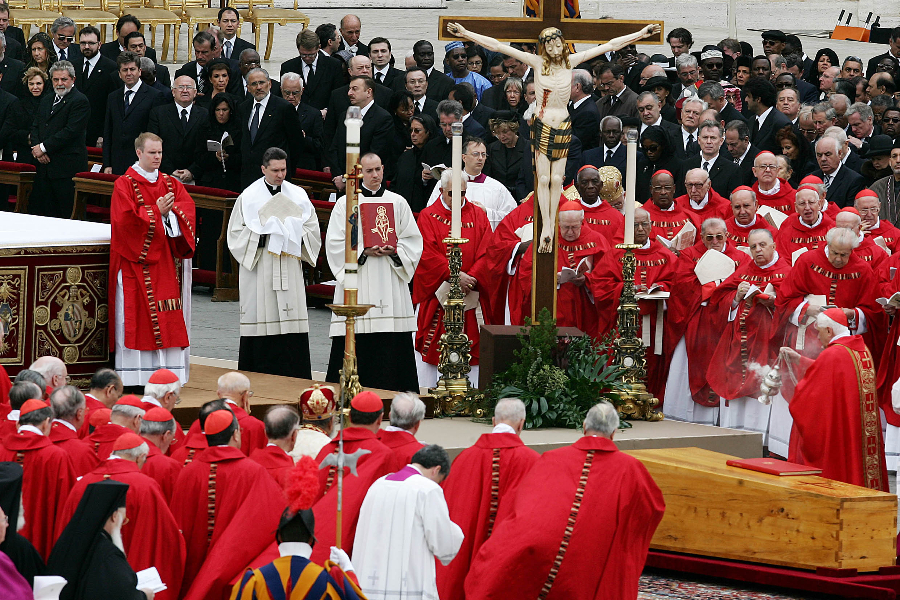
Cardinal Joseph Ratzinger presides at the funeral of Pope John Paul II on April 8, 2005. Ricardo Stuckert/PR - Agência Brasil via Wikimedia (CC BY 3.0 br).

The Church is alive

After four ballots, he was elected pope on April 19, 2005, at the age of 78. He chose the name Benedict XVI in honor of Benedict XV, who “guided the Church through the turbulent times of the First World War,” and St. Benedict, “a fundamental point of reference for the unity of Europe.”

At his installation Mass, he appeared to acknowledge the forces arrayed against him, asking for prayers “that I may not flee for fear of the wolves.” But he also struck a hopeful note, saying that in his predecessor’s last days, “it became wonderfully evident to us that the Church is alive. And the Church is young.”

“She holds within herself the future of the world and therefore shows each of us the way towards the future,” he said.

His almost eight-year pontificate was marked by a series of crises.

The most challenging and extended was the abuse crisis. Just two months after his election, he imposed restrictions on Fr. Marcial Maciel, the powerful founder of the Legionaries of Christ, who appeared to have been protected by figures at the Vatican despite evidence of his depravity.

The global media repeatedly accused Benedict XVI of having covered up abuse as an archbishop in Germany and a prefect in Rome — claims firmly rejected by his supporters.

He met abuse survivors during his foreign visits and sent a landmark letter to Irish Catholics in 2010, acknowledging that some abuse survivors “find it difficult even to enter the doors of a church after all that has occurred.”

Another crisis occurred in 2006, when he gave an address at the University of Regensberg in Germany in which he cited a Byzantine emperor who told a Muslim interlocutor that Mohammed had brought into the world “things only evil and inhuman, such as his command to spread by the sword the faith he preached.”

Benedict noted that the emperor delivered the words with “a brusqueness that we find unacceptable,” but his speech was reported around the world as if he had endorsed the remark. Muslims erupted in protest from Jordan to Indonesia.

Two months later, he made a conciliatory visit to Turkey, pausing for a moment of reflection alongside an Islamic cleric in Istanbul’s Blue Mosque.

In 2009, he sparked a another crisis when he lifted the excommunications of four bishops belonging to the Society of St. Pius (SSPX), the breakaway group founded by Archbishop Marcel Lefebvre. The move coincided with an interview in which one of the four, Bishop Richard Williamson, denied the Holocaust. Benedict wrote an apologetic letter to the world’s bishops, noting that he had been told “that consulting the information available on the internet would have made it possible to perceive the problem early on.”

As pope, he made far-reaching decisions on the liturgy, ecumenism, and Vatican finances.

His 2007 motu proprio Summorum Pontificum acknowledged priests’ right to offer Mass using the Roman Missal of 1962, which is in Latin. He defined the new and old versions of the Roman Missal as the “ordinary” and “extraordinary” forms of the Roman Rite, expressing the hope that they would be “mutually enriching.”

In his 2009 apostolic constitution Anglicanorum coetibus, he established personal ordinariates enabling groups of Anglicans to enter into full communion with Rome while preserving elements of their patrimony.

In 2010, he attempted to shed light on the Vatican’s notoriously opaque finances with the creation of a watchdog body, the Financial Information Authority. His efforts at reform were undermined by a series of leaked documents in what came to be known as the “Vati-Leaks” scandal, which led to the jailing of his butler.

Despite his advanced age, he made trips to countries including Australia, Brazil, and Benin. In 2008, he undertook a six-day visit to the United States, addressing the United Nations General Assembly, praying at Ground Zero, and visiting the White House.

He beatified more than 800 people, including Cardinal John Henry Newman, canonized 45 others, and proclaimed St. Hildegard of Bingen and St. John of Avila Doctors of the Church.

He published three encyclicals: Deus caritas est, on love; Spe salvi, on hope; and Caritas in Veritate, on charity. His fourth, Lumen fidei, was left unfinished and completed by his successor Pope Francis.

Throughout his pontificate, he stressed the continuity of the Catholic faith. Speaking to Vatican officials in 2005, he criticized those who interpreted Vatican II in terms of “discontinuity and rupture,” arguing that it should be understood instead with a “hermeneutic of reform” that did not imply “a split between the pre-conciliar Church and the post-conciliar Church.”

Benedict XVI resigned on Feb. 11, 2013, announcing the dramatic break with centuries of tradition in Latin to an audience of shocked cardinals. He told them that “both strength of mind and body” were necessary to govern the Church, but that strength had “deteriorated in me to the extent that I have had to recognize my incapacity to adequately fulfill the ministry entrusted to me.”

His resignation took effect on Feb. 28, 2013, when he departed Vatican City by helicopter. Arriving at the papal summer residence of Castel Gandolfo, he described himself as “simply a pilgrim who is starting the last stage of his pilgrimage on Earth.”

“Let us go ahead together with the Lord for the good of the Church and of the world,” he said, before departing into retirement.
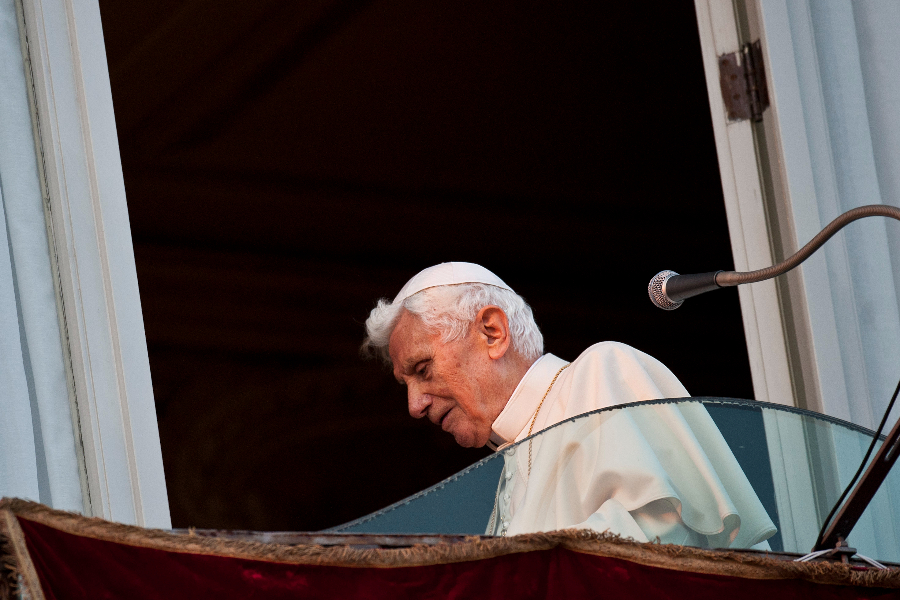
Benedict XVI’s last public appearance as pope, at Castel Gandolfo on Feb. 28, 2013. © Mazur/catholicnews.org.uk.

The last stretch

Benedict XVI adopted the title “pope emeritus” and continued to wear white — choices that critics said might lead Catholics to think he was still pope. He settled in a new home, the Mater Ecclesiae Monastery in the Vatican Gardens. He was 85 years old and not expected to live long, though the Vatican had not indicated a terminal illness. But over the next 10 years, he remained active.

His first public appearance after his resignation came in February 2014, at Pope Francis’ first consistory for the creation of new cardinals. Months later, he was present at the canonization of John Paul II and John XXIII.

In retirement, he continued his long collaboration with the journalist Peter Seewald. Together, they produced the 2016 book-length interview “Last Testament,” their fourth after “Salt of the Earth” (1997), “God and the World” (2002), and “Light of the World” (2010).  They also worked together on a multi-volume biography “Benedict XVI: A Life,” published in German in 2020.

He occasionally generated controversy in retirement, contributing in 2019 to a book supporting clerical celibacy amid a debate about a relaxation of the discipline in the Amazon region. In an essay published in the same year, he was accused of blaming clerical abuse on the sexual revolution of the 1960s. But he insisted that his point was that the crisis was caused by a turning away from God.

Catholics around the world continued to cherish the German pope in his retirement. On his 95th birthday, thousands of people sent messages via a website dedicated to his work.

His longtime personal secretary Archbishop Georg Gänswein confided that Benedict himself was surprised by his longevity, recalling that he once said: “I would never have believed that the last stretch of the journey that would take me from the Mater Ecclesiae Monastery to the gates of heaven with St. Peter would be so long.”

Benedict XVI was born on April 16, 1927. He died on Dec. 31, 2022, aged 95.

Thursday, February 28, 2013

Sede vacante begins


Benedict XVI is now in Castel Gandolfo. Notwithstanding his resignation he will still be addressed as “Your Holiness Benedict XVI.”   Benedict XVI will now be referred to as “Pontiff emeritus” or “Pope emeritus” Originally, it was being suggested that his title would / should be Bishop emeritus of Rome. He will dress in a simple white cassock without the mozzetta (elbow-length cape).

Blessed John Paul II's Apostolic Constitution Universi Dominici Gregis which is the governing Church document, provides:

37. Praecipimus etiam, ut post Pontificis mortem Cardinales electores praesentes exspectare debeant absentes per quindecim solidos dies, facta tamen Sacro Cardinalium Collegio potestate ingressus in Conclave per aliquot dies proferendi; ea tamen lege, ut, viginti diebus ad summum elapsis, Cardinales electores, quotquot praesentes adsint, in Conclave ingredi debeant et ad electionis negotium procedere.

The Conclave must therefore start between 15 and 20 days after today.

One of Benedict XVI's last acts was the publication of the Apostolic Letter given motu proprio Normas Nonnullas that slightly modified Universi Dominici Gregis to take into account the current situation. Following is the text in English and Latin.


APOSTOLIC LETTER

GIVEN MOTU PROPRIO

NORMAS NONNULLAS

OF THE SUPREME PONTIFF

BENEDICT XVI

on some modifications of the norms

concerning the election of the Roman Pontiff

With the Apostolic Letter De aliquibus mutationibus in normis de electione Romani Pontificis given Motu Proprio in Rome on 11 June 2007 in the third year of my pontificate, I established some norms that, rescinding those prescribed in n. 75 of the Apostolic Constitution Universi Dominici Gregis promulgated by my predecessor Blessed John Paul II, having re-established the regulation, sanctioned by tradition, according to which a two thirds majority of the votes of the Cardinal electors present is always required for the valid election of the Roman Pontiff.

Considering the importance of ensuring the best implementation of what is concerned, albeit with a different significance, regarding the election of the Roman Pontiff, in particular a more certain interpretation and execution of some provisions, I establish and prescribe that some norms of the Apostolic Constitution Universi Dominici Gregis, as well as what I myself set forth in the above-mentioned Apostolic Letter, be replaced with the following norms:

35. No Cardinal elector can be excluded from active or passive voice in the election of the Supreme Pontiff, for any reason or pretext, with due regard for the provisions of n. 40 and n. 75 of this Constitution.

37. I furthermore decree that, from the moment when the Apostolic See is lawfully vacant, the Cardinal electors who are present must wait fifteen full days for those who are absent before beginning the Conclave; however, the College of Cardinals is also granted the faculty to anticipate the beginning of the Conclave if all the Cardinal electors are present as well as the faculty to defer, for serious reasons, the beginning of the election for a few additional days. But when a maximum twenty days have elapsed from the beginning of the vacancy of the See, all the Cardinal electors present are obliged to proceed to the election.

43. From the beginning of the electoral process until the public announcement that the election of the Supreme Pontiff has taken place, or in any case until the new Pope so disposes, the rooms of the Domus Sanctae Marthae, and, in particular, the Sistine Chapel and the areas reserved for liturgical celebrations are to be closed to unauthorized persons, by the authority of the Cardinal Camerlengo and with the outside assistance of the Vice Camerlengo and the Substitute of the Secretariat of State, in accordance with the provisions set forth in the following Numbers.

During this period, the entire territory of Vatican City and the ordinary activity of the offices located therein shall be regulated, for the period mentioned, in a way that ensures the confidentiality and the free development of all the undertakings connected with the election of the Supreme Pontiff. In particular, provision shall be made, with the help of the Cleric Prelates of the Chamber to ensure that no one approaches the Cardinal electors while they are being transported from the Domus Sanctae Marthae to the Apostolic Vatican Palace.

46, § 1°. In order to meet the personal and official needs connected with the election process, the following individuals must be available and therefore properly lodged in suitable areas within the confines mentioned in n. 43 of this Constitution: the Secretary of the College of Cardinals, who acts as Secretary of the electoral assembly; the Master of Papal Liturgical Celebrations with eight Masters of Ceremonies and two Religious attached to the Papal Sacristy; and an ecclesiastic chosen by the Cardinal Dean or by the Cardinal taking his place, in order to assist him in his duties.

47. All persons listed in n. 46 and n. 55, § 2° of this Constitution who in any way or at any time should come to learn anything from any source, directly or indirectly, regarding the election process, and in particular regarding the voting which took place in the election itself, are obliged to maintain strict secrecy with all persons extraneous to the College of Cardinal electors: accordingly, before the election begins, they shall take an oath in the form and using the formula indicated in n. 48.

48. The persons listed in n. 46 and n. 55, § 2° of this Constitution, having been duly warned about the meaning and extent of the oath that they are to take, before the start of the election process, shall, in the presence of the Cardinal Camerlengo or another Cardinal delegated by him, and in the presence of two numerary participant Apostolic Protonotaries, in due course swear and sign the oath according to the following formula:

“I, N.N., promise and swear that, unless I should receive a special faculty given expressly by the newly-elected Pontiff or by his successors, I will observe absolute and perpetual secrecy with all who are not part of the College of Cardinal electors concerning all matters directly or indirectly related to the ballots cast and their scrutiny for the election of the Supreme Pontiff.”

“I likewise promise and swear to refrain from using any audio or video equipment capable of recording anything which takes place during the period of the election within Vatican City, and in particular anything which in any way, directly or indirectly, is related to the process of the election itself.”

“I declare that I take this oath fully aware that an infraction thereof will make me subject to the penalty of excommunication latae sententiae, which is reserved to the Apostolic See."

“So help me God and these Holy Gospels, which I touch with my hand.”

49. When the funeral rites for the deceased Pope have been celebrated according to the prescribed ritual, and everything necessary for the regular functioning of the election has been prepared, on the appointed day of the beginning of the Conclave established in conformity with the provisions of n. 37 of the present Constitution, the Cardinal electors shall meet in the Basilica of Saint Peter's in the Vatican, or elsewhere, should circumstances warrant it, in order to take part in a solemn Eucharistic celebration with the Votive Mass Pro Eligendo Papa. This celebration should preferably take place at a suitable hour in the morning, so that in the afternoon the prescriptions of the following Numbers of this Constitution can be carried out.

50. From the Pauline Chapel of the Apostolic Palace, where they will assemble at a suitable hour in the afternoon, the Cardinal electors, in choir dress and invoking the assistance of the Holy Spirit with the chant of the 'Veni Creator', will solemnly proceed to the Sistine Chapel of the Apostolic Palace, where the election will be held. The Vice Camerlengo, the General Auditor of the Apostolic Camera, and two members of each of the colleges of numerary participant Apostolic Protonotaries, Prelate Auditors of the Roman Rota, and Cleric Prelates of the Chamber will participate in the procession.

51, § 2°. It will therefore be the responsibility of the College of Cardinals, operating under the authority and responsibility of the Camerlengo, assisted by the Particular Congregation mentioned in n. 7 of the present Constitution, and with the outside assistance of the Vice Camerlengo and the Substitute of the Secretariat of State, to make all prior arrangements for the interior of the Sistine Chapel and adjacent areas to be prepared, so that an orderly election and its privacy will be ensured.

55, § 3°. Should any infraction whatsoever of this norm occur, those responsible should know that they will be subject to the penalty of excommunication latae sententiae, which is reserved to the Apostolic See.

62. Since the forms of election known as per acclamationem seu inspirationem and per compromissum are abolished, the form of electing the Roman Pontiff shall henceforth be per scrutinium alone.

I therefore decree that, for the valid election of the Roman Pontiff, at least two thirds of the votes are required, calculated on the basis of the total number of electors present and voting.

64. The voting process is carried out in three phases. The first phase, which can be called the pre-scrutiny, comprises: 1) the preparation and distribution of the ballot papers by the Masters of Ceremonies—called meanwhile into the Hall together with the Secretary of the College of Cardinals and with the Master of Papal Liturgical Celebrations—who give at least two or three to each Cardinal elector; 2) the drawing by lot, from among all the Cardinal electors, of three Scrutineers, of three persons charged with collecting the votes of the sick, called for the sake of brevity 'Infirmarii', and of three Revisers; this drawing is carried out in public by the junior Cardinal Deacon, who draws out nine names, one after another, of those who shall carry out these tasks; 3) if, in the drawing of lots for the Scrutineers, 'Infirmarii' and Revisers, there should come out the names of Cardinal electors who because of infirmity or other reasons are unable to carry out these tasks, the names of others who are not impeded are to be drawn in their place. The first three drawn will act as Scrutineers, the second three as 'Infirmarii', and the last three as Revisers.

70, § 2°. The Scrutineers add up all the votes that each individual has received, and if no one has obtained at least two thirds of the votes on that ballot, the Pope has not been elected; if however it turns out that someone has obtained at least two thirds of the votes, the canonically valid election of the Roman Pontiff has taken place.

75. If the votes referred to in n. 72, 73, and 74 of the above-mentioned Constitution do not result in an election, a day will be dedicated to prayer, reflection, and discussion. In subsequent votes, in accordance with the procedure established in n. 74 of this same Constitution, only the two whose names have received the greatest number of votes in the immediately preceding ballot will have the passive electoral right. There can be no waiving of the requirement that a valid election takes place only by a qualified majority of at least two thirds of the votes of the cardinals who are present and voting. Moreover, in these ballots, the two persons who enjoy the passive electoral right lose their active electoral right.

When the election has canonically taken place, the junior Cardinal Deacon summons into the Hall of election the Secretary of the College of Cardinals, the Master of Papal Liturgical Celebrations, and two Masters of Ceremonies. The Cardinal Dean, or the Cardinal who is first in order and seniority, in the name of the whole College of electors, then asks the consent of the one elected in the following words: 'Do you accept your canonical election as Supreme Pontiff?' And, as soon as he has received the consent, he asks him: 'By what name do you wish to be called?' Then the Master of Papal Liturgical Celebrations, acting as notary and having as witnesses the two Masters of Ceremonies, draws up a document certifying acceptance by the new Pope and the name taken by him.

This document will enter into force immediately upon its publication in the Osservatore Romano.

This I do decree and establish, notwithstanding any instruction to the contrary.

Given in Rome, at Saint Peter’s, on February 22, 2013, the eighth of my Pontificate.

BENEDICTUS PP XVI


Latin Text

BENEDICTUS PP. XVI

LITTERAE APOSTOLICAE

MOTU PROPRIO DATAE

NORMAS NONNULLAS


DE NONNULLIS MUTATIONIBUS IN NORMIS

AD ELECTIONEM ROMANI PONTIFICIS ATTINENTIBUS


Normas nonnullas per Apostolicas Litteras De aliquibus mutationibus in normis de electione Romani Pontificis Motu Proprio die XI mensis Iunii anno MMVII, tertio Nostri Pontificatus, datas, statuimus, quae, cum eas abrogarent normas quae in numero 75 continentur Constitutionis Apostolicae Universi Dominici gregis quam die XX mensis Februarii anno MCMXCVI Decessor Noster beatus Ioannes Paulus II promulgavit, normam statuerunt, traditione sancitam, ad quam, ut valida Summi Pontificis habeatur electio, duae ex tribus partes suffragiorum omnium Cardinalium electorum praesentium semper requiruntur.

Gravitate quidem considerata quo aptiore modo id evolvatur quod, quamvis vario pondere, ad electionem attinet Romani Pontificis, potissimum ad certam interpretationem et exsecutionem nonnullorum praeceptorum, statuimus et decernimus ut quaedam normae Consitutionis Apostolicae Universi Dominici gregis necnon ea quae in supra memoratis Apostolicis Litteris Nos Ipsi statuimus, substituantur normis quae sequuntur:

35. Cardinalis elector nulla ratione vel causa a Summi Pontificis electione activa et passiva excludi potest, vigentibus tamen iis omnibus quae sub n. 40 et 75 huius Constitutionis statuuntur.

37. Praecipimus praeterea ut, ex quo Apostolica Sedes legitime vacat, antequam Conclave incohetur, mora sit interponenda quindecim solidorum dierum, facta tamen Cardinalium Collegio potestate Conclavis initium anticipandi, si constat omnes Cardinales electores adesse, vel etiam proferendi per aliquot dies, si graves obstant causae; tamen viginti diebus ad summum elapsis ab initio Sedis vacantis, cuncti Cardinales electores praesentes ad electionis negotium procedant.

43. Ex quo initium negotiorum electionis statutum est ad peractae usque Summi Pontificis electionis publicum nuntium vel, utcumque, hoc iusserit novus Pontifex, aedesDomus Sanctae Marthae, pariterque Sacellum Sixtinum atque loci designati liturgicis celebrationibus obserari debebunt, sub auctoritate Cardinalis Camerarii externaque cooperatione Vicecamerarii et Substituti Secretariae Status, omnibus licentia carentibus, prout statuitur in sequentibus numeris.

Integra regio Civitatis Vaticanae, atque etiam ordinaria industria Ministeriorum quorum sedes stat intra eius fines, ita moderandae erunt, hoc tempore, ut circumspectio in tuto collocetur nec non expedita explicatio actionum ad Summi Pontificis electionem pertinentium. Provideatur peculiariter, Praelatis Clericis de Camera etiam opem ferentibus, ut Cardinales electores a nullo conveniantur iter facientes ab aedibus Domus Sanctae Marthae ad Palatium Apostolicum Vaticanum.

46. § 1° Ut personarum necessitatibus et officii, quae cum electionis cursu nectuntur, occurratur, praesto esse debent ideoque convenientibus locis recepti intra fines quorum in huius Constitutionis n. 43 fit mentio, Secretarius Cardinalium Collegii, qui conventus electivi Secretarii fungitur munere, Magister Pontificiarum Celebrationum Liturgicarum cum octo Caeremoniariis et duobus Religiosis qui Sacrarium Pontificium curant; atque ecclesiasticus vir a Cardinale Decano electus vel a Cardinale vicem gerente, ut in munere explendo eum iuvet.

47. Omnes personae quae n. 46 et n. 55, § 2° significantur huius Constitutionis Apostolicae, quae quavis ratione ac quovis tempore a quocumque resciscunt ea quae ad recte obliquove proprios electionis actus attinent, potissimum quae peracta ipsius electionis scrutinia contingunt, arto secreto tenentur cum qualibet persona ad Collegium Cardinalium electorum non pertinente; hac de causa, antequam incipiat electio, ius iurandum nuncupare debent, secundum modum et formulam, ut subsequens numerus indicabit.

48. Illi omnes, de quibus dicitur n. 46 et n. 55, § 2° huius Constitutionis, rite certiores facti circa significationem amplitudinemque iuris iurandi faciendi ante negotiorum electionis initium coram Cardinale Camerario vel alio Cardinale ab eo delegato et coram duobus Protonotariis Apostolicis de Numero Participantium, tempore opportuno pronuntiabunt et subscribent ius iurandum secundum hanc formulam:

Ego N. N. promitto et iuro me inviolate servaturum esse secretum absolutum cum omnibus quotquot participes non sunt Collegii Cardinalium electorum, hoc quidem in perpetuum, nisi mihi datur expresse peculiaris facultas a novo Pontifice electo eiusve Successoribus, in omnibus quae directe vel indirecte respiciunt suffragia et scrutinia ad novum Pontificem eligendum.

Itemque promitto et iuro me nullo modo in Conclavi usurum esse instrumentis quibuslibet ad vocem transmittendam vel recipiendam aut ad imagines exprimendas quovis modo aptis de iis quae tempore electionis fiunt intra fines Civitatis Vaticanae, atque praecipue de iis quae quolibet modo directe vel indirecte attinent ad negotia coniuncta cum ipsa electione.

Declaro me editurum esse ius iurandum utpote qui plane noverim quamlibet eius violationem adducturam esse excommunicationis mihi poenam latae sententiaeSedi Apostolicae reservatae.

Sic me Deus adiuvet et haec sancta Dei Evangelia, quae manu mea tango.

49. Exsequiis defuncti Pontificis rite persolutis et apparatis iis quae requiruntur ad legitimam electionem exsequendam, die constituto - decimo quinto id est a Pontificis morte aut non ultra vicesimum diem, prout n. 37 huius Constitutionis decernitur - Cardinales omnes convenient in Basilicam Vaticanam Sancti Petri, vel alium in locum pro temporis et loci opportunitate, ad participandam sollemnem Eucharisticam celebrationem cum Missa votiva pro eligendo Papa. Hoc congruenti tempore matutino persolvendum est, ita ut horis postmeridianis impleri possit quod praescribitur sequentibus numeris huius Constitutionis.

50. A Sacello Paulino Palatii Apostolici, ubi congruo pomeridiano tempore Cardinales electores adstiterint, chorali vestimento induti sollemni processione, cantu invocantes Veni, creator Spiritus Sancti assistentiam, se conferent in Cappellam Sixtinam Palatii Apostolici, locum et sedem electionis peragendae. Processionem participabunt Vicecamerarius, Auditor Generalis Camerae Apostolicae et duo membra cuiusque Collegii Protonotariorum Apostolicorum de Numero Participantium, Praelatorum Auditorum Rotae Romanae et Praelatorum Clericorum de Camera.

51, § 2° Quapropter Collegium Cardinalium, agens de auctoritate et officio Camerarii, quem adiuvabit Congregatio particularis de qua in numero 7 huius Constitutionis, curabit ut, intra praefatum Sacellum et in locis contiguis, omnia prius disponantur adiuvantibus quoque foris Vicecamerario et Substituto Secretariae Status, ita ut regularis electio eiusdemque secreta indoles in tuto ponantur.

55, § 3° Si quid tale contra hanc normam admissum fuerit, sciant auctores se innodari excommunicationis poena latae sententiae Sedi Apostolicae reservatae.

62. Modis abrogatis electionis qui per acclamationem seu inspirationem et per compromissum dicuntur, electionis forma Romani Pontificis futuro de tempore erit tantum per scrutinium.

Decernimus igitur ut Summi Pontificis ad validam electionem saltem duae ex tribus partes suffragiorum requirantur omnium electorum praesentium et suffragia ferentium.

64. Tribus gradibus explicatur scrutinium, quorum primus, qui antescrutinium vocari potest, complectitur: 1) schedularum praeparationem et partitionem per Caeremoniarios - qui interea in aulam revocantur una cum Secretario Collegii Cardinalium simulque cum Magistro Pontificiarum celebrationum Liturgicarum – quique earum saltem duas vel tres cuique Cardinali electori dabunt; 2) ex omnibus Cardinalibus electoribus sortitionem trium Scrutatorum, trium ad infirmorum excipienda suffragia qui destinantur, qui brevitatis gratia Infirmarii appellantur, et trium Recognitorum; sortes has publice iacit novissimus Cardinalis Diaconus, qui subinde novem nomina depromit illorum qui munia haec sustinere debent; 3) si in extractione Scrutatorum, Infirmariorum et Recognitorum ducta nomina exierint Cardinalium electorum qui, ob infirmitatem vel aliam ob causam impedientur quominus officia haec gerant, eorum loco alia nomina non impeditorum depromantur. Primi tres sorte educti erunt Scrutatores, alteri tres Infirmarii, ceteri vero tres Recognitores.

70, § 2° Scrutatores in unam summam redigunt suffragia, quae quilibet obtinuit, et si nemo saltem ad duas partes ex tribus suffragiorum pervenit, non est electus Papa in illo scrutinio; si quis vero duas partes ex tribus saltem accepit, habetur electio Romani Pontificis et quidem canonice valida.

75. Si scrutinia de quibus in numeris septuagesimo secundo, tertio et quarto memoratae Constitutionis incassum reciderint, habeatur unus dies orationi, reflexioni et dialogo dicatus; in subsequentibus vero suffragationibus, servato ordine in numero septuagesimo quarto eiusdem Constitutionis statuto, vocem passivam habebunt tantummodo duo nomina quae in superiore scrutinio maiorem numerum suffragiorum obtinuerunt, nec recedatur a ratione ut etiam in his suffragationibus minimum maioritas qualificata duarum ex tribus partium suffragiorum Cardinalium praesentium et vocem activam habentium ad validitatem electionis requiratur. In his autem suffragationibus, duo nomina quae vocem passivam habent, voce activa carent.

87. Post electionem canonice factam, ultimus Cardinalis Diaconus vocat in aulam electionis Secretarium Collegii Cardinalium et Magistrum Pontificiarum Celebrationum Liturgicarum et duos Caeremoniarios; atque consensus electi per Cardinalem Decanum aut per Cardinalium primum ordine et aetate, nomine totius Collegii electorum, his verbis requiratur: Acceptasne electionem de te canonice factam in Summum Pontificem? Statimque, post consensum declaratum, electus interrogetur: Quo nomine vis vocari? Tunc per Magistrum Pontificiarum Celebrationum Liturgicarum, munere notarii fungentem, testibus adhibitis duobus Viris a caeremoniis, instrumentum de acceptatione novi Pontificis et de nomine ab eo assumpto conficitur.

Omnia quae in his Litteris Apostolicis in forma Motu Proprio deliberavimus, ordinamus ut in omnibus earum partibus serventur, contrariis rebus minime quibuslibet officientibus.

Hoc documentum cum in actis diurnis L’Osservatore Romano evulgabitur, statim vigere incipiet.

Datum Romae, apud Sanctum Petrum, die XXII mensis Februarii, anno MMXIII, Pontificatus Nostri octavo.

BENEDICTUS PP XVI