Benedict XVI, one of the world’s foremost theologians and the first pope to retire in almost 600 years, died on Dec. 31 at the age of 95.
(adapted from The Pillar)
A Dec. 31 statement from the Holy See press office said: “With sorrow I inform you that the Pope Emeritus, Benedict XVI, passed away today at 9:34 in the Mater Ecclesiae Monastery in the Vatican. Further information will be provided as soon as possible.”
Benedict XVI helped to shape the Catholic Church’s trajectory long before he was elected to the papacy, first as a young theological adviser at the Second Vatican Council and then as head of the Vatican’s doctrinal office.
Benedict influenced generations of Catholics with his writings, including his 1968 book “Introduction to Christianity,” his treatise “The Spirit of the Liturgy,” and his trilogy “Jesus of Nazareth,” composed while he was pope.
He reflected deeply on the tensions between secular modernity and the Church, introducing phrases such as “the dictatorship of relativism” into Catholic discourse and popularizing the concept of Catholics serving as a “creative minority” within secularized societies.
As pope from 2005 to 2013, he led the Church’s response to the clerical abuse crisis, dismissing hundreds of perpetrators from the clerical state. But he later personally asked forgiveness from abuse survivors amid criticism of his handling of cases as archbishop of Munich, southern Germany, from 1977 to 1982.
Awaiting Easter
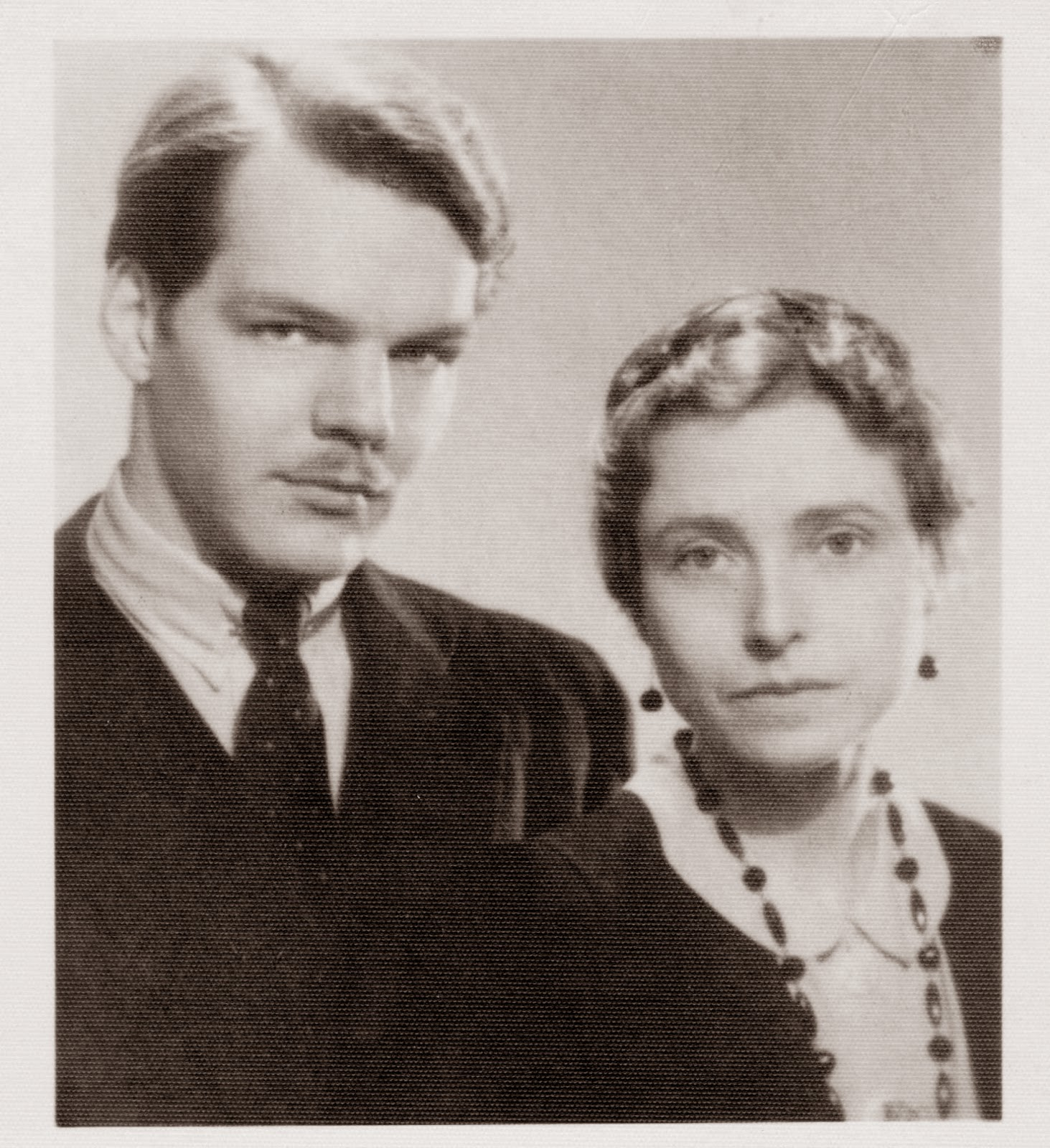
He was born Joseph Aloisius Ratzinger on April 16, 1927, in Marktl am Inn, a village in the German state of Bavaria. In his 1998 memoir Milestones, he noted that he emerged into the world on Holy Saturday.
“I have always been filled with thanksgiving for having had my life immersed in this way in the Easter mystery, since this could only be a sign of blessing,” he wrote. “To be sure, it was not Easter Sunday but Holy Saturday, but, the more I reflect on it, the more this seems to be fitting for the nature of our human life: We are still awaiting Easter; we are still not standing in the full light, but walking toward it in full trust.”
He was the third child after his sister Maria and brother Georg, who went on to become a priest and conductor of the renowned Regensburger Domspatzen choir. His mother was a cook and his father a police officer who was disciplined after criticizing the Nazis.
An intellectually precocious child who disliked school sports, he entered a minor seminary in 1939, at the age of 12. That year, German youngsters were legally required to join the Hitler Youth. He was enrolled but avoided attending meetings of the Nazi organization.
After the Second World War broke out, the seminary was shuttered and he was drafted into the military, serving in an anti-aircraft unit and helping to prepare anti-tank defenses. He abandoned his post in 1945 as the Allies swept into Germany, although the penalty for desertion was death.
In “Milestones,” he described how he attempted to reach home on foot without being detected. “But, as I walked out of a railroad underpass, two soldiers were standing at their posts, and for a moment the situation was extremely critical for me,” he wrote. “Thank God that they, too, had had their fill of war and did not want to become murderers.”
He was reunited briefly with his family, but then seized by U.S. forces and interned in a prisoner-of-war camp near the city of Ulm. He slept outdoors, but was consoled by the sight of the spire of Ulm cathedral. “Day after day the sight of it was for me like a consoling proclamation of the indestructible humaneness of faith,” he later wrote.
When he was finally released, the driver of a milk truck gave him a lift back to his hometown. He reached it before sunset, recalling that “the heavenly Jerusalem itself could not have appeared more beautiful to me at that moment.”
He returned to his seminary studies and was ordained a priest of the Archdiocese of Munich and Freising on June 29, 1951, at the age of 24. When the archbishop placed his hands on him during the rite, a bird flew up from the high altar and began to sing, which he took to be “a reassurance from on high” that he was on the right path.
Coworker of the truth
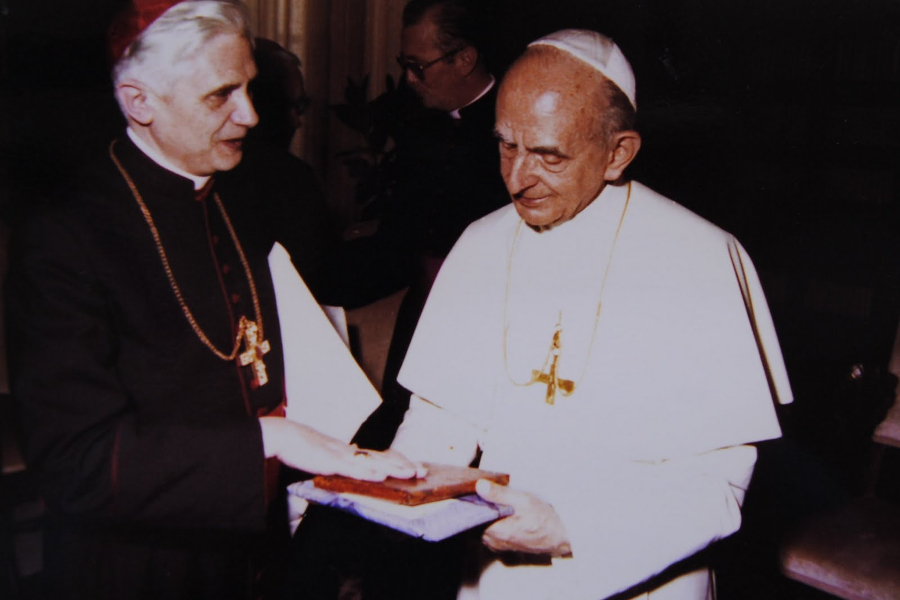
After earning a doctorate, Ratzinger began teaching, and his reputation as a theologian grew. Cologne’s Cardinal Joseph Frings asked him to serve as a peritus, or adviser, at Vatican II, one of the major Catholic events of the 20th century.
He supported the reforming current at the ecumenical council and afterward received an invitation from the prominent progressive theologian Hans Küng to teach at the renowned University of Tübingen. But there he concluded that the Council’s reforms were being distorted by activists imbued with the revolutionary spirit of the late 1960s. “Anyone who wanted to remain a progressive in this context had to give up his integrity,” he said decades later.
He left Tübingen in 1969 to teach at the less prestigious University of Regensburg in his Bavarian homeland. That year, he made a radio broadcast in which he pondered the Church’s future.
“From the crisis of today,” he said, “the Church of tomorrow will emerge — a Church that has lost much. She will become small and will have to start afresh more or less from the beginning.”
But in the end, he predicted, “the church of faith” would remain. “It may well no longer be the dominant social power to the extent that she was until recently; but it will enjoy a fresh blossoming and be seen as Man’s home, where he will find life and hope beyond death,” he said.
In 1972, Ratzinger helped to found the influential theological journal Communio, with fellow theological luminaries Hans Urs von Balthasar and Henri de Lubac.
He was appointed Archbishop of Munich and Freising on May 28, 1977, at the relatively young age of 49. He took the motto “Cooperatores veritatis” (“Coworkers of the truth”), drawn from 3 John 8. He was made a cardinal a month after his episcopal ordination.
His tenure in Munich was overshadowed decades later by a report that accused him of mishandling four abuse cases. He denied claims that he had sought to cover up wrongdoing, but in a letter issued in 2022, he said: “I have had great responsibilities in the Catholic Church. All the greater is my pain for the abuses and the errors that occurred in those different places during the time of my mandate.”
Doctrinal defender
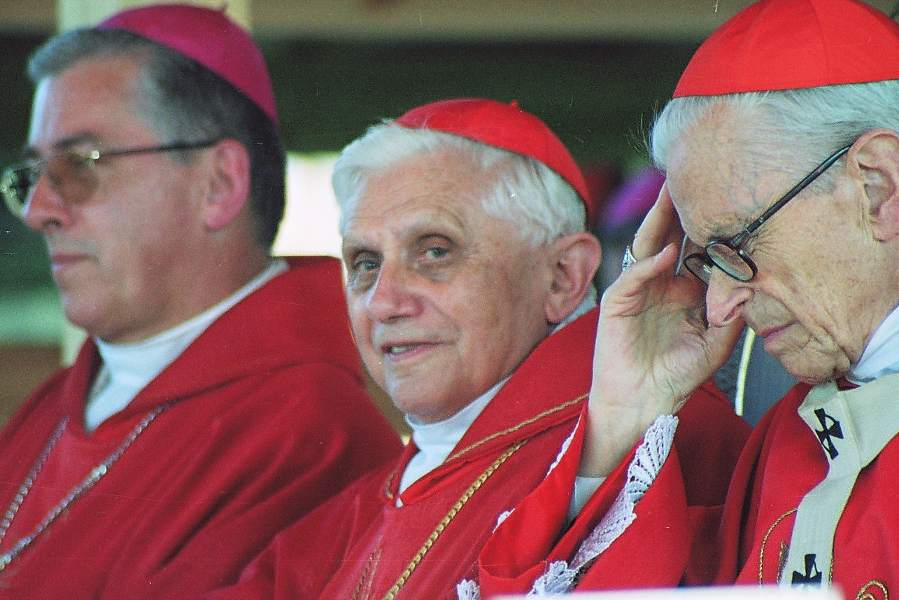
Pope John Paul II summoned Ratzinger to Rome in 1981 to serve as prefect of the Congregation for the Doctrine of the Faith. The Polish pope believed that the decades after Vatican II were marred by a theological free-for-all and encouraged the cardinal to help restore a sense of balance.
Ratzinger took action against prominent theologians he believed had departed from Catholic teaching, including the Brazilian liberation theologian Leonardo Boff, the Sri Lankan priest Tissa Balasuriya, and the Belgian Jesuit Jacques Dupuis.
These actions made him a controversial figure among Catholics on the Church’s progressive wing, who referred to him as the “Panzer Cardinal” and “God’s Rottweiler.” He complained that he was being cast as a bogeyman when he was only seeking to help simple believers recognize misleading accounts of the faith.
With John Paul II’s unflagging support, he tackled the Church’s most contested topics, from women priests to homosexuality. He also sought to present Catholic teaching in a positive light in his personal theological works and through his labor on the 1992 Catechism of the Catholic Church, a monumental guide to the faith.
After the turn of the millennium, he continued to serve as a theological lightning rod. In the year 2000, he signed the declaration Dominus Iesus, which affirmed that there is “a single Church of Christ, which subsists in the Catholic Church” — prompting criticism from Protestant leaders.
In 2001, Ratzinger convinced John Paul II to allow his Vatican congregation to investigate cases of clerical abuse worldwide. Once a week, he would read through dossiers on accused priests, a practice he referred to as “our Friday penance.” Between 2004 and 2014, 848 priests were laicized and 2,572 given other penalties.
In a 2004 lecture on Europe’s Christian roots, Ratzinger invoked the historian Arnold Toynbee’s idea of “creative minorities” who help to revitalize civilizations. “Christian believers should look upon themselves as just such a creative minority, and help Europe to reclaim what is best in its heritage and to therefore place itself at the service of all humankind,” he said.
In light of his age and bouts of ill health, he tried to resign several times, but continued to work as the Vatican’s doctrinal enforcer until John Paul II’s death in 2005.
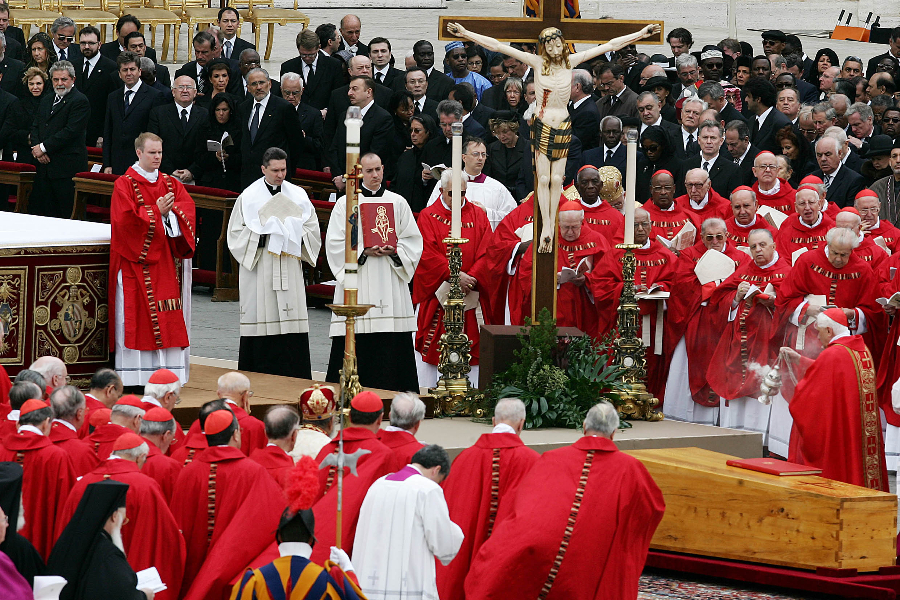
Ratzinger presided at the Polish pope’s funeral, before a television audience of more than 2 billion. In his role as dean of the College of Cardinals, he preached to the world’s cardinals before they entered the conclave to elect John Paul II’s successor. He warned them that “having a clear faith based on the Creed of the Church is often labeled as fundamentalism,” while a “dictatorship of relativism” was being built “that does not recognize anything as definitive and whose ultimate goal consists solely of one’s own ego and desires.”
The Church is alive
After four ballots, he was elected pope on April 19, 2005, at the age of 78. He chose the name Benedict XVI in honor of Benedict XV, who “guided the Church through the turbulent times of the First World War,” and St. Benedict, “a fundamental point of reference for the unity of Europe.”
At his installation Mass, he appeared to acknowledge the forces arrayed against him, asking for prayers “that I may not flee for fear of the wolves.” But he also struck a hopeful note, saying that in his predecessor’s last days, “it became wonderfully evident to us that the Church is alive. And the Church is young.”
“She holds within herself the future of the world and therefore shows each of us the way towards the future,” he said.
His almost eight-year pontificate was marked by a series of crises.
The most challenging and extended was the abuse crisis. Just two months after his election, he imposed restrictions on Fr. Marcial Maciel, the powerful founder of the Legionaries of Christ, who appeared to have been protected by figures at the Vatican despite evidence of his depravity.
The global media repeatedly accused Benedict XVI of having covered up abuse as an archbishop in Germany and a prefect in Rome — claims firmly rejected by his supporters.
He met abuse survivors during his foreign visits and sent a landmark letter to Irish Catholics in 2010, acknowledging that some abuse survivors “find it difficult even to enter the doors of a church after all that has occurred.”
Another crisis occurred in 2006, when he gave an address at the University of Regensberg in Germany in which he cited a Byzantine emperor who told a Muslim interlocutor that Mohammed had brought into the world “things only evil and inhuman, such as his command to spread by the sword the faith he preached.”
Benedict noted that the emperor delivered the words with “a brusqueness that we find unacceptable,” but his speech was reported around the world as if he had endorsed the remark. Muslims erupted in protest from Jordan to Indonesia.
Two months later, he made a conciliatory visit to Turkey, pausing for a moment of reflection alongside an Islamic cleric in Istanbul’s Blue Mosque.
In 2009, he sparked a another crisis when he lifted the excommunications of four bishops belonging to the Society of St. Pius (SSPX), the breakaway group founded by Archbishop Marcel Lefebvre. The move coincided with an interview in which one of the four, Bishop Richard Williamson, denied the Holocaust. Benedict wrote an apologetic letter to the world’s bishops, noting that he had been told “that consulting the information available on the internet would have made it possible to perceive the problem early on.”
As pope, he made far-reaching decisions on the liturgy, ecumenism, and Vatican finances.
His 2007 motu proprio Summorum Pontificum acknowledged priests’ right to offer Mass using the Roman Missal of 1962, which is in Latin. He defined the new and old versions of the Roman Missal as the “ordinary” and “extraordinary” forms of the Roman Rite, expressing the hope that they would be “mutually enriching.”
In his 2009 apostolic constitution Anglicanorum coetibus, he established personal ordinariates enabling groups of Anglicans to enter into full communion with Rome while preserving elements of their patrimony.
In 2010, he attempted to shed light on the Vatican’s notoriously opaque finances with the creation of a watchdog body, the Financial Information Authority. His efforts at reform were undermined by a series of leaked documents in what came to be known as the “Vati-Leaks” scandal, which led to the jailing of his butler.
Despite his advanced age, he made trips to countries including Australia, Brazil, and Benin. In 2008, he undertook a six-day visit to the United States, addressing the United Nations General Assembly, praying at Ground Zero, and visiting the White House.
He beatified more than 800 people, including Cardinal John Henry Newman, canonized 45 others, and proclaimed St. Hildegard of Bingen and St. John of Avila Doctors of the Church.
He published three encyclicals: Deus caritas est, on love; Spe salvi, on hope; and Caritas in Veritate, on charity. His fourth, Lumen fidei, was left unfinished and completed by his successor Pope Francis.
Throughout his pontificate, he stressed the continuity of the Catholic faith. Speaking to Vatican officials in 2005, he criticized those who interpreted Vatican II in terms of “discontinuity and rupture,” arguing that it should be understood instead with a “hermeneutic of reform” that did not imply “a split between the pre-conciliar Church and the post-conciliar Church.”
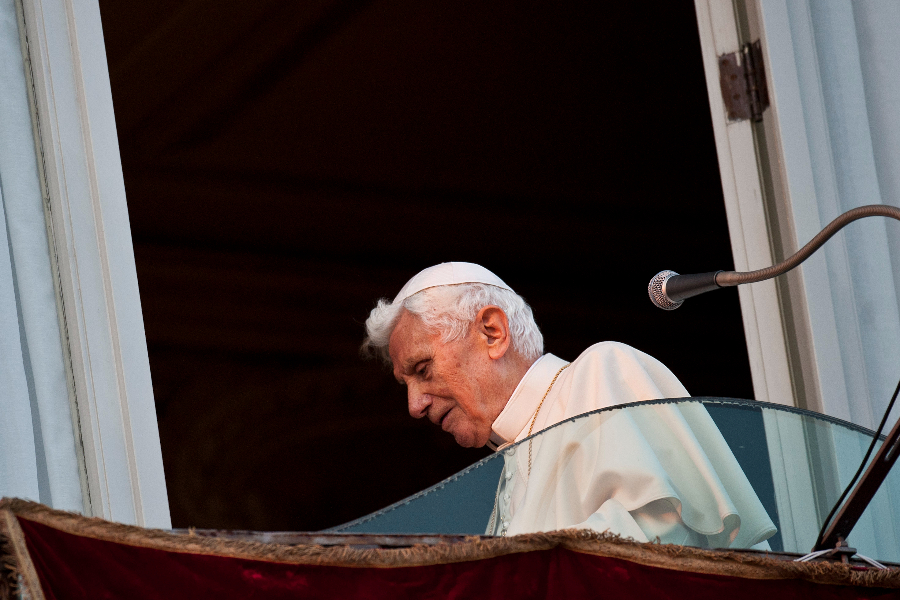
Benedict XVI resigned on Feb. 11, 2013, announcing the dramatic break with centuries of tradition in Latin to an audience of shocked cardinals. He told them that “both strength of mind and body” were necessary to govern the Church, but that strength had “deteriorated in me to the extent that I have had to recognize my incapacity to adequately fulfill the ministry entrusted to me.”
His resignation took effect on Feb. 28, 2013, when he departed Vatican City by helicopter. Arriving at the papal summer residence of Castel Gandolfo, he described himself as “simply a pilgrim who is starting the last stage of his pilgrimage on Earth.”
“Let us go ahead together with the Lord for the good of the Church and of the world,” he said, before departing into retirement.
The last stretch
Benedict XVI adopted the title “pope emeritus” and continued to wear white — choices that critics said might lead Catholics to think he was still pope. He settled in a new home, the Mater Ecclesiae Monastery in the Vatican Gardens. He was 85 years old and not expected to live long, though the Vatican had not indicated a terminal illness. But over the next 10 years, he remained active.
His first public appearance after his resignation came in February 2014, at Pope Francis’ first consistory for the creation of new cardinals. Months later, he was present at the canonization of John Paul II and John XXIII.
In retirement, he continued his long collaboration with the journalist Peter Seewald. Together, they produced the 2016 book-length interview “Last Testament,” their fourth after “Salt of the Earth” (1997), “God and the World” (2002), and “Light of the World” (2010). They also worked together on a multi-volume biography “Benedict XVI: A Life,” published in German in 2020.
He occasionally generated controversy in retirement, contributing in 2019 to a book supporting clerical celibacy amid a debate about a relaxation of the discipline in the Amazon region. In an essay published in the same year, he was accused of blaming clerical abuse on the sexual revolution of the 1960s. But he insisted that his point was that the crisis was caused by a turning away from God.
Catholics around the world continued to cherish the German pope in his retirement. On his 95th birthday, thousands of people sent messages via a website dedicated to his work.
His longtime personal secretary Archbishop Georg Gänswein confided that Benedict himself was surprised by his longevity, recalling that he once said: “I would never have believed that the last stretch of the journey that would take me from the Mater Ecclesiae Monastery to the gates of heaven with St. Peter would be so long.”
Benedict XVI was born on April 16, 1927. He died on Dec. 31, 2022, aged 95.