Showing posts with label St. John Chrysostom. Show all posts

Saturday, October 26, 2024

On the Number of Sins Beyond Which God Pardons No More


by St. Alphonsus de Liguori


"Thou shalt not tempt the Lord thy God" - Matt., 4:7

In this day's Gospel we read that having gone into the desert, Jesus Christ permitted the Devil to set Him on the pinnacle of the temple and say to Him: "If Thou be the Son of God, cast thyself down"; for the angels shall preserve Thee from all injury. But the Lord answered that in the Sacred Scriptures it is written: Thou shalt not tempt the Lord thy God. The sinner who abandons himself to sin without striving to resist temptations, or without at least asking God's help to conquer them, and hopes that the Lord will one day draw him from the precipice, tempts God to work miracles, or rather to show to him an extraordinary mercy not extended to the generality of Christians.

God, as the Apostle says, "will have all men to be saved" (1 Tim. 2:4); but He also wishes us all to labour for our own salvation, at least by adopting the means of overcoming our enemies, and of obeying Him when He calls us to repentance. Sinners hear the calls of God, but they forget them, and continue to offend Him. But God does not forget them. He numbers the graces which He dispenses, as well as the sins which (we) commit. Hence, when the time which He has fixed arrives, God deprives us of His graces, and begins to inflict chastisement. I intend to show in this discourse that when sins reach a certain number, God pardons no more. Be attentive.

St. Basil, St. Jerome, St. John Chrysostom, St. Augustine and other fathers, teach, that as God according to the words of Scripture, "Thou hast ordered all things in measure, and number, and weight" (Wis. 11:21) has fixed for each person the number of the days of his life, and the degrees of health and talent which He will give him, so He has also determined for each the number of sins which He will pardon; and when this number is completed, He will pardon no more.

"The Lord hath sent me to heal the contrite of heart" (Isa. 61:1) God is ready to heal those who sincerely wish to amend their lives, but cannot take pity on the obstinate sinner. The Lord pardons sins, but He cannot pardon those who are determined to offend Him. Nor can we demand from god a reason why He pardons one a hundred sins, and takes others out of life and sends them to Hell, after three or four sins. By His Prophet Amos, God has said: "For three crimes of Damascus, and for four, I will not convert it" (1:3). In this we must adore the judgments of God, and say with the Apostle: "O the depth of the riches, of the wisdom, and of the knowledge of God! How incomprehensible are His judgments" (Rom. 11:33). He who receives pardon, says St. Augustine, is pardoned through the pure mercy of God; and they who are chastised, are justly punished. 

How many has God sent to Hell for the first offense? St. Gregory relates, that a child of five years, who had arrived at the use of reason, for having uttered a blasphemy, was seized by the Devil and carried to Hell. The divine Mother revealed to that great servant of God, Benedicta of Florence, that a boy of twelve years was damned after the first sin. Another boy of eight years died after his first sin, and was lost. You say: I am young; there are many who have committed more sins than I have. But is God on that account obliged to wait for your repentance if you offend Him? In the Gospel of St. Matthew (21:19), we read that the Saviour cursed a fig tree the first time He saw it without fruit. "May no fruit grow on thee henceforward forever. An immediately the fig tree withered away." You must, then tremble at the thought of committing a single mortal sin, particularly if you have already been guilty of mortal sins.

"Be not without fear about sin forgiven, and add not sin to sin" (Eccl. 5:5). Say not then, O sinner: "As God has forgiven me other sins, so He will pardon me this one if I commit it." Say not this; for, if to the sin which has been forgiven you add another, you have reason to fear that this new sin shall be united to your former guilt, and that thus the number will be completed, and that you shall be abandoned. Behold how the Scripture unfolds this truth more clearly in another place. "The Lord patiently expecteth, that when the day of judgment shall come, He may punish them in the fullness of sins" (II. Mac. 6:14). God waits with patience until a certain number of sins is committed but, when the measure of guilt is filled up, He waits no longer, but chastises the sinner. "Thou hast sealed up my offenses as it were in a bag" (Job 14:17). Sinners multiply their sins without keeping any account of them; but God numbers them, that, when the harvest is ripe, that is, when the number of sins is completed, He may take vengeance on them. "Put ye in the sickles, for the harvest is ripe" (Joel 3:13).

Of this there are many examples in the Scriptures. Speaking of the Hebrews, the Lord in one place says: "All the men that have tempted Me now ten times. . . .shall not see the land" (Num. 14:22, 23). In another place, He says, that He restrained His vengeance against the Amorrhites, because the number of their sins was not completed. "For as yet the iniquities of the Amorrhites are not at the full" (Gen. 15:16). We have again the example of Saul who, after having disobeyed God a second time, was abandoned. He entreated Samuel to interpose before the Lord in his behalf. "Bear, I beseech thee, my sin, and return with me, that I may adore the Lord" (I Kings 15:25). But, knowing that God had abandoned Saul, Samuel answered: "I will not return with thee, because thou hast rejected the word of the Lord, and the Lord hath rejected thee," etc. (5:26). Saul, you have abandoned God, and He has abandoned you. 

We have another example in Balthassar, who, after having profaned the vessels of the Temple, saw a hand writing on the wall, Mane, Thecel, Phares. Daniel was requested to expound the meaning of these words. In explaining the word Thecel, he said to the king: "Thou art weighed in the balance, and art found wanting" (Dan. 5:27). By this explanation, he gave the king to understand that the weight of his sins in the balance of divine justice, had made the scale descend. "The same night Balthassar, the Chaldean king, was killed" (Dan. 5:30). Oh! how many sinners have met with a similar fate! Continuing to offend God till their sins amounted to a certain number, they have been struck dead and sent to Hell! "They spend their days in wealth, and in a moment they go down to Hell" (Job 21:13). Tremble, brethren, lest if you commit another mortal sin, God should cast you into Hell.

If God chastised sinners the moment they insult Him, we should not see Him so much despised. But, because He does not instantly punish their transgressions, and because through mercy He restrains His anger and waits for their return, they are encouraged to continue to offend Him. "For, because sentence is not speedily pronounced against the evil, the children of men commit evil without any fear" (Eccles. 8:11). But it is necessary to be persuaded, that though God bears with us, He does not wait, nor bear with us forever. Expecting, as on former occasions, to escape from the snares of the Philistines, Samson continued to allow himself to be deluded by Delilah. "I will go out as I did before, and shake myself" (Judges 16:20). But "the Lord departed from him." Samson was at length taken by his enemies, and lost his life. The Lord warns you not to say: I have committed so many sins, and God has not chastised me. "Say not: I have sinned, and what harm hath befallen me; for the Most High is a patient rewarder" (Eccl. 5:4). God has patience for a certain term, after which He punishes the first and last sins. And the greater has been His patience, the more severe His vengeance.

Hence, according to St. Chrysostom, God is more to be feared when He bears with sinners, than when He instantly punishes their sin. And why? Because, says St. Gregory, they to whom God has shown most mercy shall, if they do not cease to offend Him, be chastised with the greatest rigor. The saint adds that God often punishes such sinners with a sudden death, and does not allow them time for repentance. And the greater the light which God gives to certain sinners for their correction, the greater is their blindness and obstinacy in sin. "For it had been better for them not to have known the way of justice, than, after they had known it, to turn back" (II Pet. 2:21). Miserable the sinners, who, after having been enlightened, return to the vomit. St. Paul says, that it is morally impossible for them to be again converted. "For it is impossible for those who were once illuminated-have tasted also the Heavenly gifts... and are fallen away, to be renewed again to penance" (Heb. 6:4, 6).

Listen, then, O sinner, to the admonition of the Lord: "My son, hast thou sinned? Do so no more, but for thy former sins pray that they may be forgiven thee" (Eccl. 21:1). Son, add not sins to those which you have already committed, but be careful to pray for the pardon of your past transgressions; otherwise, if you commit another mortal sin, the gates of divine mercy may be closed against you, and your soul may be lost forever. When then, beloved brethren, the devil tempts you again to yield to sin, say to yourself: If God pardons me no more, what shall become of me for all eternity? Should the Devil in reply, say: fear not, God is merciful; answer him by saying: What certainty or what probability have I that, if I return again to sin, God will show me mercy or grant me pardon? Behold the threat of the Lord against all who despise His calls: "Because I have called and you refused,.....I also will laugh in your destruction, and will mock when that shall come to you which you feared" (Prov. 1:24, 26). Mark the words "I also"; they mean that, as you have mocked the Lord by betraying Him again after your confession and promises of amendment, so He will mock you at the hour of death. I will laugh and will mock. But, "God is not mocked" (Gal. 6:7). "As a dog," says the Wise Man, "that returneth to his vomit, so is the fool that repeateth his folly" (Prov. 26:11). Bl. Denis the Carthusian gives an excellent exposition of this text. He says that, as a dog that eats what he has just vomited, is an object of disgust and abomination, so the sinner who returns to the sins which he has detested and confessed, becomes hateful in the sight of God.

O folly of sinners! If you purchase a house, you spare no pains to get all the securities necessary to guard against the loss of your money; if you take medicine, you are careful to assure yourself that it cannot injure you; if you pass over a river, you cautiously avoid all danger of falling into it: and for a transitory enjoyment, for the gratification of revenge, for a beastly pleasure, which lasts but a moment, you risk your eternal salvation, saying: I will go to confession after I commit this sin. And when, I ask, are you to go to confession? You say: On tomorrow. But who promises you tomorrow? Who assures you that you shall have time for confession, and that God will not deprive you of life as He has deprived so many others, in the act of sin? "Diem tenes" says St. Augustine, "qui horam non tenes." You cannot be certain of living for another hour, and you say: I will go to confession tomorrow. Listen to the words of St. Gregory: "He who has promised pardon to penitents, has not promised tomorrow to sinners" (Hom. 12 in Evan). God has promised pardon to all who repent; but He has not promised to wait until tomorrow for those who insult Him. Perhaps God will give you time for repentance, perhaps He will not. But, should He not give it, what shall become of your soul? In the meantime, for the sake of a miserable pleasure, you lose the grace of God and expose yourself to the danger of being lost forever.

Would you, for such transient enjoyments, risk your money, your honour, your possessions, your liberty, and your life? No, you would not. How then does it happen that, for a miserable gratification, you lose your soul, Heaven, and God? Tell me: do you believe that Heaven, Hell, eternity, are truths of faith? Do you believe that, if you die in sin, you are lost forever? Oh! what temerity, what folly is it, to condemn yourself voluntarily to an eternity of torments with the hope of afterwards reversing the sentence of your condemnation! "Nemo," says St. Augustine, "sub spe salutis vult aegrotare." No one can be found so foolish as to take poison with the hope of preventing its deadly effects by adopting the ordinary remedies. And you will condemn yourself to Hell, saying that you expect to be afterwards preserved from it. O folly! which, in conformity with the divine threats, has brought, and brings every day, so many to Hell. "Thou hast trusted in thy wickedness, and evil shall come upon thee, and thou shalt not know the rising thereof" (Isa. 47:10, 11). You have sinned, trusting rashly in the divine mercy: the punishment of your guilt shall fall suddenly upon you, and you shall not know from whence it comes. What do you say? What resolution do you make? If, after this sermon, you do not firmly resolve to give yourself to God, I weep over you and regard you as lost.

Thursday, August 22, 2019

Catholic Rites and Churches

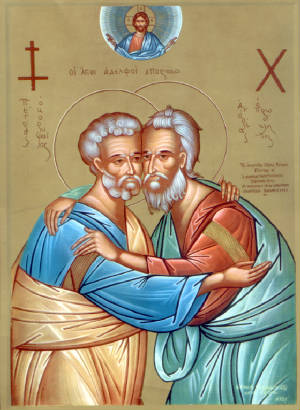
Image result for saints peter and andrew
Christ, having been lifted up from the earth has drawn all men to Himself. Rising from the dead He sent His life–giving Spirit upon His disciples and through Him has established His Body which is the Church as the universal sacrament of salvation. Sitting at the right hand of the Father, He is continually active in the world that He might lead men to the Church and through it join them to Himself and that He might make them partakers of His glorious life by nourishing them with His own Body and Blood. [Vatican Council II, Dogmatic Constitution on the Church Lumen gentium 48]
 See the source image

RITES
 
A Rite represents an ecclesiastical, or church, tradition about how the sacraments are to be celebrated. Each of the sacraments has at its core an essential nature which must be satisfied for the sacrament to be confected or realized. This essence – of matter, form and intention – derives from the divinely revealed nature of the particular sacrament. It cannot be changed by the Church. Scripture and Sacred Tradition, as interpreted by the Magisterium, tells us what is essential in each of the sacraments (2 Thes. 2:15).
 
When the apostles brought the Gospel to the major cultural centers of their day the essential elements of religious practice were inculturated into those cultures. This means that the essential elements were clothed in the symbols and trappings of the particular people, so that the rituals conveyed the desired spiritual meaning to that culture. In this way the Church becomes all things to all men that some might be saved (1 Cor. 9:22).
 
There are three major groupings of Rites based on this initial transmission of the faith, the Roman, the Antiochian (Syria) and the Alexandrian (Egypt). Later on the Byzantine derived as a major Rite from the Antiochian, under the influence of St. Basil and St. John Chrysostom. From these four derive the over 20 liturgical Rites present in the Church today.
 

CHURCHES
 
A Church is an assembly of the faithful, hierarchically ordered, both in the entire world –  the Catholic Church, or in a certain  territory – a particular Church. To be a sacrament (a sign) of the Mystical Body of Christ in the world, a Church must have both a head and members (Col. 1:18).  The sacramental sign of Christ the Head is the sacred hierarchy – the bishops, priests and deacons (Eph. 2:19–22). More specifically, it is the local bishop, with his priests and deacons gathered around and assisting him in his office of teaching, sanctifying and governing (Mt. 28:19–20; Titus 1:4–9). The sacramental sign of the Mystical Body is the Christian faithful. Thus the Church of Christ is fully present sacramentally (by way of a sign) wherever there is a sign of Christ the Head, a bishop and those who assist him, and a sign of Christ's Body, Christian faithful. Each diocese is therefore a particular Church.
 
The Church of Christ is also present sacramentally in ritual Churches that represent an ecclesiastical tradition of celebrating the sacraments. They are generally organized under a Patriarch, who together with the bishops and other clergy of that ritual Church represent Christ the Head to the people of that tradition. In some cases a Rite is completely coincident with a Church. For example, the Maronite Church with its Patriarch has a Rite not found in any other Church. In other cases, such as the Byzantine Rite, several Churches use the same or a very similar liturgical Rite. For example, the Ukrainian Catholic Church uses the Byzantine Rite, but this Rite is also found in other Catholic Churches, as well as the Eastern Orthodox Churches not in union with Rome.
 
Finally, the Church of Christ is sacramentally present in the Universal or Catholic Church spread over the entire world. It is identified by the sign of Christ our Rock, the Bishop of Rome, Successor of St. Peter (Mt. 16:18). To be Catholic particular Churches and ritual Churches must be in communion with this Head, just as the other apostles, and the Churches they founded, were in communion with Peter (Gal. 1:18). Through this communion with Peter and his successors the Church becomes a universal sacrament of salvation in all times and places, even to the end of the age (Mt. 28:20).
 

Western Rites and Churches
 
Immediately subject to the Bishop of Rome, the Supreme Pontiff, who exercises his authority over the liturgy through the Congregation for Divine Worship and the Discipline of the Sacraments.

ROMAN/LATIN FAMILY OF LITURGICAL RITES


The Church of Rome is the Primatial See of the world and one of the five Patriarchal Sees of the early Church (Rome, Constantinople, Alexandria, Antioch and Jerusalem). Founded by St. Peter in 42 AD it was consecrated by the blood of Sts. Peter and Paul during the persecution of Nero (63–67 AD). It has maintained a continual existence since then and is the source of a family of Rites in the West. Considerable scholarship (such as that of Fr. Louis Boyer in Eucharist) suggests the close affinity of the Roman Rite proper with the Jewish prayers of the synagogue, which also accompanied the Temple sacrifices. While the origin of the current Rite, even in the reform of Vatican II, can be traced directly only to the 4th century, these connections point to an ancient apostolic tradition brought to that city that was decidedly Jewish in origin.
After the Council of Trent it was necessary to consolidate liturgical doctrine and practice in the face of the Reformation. Thus, Pope St. Pius V imposed the Rite of Rome on the Latin Church (that subject to him in his capacity as Patriarch of the West), allowing only smaller Western Rites with hundreds of years of history to remain. Younger Rites of particular dioceses or regions ceased to exist.

As a consequence of the Second Vatican Council's Dogmatic Constitution on the Sacred Liturgy, Pope Paul VI undertook a reform of the Mass of the Roman Rite, promulgating a revised rite with the Missal of 1970. This Missal has since been modified twice (1975 and 2002). Mass celebrated in accordance with this missal is the Ordinary Form of the Roman Rite.
 
At the time of the revised Missal's promulgation in 1970 almost all Catholics assumed that the previous rite, that of the Missal of 1962, had been abolished. By decision of the Supreme Pontiff Benedict XVI this general assumption has been declared false and the right of Latin Rite priests to celebrate Mass according to the former missal has been affirmed (Apostolic Letter Summorum Pontificum, 7 July 2007). Mass celebrated in accordance with the Missal of 1962 constitutes the Extraordinary Form of the Roman Rite.
 
• Roman – The overwhelming majority of Latin Catholics and of Catholics in general.

– Ordinary Form of the Roman RiteMass celebrated in accordance with the Missale Romanum of 1970, promulgated by Pope Paul VI, currently in its third edition (2002). The vernacular editions of this Missal, as well as the rites of the other sacraments, are translated from the Latin typical editions revised after the Second Vatican Council.

– Extraordinary Form of the Roman RiteMass celebrated in accordance with the Missale Romanum of 1962, promulgated by Blessed Pope John XXIII. The other sacraments are celebrated according to the Roman Ritual in force at the time of the Second Vatican Council. The Extraordinary Form is most notable for being almost entirely in Latin. In addition to institutes which have the faculty to celebrate the Extraordinary Form routinely, such as the Priestly Fraternity of St. Peter and the Institute of Christ the King Sovereign Priest, any Latin Rite priest may now offer the Mass and other sacraments in accordance with norms of Summorum Pontificum.

– Anglican Use. Since the 1980s the Holy See has granted some former Anglican and Episcopal clergy converting with their parishes the faculty of celebrating the sacramental rites according to Anglican forms, doctrinally corrected.

• Mozarabic – The Rite of the Iberian peninsula (Spain and Portugal) known from at least the 6th century, but probably with roots to the original evangelization. Beginning in the 11th century it was generally replaced by the Roman Rite, although it has remained the Rite of the Cathedral of the Archdiocese of Toledo, Spain, and six parishes which sought permission to adhere to it. Its celebration today is generally semi–private.

• Ambrosian – The Rite of the Archdiocese of Milan, Italy, thought to be of early origin and probably consolidated, but not originated, by St. Ambrose. Pope Paul VI was from this Roman Rite. It continues to be celebrated in Milan, though not by all parishes.

• Bragan – Rite of the Archdiocese of Braga, the Primatial See of Portugal, it derives from the 12th century or earlier. It continues to be of occasional use.

• Dominican – Rite of the Order of Friars Preacher (OP), founded by St. Dominic in 1215.

• Carmelite – Rite of the Order of Carmel, whose modern foundation was by St. Berthold c.1154.

• Carthusian – Rite of the Carthusian Order founded by St. Bruno in 1084.
 

Eastern Rites and Churches
The Eastern Catholic Churches have their own hierarchy, system of governance (synods) and general law, the Code of Canons for the Eastern Churches. The Supreme Pontiff exercises his primacy over them through the Congregation for the Eastern Churches.

ANTIOCHIAN FAMILY OF LITURGICAL RITES

The Church of Antioch in Syria (the ancient Roman Province of Syria) is considered an apostolic See by virtue of having been founded by St. Peter. It was one of the ancient centers of the Church, as the New Testament attests, and is the source of a family of similar Rites using the ancient Syriac language (the Semitic dialect used in Jesus' time and better known as Aramaic). Its Liturgy is attributed to St. James and the Church of Jerusalem.
 
1. WEST SYRIAC

• Maronite – Never separated from Rome. Maronite Patriarch of Antioch. The liturgical language  is Aramaic. The 3 million Maronites are found in Lebanon (origin), Cyprus, Egypt, Syria, Israel, Canada, US, Mexico, Brazil, Argentina and Australia.

• Syriac – Syriac Catholics who returned to Rome in 1781 from the monophysite heresy. Syriac Patriarch of Antioch. The 110,000 Syriac Catholics are found in Syria, Lebanon, Iraq, Egypt, Canada and the US.

• Malankarese – Catholics from the South of India evangelized by St. Thomas, uses the West Syriac liturgy. Reunited with Rome in 1930. Liturgical languages today are West Syriac and Malayalam. The 350,000 Malankarese Catholics are found in India and North America.
 
2. EAST SYRIAC

• Chaldean – Babylonian Catholics returned to Rome in 1692 from the Nestorian heresy. Patriarch of Babylon of the Chaldeans. Liturgical languages are Syriac and Arabic. The 310,000 Chaldean Catholics are found in Iraq, Iran, Syria, Lebanon, Egypt, Turkey and the US.

• Syro–Malabarese – Catholics from Southern India using the East Syriac liturgy. Returned to Rome in the 16th century from the Nestorian heresy. Liturgical languages are Syriac and Malayalam. Over 3 million Syro–Malabarese Catholics can be found in the state of Kerela, in SW India.

BYZANTINE FAMILY OF LITURGICAL RITES

The Church of Constantinople became the political and religious center of the eastern Roman Empire after the Emperor Constantine built a new capital there (324–330) on the site of the ancient town of Byzantium. Constantinople developed its own liturgical rite from the Liturgy of St. James, in one form as modified by St. Basil, and in a more commonly used form, as modified by St. John Chrysostom. After 1054, except for brief periods of reunion, most Byzantine Christians have not been in communion with Rome. They make up the Orthodox Churches of the East, whose titular head is the Patriarch of Constantinople. The Orthodox Churches are mostly autocephalous, meaning self–headed, united to each other by communion with Constantinople, which exercises no real authority over them. They are typically divided into Churches along nation lines. Those that have returned to communion with the Holy See are represented among the Eastern Churches and Rites of the Catholic Church.

1. ARMENIAN

Considered either its own Rite or an older version of the Byzantine. Its exact form is not used by any other Byzantine Rite. It is composed of Catholics from the first people to convert as a nation, the Armenians (N.E. of  Turkey), and who returned to Rome at the time of the Crusades. Patriarch of Cilicia of the Armenians. The liturgical language is classical Armenian. The 350,000 Armenian Catholics are found in Armenia, Syria, Iran, Iraq, Lebanon, Turkey, Egypt, Greece, Ukraine, France, Romania, United States and Argentina. Most Armenians are Orthodox, not in union with Rome.

2. BYZANTINE

• Albanian – Albanian Christians, numbering only 1400 today, who resumed communion with Rome in 1628. Liturgical language is Albanian. Most Albanian Christians are Albanian Orthodox.

• Belarussian/Byelorussian – Unknown number of Belarussians who returned to Rome in the 17th century. The liturgical language is Old Slavonic. The faithful can be found in Belarus, as well as Europe, the Americas and Australia.

• Bulgarian – Bulgarians who returned to Rome in 1861. Liturgical language is Old Slavonic. The 20,000 faithful can be found in Bulgaria. Most Bulgarian Christians are Bulgarian Orthodox.

• Czech – Czech Catholics of Byzantine Rite organized into a jurisdiction in 1996.

• Krizevci – Croatian Catholics of Byzantine Rite who resumed communion with Rome in 1611. The liturgical language is Old Slavonic.  The 50,000 faithful can be found in Croatia and the Americas. Most Croatians are Roman (Rite) Catholics.

• Greek – Greek Christians who returned to Rome in 1829. The liturgical language is Greek. Only 2500 faithful in Greece, Asia Minor (Turkey) and Europe. Greek Christians are almost all Orthodox, whose Patriarch is the Orthodox Patriarch of Constantinople.

• Hungarian – Descendants of Ruthenians who returned to Rome in 1646. The liturgical languages are Greek, Hungarian and English. The 300,000 faithful are found in Hungary, Europe and the Americas.

• Italo–Albanian – Never separated from Rome, these 60,000 Byzantine Rite Catholics are found in Italy, Sicily, Malta (added by this Blog) and the Americas. The liturgical languages are Greek and Italo–Albanian.

• Melkite – Catholics from among those separated from Rome in Syria and Egypt who resumed Communion with Rome at the time of the Crusades. However, definitive union only came in the 18th century. Melkite Greek Patriarch of Damascus. Liturgical languages are Greek, Arabic, English, Portuguese and Spanish. The over 1 million Melkite Catholics can be found in Syria, Lebanon, Jordan, Israel, Canada, US, Mexico, Brazil, Venezuela, Argentina and Australia.

• Romanian – Romanians who returned to Rome in 1697. The liturgical language is Romanian. There are over 1 million Romanian Catholics in Romania, Europe and the Americas. Most Romanian Christians are Romanian Orthodox.

• Russian – Russians who returned to communion with Rome in 1905. The liturgical language is Old Slavonic. An unknown number of the faithful in Russia, China, the Americas and Australia. Most Russian Christians are Russian Orthodox, whose Patriarch is the Orthodox Patriarch of Moscow.

• Ruthenian – Catholics from among those separated from Rome in Russia, Hungary and Croatia who reunited with Rome in 1596 (Brest–Litovsk) and 1646 (Uzhorod).

• Slovak – Byzantine Rite Catholics of Slovakian origin numbering 225,000 and found in Slovakia and Canada.

• Ukrainian – Catholics from among those separated from Rome by the Greek Schism and reunited about 1595. Patriarch or Metropolitan of Lviv. Liturgical languages are Old Slavonic and the vernacular. The 5.5 million Ukrainian Catholics can be found in Ukraine, Poland, England, Germany, France, Canada, US, Brazil, Argentina and Australia. During the Soviet era Ukrainian Catholics were violently forced to join the Ukrainian Orthodox Church. Their hierarchy, which continued to exist outside the homeland, has since been re–established in Ukraine.
 

ALEXANDRIAN FAMILY OF LITURGICAL RITES

The Church of Alexandria in Egypt was one of the original centers of Christianity, since like Rome and Antioch it had a large Jewish population which was the initial object of apostolic evangelization. Its Liturgy is attributed to St. Mark the Evangelist, and shows the later influence of the Byzantine Liturgy, in addition to its unique elements.
 
• Coptic – Egyptian Catholics who returned to communion with Rome in 1741. The Patriarch of Alexandria leads the 200,000 faithful of this ritual Church spread throughout Egypt and the Near East.  The liturgical languages are Coptic (Egyptian) and Arabic. Most Copts are not Catholics.
 
• Ethiopian/Abyssinian – Ethiopian Coptic Christians who returned to Rome in 1846. The liturgical language is Geez. The 200,000 faithful are found in Ethiopia, Eritrea,  Somalia, and Jerusalem.


Colin B. Donovan, STL (originally published on EWTN website)