Showing posts with label Magisterium. Show all posts

Tuesday, September 1, 2020

Crisis in the Church according to Fr. Alfredo Morselli

Don Alfredo Morselli: Dio è cattolico – Cristianesimo Cattolico

Fr. Alfredo Morselli's “Thesis on the Council” can be explained briefly as follows:

1 The present crisis is of unprecedented gravity, essentially neo-modernist, but much graver than the original modernist crisis at the beginning of the 20th century.

2 However, Vatican II is not simply the cause of the present crisis, because:

2.1 The crisis began long before 1960,

2.2 its neo-modernism would never have taken root without the deep corruption of modern man, and

2.3 similarly the pontificate of Pope Francis was prepared long before the 21st century.

3 We must distinguish between the Council itself and the post-Council, or aftermath of the Council:

3.1 The Council cannot be blamed for all errors attributed to it, even if they were done in its name,

3.2 The Holy Spirit was at the Council, so that one cannot say there was no good at all in the Council.

4 The Council texts do include ambiguous formulae, which give the neo-modernists an opening.

5 Almost all these problems have been solved subsequently by official Church Declarations.

6 The problems represent not so much errors as the desire to be inclusive rather than exclusive.

7 A tragic example of that desire is the Council’s refusal to condemn Communism.

8 Calling the Council “pastoral” does not mean that there is nothing dogmatic in its pronouncements.

9 One may only criticize the Council in accordance with Church teaching on the Faith. Hence

9.1 Faith means believing God, i.e. accepting and not choosing what truths one will believe.

9.2 The Catholic Church’s Magisterium is the prime decider of which are those truths to believe.

9.3 That Magisterium is not open to private interpretation. It alone can interpret its own decisions.

Monday, November 25, 2019

Quotes to reflect upon (20)


We hold fast, with all our heart and with all our soul, to Catholic Rome, Guardian of the Catholic Faith and of the traditions necessary to preserve this faith, to Eternal Rome, Mistress of wisdom and truth.
We refuse, on the other hand, and have always refused to follow the Rome of neo-Modernist and neo-Protestant tendencies which were clearly evident in the Second Vatican Council and, after the Council, in all the reforms which issued from it.
All these reforms, indeed, have contributed and are still contributing to the destruction of the Church, to the ruin of the priesthood, to the abolition of the Sacrifice of the Mass and of the sacraments, to the disappearance of religious life, to a naturalist and Teilhardian teaching in universities, seminaries and catechists; a teaching derived from Liberalism and Protestantism, many times condemned by the solemn Magisterium of the Church.
No authority, not even the highest in the hierarchy, can force us to abandon or diminish our Catholic Faith, so clearly expressed and professed by the Church’s Magisterium for nineteen centuries.
“But though we,” says St. Paul, “or an angel from heaven preach a gospel to you besides that which we have preached to you, let him be anathema” (Gal. 1:8).
Is it not this that the Holy Father is repeating to us today? And if we can discern a certain contradiction in his words and deeds, as well as in those of the dicasteries, well we choose what was always taught and we turn a deaf ear to the novelties destroying the Church.
It is impossible to modify profoundly the lex orandi without modifying the lex credendi. To the Novus Ordo Missae correspond a new catechism, a new priesthood, new seminaries, a charismatic Pentecostal Church—all things opposed to orthodoxy and the perennial teaching of the Church.
This Reformation, born of Liberalism and Modernism, is poisoned through and through; it derives from heresy and ends in heresy, even if all its acts are not formally heretical. It is therefore impossible for any conscientious and faithful Catholic to espouse this Reformation or to submit to it in any way whatsoever.
The only attitude of faithfulness to the Church and Catholic doctrine, in view of our salvation, is a categorical refusal to accept this Reformation.
That is why, without any spirit of rebellion, bitterness or resentment, we pursue our work of forming priests, with the timeless Magisterium as our guide. We are persuaded that we can render no greater service to the Holy Catholic Church, to the Sovereign Pontiff and to posterity.
That is why we hold fast to all that has been believed and practiced in the faith, morals, liturgy, teaching of the catechism, formation of the priest and institution of the Church, by the Church of all time; to all these things as codified in those books which saw day before the Modernist influence of the Council. This we shall do until such time that the true light of Tradition dissipates the darkness obscuring the sky of Eternal Rome.
By doing this, with the grace of God and the help of the Blessed Virgin Mary, and that of St. Joseph and St. Pius X, we are assured of remaining faithful to the Roman Catholic Church and to all the successors of Peter, and of being the fideles dispensatores mysteriorum Domini Nostri Jesu Christi in Spiritu Sancto. Amen.
Archbishop Marcel Lefebvre
21 November, 1974
Ecône, Switzerland

Thursday, August 22, 2019

Catholic Rites and Churches

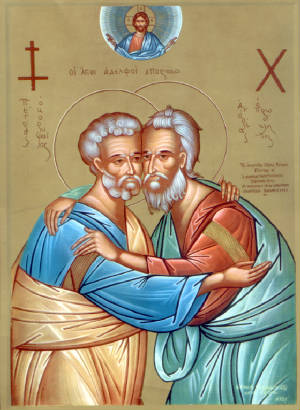
Image result for saints peter and andrew
Christ, having been lifted up from the earth has drawn all men to Himself. Rising from the dead He sent His life–giving Spirit upon His disciples and through Him has established His Body which is the Church as the universal sacrament of salvation. Sitting at the right hand of the Father, He is continually active in the world that He might lead men to the Church and through it join them to Himself and that He might make them partakers of His glorious life by nourishing them with His own Body and Blood. [Vatican Council II, Dogmatic Constitution on the Church Lumen gentium 48]
 See the source image

RITES
 
A Rite represents an ecclesiastical, or church, tradition about how the sacraments are to be celebrated. Each of the sacraments has at its core an essential nature which must be satisfied for the sacrament to be confected or realized. This essence – of matter, form and intention – derives from the divinely revealed nature of the particular sacrament. It cannot be changed by the Church. Scripture and Sacred Tradition, as interpreted by the Magisterium, tells us what is essential in each of the sacraments (2 Thes. 2:15).
 
When the apostles brought the Gospel to the major cultural centers of their day the essential elements of religious practice were inculturated into those cultures. This means that the essential elements were clothed in the symbols and trappings of the particular people, so that the rituals conveyed the desired spiritual meaning to that culture. In this way the Church becomes all things to all men that some might be saved (1 Cor. 9:22).
 
There are three major groupings of Rites based on this initial transmission of the faith, the Roman, the Antiochian (Syria) and the Alexandrian (Egypt). Later on the Byzantine derived as a major Rite from the Antiochian, under the influence of St. Basil and St. John Chrysostom. From these four derive the over 20 liturgical Rites present in the Church today.
 

CHURCHES
 
A Church is an assembly of the faithful, hierarchically ordered, both in the entire world –  the Catholic Church, or in a certain  territory – a particular Church. To be a sacrament (a sign) of the Mystical Body of Christ in the world, a Church must have both a head and members (Col. 1:18).  The sacramental sign of Christ the Head is the sacred hierarchy – the bishops, priests and deacons (Eph. 2:19–22). More specifically, it is the local bishop, with his priests and deacons gathered around and assisting him in his office of teaching, sanctifying and governing (Mt. 28:19–20; Titus 1:4–9). The sacramental sign of the Mystical Body is the Christian faithful. Thus the Church of Christ is fully present sacramentally (by way of a sign) wherever there is a sign of Christ the Head, a bishop and those who assist him, and a sign of Christ's Body, Christian faithful. Each diocese is therefore a particular Church.
 
The Church of Christ is also present sacramentally in ritual Churches that represent an ecclesiastical tradition of celebrating the sacraments. They are generally organized under a Patriarch, who together with the bishops and other clergy of that ritual Church represent Christ the Head to the people of that tradition. In some cases a Rite is completely coincident with a Church. For example, the Maronite Church with its Patriarch has a Rite not found in any other Church. In other cases, such as the Byzantine Rite, several Churches use the same or a very similar liturgical Rite. For example, the Ukrainian Catholic Church uses the Byzantine Rite, but this Rite is also found in other Catholic Churches, as well as the Eastern Orthodox Churches not in union with Rome.
 
Finally, the Church of Christ is sacramentally present in the Universal or Catholic Church spread over the entire world. It is identified by the sign of Christ our Rock, the Bishop of Rome, Successor of St. Peter (Mt. 16:18). To be Catholic particular Churches and ritual Churches must be in communion with this Head, just as the other apostles, and the Churches they founded, were in communion with Peter (Gal. 1:18). Through this communion with Peter and his successors the Church becomes a universal sacrament of salvation in all times and places, even to the end of the age (Mt. 28:20).
 

Western Rites and Churches
 
Immediately subject to the Bishop of Rome, the Supreme Pontiff, who exercises his authority over the liturgy through the Congregation for Divine Worship and the Discipline of the Sacraments.

ROMAN/LATIN FAMILY OF LITURGICAL RITES


The Church of Rome is the Primatial See of the world and one of the five Patriarchal Sees of the early Church (Rome, Constantinople, Alexandria, Antioch and Jerusalem). Founded by St. Peter in 42 AD it was consecrated by the blood of Sts. Peter and Paul during the persecution of Nero (63–67 AD). It has maintained a continual existence since then and is the source of a family of Rites in the West. Considerable scholarship (such as that of Fr. Louis Boyer in Eucharist) suggests the close affinity of the Roman Rite proper with the Jewish prayers of the synagogue, which also accompanied the Temple sacrifices. While the origin of the current Rite, even in the reform of Vatican II, can be traced directly only to the 4th century, these connections point to an ancient apostolic tradition brought to that city that was decidedly Jewish in origin.
After the Council of Trent it was necessary to consolidate liturgical doctrine and practice in the face of the Reformation. Thus, Pope St. Pius V imposed the Rite of Rome on the Latin Church (that subject to him in his capacity as Patriarch of the West), allowing only smaller Western Rites with hundreds of years of history to remain. Younger Rites of particular dioceses or regions ceased to exist.

As a consequence of the Second Vatican Council's Dogmatic Constitution on the Sacred Liturgy, Pope Paul VI undertook a reform of the Mass of the Roman Rite, promulgating a revised rite with the Missal of 1970. This Missal has since been modified twice (1975 and 2002). Mass celebrated in accordance with this missal is the Ordinary Form of the Roman Rite.
 
At the time of the revised Missal's promulgation in 1970 almost all Catholics assumed that the previous rite, that of the Missal of 1962, had been abolished. By decision of the Supreme Pontiff Benedict XVI this general assumption has been declared false and the right of Latin Rite priests to celebrate Mass according to the former missal has been affirmed (Apostolic Letter Summorum Pontificum, 7 July 2007). Mass celebrated in accordance with the Missal of 1962 constitutes the Extraordinary Form of the Roman Rite.
 
• Roman – The overwhelming majority of Latin Catholics and of Catholics in general.

– Ordinary Form of the Roman RiteMass celebrated in accordance with the Missale Romanum of 1970, promulgated by Pope Paul VI, currently in its third edition (2002). The vernacular editions of this Missal, as well as the rites of the other sacraments, are translated from the Latin typical editions revised after the Second Vatican Council.

– Extraordinary Form of the Roman RiteMass celebrated in accordance with the Missale Romanum of 1962, promulgated by Blessed Pope John XXIII. The other sacraments are celebrated according to the Roman Ritual in force at the time of the Second Vatican Council. The Extraordinary Form is most notable for being almost entirely in Latin. In addition to institutes which have the faculty to celebrate the Extraordinary Form routinely, such as the Priestly Fraternity of St. Peter and the Institute of Christ the King Sovereign Priest, any Latin Rite priest may now offer the Mass and other sacraments in accordance with norms of Summorum Pontificum.

– Anglican Use. Since the 1980s the Holy See has granted some former Anglican and Episcopal clergy converting with their parishes the faculty of celebrating the sacramental rites according to Anglican forms, doctrinally corrected.

• Mozarabic – The Rite of the Iberian peninsula (Spain and Portugal) known from at least the 6th century, but probably with roots to the original evangelization. Beginning in the 11th century it was generally replaced by the Roman Rite, although it has remained the Rite of the Cathedral of the Archdiocese of Toledo, Spain, and six parishes which sought permission to adhere to it. Its celebration today is generally semi–private.

• Ambrosian – The Rite of the Archdiocese of Milan, Italy, thought to be of early origin and probably consolidated, but not originated, by St. Ambrose. Pope Paul VI was from this Roman Rite. It continues to be celebrated in Milan, though not by all parishes.

• Bragan – Rite of the Archdiocese of Braga, the Primatial See of Portugal, it derives from the 12th century or earlier. It continues to be of occasional use.

• Dominican – Rite of the Order of Friars Preacher (OP), founded by St. Dominic in 1215.

• Carmelite – Rite of the Order of Carmel, whose modern foundation was by St. Berthold c.1154.

• Carthusian – Rite of the Carthusian Order founded by St. Bruno in 1084.
 

Eastern Rites and Churches
The Eastern Catholic Churches have their own hierarchy, system of governance (synods) and general law, the Code of Canons for the Eastern Churches. The Supreme Pontiff exercises his primacy over them through the Congregation for the Eastern Churches.

ANTIOCHIAN FAMILY OF LITURGICAL RITES

The Church of Antioch in Syria (the ancient Roman Province of Syria) is considered an apostolic See by virtue of having been founded by St. Peter. It was one of the ancient centers of the Church, as the New Testament attests, and is the source of a family of similar Rites using the ancient Syriac language (the Semitic dialect used in Jesus' time and better known as Aramaic). Its Liturgy is attributed to St. James and the Church of Jerusalem.
 
1. WEST SYRIAC

• Maronite – Never separated from Rome. Maronite Patriarch of Antioch. The liturgical language  is Aramaic. The 3 million Maronites are found in Lebanon (origin), Cyprus, Egypt, Syria, Israel, Canada, US, Mexico, Brazil, Argentina and Australia.

• Syriac – Syriac Catholics who returned to Rome in 1781 from the monophysite heresy. Syriac Patriarch of Antioch. The 110,000 Syriac Catholics are found in Syria, Lebanon, Iraq, Egypt, Canada and the US.

• Malankarese – Catholics from the South of India evangelized by St. Thomas, uses the West Syriac liturgy. Reunited with Rome in 1930. Liturgical languages today are West Syriac and Malayalam. The 350,000 Malankarese Catholics are found in India and North America.
 
2. EAST SYRIAC

• Chaldean – Babylonian Catholics returned to Rome in 1692 from the Nestorian heresy. Patriarch of Babylon of the Chaldeans. Liturgical languages are Syriac and Arabic. The 310,000 Chaldean Catholics are found in Iraq, Iran, Syria, Lebanon, Egypt, Turkey and the US.

• Syro–Malabarese – Catholics from Southern India using the East Syriac liturgy. Returned to Rome in the 16th century from the Nestorian heresy. Liturgical languages are Syriac and Malayalam. Over 3 million Syro–Malabarese Catholics can be found in the state of Kerela, in SW India.

BYZANTINE FAMILY OF LITURGICAL RITES

The Church of Constantinople became the political and religious center of the eastern Roman Empire after the Emperor Constantine built a new capital there (324–330) on the site of the ancient town of Byzantium. Constantinople developed its own liturgical rite from the Liturgy of St. James, in one form as modified by St. Basil, and in a more commonly used form, as modified by St. John Chrysostom. After 1054, except for brief periods of reunion, most Byzantine Christians have not been in communion with Rome. They make up the Orthodox Churches of the East, whose titular head is the Patriarch of Constantinople. The Orthodox Churches are mostly autocephalous, meaning self–headed, united to each other by communion with Constantinople, which exercises no real authority over them. They are typically divided into Churches along nation lines. Those that have returned to communion with the Holy See are represented among the Eastern Churches and Rites of the Catholic Church.

1. ARMENIAN

Considered either its own Rite or an older version of the Byzantine. Its exact form is not used by any other Byzantine Rite. It is composed of Catholics from the first people to convert as a nation, the Armenians (N.E. of  Turkey), and who returned to Rome at the time of the Crusades. Patriarch of Cilicia of the Armenians. The liturgical language is classical Armenian. The 350,000 Armenian Catholics are found in Armenia, Syria, Iran, Iraq, Lebanon, Turkey, Egypt, Greece, Ukraine, France, Romania, United States and Argentina. Most Armenians are Orthodox, not in union with Rome.

2. BYZANTINE

• Albanian – Albanian Christians, numbering only 1400 today, who resumed communion with Rome in 1628. Liturgical language is Albanian. Most Albanian Christians are Albanian Orthodox.

• Belarussian/Byelorussian – Unknown number of Belarussians who returned to Rome in the 17th century. The liturgical language is Old Slavonic. The faithful can be found in Belarus, as well as Europe, the Americas and Australia.

• Bulgarian – Bulgarians who returned to Rome in 1861. Liturgical language is Old Slavonic. The 20,000 faithful can be found in Bulgaria. Most Bulgarian Christians are Bulgarian Orthodox.

• Czech – Czech Catholics of Byzantine Rite organized into a jurisdiction in 1996.

• Krizevci – Croatian Catholics of Byzantine Rite who resumed communion with Rome in 1611. The liturgical language is Old Slavonic.  The 50,000 faithful can be found in Croatia and the Americas. Most Croatians are Roman (Rite) Catholics.

• Greek – Greek Christians who returned to Rome in 1829. The liturgical language is Greek. Only 2500 faithful in Greece, Asia Minor (Turkey) and Europe. Greek Christians are almost all Orthodox, whose Patriarch is the Orthodox Patriarch of Constantinople.

• Hungarian – Descendants of Ruthenians who returned to Rome in 1646. The liturgical languages are Greek, Hungarian and English. The 300,000 faithful are found in Hungary, Europe and the Americas.

• Italo–Albanian – Never separated from Rome, these 60,000 Byzantine Rite Catholics are found in Italy, Sicily, Malta (added by this Blog) and the Americas. The liturgical languages are Greek and Italo–Albanian.

• Melkite – Catholics from among those separated from Rome in Syria and Egypt who resumed Communion with Rome at the time of the Crusades. However, definitive union only came in the 18th century. Melkite Greek Patriarch of Damascus. Liturgical languages are Greek, Arabic, English, Portuguese and Spanish. The over 1 million Melkite Catholics can be found in Syria, Lebanon, Jordan, Israel, Canada, US, Mexico, Brazil, Venezuela, Argentina and Australia.

• Romanian – Romanians who returned to Rome in 1697. The liturgical language is Romanian. There are over 1 million Romanian Catholics in Romania, Europe and the Americas. Most Romanian Christians are Romanian Orthodox.

• Russian – Russians who returned to communion with Rome in 1905. The liturgical language is Old Slavonic. An unknown number of the faithful in Russia, China, the Americas and Australia. Most Russian Christians are Russian Orthodox, whose Patriarch is the Orthodox Patriarch of Moscow.

• Ruthenian – Catholics from among those separated from Rome in Russia, Hungary and Croatia who reunited with Rome in 1596 (Brest–Litovsk) and 1646 (Uzhorod).

• Slovak – Byzantine Rite Catholics of Slovakian origin numbering 225,000 and found in Slovakia and Canada.

• Ukrainian – Catholics from among those separated from Rome by the Greek Schism and reunited about 1595. Patriarch or Metropolitan of Lviv. Liturgical languages are Old Slavonic and the vernacular. The 5.5 million Ukrainian Catholics can be found in Ukraine, Poland, England, Germany, France, Canada, US, Brazil, Argentina and Australia. During the Soviet era Ukrainian Catholics were violently forced to join the Ukrainian Orthodox Church. Their hierarchy, which continued to exist outside the homeland, has since been re–established in Ukraine.
 

ALEXANDRIAN FAMILY OF LITURGICAL RITES

The Church of Alexandria in Egypt was one of the original centers of Christianity, since like Rome and Antioch it had a large Jewish population which was the initial object of apostolic evangelization. Its Liturgy is attributed to St. Mark the Evangelist, and shows the later influence of the Byzantine Liturgy, in addition to its unique elements.
 
• Coptic – Egyptian Catholics who returned to communion with Rome in 1741. The Patriarch of Alexandria leads the 200,000 faithful of this ritual Church spread throughout Egypt and the Near East.  The liturgical languages are Coptic (Egyptian) and Arabic. Most Copts are not Catholics.
 
• Ethiopian/Abyssinian – Ethiopian Coptic Christians who returned to Rome in 1846. The liturgical language is Geez. The 200,000 faithful are found in Ethiopia, Eritrea,  Somalia, and Jerusalem.


Colin B. Donovan, STL (originally published on EWTN website)

Monday, June 25, 2018

A 'fraternal' organisation to Pro Tridentina (Malta)


A new organisation with complementary aims to Pro Tridentina (Malta) was founded some months ago. Pro Malta Christiana, or Maltese Foundation for a Christian Civilisation, is a Voluntary, Non-Profit Making Organisation with Registered Charitable Status.
 
The present official address Flat 4, Victoria Mansions, Victoria Junction, Sliema, SLM 1833, Malta, according to Article 2 of the provisional statutes.

According to Article 3, the aim of the Society shall be the promotion and defense of the ideals and values of Christian Civilisation in Malta. These principles are expounded in the work Revolution and Counter-Revolution authored by Professor Plinio Correa de Oliveira in 1959. 


The Society is committed to promoting and defending:

-          the traditions in Malta and Gozo that give the Maltese Islands their distinct cultural identity, and which have a foundation in the islands’ heritage of two thousand years of Christian civilization;

-          the natural and traditional family based on the indissoluble bond of marriage of one man and one woman in line with the traditional Magisterium of the Roman Catholic and Apostolic Church;

-          the principle and right of individuals to own property, in consonance with the teaching of the Catholic Church that private ownership is one of the pillars of the natural law, with said right having a social function which it must fulfill in all of its extension.

 
The Objectives of said organisation are:
 
To defend and promote, on a national level, the Christian traditions of the Maltese nation.
 
To defend and promote, on a national level, the right of private ownership of property in line with the traditional Magisterium of the Catholic Church.
 
To defend and promote, on a national level, the natural and traditional family, based on the indissoluble bond of marriage between a man and a woman.

To defend and promote the right to life – understood as the inalienable right to be born - in the Maltese islands and actively oppose all forms of abortion and infanticide.
 
To provide support and information for all legal groups, entities and other organizations seeking to enhance and promote the ideals of tradition, family and property.
 
To educate the Maltese populace, thereby raising public awareness on a national level of the importance of promoting, fostering and defending the ideals of Christian Civilization and especially those ideals relating to tradition, family and property.
 
To perform works of charity and philanthropy in line with the Society/Foundation’s commitment to the perennial ideals of Christian Civilization by disseminating publications, religious objects and miscellaneous articles, and through other standard works of charity analogous to those practiced by the Catholic Church over the centuries.
 
To raise funds for the Society / Foundation by means of donations of members, supporters, and volunteers or otherwise for all the purposes of the Society / Foundation  through requests for donations for objects, publications, research and materials distributed, through public campaigns and specific requests for donations, as well as through other means of fund-raising that are both authorized by the National Council and consonant with the Society’s / Foundation’s status as a voluntary, non-profit making organization with registered charity status in Malta.
 
To promote and present the interests of the Society / Foundation and of its members to the notice of local administration and authorities, international Organisations and other authorities.

To enhance the level of cultural attainment in Malta among its members, supporters, donors and volunteers and among the general populace through the holding of cultural public manifestations that are inspired by the traditional Magisterium of the Catholic Church.
 
To form part of any national/international Organisation/s whose aims are similar to that of the Organisation.
 
To promote, encourage and promote research in the subject areas of sociology, anthropology, pure and applied science, religious doctrine, philosophy, theology, ethics and economics, and which relate to the defense and promotion of the ideals of Christian Civilisation and to publish and disseminate the results of said research.   

To do all that which is ancillary, incidental or conducive to the attainment of the above objectives.
 
Pro Tridentina (Malta) wishes all the best to this organisation, led by Pro Tridentina (Malta) founder, Philip Beattie. The co-operation between Pro Malta Christiana and ASPM's Chaplain Canon Nicholas Doublet (former member of Pro Tridentina (Malta) is also a step in the right direction.


Thursday, February 1, 2018

Profession of the immutable truths about sacramental marriage


After the publication of the Apostolic Exhortation "Amoris Laetitia" (2016) various bishops issued at local, regional, and national levels applicable norms regarding the sacramental discipline of those faithful, called "divorced and remarried," who having still a living spouse to whom they are united with a valid sacramental matrimonial bond, have nevertheless begun a stable cohabitation more uxorio with a person who is not their legitimate spouse.

The aforementioned rules provide inter alia that in individual cases the persons, called "divorced and remarried," may receive the sacrament of Penance and Holy Communion, while continuing to live habitually and intentionally more uxorio with a person who is not their legitimate spouse. These pastoral norms have received approval from various hierarchical authorities. Some of these norms have received approval even from the supreme authority of the Church.
The spread of these ecclesiastically approved pastoral norms has caused a considerable and ever increasing confusion among the faithful and the clergy, a confusion that touches the central manifestations of the life of the Church, such as sacramental marriage with the family, the domestic church, and the sacrament of the Most Holy Eucharist.

According to the doctrine of the Church, only the sacramental matrimonial bond constitutes a domestic church (see Second Vatican Council, Lumen Gentium, 11). The admission of so-called "divorced and remarried" faithful to Holy Communion, which is the highest expression of the unity of Christ the Spouse with His Church, means in practice a way of approving or legitimizing divorce, and in this meaning a kind of introduction of divorce in the life of the Church.

The mentioned pastoral norms are revealed in practice and in time as a means of spreading the "plague of divorce" (an expression used by the Second Vatican Council, see Gaudium et spes, 47). It is a matter of spreading the "plague of divorce" even in the life of the Church, when the Church, instead, because of her unconditional fidelity to the doctrine of Christ, should be a bulwark and an unmistakable sign of contradiction against the plague of divorce which is every day more rampant in civil society.
Unequivocally and without admitting any exception Our Lord and Redeemer Jesus Christ solemnly reaffirmed God's will regarding the absolute prohibition of divorce. An approval or legitimation of the violation of the sacredness of the marriage bond, even indirectly through the mentioned new sacramental discipline, seriously contradicts God's express will and His commandment. This practice therefore represents a substantial alteration of the two thousand-year-old sacramental discipline of the Church. Furthermore, a substantially altered discipline will eventually lead to an alteration in the corresponding doctrine.

The constant Magisterium of the Church, beginning with the teachings of the Apostles and of all the Supreme Pontiffs, has preserved and faithfully transmitted both in the doctrine (in theory) and in the sacramental discipline (in practice) in an unequivocal way, without any shadow of doubt and always in the same sense and in the same meaning (eodem sensu eademque sententia), the crystalline teaching of Christ concerning the indissolubility of marriage.
Because of its Divinely established nature, the discipline of the sacraments must never contradict the revealed word of God and the faith of the Church in the absolute indissolubility of a ratified and consummated marriage. "The sacraments not only presuppose faith, but by words and objects they also nourish, strengthen, and express it; that is why they are called "sacraments of faith." (Second Vatican Council, Sacrosanctum Concilium, 59). "Even the supreme authority in the Church may not change the liturgy arbitrarily, but only in the obedience of faith and with religious respect for the mystery of the liturgy" (Catechism of the Catholic Church, 1125).

The Catholic faith by its nature excludes a formal contradiction between the faith professed on the one hand and the life and practice of the sacraments on the other. In this sense we can also understand the following affirmation of the Magisterium: "This split between the faith which many profess and their daily lives deserves to be counted among the more serious errors of our age." (Second Vatican Council, Gaudium et Spes, 43) and "Accordingly, the concrete pedagogy of the Church must always remain linked with her doctrine and never be separated from it" (John Paul II, Apostolic Exhortation Familiaris Consortio, 33).
In view of the vital importance that the doctrine and discipline of marriage and the Eucharist constitute, the Church is obliged to speak with the same voice. The pastoral norms regarding the indissolubility of marriage must not, therefore, be contradicted between one diocese and another, between one country and another. Since the time of the Apostles, the Church has observed this principle as St. Irenaeus of Lyons testifies: "The Church, though spread throughout the world to the ends of the earth, having received the faith from the Apostles and their disciples, preserves this preaching and this faith with care and, as if she inhabits a single house, believes in the same identical way, as if she had only one soul and only one heart, and preaches the truth of the faith, teaches it and transmits it in a unanimous voice, as if she had only one mouth"(Adversus haereses, I, 10, 2). Saint Thomas Aquinas transmits to us the same perennial principle of the life of the Church: "There is one and the same faith of the ancients and the moderns, otherwise there would not be one and the same Church" (Questiones Disputatae de Veritate, q. 14, a. 12c).

The following warning from Pope John Paul II remains current and valid: "The confusion, created in the conscience of many faithful by the differences of opinions and teachings in theology, in preaching, in catechesis, in spiritual direction, about serious and delicate questions of Christian morals, ends up by diminishing the true sense of sin almost to the point of eliminating it" (Apostolic Exhortation Reconciliatio et Paenitenia, 18).
The meaning of the following statements of the Magisterium of the Church is fully applicable to the doctrine and sacramental discipline concerning the indissolubility of a ratified and consummated marriage:

• "For the Church of Christ, watchful guardian that she is, and defender of the dogmas deposited with her, never changes anything, never diminishes anything, never adds anything to them; but with all diligence she treats the ancient doctrines faithfully and wisely, which the faith of the Fathers has transmitted. She strives to investigate and explain them in such a way that the ancient dogmas of heavenly doctrine will be made evident and clear, but will retain their full, integral, and proper nature, and will grow only within their own genus — that is, within the same dogma, in the same sense and the same meaning” (Pius IX, Dogmatic Bull Ineffabilis Deus)
• "With regard to the very substance of truth, the Church has before God and men the sacred duty to announce it, to teach it without any attenuation, as Christ revealed it, and there is no condition of time that can reduce the rigor of this obligation. It binds in conscience every priest who is entrusted with the care of teaching, admonishing, and guiding the faithful "(Pius XII, Discourse to parish priests and Lenten preachers, March 23, 1949).

• "The Church does not historicize, does not relativize to the metamorphoses of profane culture the nature of the Church that is always equal and faithful to itself, as Christ wanted it and authentic tradition perfected it" (Paul VI, Homily from October 28, 1965).
• "Now it is an outstanding manifestation of charity toward souls to omit nothing from the saving doctrine of Christ" (Paul VI, Encyclical Humanae Vitae, 29).

• "Any conjugal difficulties are resolved without ever falsifying and compromising the truth" (John Paul II, Apostolic Exhortation Familiaris Consortio, 33).
• "The Church is in no way the author or the arbiter of this norm [of the Divine moral law]. In obedience to the truth which is Christ, whose image is reflected in the nature and dignity of the human person, the Church interprets the moral norm and proposes it to all people of good will, without concealing its demands of radicalness and perfection" (John Paul II, Apostolic Exhortation Familiaris Consortio, 33).

• “The other principle is that of truth and consistency, whereby the church does not agree to call good evil and evil good. Basing herself on these two complementary principles, the church can only invite her children who find themselves in these painful situations to approach the divine mercy by other ways, not however through the sacraments of penance and the eucharist until such time as they have attained the required dispositions” (John Paul II, Apostolic Exhortation Reconciliatio et Paenitentia, 34).
• "The Church's firmness in defending the universal and unchanging moral norms is not demeaning at all. Its only purpose is to serve man's true freedom. Because there can be no freedom apart from or in opposition to the truth"(John Paul II, Encyclical Veritatis Splendor, 96).

• “When it is a matter of the moral norms prohibiting intrinsic evil, there are no privileges or exceptions for anyone. It makes no difference whether one is the master of the world or the "poorest of the poor" on the face of the earth. Before the demands of morality we are all absolutely equal" (emphasis in original) (John Paul II, Encyclical Veritatis Splendor, 96).
• "The obligation of reiterating this impossibility of admission to the Eucharist is required for genuine pastoral care and for an authentic concern for the well-being of these faithful and of the whole Church, as it indicates the conditions necessary for the fullness of that conversion to which all are always invited by the Lord“ (Pontifical Council for Legislative Texts, Declaration on the admissibility to the Holy Communion of the divorced and remarried, 24 June 2000, n. 5).

As Catholic bishops, who - according to the teaching of the Second Vatican Council - must defend the unity of faith and the common discipline of the Church, and take care that the light of the full truth should arise for all men (see Lumen Gentium, 23) we are forced in conscience to profess in the face of the current rampant confusion the unchanging truth and the equally immutable sacramental discipline regarding the indissolubility of marriage according to the bimillennial and unaltered teaching of the Magisterium of the Church. In this spirit we reiterate:


• Sexual relationships between people who are not in the bond to one another of a valid marriage - which occurs in the case of the so-called "divorced and remarried" - are always contrary to God's will and constitute a grave offense against God.
• No circumstance or finality, not even a possible imputability or diminished guilt, can make such sexual relations a positive moral reality and pleasing to God. The same applies to the other negative precepts of the Ten Commandments of God. Since “there exist acts which, per se and in themselves, independently of circumstances, are always seriously wrong by reason of their object" (John Paul II, Apostolic Exhortation Reconciliatio et Paenitentia, 17).

• The Church does not possess the infallible charism of judging the internal state of grace of a member of the faithful (see Council of Trent, session 24, chapter 1). The non-admission to Holy Communion of the so-called "divorced and remarried" does not therefore mean a judgment on their state of grace before God, but a judgment on the visible, public, and objective character of their situation. Because of the visible nature of the sacraments and of the Church herself, the reception of the sacraments necessarily depends on the corresponding visible and objective situation of the faithful.
• It is not morally licit to engage in sexual relations with a person who is not one’s legitimate spouse supposedly to avoid another sin. Since the Word of God teaches us, it is not lawful "to do evil so that good may come" (Romans 3, 8).

• The admission of such persons to Holy Communion may be permitted only when they with the help of God's grace and a patient and individual pastoral accompaniment make a sincere intention to cease from now on the habit of such sexual relations and to avoid scandal. It is in this way that true discernment and authentic pastoral accompaniment were always expressed in the Church.
• People who have habitual non-marital sexual relations violate their indissoluble sacramental nuptial bond with their life style in relation to their legitimate spouse. For this reason they are not able to participate "in Spirit and in Truth" (see John 4, 23) at the Eucharistic wedding supper of Christ, also taking into account the words of the rite of Holy Communion: "Blessed are the guests at the wedding supper of the Lamb!" (Revelation 19, 9).

• The fulfillment of God's will, revealed in His Ten Commandments and in His explicit and absolute prohibition of divorce, constitutes the true spiritual good of the people here on earth and will lead them to the true joy of love in the salvation of eternal life.
Being bishops in the pastoral office those, who promote the Catholic and Apostolic faith ("cultores catholicae et apostolicae fidei", see Missale Romanum, Canon Romanus), we are aware of this grave responsibility and our duty before the faithful who await from us a public and unequivocal profession of the truth and the immutable discipline of the Church regarding the indissolubility of marriage. For this reason we are not allowed to be silent.

We affirm therefore in the spirit of St. John the Baptist, of St. John Fisher, of St. Thomas More, of Blessed Laura Vicuña and of numerous known and unknown confessors and martyrs of the indissolubility of marriage:
It is not licit (non licet) to justify, approve, or legitimize either directly or indirectly divorce and a non-conjugal stable sexual relationship through the sacramental discipline of the admission of so-called "divorced and remarried" to Holy Communion, in this case a discipline alien to the entire Tradition of the Catholic and Apostolic faith.

By making this public profession before our conscience and before God who will judge us, we are sincerely convinced that we have provided a service of charity in truth to the Church of our day and to the Supreme Pontiff, Successor of Saint Peter and Vicar of Christ on earth .
31 December 2017, the Feast of the Holy Family, in the year of the centenary of the apparitions of Our Lady at Fatima.

+ Tomash Peta, Archbishop Metropolitan of the Archdiocese of Saint Mary in Astana

+ Jan Pawel Lenga, Archbishop-Bishop of Karaganda

+ Athanasius Schneider, Auxiliary Bishop of the Archdiocese of Saint Mary in Astana

Saturday, June 29, 2013

Dissent: Fr René Camilleri follows Archbishop Marcel Lefebvre

https://blogger.googleusercontent.com/img/b/R29vZ2xl/AVvXsEhQQz8096ZccsvLBEg5J6p62aqJ-7_CImmWnD9CWH6dIxvi21Lz-gsXBtHtuRk8U7Rc8yrPx7e0ylmHraVoSrJmAExUaDyMG32Jo_SuD-0Lzbd054yhHgQUd6NXPQrIQ0NzhQ-HRsYM845i/s320/StsPeterAndPaul.jpgOn behalf of the purity of faith Saint Paul resisted the first Pope, Saint Peter, to the face. This is to be found in Galatians 2:11 "But when Cephas was come to Antioch, I withstood him to the face, because he was to be blamed" (DRV). Here Saint Paul made the first public statement of Catholic resistance to the teachings of the Council and of the Popes that are objectively opposed to the Magisterium. The Epistle to the Galatians is a piece of passionate writing, and a note of indignation runs throughout. 

Today, being the Solemnity of Saints Peter and Paul, i.e. the liturgical feast in honour of their martyrdom in Rome, we think it is appropriate to show how a progressive Maltese priest (René Camilleri) follows the example of Archbishop Marcel Lefebvre, and traditional Catholics, as far as dissent in the Church is concerned.

Who is Fr René Camilleri

Rev. Dr Camilleri read Theology and Philosophy at the University of Malta between 1972 – 1978. In 1979 he furthered his studies at the Pontifical Gregorian University in Rome obtaining his Doctorate in Systematic Theology under the tutorship of Profs F. A. Sullivan SJ. In 1988 he took his teaching post in the Department of Fundamental & Dogmatic Theology in the Faculty of Theology at the University of Malta. He teaches Systematic Theology and his main areas of teaching and research are Ecclesiology, Anthropology, Faith and Culture. In 1994 he was Visiting Scholar at Heythrop College, University of London. He had various assignments on the Diocesan level and is a regular contributor in papers and on the media. He is currently the Archbishop’s Delegate for Catechesis. (Source: University of Malta)

In 2012 Camilleri was perceived as a ringleader in an apparent ‘priest’s revolt’, something that he denied, arguing that dissent is sometimes necessary. Fr Camilleri himself refused (along with other priests) to read out the pastoral letter on IVF during Mass. 

Fr Camilleri on crisis in the Church and dissent

In an interview around 10 years ago, Understanding Malta 2003: a church odyssey, Fr Camilleri had argued that the Church has to come to terms with today’s reality. He stated that:

Fr René Camilleri
"Institutionalised religion in Malta is also in a crisis as it is the rest of Europe. Less people attend mass, less will probably get married through the church, less will give importance to the church’s teachings.

... In the recent past the Maltese church has rested on its laurels just because the majority of people went to mass and participated in religious celebrations.

... I believe that the church has to come to terms with certain things. It needs to deeply reflect on certain issues. We cannot continue to believe that the church is a self-contained reality, as if it were a mother telling its flock what to do. That age has come to an end."

Interestingly enough, the Maltese theologian believed that the Church in its first millennium of existence was very up to date with spiritual and cultural pluralism: 

"The church’s mystics were not the yes-men we often portray them to be. There were mystics who were rebels. However, the age of secularisation and today’s culture has thrust into crisis spirituality imposed from above."

In a more recent article, A different Church, Fr Camilleri admitted that there was a rift opening up within the Church in Malta and spoke openly about it. Relevant quotes follow:

"There is and I am not surprised. As I see it, what is happening is that we have a traditionally monolithic Church being confronted with a fast-changing society. It is quite natural for there to be internal dissent under these circumstances. Hopefully, we will mature as a result.

... You should have internal dissent; it is not something to be afraid of. It is in fact healthy; apart from being in the nature of the Church as an institution. Many might not be aware of this, but without internal dissent there would be no Church at all. It would be dead. There was dissent among the original 12, who were chosen directly by Christ Himself. Look at the history of the Church, with its heresies and its persecutions... what was this, if not dissent?

... when obedience amounts to shunning personal responsibility, then it is no longer a virtue at all. I am a priest. I know I have a vow of obedience. But it does not mean we are puppets. Many people believe we should keep our mouths shut at all times. But that is not obedience...

... The irony is that the Church herself celebrates so many people who were disobedient... Christ was the first to be disobedient: he openly challenged the religious authorities of his time...

... the fact that the Church is not democratic does not mean it should be dictatorial. Vatican Council Two makes it clear that even bishops should listen...

... I've been struggling for over 30 years now to have a different Church. I still believe it will happen one day... though it's not around the corner. The bedrock of this Church are those who believe in spite of everything. Fortunately there are still people who retain their faith in spite of the Church, rather than because of her. I rejoice for these people. They are the Church's hope."

Whether one agrees or not with the Maltese priest, some of his words can easily be applied to the work done by Archbishop Lefebvre, albeit originating for opposite reasons.

Archbishop Lefebvre never argued that nothing in the Church is subject to change. He argued (as did Blessed John Henry Newman in his Essay on Development) that authentic developments must be consistent with what preceded them, and since the Second Vatican Council was not consistent with the pre-conciliar Magisterium on several points, it could not command the assent of Catholics. That is a very different argument. Traditionalism (even of the SSPX variety) is therefore not the same thing as integralism.
 
Archbishop Marcel Lefebvre
Another important point of difference is the fact that the dissent of Lefebvre is based on the teaching of several doctors of the Church (whose teachings on this subject were more recently gathered by Blessed Newman) which claim that it is a matter of obedience to God to oppose a pope whose actions tend to destroy the Church. 

Thus, if we are to believe the doctors of the Church rather than some self-appointed new 'doctors of apologetics', we really must ask if the dissent of Lefebvre, the SSPX or other traditional Catholics was legitimately trying to avoid the auto-demolition of the Church or if it was merely a desire to be one's own authority. 

In connection with this Archbishop Lefebvre said "I do not want to be the head of a movement. I merely want to do what every Catholic bishop is created to do: transmit the same faith that was transmitted to me."

Further, it's very hard to see what mainstream Catholics mean when they say that traditional Catholics deny Vatican II when so many non-dissenting traditionalists have likewise affirmed that the Council is pastoral rather than dogmatic. In fact several of the major seminaries in Rome have approved such conclusions being made as doctoral theses.

At this stage, it is worth repeating (ad nauseam perhaps) that there are traditionalists who accept the Council, are in union with the Church, and are not part of the SSPX. Criticism of the Council from a traditional perspective is valuable, even necessary, for the Church to remove itself from the post-conciliar disaster.

All disunity, whether canonical or ideological, is bad. But to present the existence of an extremely small minority who are in an irregular canonical situation as an equally grave threat as the ubiquitous presence of liberalism in almost every corner of the Church, even in the hierarchy, is just not accurate. 

Ironically, since the retirement of Benedict XVI many have implied that he was wasting his time in dealing with the SSPX. There are also those who want Summorum Pontificum to be consigned to the dustbin of history as if the Pope's motivation had nothing to do with wanting to restore liturgical sanity in the Church and was simply to appease some radical traditionalists. 

Liberalism and expressions of traditionalism that deny the validity of the Second Vatican Council are both errors. But they are not errors of an equal sort, nor does the Church stand with equal distance from each, nor are the threats from each equivalent.

The hope in Malta is that the more the Tridentine Mass expands, the more souls are exposed to the beauty, the elegance, the glory of more traditional Catholicism.

Sunday, March 3, 2013

Benedict XVI's 'testament' to the SSPX


In one of his last acts, Benedict XVI gave the Society of St. Pius X a new opportunity to fully join the Church. Before Christmas 2012, the Vice President of Ecclesia Dei Commission, Augustine Di Noia O.P., sent the SSPX a letter, which was personally reviewed and accepted by the Pope. With hindsight, it can be considered as Benedict XVI's testament to the SSPX. It proposes two solutions (see text of the letter further below).

Subsequently, Archbishop Gerhard Müller, Prefect of the Congregation for the Doctrine of the Faith, sent another letter (dated 8 January 2013) to the SSPX asking it to give a positive response to the Vatican's conditions for ecclesial reunion by 22 February 2013, the Feast of the Chair of St. Peter. This was the 'final' chance to reconcile with Rome before Benedict XVI's resignation came into effect.

Alas the SSPX (currently facing internal divisions) did not agree to sign the doctrinal preamble the Holy See sent to it last June by the Congregation for the Doctrine of the Faith. Together with the doctrinal preamble, a proposal for a Canonical settlement which involved transforming the SSPX into a Personal Prelature was sent.

The conditions were that the SSPX:
  • recognises that the papal magisterium is the authentic interpreter of Tradition, 
  • that the Second Vatican Council agrees with Tradition, and 
  • that the post-conciliar liturgical reform promulgated by Paul VI was not only valid but legitimate as well.
Had the SSPX agreed, it would then have become the second Personal Prelature in the Church, following Opus Dei.

Full Text of the Advent Letter from Archbishop J. Augustine Di Noia Vice-President of the Ecclesia Dei Commission to the Fraternity of St. Pius X

Advent 2012

Your Excellency and dear Priestly Brothers of the Fraternity of St. Pius X,

Our recent declaration (28 October 2012) affirmed in a public and authoritative manner that the Holy See’s relations with the Priestly Fraternity of St. Pius X remain open and hopeful. Until now, apart from its official pronouncements, the Holy See has for various reasons refrained from correcting certain inaccurate assertions regarding its conduct and competence in these interactions. A time is rapidly approaching, however, when in the interest of truth the Holy See will be compelled to address some of these inaccuracies. Particularly dolorous are statements that impugn the office, and person, of the Holy Father and that, at some point, would demand some response.

Recent assertions by persons holding significant positions of authority within the Fraternity cannot but cause concern about the realistic prospects for reconciliation. One thinks in particular of interviews given by the District Superior for Germany, formerly General Superior of the Fraternity (18 September 2012) and by the First Assistant General of the Fraternity (16 October 2012), and a recent sermon of the General Superior (1 November 2012). The tone and content of these interventions have given rise to a certain perplexity about the seriousness and, indeed, the very possibility of straightforward conversation between us. While the Holy See patiently awaits an official response from the Fraternity, some of its superiors employ language, in unofficial communications, that to all the world appears to reject the very provisions, assumed to be still under study, that are required for the reconciliation and for the canonical regularisation of the Fraternity within the Catholic Church.

What is more, a review of the history of our relations since the 1970s leads to the sobering realisation that the terms of our disagreement concerning Vatican Council II have remained, in effect, unchanged. With magisterial authority, the Holy See has consistently maintained that the documents of the Council must be interpreted in the light of Tradition and the Magisterium and not vice versa, while the Fraternity has insisted that certain teachings of the Council are erroneous and are thus not susceptible to an interpretation in line with the Tradition and the Magisterium. Over the years, this stalemate has remained more or less in place. The three years of doctrinal dialogues just concluded, though permitting a fruitful airing of views on specific issues, did not fundamentally alter this situation.

In these circumstances, while hope remains strong, it is clear that something new must be injected into our conversations if we are not to appear to the Church, to the general public, and indeed to ourselves, to be engaged in a well-meaning but unending and fruitless exchange. Some new considerations of a more spiritual and theological nature are needed, considerations that transcend the important but seemingly intractable disagreements over the authority and interpretation of Vatican Council II that now divide us, considerations that focus rather on our duty to preserve and cherish the divinely willed unity and peace of the Church.

It seems opportune that I should introduce these new considerations in the form of a personal Advent letter addressed to you as well as to the members of the Priestly Fraternity. Nothing less than the unity of the Church is at stake.

The Preservation of the Unity of the Church

In this context, the words of St. Paul spring to mind: “I, a prisoner for the Lord, urge you to live in a manner worthy of the call you have received, with all humility and gentleness, with patience, bearing with one another through love, striving to preserve the unity of the Spirit through the bond of peace: one Body and one Spirit, as you were also called to the one hope of your call; one Lord, one faith, one baptism; one God and Father of all, who is over all and through all and in all” (Eph 4:1-6).

With these words, the Apostle Paul admonishes us to maintain the unity of the Church, the unity that is given by the Spirit and which unites us to the one God “who is over all and through all and in all” (Eph 4:6). True unity is a gift of the Spirit, not something of our own making.

Nevertheless, through our actions and decisions we are able to cooperate in the unity of the Spirit, or to act against the Spirit’s promptings. Therefore, St. Paul exhorts us to “live in a manner worthy of the call you have received” (Eph 4:1) to live so that we may preserve this precious gift of unity.

In order to persevere in the unity of the Church, St. Thomas Aquinas notes that, according to St. Paul, “four virtues must be cultivated, and their four opposite vices shunned” (Commentary on the Letter to the Ephesians §191). What gets in the way of unity? Pride, anger, impatience, and inordinate zeal. According to Aquinas, “the first vice which he [St. Paul] rejects is pride. When one arrogant person decides to rule others, while the other proud individuals do not want to submit, dissension arises in the society and peace disappears. ... Anger is the second vice. For an angry person is inclined to inflict injury, whether verbal or physical, from which disturbances occur. ... The third is impatience. Occasionally, someone who himself is humble and mild, refraining from causing trouble, nevertheless will not endure patiently the real or attempted wrongs done to himself. ... An inordinate zeal is the fourth vice. Inordinately zealous about everything, men will pass judgement on whatever they see, not waiting for the proper time and place; and a turmoil arises in society” (ibid).

How are we to overcome these vices? St. Paul says: “With all humility and gentleness, with patience, bearing with one another through love” (Eph 4:2).

According to Aquinas, humility, by recognizing the goodness in others and accurately acknowledging our own strengths and weaknesses, helps us to avoid contention in our interactions with others. Mildness “softens arguments and preserves peace” (Commentary on the Letter to the Ephesians, §191). It helps us to avoid inordinate displays of anger by giving us the serenity to do what we are called to do in a spirit of equanimity and peace. Patience enables us to endure suffering when it is necessary for the sake of the good we seek, especially in the case of a difficult or arduous good or when external circumstances militate against the achievement of the goal. Charity casts out inordinate zeal by allowing us to support one another in charity, “mutually bearing with the defects of others out of charity” (ibid.). St. Thomas counsels: “When someone falls he should not be immediately corrected—unless it is the time and the place for it. With mercy these should be awaited since charity bears all things (1 Cor 13:7). Not that these things are tolerated out of negligence or consent, nor from familiarity or carnal friendship, but from charity. ... Now, we that are stronger ought to bear the infirmities of the weak (Rom 15:1)” (ibid.).

The prudent counsel of St. Thomas may be of assistance to us if we can allow ourselves to be formed by his wisdom. In the past forty years, has there at times been a lack of humility, mildness, patience, and charity in our mutual relations?

Consider these words Pope Benedict wrote to his brother bishops to explain why he promulgated the Motu Proprio Summorum Pontificum: “Looking back over the past, to the divisions which in the course of the centuries have rent the Body of Christ, one continually has the impression that, at critical moments when divisions were coming about, not enough was done by the Church’s leaders to maintain or regain reconciliation and unity. One has the impression that omissions on the part of the Church have had their share of blame for the fact that these divisions were able to harden. This glance at the past imposes an obligation on us today: to make every effort to enable for all those who truly desire unity to remain in that unity or to attain it anew” (Letter of 7 July 2007).

How might the virtues of humility, mildness, patience, and charity shape our thoughts and actions? First, by humbly striving to recognise the goodness that exists in others with whom we may disagree, even on seemingly fundamental issues, we are able to approach contested issues in a spirit of openness and good faith. Secondly, by practising true mildness we may maintain a spirit of serenity, avoiding the introduction of a divisive tone or imprudent statements that will offend rather than promote peace and mutual understanding. Thirdly, by true patience we will recognize that in our striving after the arduous good we seek, we must be willing, when necessary, to accept suffering while waiting. Finally, even when we still feel the need to correct our brothers it must be with charity, in the proper time and place.

In the life of the Church, all of these virtues are aimed at preserving “the unity of the Spirit through the bond of peace” (Eph 4:3). If our interactions are marked by pride, anger, impatience, and inordinate zeal, our intemperate striving for the good of the Church will lead to nothing but bitterness. If, on the other hand, through the grace of God we grow in true humility, mildness, patience, and charity, our unity in the Spirit will be maintained and we will grow deeper in our love of God and of our neighbours, fulfilling the whole of God’s law for us.

We place such emphasis on the unity of the Church because it reflects and is constituted by the communion of the Holy Trinity. As we read in a sermon of St. Augustine: “Both the Father and the Son wished us to have communion both with them and among ourselves; by this gift which they both possess as one, they wished to gather us together and make us one, that is to say, by the Holy Spirit who is God and the gift of God” (Sermon 71.18).

The unity of the Church is not something that we grasp for ourselves by our own power, but is a gift of divine grace. It is in recognition of this gift that Augustine is able to say: “But one who is an enemy of unity has no share in the love of God. Those, therefore, who are outside the Church do not have the Holy Spirit” (Epistle 185 §50). These are chilling words: one who is an enemy of unity becomes an enemy of God, for he rejects the gift that God has bestowed on us. “What proof is there that we love the brotherhood?” St. Augustine asks. “That we don’t sever its unity, because we maintain charity” (Homilies on the First Letter of John, 2.3). Hear what Augustine has to say to those who divide the Church: “You don’t have charity because, for the sake of your honour, you cause divisions in unity. Understand from this, then, that the spirit is from God. ... You are removing yourself from the world’s unity, you are dividing the Church with schisms, you are tearing to pieces the body of Christ. He came in the flesh so as to bring it together; you are crying out so as to scatter it” (ibid. 6.13). How can we avoid becoming enemies of God? “Let each one question his heart. If a person loves his brother, the Spirit of God is abiding in him. Let him look, let him probe himself before God’s eyes. Let him see if there is in him a love of peace and unity, a love of the Church spread throughout the earth” (ibid. 6.10).

What about those with whom fellowship is difficult? Listen to St. Augustine: “Love your enemies in such a way that you wish them to be brothers; love your enemies in such a way that they are brought into your fellowship” (ibid. 1.9). For Augustine, this authentic form of love can only come as God’s gift: “Ask God that you may love one another. You should love all people, even your enemies, not because they are your brothers but so that they may become your brothers, so that you may always be aflame with brotherly love, whether towards one who has become your brother or towards your enemy, so that by loving him he may become your brother” (ibid.10.7).

The example for loving our enemies so that they might become our friends ultimately comes from Christ himself: “Let us love, because he loved us first (4:19). For how would we love if he had not loved us first? By his love we were made his friends, but he loved us as enemies so that we would become his friends. He loved us first and bestowed on us the means of loving him” (ibid. 9.9).

For St. Augustine, then, the unity of the Church flows from the communion of the Blessed Trinity and must be maintained if we are to remain in communion with God himself. Through God’s grace, we must preserve this unity with great determination, even if it involves suffering and patient endurance: “Let us endure the world, let us endure tribulations, let us endure the scandals of trials. Let us not turn aside from the way. Let us hold onto the unity of the Church, let us hold onto Christ, let us hold onto charity. Let us not be torn away from the members of his bride, let us not be torn away from the faith, so that we may glory in his presence, and we shall remain secure in him, now through faith and then through sight, the pledge of which we have as the gift of the Holy Spirit” (ibid. 9.11).

The Place for the Priestly Fraternity in the Church

What, then, is being asked of the Priestly Fraternity in the present situation? Not to abandon the zeal of your founder, Archbishop Lefebvre. Far from it! Rather you are being asked to renew the flame of his ardent zeal to form men in the priesthood of Jesus Christ. Surely, the time has come to abandon the harsh and counter-productive rhetoric that has emerged over the past years.

That original charism entrusted to Archbishop Lefebvre must be recaptured, the charism of the formation of priests in the fullness of Catholic Tradition for the sake of undertaking an apostolate to the faithful that flows from this priestly formation. This was the charism the Church discerned when the Priestly Fraternity of St. Pius X was first approved in 1970. We recall Cardinal Gagnon’s favorable judgment of your seminary at Ecône in 1987.

The authentic charism of the Fraternity is to form priests for the service of the people of God, not the usurpation of the office of judging and correcting the theology or discipline of others within the Church. Your focus should be on the inculcation of sound philosophical, theological, pastoral, spiritual, and human formation for your candidates so that they may preach the word of Christ and act as instruments of God’s grace in the world, especially through the solemn celebration of the Holy Sacrifice of the Mass.

Attention should certainly be paid to the passages of the Magisterium that seem difficult to reconcile with magisterial teaching, but these theological questions should not be the focus of your preaching or of your formation.

With respect to the competence to correct, we might well consider the example of St. Pius X and his interventions on the question of sacred music. In 1903, St. Pius promulgated the famous motu proprio Tra le sollecitudini, promoting throughout the Church a reform of ecclesiastical music. This document, however, was in a sense the culmination of two earlier initiatives of the then Giuseppe Sarto: a votum on sacred music written at the request of the Congregation of Sacred Rites in 1893, and a pastoral letter on the reform of sacred music to the Church of Venice published in 1895.

These three documents essentially contained the same message, and yet the first was a suggestion for the Roman Curia, the next was an instruction for the faithful under his jurisdiction as Patriarch of Venice, and the third was a command for the universal Church. As Pope, St. Pius X had the authority to address abuses in ecclesiastical music throughout the world, whereas as bishop he could only intervene within his diocese. St. Pius X was able to address problems in the church on a universal level in his disciplinary and doctrinal prescriptions, precisely because of his universal authority.

Even if we are convinced that our perspective on a particular disputed question is the true one, we cannot usurp the office of the universal pontiff by presuming publicly to correct others within the Church. We may propose and seek to exert influence, but we must not disrespect or act against legitimate local authorities. We need to respect the proper fora of different types of issues: it is the faith that should be preached from our pulpits, not the latest interpretation of what we take to be problematic about a magisterial document.

It has been a mistake to make every difficult point in the theological interpretation of Vatican II a matter of public controversy, trying to sway those who are not theologically sophisticated into adopting one’s own point of view regarding subtle theological matters.

The Instruction Donum Veritatis on the Ecclesial Vocation of the Theologian (Congregation for the Doctrine of the Faith, 1990) states that a theologian “may raise questions regarding the timeliness, the form, or even the contents of magisterial interventions” (§24), although “the willingness to submit loyally to the teaching of the Magisterium on matters per se not irreformable must be the rule.” But a theologian should “not present his own opinions or divergent hypotheses as though they were non-arguable conclusions. Respect for the truth as well as for the People of God requires this discretion (cf. Rom 14: 1-15; 1 Cor 8; 10: 23-33). For the same reasons, the theologian will refrain from giving untimely public expression to them” (§27).

If, after intense reflection on the part of a theologian, difficulties persist, he “has the duty to make known to the Magisterial authorities the problems raised by the teaching in itself, in the arguments proposed to justify it, or even in the manner in which it is presented. He should do this in an evangelical spirit and with a profound desire to resolve the difficulties. His objections could then contribute to real progress and provide a stimulus to the Magisterium to propose the teaching of the Church in greater depth and with a clearer presentation of the arguments. In cases like these, the theologian should avoid turning to the ‘mass media’, but have recourse to the responsible authority, for it is not by seeking to exert the pressure of public opinion that one contributes to the clarification of doctrinal issues and renders service to the truth” (§30).

This part of the task of a theologian, acting with a loyal spirit, animated by love for the Church, can at times be a difficult trial. “It can be a call to suffer for the truth, in silence and prayer, but with the certainty, that if the truth really is at stake, it will ultimately prevail” (§31).

Nevertheless, critical engagement with the acts of the Magisterium must never become a sort of “parallel magisterium” of theologians (cf. §34), for it must be submitted to the judgement of the Supreme Pontiff, who has “the duty to safeguard the unity of the Church with concern to offer help to all in order to respond appropriately to this vocation and divine grace” (Apostolic Letter, Ecclesiae Unitatem, §1).

Thus we can see that for those within the Church who have the canonical mandate or mission to teach, there is room for a truly theological and non-polemical engagement with the Magisterium. Intellectually speaking, however, we cannot be satisfied merely with generating and sustaining controversy. Difficult theological problems can only be adequately dealt with through the analogy of faith, that is, the synthesis of all that the Lord has revealed to us. We must see each doctrine and article of faith as supporting the others, and learn to understand the inner connections between each element of our faith.

To engage in the study of theology, we must have adequate cultural, biblical, and philosophical training. I think for instance of a passage from the 1917 Code of Canon Law that is printed in the introduction to the 1947 Benziger English edition of the Summa Theologiae: “Religious who have already studied their humanities should devote themselves for two years at least to philosophy, and four years to theology, following the teaching of St. Thomas in accordance with the instructions of the Holy See” (CIC 1917, can. 589). Consider the wisdom embodied in this directive: theology is to be undertaken only by those who have been adequately formed both in the humanities and philosophy. Recently, the Congregation for Catholic Education has required that the study of philosophy continue for three years during priestly formation. Without this breadth of learning, our theological inquiry will not have the rich soil of culture in which the faith took root and which is indispensable for fully understanding both the philosophical concepts and terms that underlie the doctrinal formulations of the Church.

If we concentrate only on the most difficult and most controversial questions—which, by all means, need to receive careful attention—we might over time lose a sense of the analogy of faith and begin to see theology mainly as a sort of intellectual dialectic of competing claims, rather than as a sapiential engagement with the living God who has revealed himself to us in Jesus Christ and who inspires our study, our preaching, our pastoral care through the Holy Spirit.

Conclusion

Pope Benedict XVI, in his magnanimous exercise of the munus Petrinum, is striving to overcome the tensions that have existed between the Church and your Fraternity. Would a full ecclesial reconciliation bring about an immediate end to the suspicion and bad feeling we have experienced? Perhaps not so readily.

But what we are seeking is not a human work: we are seeking reconciliation and healing by God’s grace under the loving guidance of the Holy Spirit. Let us recall the effects of grace articulated by St. Thomas: to heal the soul, to desire good, to carry into effect the good proposed, to persevere in good, and finally, to reach glory (cf. Summa theologiae 1a.2ae, 111, 3).

Our souls need first to be healed, to be cleansed of the bitterness and resentment that comes from thirty years of suspicion and anguish on both sides. We need to pray that the Lord may heal us of any imperfections that have come about precisely because of the difficulties, especially the desire for an autonomy that is in fact outside the traditional forms of governance of the Church. The Lord gives us the grace to desire certain goods, in this case the good of full ecclesial unity and communion. This is a desire that many of us share humanly speaking, but what we need from the Lord is for him to let this desire suffuse our souls, so that we may desire with the same desire of Christ ut unum sint.

Only then does God’s grace allow us to carry into effect the good proposed. It is He who prompts us to seek reconciliation and brings it to completion.

This is a moment of tremendous grace: let us embrace it with our whole heart and mind. As we prepare for the coming of the Saviour of the world during this Advent season of the Year of Faith, let us pray and hope boldly: may we not also anticipate the longed for reconciliation of the Priestly Fraternity of St. Pius X with the See of Peter?

The only imaginable future for the Priestly Fraternity lies along the path of full communion with the Holy See, with the acceptance of an unqualified profession of the faith in its fullness, and thus with a properly ordered ecclesial, sacramental and pastoral life.

Having received from the Successor of Peter this charge to be an instrument in the reconciliation of the Priestly Fraternity, I dare to make my own the words of the Apostle Paul in urging us “to live in a manner worthy of the call you have received, with all humility and gentleness, with patience, bearing with one another through love, striving to preserve the unity of the Spirit through the bond of peace.”


Sincerely yours in Christ,   

+Archbishop J. Augustine Di Noia O.P.