Showing posts with label Council of Trent. Show all posts

Tuesday, May 7, 2024

Leave behind Tridentine model of priesthood, embrace synodality


As has been the trend during Pope Francis' pontificate, any occasion is good to attack the Catholic Church's pre-Vatican II's teachings. The latest occasion was the following. Original article here. 

CWN Editor's Note: On the last day of Parish Priests for the Synod—an international meeting of parish priests at the Vatican — Cardinal Jean-Claude Hollerich, SJ, encouraged participants “to become ambassadors of synodality, to be full participants in a synodal Church, to become with all the people of God, missionary disciples of Jesus.”

“Many times their training and their reality have been oriented towards a Tridentine model of the priesthood,” Cardinal Hollerich, the relator-general of the synod on synodality, said of parish priests, in an address to Pope Francis in the presence of participants. “And now they see that the identity they had for centuries is crumbling, and sometimes this identity is lost ... and there is the danger of wanting to build a new identity based on the experience of the past.”

“The identity of priests and parish priests (even bishops) is given to us by the Holy Spirit when we walk with the people,” he continued. “Then the sacraments are no longer the expression of a ritualism in search of identity, but become a true rite where God communicates himself to his people.”

Cardinal Hollerich’s reference to the “Tridentine model of the priesthood” appears to be a reference to the Council of Trent’s teaching on the priesthood, and not simply a reference to the traditional Latin Mass.

The archbishop of Luxembourg, now 65, gained notoriety in 2022 when he said that Catholic teaching on homosexuality is “false.” In 2023, Pope Francis appointed Cardinal Hollerich to his nine-member advisory Council of Cardinals.

Wednesday, February 10, 2021

Vatican Council II Documents: a compass to guide the ship of the Church

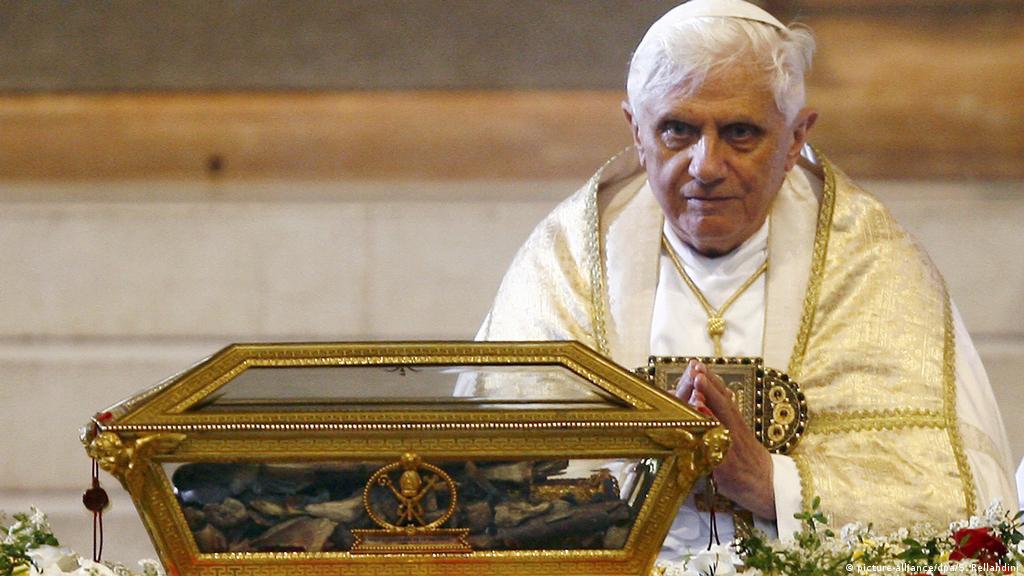
Image result for benedict xviWe are reproducing parts of the speech by then Pope Benedict XVI, during a general audience dated 10 October 2012. This is important in the context of the current quarrels between different traditional Catholics in Malta. They range from Novus Ordo conservatives, to SSPX symphatisers to sedevacantists and even outright Conclavists. The latter, in particular, are known to be very active lately.

 "We have reached the eve of the day on which we will celebrate the fiftieth anniversary of Vatican Council II and the beginning of the Year of Faith. And it is about the great ecclesial event of the Council that I wish to speak.


The documents of Vatican Council II are, even in our own time, a compass guiding the ship of the Church as she sails on the open seas, amidst tempests or peaceful waves, to reach her destination. ... I was able to witness the living Church ... which places herself at the school of the Holy Spirit, the true driving force behind the Council. Rarely in history has it been possible, as it was then, to touch almost physically the universality of the Church at a moment of peak fulfilment of her mission to carry the Gospel into all ages and unto the ends of the earth.


In Church history Vatican II was preceded by many other Councils such as Nicea, Ephesus, Chalcedon and Trent. In general though, they met to define fundamental elements of the faith, and particularly to the correct errors endangering that faith. This was not the case with Vatican Council II, because at that time there were no particular errors of the faith to correct and condemn, nor were there specific questions of doctrine and discipline to be clarified. ... The first question that arose during the preparation of this great event was how to begin, what task to give it. Blessed John XXIII in his opening address of 11 October fifty years ago gave some general guidelines: the faith had to speak with a 'renewed' and more incisive voice, because the world was changing rapidly, but it had to maintain its perennial message intact, without giving way or compromising.


The Pope wanted the Church to reflect upon her faith and upon the truths that guide her. But that serious and profound reflection ... had to be the starting point for a new relationship between the Church and the modern age, between Christianity and certain essential elements of modern thought, not in order to seek conformity, but to show our world, which tends to distance itself from God, the requirements of the Gospel in all its greatness and purity.


The age in which we live continues to be marked by forgetfulness and deafness towards God. I believe, then, that we must learn the simplest and most fundamental lesson of the Council: that the essence of Christianity consists in faith in God, ... and in the individual and community encounter with Christ Who guides our lives. ... The important thing today, as was the desire of the Council Fathers, is for us to see - clearly and anew - that God is present, that He concerns us and responds to us. And when faith in God is lacking our essential foundations give way because man loses his dignity. ... The Council reminds us that the Church ... has the mandate to transmit God's salvific word of love, so that the divine call which contains our eternal beatitude may be heard and accepted.


The four cardinal points of our guiding compass: Sacrosanctum Concilium on the sacred liturgy, which speaks of the centrality of the mystery of Christ's presence in the Church; Lumen Gentium which highlights the Church's fundamental duty to glorify God; Dei Verbum on divine Revelation, which speaks of the living Word of God that unites and animates the Church throughout history, and finally Gaudium et Spes which deals with the way the Church transmits to the world the light it received from God.


Vatican Council II is a powerful appeal to us to make a daily rediscovery of the beauty of our faith, to understand it deeply through a more intense relationship with the Lord, and to live out our Christian vocation to the full".


Wednesday, August 26, 2020

Archbishop Viganò on the Second Vatican Council

This is a summary of his 9 June 2020 public letter: "People talk of “the Spirit of the Council.” But when was there talk of “the Spirit of Trent,” or of any other Catholic Council? There never was, because all other Councils simply followed the spirit of the Church. However, the good Bishop should beware of exaggerating “errors” that needed “correcting” in past teachings of the Church, because whatever these may have been, they were nothing like what the Second Vatican Council did, which was comparable (even in content) with the Council of Pistoia (A.D. 1786), later condemned by the Church. At Vatican II, many of us were fooled. In good faith, we made too many allowances for the supposed good intentions of those promoting an ecumenism which turned later into false teaching on the Church. Today many Catholics no longer believe that there is no salvation outside the Catholic Church, and it is in the texts of Vatican II that the ambiguities are to be found which opened the way to this undermining of the Faith. It began with inter-religious meetings, but it is due to end in some universal religion from which the one true God will have been banished. This was all planned long ago. Numerous errors of today have their roots in Vatican II, to the texts of which it is easy to trace back today’s multiple betrayals of truly Catholic belief and practice. Vatican II is now used to justify all aberrations, whereas its texts prove uniquely difficult to interpret, and they contradict previous Church Tradition in a way no other Church Council has ever done. I confess serenely now that I was at the time too unconditionally obedient to the Church authorities. I think that many of us could not then imagine the Hierarchy being unfaithful to the Church, as we see now especially in the present Pontificate. With the election of Pope Francis, at last the conspirators’ mask came off. They were finally free from the philo-Tridentine Benedict XVI, free to create the Newchurch, to replace the old Church with a Masonic substitute for both the form and substance of Catholicism. Democratisation, synodality, women priests, pan-ecumenism, dialogue, demythologising the Papacy, the politically correct, gender theory, sodomy, homosexual marriage, contraception, immigrationism, ecologism, – if we cannot recognise how all these have their roots in Vatican II, there will be no cure for them. Such a recognition “requires a great humility, first of all in recognizing that for decades we have been led into error, in good faith, by people who, established in authority, have not known how to watch over and guard the flock of Christ.” Those shepherds who in bad faith or even with malicious intent betrayed the Church, must be identified and excommunicated . We have had far too many mercenaries, more concerned with pleasing Christ’s enemies than with being faithful to His Church. “Just as I honestly and serenely obeyed questionable orders sixty years ago, believing that they represented the loving voice of the Church, so today with equal serenity and honesty I recognize that I have been deceived.” I cannot now persevere in my error. Nor can I claim that I saw clear from the start. We all knew that the Council was more or less a revolution, but none of us imagined just how devastating it would be. We could say that Benedict XVI slowed it down, but the Pontificate of Francis has proved beyond all possible doubt that among the shepherds at the top of the Church there is sheer apostasy, while the sheep below are abandoned and virtually scorned. The Declaration of Abu Dhabi (“God is pleased with all religions”) was unforgivable for a Catholic. True charity does not compromise with error. And if one day Francis refuses any longer to play the game, he will be removed, just like Benedict XVI was removed, and replaced. But the Truth remains and will prevail: “Outside the Catholic Church there is no salvation.”

Thursday, August 22, 2019

Catholic Rites and Churches

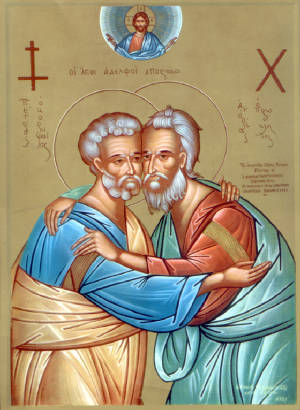
Image result for saints peter and andrew
Christ, having been lifted up from the earth has drawn all men to Himself. Rising from the dead He sent His life–giving Spirit upon His disciples and through Him has established His Body which is the Church as the universal sacrament of salvation. Sitting at the right hand of the Father, He is continually active in the world that He might lead men to the Church and through it join them to Himself and that He might make them partakers of His glorious life by nourishing them with His own Body and Blood. [Vatican Council II, Dogmatic Constitution on the Church Lumen gentium 48]
 See the source image

RITES
 
A Rite represents an ecclesiastical, or church, tradition about how the sacraments are to be celebrated. Each of the sacraments has at its core an essential nature which must be satisfied for the sacrament to be confected or realized. This essence – of matter, form and intention – derives from the divinely revealed nature of the particular sacrament. It cannot be changed by the Church. Scripture and Sacred Tradition, as interpreted by the Magisterium, tells us what is essential in each of the sacraments (2 Thes. 2:15).
 
When the apostles brought the Gospel to the major cultural centers of their day the essential elements of religious practice were inculturated into those cultures. This means that the essential elements were clothed in the symbols and trappings of the particular people, so that the rituals conveyed the desired spiritual meaning to that culture. In this way the Church becomes all things to all men that some might be saved (1 Cor. 9:22).
 
There are three major groupings of Rites based on this initial transmission of the faith, the Roman, the Antiochian (Syria) and the Alexandrian (Egypt). Later on the Byzantine derived as a major Rite from the Antiochian, under the influence of St. Basil and St. John Chrysostom. From these four derive the over 20 liturgical Rites present in the Church today.
 

CHURCHES
 
A Church is an assembly of the faithful, hierarchically ordered, both in the entire world –  the Catholic Church, or in a certain  territory – a particular Church. To be a sacrament (a sign) of the Mystical Body of Christ in the world, a Church must have both a head and members (Col. 1:18).  The sacramental sign of Christ the Head is the sacred hierarchy – the bishops, priests and deacons (Eph. 2:19–22). More specifically, it is the local bishop, with his priests and deacons gathered around and assisting him in his office of teaching, sanctifying and governing (Mt. 28:19–20; Titus 1:4–9). The sacramental sign of the Mystical Body is the Christian faithful. Thus the Church of Christ is fully present sacramentally (by way of a sign) wherever there is a sign of Christ the Head, a bishop and those who assist him, and a sign of Christ's Body, Christian faithful. Each diocese is therefore a particular Church.
 
The Church of Christ is also present sacramentally in ritual Churches that represent an ecclesiastical tradition of celebrating the sacraments. They are generally organized under a Patriarch, who together with the bishops and other clergy of that ritual Church represent Christ the Head to the people of that tradition. In some cases a Rite is completely coincident with a Church. For example, the Maronite Church with its Patriarch has a Rite not found in any other Church. In other cases, such as the Byzantine Rite, several Churches use the same or a very similar liturgical Rite. For example, the Ukrainian Catholic Church uses the Byzantine Rite, but this Rite is also found in other Catholic Churches, as well as the Eastern Orthodox Churches not in union with Rome.
 
Finally, the Church of Christ is sacramentally present in the Universal or Catholic Church spread over the entire world. It is identified by the sign of Christ our Rock, the Bishop of Rome, Successor of St. Peter (Mt. 16:18). To be Catholic particular Churches and ritual Churches must be in communion with this Head, just as the other apostles, and the Churches they founded, were in communion with Peter (Gal. 1:18). Through this communion with Peter and his successors the Church becomes a universal sacrament of salvation in all times and places, even to the end of the age (Mt. 28:20).
 

Western Rites and Churches
 
Immediately subject to the Bishop of Rome, the Supreme Pontiff, who exercises his authority over the liturgy through the Congregation for Divine Worship and the Discipline of the Sacraments.

ROMAN/LATIN FAMILY OF LITURGICAL RITES


The Church of Rome is the Primatial See of the world and one of the five Patriarchal Sees of the early Church (Rome, Constantinople, Alexandria, Antioch and Jerusalem). Founded by St. Peter in 42 AD it was consecrated by the blood of Sts. Peter and Paul during the persecution of Nero (63–67 AD). It has maintained a continual existence since then and is the source of a family of Rites in the West. Considerable scholarship (such as that of Fr. Louis Boyer in Eucharist) suggests the close affinity of the Roman Rite proper with the Jewish prayers of the synagogue, which also accompanied the Temple sacrifices. While the origin of the current Rite, even in the reform of Vatican II, can be traced directly only to the 4th century, these connections point to an ancient apostolic tradition brought to that city that was decidedly Jewish in origin.
After the Council of Trent it was necessary to consolidate liturgical doctrine and practice in the face of the Reformation. Thus, Pope St. Pius V imposed the Rite of Rome on the Latin Church (that subject to him in his capacity as Patriarch of the West), allowing only smaller Western Rites with hundreds of years of history to remain. Younger Rites of particular dioceses or regions ceased to exist.

As a consequence of the Second Vatican Council's Dogmatic Constitution on the Sacred Liturgy, Pope Paul VI undertook a reform of the Mass of the Roman Rite, promulgating a revised rite with the Missal of 1970. This Missal has since been modified twice (1975 and 2002). Mass celebrated in accordance with this missal is the Ordinary Form of the Roman Rite.
 
At the time of the revised Missal's promulgation in 1970 almost all Catholics assumed that the previous rite, that of the Missal of 1962, had been abolished. By decision of the Supreme Pontiff Benedict XVI this general assumption has been declared false and the right of Latin Rite priests to celebrate Mass according to the former missal has been affirmed (Apostolic Letter Summorum Pontificum, 7 July 2007). Mass celebrated in accordance with the Missal of 1962 constitutes the Extraordinary Form of the Roman Rite.
 
• Roman – The overwhelming majority of Latin Catholics and of Catholics in general.

– Ordinary Form of the Roman Rite. Mass celebrated in accordance with the Missale Romanum of 1970, promulgated by Pope Paul VI, currently in its third edition (2002). The vernacular editions of this Missal, as well as the rites of the other sacraments, are translated from the Latin typical editions revised after the Second Vatican Council.

– Extraordinary Form of the Roman Rite. Mass celebrated in accordance with the Missale Romanum of 1962, promulgated by Blessed Pope John XXIII. The other sacraments are celebrated according to the Roman Ritual in force at the time of the Second Vatican Council. The Extraordinary Form is most notable for being almost entirely in Latin. In addition to institutes which have the faculty to celebrate the Extraordinary Form routinely, such as the Priestly Fraternity of St. Peter and the Institute of Christ the King Sovereign Priest, any Latin Rite priest may now offer the Mass and other sacraments in accordance with norms of Summorum Pontificum.

– Anglican Use. Since the 1980s the Holy See has granted some former Anglican and Episcopal clergy converting with their parishes the faculty of celebrating the sacramental rites according to Anglican forms, doctrinally corrected.

• Mozarabic – The Rite of the Iberian peninsula (Spain and Portugal) known from at least the 6th century, but probably with roots to the original evangelization. Beginning in the 11th century it was generally replaced by the Roman Rite, although it has remained the Rite of the Cathedral of the Archdiocese of Toledo, Spain, and six parishes which sought permission to adhere to it. Its celebration today is generally semi–private.

• Ambrosian – The Rite of the Archdiocese of Milan, Italy, thought to be of early origin and probably consolidated, but not originated, by St. Ambrose. Pope Paul VI was from this Roman Rite. It continues to be celebrated in Milan, though not by all parishes.

• Bragan – Rite of the Archdiocese of Braga, the Primatial See of Portugal, it derives from the 12th century or earlier. It continues to be of occasional use.

• Dominican – Rite of the Order of Friars Preacher (OP), founded by St. Dominic in 1215.

• Carmelite – Rite of the Order of Carmel, whose modern foundation was by St. Berthold c.1154.

• Carthusian – Rite of the Carthusian Order founded by St. Bruno in 1084.
 

Eastern Rites and Churches
The Eastern Catholic Churches have their own hierarchy, system of governance (synods) and general law, the Code of Canons for the Eastern Churches. The Supreme Pontiff exercises his primacy over them through the Congregation for the Eastern Churches.

ANTIOCHIAN FAMILY OF LITURGICAL RITES

The Church of Antioch in Syria (the ancient Roman Province of Syria) is considered an apostolic See by virtue of having been founded by St. Peter. It was one of the ancient centers of the Church, as the New Testament attests, and is the source of a family of similar Rites using the ancient Syriac language (the Semitic dialect used in Jesus' time and better known as Aramaic). Its Liturgy is attributed to St. James and the Church of Jerusalem.
 
1. WEST SYRIAC

• Maronite – Never separated from Rome. Maronite Patriarch of Antioch. The liturgical language  is Aramaic. The 3 million Maronites are found in Lebanon (origin), Cyprus, Egypt, Syria, Israel, Canada, US, Mexico, Brazil, Argentina and Australia.

• Syriac – Syriac Catholics who returned to Rome in 1781 from the monophysite heresy. Syriac Patriarch of Antioch. The 110,000 Syriac Catholics are found in Syria, Lebanon, Iraq, Egypt, Canada and the US.

• Malankarese – Catholics from the South of India evangelized by St. Thomas, uses the West Syriac liturgy. Reunited with Rome in 1930. Liturgical languages today are West Syriac and Malayalam. The 350,000 Malankarese Catholics are found in India and North America.
 
2. EAST SYRIAC

• Chaldean – Babylonian Catholics returned to Rome in 1692 from the Nestorian heresy. Patriarch of Babylon of the Chaldeans. Liturgical languages are Syriac and Arabic. The 310,000 Chaldean Catholics are found in Iraq, Iran, Syria, Lebanon, Egypt, Turkey and the US.

• Syro–Malabarese – Catholics from Southern India using the East Syriac liturgy. Returned to Rome in the 16th century from the Nestorian heresy. Liturgical languages are Syriac and Malayalam. Over 3 million Syro–Malabarese Catholics can be found in the state of Kerela, in SW India.

BYZANTINE FAMILY OF LITURGICAL RITES

The Church of Constantinople became the political and religious center of the eastern Roman Empire after the Emperor Constantine built a new capital there (324–330) on the site of the ancient town of Byzantium. Constantinople developed its own liturgical rite from the Liturgy of St. James, in one form as modified by St. Basil, and in a more commonly used form, as modified by St. John Chrysostom. After 1054, except for brief periods of reunion, most Byzantine Christians have not been in communion with Rome. They make up the Orthodox Churches of the East, whose titular head is the Patriarch of Constantinople. The Orthodox Churches are mostly autocephalous, meaning self–headed, united to each other by communion with Constantinople, which exercises no real authority over them. They are typically divided into Churches along nation lines. Those that have returned to communion with the Holy See are represented among the Eastern Churches and Rites of the Catholic Church.

1. ARMENIAN

Considered either its own Rite or an older version of the Byzantine. Its exact form is not used by any other Byzantine Rite. It is composed of Catholics from the first people to convert as a nation, the Armenians (N.E. of  Turkey), and who returned to Rome at the time of the Crusades. Patriarch of Cilicia of the Armenians. The liturgical language is classical Armenian. The 350,000 Armenian Catholics are found in Armenia, Syria, Iran, Iraq, Lebanon, Turkey, Egypt, Greece, Ukraine, France, Romania, United States and Argentina. Most Armenians are Orthodox, not in union with Rome.

2. BYZANTINE

• Albanian – Albanian Christians, numbering only 1400 today, who resumed communion with Rome in 1628. Liturgical language is Albanian. Most Albanian Christians are Albanian Orthodox.

• Belarussian/Byelorussian – Unknown number of Belarussians who returned to Rome in the 17th century. The liturgical language is Old Slavonic. The faithful can be found in Belarus, as well as Europe, the Americas and Australia.

• Bulgarian – Bulgarians who returned to Rome in 1861. Liturgical language is Old Slavonic. The 20,000 faithful can be found in Bulgaria. Most Bulgarian Christians are Bulgarian Orthodox.

• Czech – Czech Catholics of Byzantine Rite organized into a jurisdiction in 1996.

• Krizevci – Croatian Catholics of Byzantine Rite who resumed communion with Rome in 1611. The liturgical language is Old Slavonic.  The 50,000 faithful can be found in Croatia and the Americas. Most Croatians are Roman (Rite) Catholics.

• Greek – Greek Christians who returned to Rome in 1829. The liturgical language is Greek. Only 2500 faithful in Greece, Asia Minor (Turkey) and Europe. Greek Christians are almost all Orthodox, whose Patriarch is the Orthodox Patriarch of Constantinople.

• Hungarian – Descendants of Ruthenians who returned to Rome in 1646. The liturgical languages are Greek, Hungarian and English. The 300,000 faithful are found in Hungary, Europe and the Americas.

• Italo–Albanian – Never separated from Rome, these 60,000 Byzantine Rite Catholics are found in Italy, Sicily, Malta (added by this Blog) and the Americas. The liturgical languages are Greek and Italo–Albanian.

• Melkite – Catholics from among those separated from Rome in Syria and Egypt who resumed Communion with Rome at the time of the Crusades. However, definitive union only came in the 18th century. Melkite Greek Patriarch of Damascus. Liturgical languages are Greek, Arabic, English, Portuguese and Spanish. The over 1 million Melkite Catholics can be found in Syria, Lebanon, Jordan, Israel, Canada, US, Mexico, Brazil, Venezuela, Argentina and Australia.

• Romanian – Romanians who returned to Rome in 1697. The liturgical language is Romanian. There are over 1 million Romanian Catholics in Romania, Europe and the Americas. Most Romanian Christians are Romanian Orthodox.

• Russian – Russians who returned to communion with Rome in 1905. The liturgical language is Old Slavonic. An unknown number of the faithful in Russia, China, the Americas and Australia. Most Russian Christians are Russian Orthodox, whose Patriarch is the Orthodox Patriarch of Moscow.

• Ruthenian – Catholics from among those separated from Rome in Russia, Hungary and Croatia who reunited with Rome in 1596 (Brest–Litovsk) and 1646 (Uzhorod).

• Slovak – Byzantine Rite Catholics of Slovakian origin numbering 225,000 and found in Slovakia and Canada.

• Ukrainian – Catholics from among those separated from Rome by the Greek Schism and reunited about 1595. Patriarch or Metropolitan of Lviv. Liturgical languages are Old Slavonic and the vernacular. The 5.5 million Ukrainian Catholics can be found in Ukraine, Poland, England, Germany, France, Canada, US, Brazil, Argentina and Australia. During the Soviet era Ukrainian Catholics were violently forced to join the Ukrainian Orthodox Church. Their hierarchy, which continued to exist outside the homeland, has since been re–established in Ukraine.
 

ALEXANDRIAN FAMILY OF LITURGICAL RITES

The Church of Alexandria in Egypt was one of the original centers of Christianity, since like Rome and Antioch it had a large Jewish population which was the initial object of apostolic evangelization. Its Liturgy is attributed to St. Mark the Evangelist, and shows the later influence of the Byzantine Liturgy, in addition to its unique elements.
 
• Coptic – Egyptian Catholics who returned to communion with Rome in 1741. The Patriarch of Alexandria leads the 200,000 faithful of this ritual Church spread throughout Egypt and the Near East.  The liturgical languages are Coptic (Egyptian) and Arabic. Most Copts are not Catholics.
 
• Ethiopian/Abyssinian – Ethiopian Coptic Christians who returned to Rome in 1846. The liturgical language is Geez. The 200,000 faithful are found in Ethiopia, Eritrea,  Somalia, and Jerusalem.


Colin B. Donovan, STL (originally published on EWTN website)

Sunday, March 11, 2018

Was the Tridentine Mass ever abolished?


Although Benedict XVI in Summorum Pontificum declares that the Tridentine Mass was never abolished, iscourse to twenty new cardinals, nominated in a 1976 consistory, Paul VI explicitly declared otherwise, during his discourse to new cardinals nominated in a 1976 consistory, as reproduced below:

Concistoro Segreto del Santo Padre Paolo VI per la Nomina di Venti Cardinali

"It is in the name of Tradition that we ask all our children, all Catholic communities, to celebrate, in dignity and with fervor, the renewed Liturgy. The adoption of the new "Ordo Missae" is certainly not left to the will of the priests or of the faithful: and the Instruction of 14 June, 1971 provided for the celebration of Mass in the ancient form, with the authorization of the ordinary, only for elderly or infirm priests who offer the Divine Sacrifice sine populo.

"The Novus Ordo was promulgated to replace the old, after mature deliberation, following the requests of the Second Vatican Council. Similarly, our holy predecessor Pius V had made mandatory the Missal reformed under his authority, following the Council of Trent."

Wednesday, December 30, 2015

Quotes to reflect upon (11)

http://vultus.stblogs.org/EF%2BPIUS%2BXII.JPG
Venerable Pope Pius XII celebrating Holy Mass


The liturgical movement is thus shown forth as a sign of the providential dispositions of God for the present time, of the movement of the Holy Ghost in the Church, to draw men more closely to the mysteries of the faith and the riches of grace which flow from the active participation of the faithful in the liturgical life.
 ...

As We have said in the encyclical Mediator Dei, the liturgy is a vital function of the Church as a whole, and not of a single group or “movement” only: “The sacred liturgy is the public worship of the Mystical Body of Jesus Christ in the entirety of its Head and members.” 
… 

Therefore everything is directed towards God, His service and His glory. The Church, filled with the gifts and the life of God, devotes itself with an interior and spontaneous movement to the adoration and praise of the infinite God, and through the liturgy, renders Him, as from a society, the worship that is due to Him.
… 


The solemn liturgical ceremonies are, besides, a profession of faith in action. They express the great truths of faith concerning the inscrutable designs of God’s generosity and His inexhaustible goodness to men, concerning the love and mercy of the heavenly Father for the world, to save which He sent His Son and delivered Him to death. Thus, the Church in the liturgy abundantly dispenses the treasures of the “deposit of faith,” the truth of Christ.

The care of the hierarchy extends still further to everything which contributes to the greater beauty and dignity of the liturgical ceremonies, whether in the matter of places of worship, of furnishings, of liturgical vestments, of sacred music or sacred art.

...

1) The Action of Christ

What is this principal action of the eucharistic sacrifice? We have spoken of it explicitly in the Allocution of November 2, 1954. We then quoted, first, the teaching of the Council of Trent:


In this divine sacrifice which takes place at Mass, the same Christ is present and is immolated in an unbloody manner who on the cross once and for all offered Himself in a bloody manner . . . . For the victim is one and the same, now offering Himself through the ministry of priests, who then offered Himself on the Cross; only the manner of offering is different.


We then continued in these terms:


Therefore it is the priest-celebrant, and he alone, who, putting on the person of Christ, sacrifices: not the people, nor clerics, nor even priests who reverently assist. All these, however, can and should take an active part in the sacrifice.

 ...

2) The Presence of Christ

Anyone who adheres sincerely to this doctrine does not think of the formulating objections against the presence of the tabernacle on the altar. In the Instruction of the Holy Office “On Sacred Art” of June 30, 1952, the Holy See insists, among other things, on this point:


This Supreme Sacred Congregation strictly commands that the prescriptions of Canons 1268, par. 2, and 1269, par. 1, be faithfully observed: “The Most Blessed Sacrament should be kept in the most distinguished and honorable place in the church, and hence as a rule at the main altar unless some other be considered more convenient and suitable for the veneration and worship due to so great a Sacrament. . . . The Most Blessed Sacrament must be kept in an immovable tabernacle set in the middle of the altar.”


It is not so much to the material presence of the tabernacle on the altar as to a tendency toward a lesser esteem for the presence and the action of Christ in the tabernacle that We would like to draw your attention. The sacrifice of the altar is considered sufficient, and the importance of Him who accomplished it is diminished. But the person of the Lord must occupy the centre of worship, for it is that which unifies the relations of the altar and the tabernacle and gives to them their meaning.

3) The Infinite and Divine Majesty of Christ

In conclusion we would like to add two observations on “the liturgy and the past” and “the liturgy and the present time.”

The liturgy and the past. In the matter of liturgy, as in many other spheres, one must avoid two extreme attitudes with regard to the past: a blind attachment and a complete contempt. There are found in the liturgy unchangeable elements, a sacred content which transcends time, but also elements which are variable and transitory, and sometimes even imperfect. The present-day attitude of liturgical milieux towards the past seems to Us in general to be entirely sound: there is investigation, serious study, attachment to that which truly deserves it, without, moreover, a falling into excess. Here and there, however, there appear ideas and erring tendencies, oppositions, enthusiasms or condemnations with whose concrete from you are well acquainted and of which We have said a word above.

The liturgy and the present time. the liturgy confers on the life of the Church, and even on the whole religious attitude of today, a characteristic mark. Above all, one notices an active and intelligent participation by the faithful in liturgical actions. On the part of the Church, the liturgy today admits of a preoccupation with progress, but also with conservation and defence. She returns to the past without slavishly copying it, and creates anew in the ceremonies themselves, in the use of the vernacular, in popular chant and in the building of churches. It would be, however, superfluous to recall once again that the Church has serious reasons for retaining steadfastly in the Latin rite the unconditional obligation of the celebrating priest to use the Latin language, and, likewise, for insisting that the Gregorian chant at the holy sacrifice shall be in the language of the Church. The faithful, on their part, are concerned with responding to the measures taken by the Church, but in so doing they adopt profoundly different attitudes. Some will show readiness, enthusiasm, occasionally even a too active desire, which demands interventions of authority. Others will show indifference and even opposition. Thus is manifested the diversity of temperaments, as also preferences for individual piety or for community worship.


Allocution by Pope Pius XII, taken from The Assisi Papers: Proceedings of the First International Congress of Pastoral Liturgy, Assisi-Rome, September 18-22, 1956. Published as a Supplement to Worship, by The Liturgical Press, Collegeville, Minn, 1957: pp. 223-236.


Thursday, January 24, 2013

A critical analysis of the Tridentine Mass by Fr Ratzinger

Way back in 1967, theologian Fr Joseph Ratzinger wrote about the Tridentine Mass. This was soon after the closing of Vatican II. Below is an excerpt in which Ratzinger analyses the Tridentine Mass as established by the Council of Trent:
Joseph Ratzinger in a photo from 1971
Fr Joseph Ratzinger in 1971

The [liturgical] additions of the late Middle Ages were eliminated, and at the same time severe measures were adopted to prevent a rebirth. .... At that time, the fate of the Western liturgy was linked to a set authority, which worked in a strictly bureaucratic way, lacking any historic vision and considering the problem of the liturgy from the sole viewpoint of rubrics and ceremonies, like a problem of etiquette in a saint's court, so to speak.

As a consequence of this link, there was a complete archeologisation of the liturgy, which from the state of a living history was changed into that of pure conservation and, therefore, condemned to an internal death. Liturgy became once and forever a closed construction, firmly petrified. The more it was concerned about the integrity of pre-existent formulas, the more it lost its connection to concrete devotions ....

In this situation, the baroque carved it [the liturgy] superimposing a people's para-liturgy over its true and proper archeologized liturgy. The solemn baroque mass, through the splendor of the orchestra's performance, became a kind of sacred opera, in which the songs of the priest had their role as did the alternating recitals. .... On the ordinary days that did not allow such a performance, devotions that followed the people's mentality were often added to the mass.

(Source: Ratzinger J., Problemi e risultati del Concilio Vaticano II, Brescia: Queriniana, 1967, pp. 25-27)

Sunday, March 18, 2012

Case for Tridentine Mass


Sunday, March 18, 2012 ,


by Zak Portelli, Swieqi


I would like to remind Marie Dean (The Sunday Times, February 26) that Malta is not like other countries that have indeed welcomed the Pope’s motu proprio on the celebration of the Tridentine Mass. Here the very mention of Latin would horrify some priests. Every Sunday at 9.15 a.m. there is Latin Mass at St John’s Co-Cathedral in Valletta using the 1972 missal Novus ordo, celebrated on a dining room table, but when there is a pontifical Mass (Christmas, Epiphany, etc.) it is celebrated in Maltese with only the Kyrie, Gloria, Credo, Sanctus and Agnus Dei sung in Latin.


Am I correct in believing that the Tridentine Mass has not been celebrated at the high altar of St John’s for over 40 years? What is wrong with the Tridentine Mass? If Pope St Pius V during the dogmatic Council of Trent (1545-63) published the Tridentine Missal stating “...this missal can be used everywhere lawfully and freely without any scruple of mind now and in perpetuity”, why do we still have to constantly quarrel with priests who seem to think that the Church never existed before Vatican II?

On several occasions we haveTridentine Masses at the parish church of Ta’ l-Ibraġ, with the permission of the Archbishop; however, there is no regular Tridentine Mass.

St John’s would be a perfect place for a Tridentine Mass; let us hope that the cathedral chapter will be as generous as the Gospel asks them to be and allow the Tridentine Mass to take the place of the 9.15 a.m. Conventual Latin Mass. The Cathedral has a resident choir that is extremely capable when it comes to Latin chants; it has a high altar and many other things that befit the Tridentine Mass.

Disclaimer - The posting of this letter on this site does not in any way, implied or otherwise, necessarily express or suggest endorsement or support by Godwin Xuereb.

Saturday, December 5, 2009

Latin Mass Appeal

November 29, 2009

By KENNETH J. WOLFE
Washington

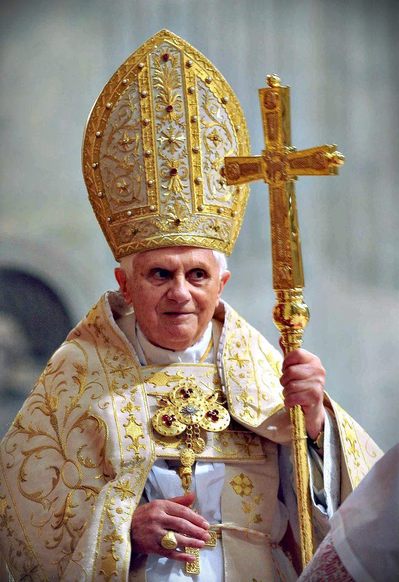
http://communio.stblogs.org/assets_c/2013/04/Benedict%20XVI,%20pope%20emer-thumb-400x582-14202.jpg
Pope Benedict XVI
WALKING into church 40 years ago on this first Sunday of Advent, many Roman Catholics might have wondered where they were. The priest not only spoke English rather than Latin, but he faced the congregation instead of the tabernacle; laymen took on duties previously reserved for priests; folk music filled the air. The great changes of Vatican II had hit home.

All this was a radical break from the traditional Latin Mass, codified in the 16th century at the Council of Trent. For centuries, that Mass served as a structured sacrifice with directives, called “rubrics,” that were not optional. This is how it is done, said the book. As recently as 1947, Pope Pius XII had issued an encyclical on liturgy that scoffed at modernization; he said that the idea of changes to the traditional Latin Mass “pained” him “grievously.”

Paradoxically, however, it was Pius himself who was largely responsible for the momentous changes of 1969. It was he who appointed the chief architect of the new Mass, Annibale Bugnini, to the Vatican’s liturgical commission in 1948.

Bugnini was born in 1912 and ordained a Vincentian priest in 1936. Though Bugnini had barely a decade of parish work, Pius XII made him secretary to the Commission for Liturgical Reform. In the 1950s, Bugnini led a major revision of the liturgies of Holy Week. As a result, on Good Friday of 1955, congregations for the first time joined the priest in reciting the Pater Noster, and the priest faced the congregation for some of the liturgy.

The next pope, John XXIII, named Bugnini secretary to the Preparatory Commission for the Liturgy of Vatican II, in which position he worked with Catholic clergymen and, surprisingly, some Protestant ministers on liturgical reforms. In 1962 he wrote what would eventually become the Constitution on the Sacred Liturgy, the document that gave the form of the new Mass.

Many of Bugnini’s reforms were aimed at appeasing non-Catholics, and changes emulating Protestant services were made, including placing altars to face the people instead of a sacrifice toward the liturgical east. As he put it, “We must strip from our ... Catholic liturgy everything which can be the shadow of a stumbling block for our separated brethren, that is, for the Protestants.” (Paradoxically, the Anglicans who will join the Catholic Church as a result of the current pope’s outreach will use a liturgy that often features the priest facing in the same direction as the congregation.)

How was Bugnini able to make such sweeping changes? In part because none of the popes he served were liturgists. Bugnini changed so many things that John’s successor, Paul VI, sometimes did not know the latest directives. The pope once questioned the vestments set out for him by his staff, saying they were the wrong color, only to be told he had eliminated the week-long celebration of Pentecost and could not wear the corresponding red garments for Mass. The pope’s master of ceremonies then witnessed Paul VI break down in tears.

Bugnini fell from grace in the 1970s. Rumors spread in the Italian press that he was a Freemason, which if true would have merited excommunication. The Vatican never denied the claims, and in 1976 Bugnini, by then an archbishop, was exiled to a ceremonial post in Iran. He died, largely forgotten, in 1982.

But his legacy lived on. Pope John Paul II continued the liberalizations of Mass, allowing females to serve in place of altar boys and to permit unordained men and women to distribute communion in the hands of standing recipients. Even conservative organizations like Opus Dei adopted the liberal liturgical reforms.

But Bugnini may have finally met his match in Benedict XVI, a noted liturgist himself who is no fan of the past 40 years of change. Chanting Latin, wearing antique vestments and distributing communion only on the tongues (rather than into the hands) of kneeling Catholics, Benedict has slowly reversed the innovations of his predecessors. And the Latin Mass is back, at least on a limited basis, in places like Arlington, Va., where one in five parishes offer the old liturgy.

Benedict understands that his younger priests and seminarians — most born after Vatican II — are helping lead a counterrevolution. They value the beauty of the solemn high Mass and its accompanying chant, incense and ceremony. Priests in cassocks and sisters in habits are again common; traditionalist societies like the Institute of Christ the King are expanding.

At the beginning of this decade, Benedict (then Cardinal Joseph Ratzinger) wrote: “The turning of the priest toward the people has turned the community into a self-enclosed circle. In its outward form, it no longer opens out on what lies ahead and above, but is closed in on itself.” He was right: 40 years of the new Mass have brought chaos and banality into the most visible and outward sign of the church. Benedict XVI wants a return to order and meaning. So, it seems, does the next generation of Catholics.

Kenneth J. Wolfe writes frequently for traditionalist Roman Catholic publications.