Showing posts with label Cardinal Robert Sarah. Show all posts

Wednesday, February 5, 2020

The Correspondence between Benedict XVI & Cardinal Sarah


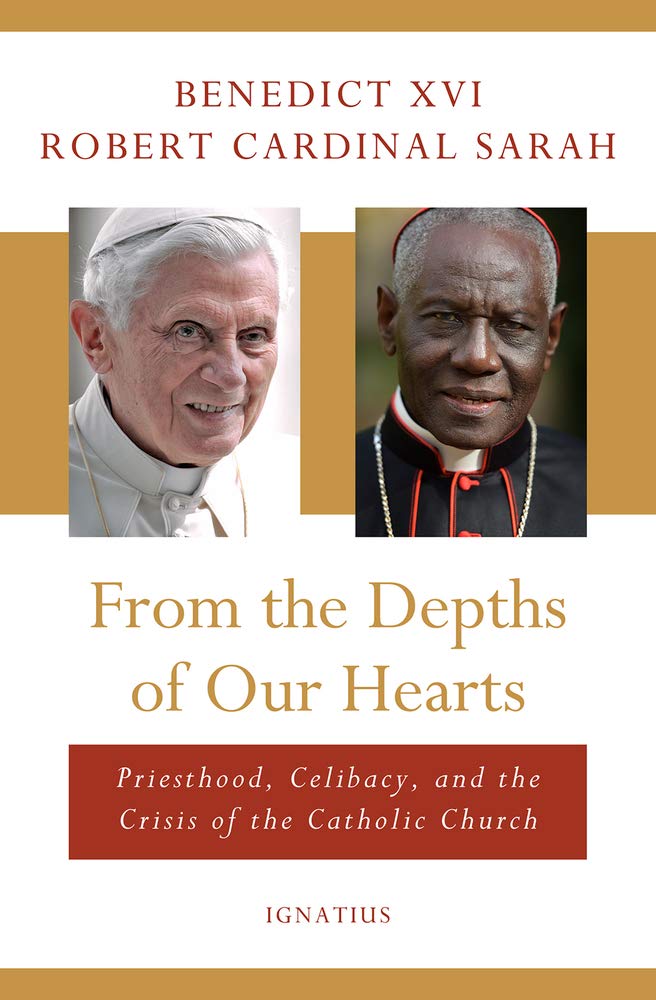
Now that last month's conflicting stories about the genesis of Pope Emeritus Benedict XVI and Cardinal Robert Sarah’s new book on priestly celibacy have calmed down (to a certain extent), it seems the right time to publish the correspondence from Pope Emeritus Benedict XVI to Cardinal Sarah. We leave our readers to reach their own conclusions. We however dismiss that this book opposes the millennial Church teachings, that Benedict XVI has no right to express his views, that the Pope Emeritus was “manipulated,” and that Cardinal Sarah has shown contempt for married priests in the Eastern Rite. 
 

Statement by His Eminence Cardinal Robert Sarah
 
14 January 2020
 
Last 5 September, after a visit to the monastery Mater Ecclesiae where Benedict XVI lives, I wrote to the Pope Emeritus to ask him if it was possible for him to compose a text on the Catholic priesthood, with special attention to celibacy. I explained to him that I myself had begun a reflection in prayer. I added: “I imagine that you will think that your reflections might not be opportune because of the polemics they might provoke in the media, but I am convinced that the whole Church needs this gift, which could be published at Christmas or at the beginning of the year 2020.”
 
On 20 September, the Pope Emeritus thanked me by writing to me that he too, on his part, even before receiving my letter, had begun to write a text on this subject, but that his strength no longer allowed him to edit a theological text. However, my letter had encouraged him to resume this long work. He added that he would transmit it to me when the translation into Italian was completed. 
 
On 12 October, during the synod of bishops on the Amazon, the Pope emeritus gave me a long text in a confidential envelope, the fruit of his work over the past months. Seeing the extent of this writing, both in substance and in form, I immediately thought that it would not be possible to propose it to a newspaper or magazine, given its volume and quality. So, I immediately proposed to the Pope Emeritus the publication of a book that would be an immense good for the Church, integrating his own text into mine. After various exchanges in view of the development of the book, on 19 November, I finally sent a manuscript, the cover, a common introduction and conclusion, the text of Benedict XVI and my own text. On 25 November, the Pope Emeritus expressed his great satisfaction with the texts written in common, and he added the following: “For my part, I agree that the text should be published in the form you have foreseen.”
 
On 3 December, I went to the Mater Ecclesiae Monastery to thank the Pope Emeritus once again for placing his trust in me. I explained to him that our book would be printed during the Christmas holidays, that it would be published on Wednesday 15 January, and that I would come to bring it to him at the beginning of January on my return from a trip to my native country. 
 
The polemic that has sought to smear me for several hours now, by insinuating that Benedict XVI was not informed of the publication of the book ‘From the Depths of our Hearts’ is deeply abject. I sincerely forgive all those who slander me or who want to oppose me to Pope Francis. My attachment to Benedict XVI remains intact and my filial obeisance to Pope Francis remains absolute.

LETTERS FROM BENEDICT XVI TO CARDINAL ROBERT SARAH
 
Benedict XVI
Pope emeritus
                                                                                                Vatican City
                                                                                                20 September 2019
 
To His Eminence the Most Rev. 
Cardinal Robert SARAH
Prefect of the Congregation for Divine Worship
and the Discipline of the Sacraments
00120   Vatican City
 
Your Eminence, 
 
Thank you for your letter of September 5 and for your prayers for the priesthood in these difficult times!
 
Prior to your letter, I had already begun to write down some reflections on the priesthood. But in writing I always felt that my forces no longer allow me to edit a theological text. 
 
Then your letter came with the unexpected question of a text on the priesthood, with particular attention to celibacy. So, I resumed by work and will pass on to you the text, once it is translated from German into Italian. I leave it to you [to determine] if these notes, whose insufficiency I feel strongly, can be of any use.
 
Following your question, I impart my apostolic blessing to you, to your collaborators, and to all your loved ones.
                                                                                                Yours in the Lord,
                                                                                                Benedict XVI
 
***
 
            Vatican City
                                                                                                12 October 2019
 
To His Eminence the Most Rev. 
Cardinal Robert SARAH
Prefect of the Congregation forDivine Worship
and the Discipline of the Sacraments
00120   Vatican City
 
Your Eminence, 
 
Finally, I may pass on my Thoughts on the Priesthood. I shall leave it to you if you find any use in my poor thoughts. 
 
I greet you cordially, thankful for your service to the Holy Church. 
 
                                                                                                Yours in the Lord,
                                                                                                Benedict XVI
 
***
 
Benedict XVI
Pope emeritus
                                                                                                Vatican City
                                                                                                25 November 2019
 
To His Eminence the Most Rev. 
Cardinal Robert SARAH
Prefect of the Congregation for Divine Worship
and the Discipline of the Sacraments
00120   Vatican City
 
Your Eminence, 
 
With all my heart I would like to say thank you for the text added to my contribution and for all the work you have done. It touched me deeply that you understood my last intentions: I had actually written 7 pages clarifying the methodology of my text and I am truly happy to say that you were able to say the essential in half a page. So, I do not see a need to send you the 7 pages, since you have expressed the essentials in half a page. 
 
For my part, the text can be published in the form that you have foreseen. 
 
I am happy to see you before your departure for your homeland and to express my best wishes for your double jubilee. 
 
Thank you also for the three volumes of your dialogue with Monsieur Diat!
 
 
In communion of prayer, 
                                                                                                Yours in the Lord,
                                                                                                Benedict XVI

Monday, December 9, 2019

Rorate Caeli - so Pro Tridentina (Malta) was correct after all!

Image result for all saints day

Cardinal Robert Sarah's retirement as Prefect of the Congregation for Divine Worship has been postponed. This has been interpreted by sources close to this Blog as implying that next month the first in a series of  liturgical changes that this Blog had mentioned more than 2 years ago will start being implemented.
 
Seven Saints will be added to the Tridentine Mass of 1962. The typical practice is to add new saints to the calendar and then incorporate them into the next edition of the Missal. This practice implies that a new version of the 1962 Missal is coming soon, with possibly additional changes. 
 
Rorate Coeli has given credit to this news to an Italian website Messa in Latino. We are happy that they have given positive feedback to this Italian website. However, lest we forget, when we had published the afore-mentioned breaking news, which was widely reported, Rorate Coeli tried to denigrate this Blog as this and this articles amply show.
 
A year after, we published another article showing that the changes had been merely postponed. All of the above shows that this Blog disseminates facts and not fiction. Maybe, in due course, Rorate Coeli will acknowledge that this Blog was right after all. 

Friday, November 10, 2017

A sustained attack in Malta on those in favour of the Tridentine Mass - 4

Original Sunday Times of Malta

Poor translations of the liturgy

The essence of the liturgy is the meeting of God’s People with God without barriers, to communicate with Him… and not through a dead language, or tortuous or anachronistic translations of it.
 
The essence of the liturgy is the meeting of God’s People with God without barriers, to communicate with Him… and not through a dead language, or tortuous or anachronistic translations of it.
 
On March 28, 2001, the Congregation for Divine Worship and the Discipline of the Sacraments issued the fifth instruction “for the right implementation of the Constitution on the Sacred Liturgy of the Second Vatican Council” on the use of vernacular languages in the publication of the books of the Roman liturgy.
 
The document was given the awesome title of Liturgiam Authenticam, that is, authentic liturgy.
 
While the title is awesome, the rest is very disappointing; it smells of an ideology rather the “odour of the sheep”. Rather than spelling out what should be done in the liturgy so that the People of God could fully participate – in mind, heart and soul – in the highest act of adoration, Liturgiam Authenticam gave directives on how liturgical texts should be translated (or transliterated) from the Latin to local languages.
 
‘Mind your language’ would have been a more apt title for the document! In my view, LA has sidelined the express word of Vatican II, that “since the use of the mother tongue, whether in the Mass, the administration of the sacraments, or other parts of the liturgy, frequently may be of great advantage to the people, the limits of its employment may be extended. This will apply in the first place to the readings and directives, and to some of the prayers and chants, according to the regulations on this matter to be laid down separately in subsequent chapters”. (Sacrosanctum Concilium, art. 36).
 
And this is what happened in the Church in the early decades after Vatican II: the usage of local languages was extended. The anti-pastoral results of the directives given by LA can be clearly seen in the Congregation’s imposition of the English translation of the Mass.
 
Six years had been spent by US bishops to revise the Lectionary, the Scripture readings used in Mass, but a Vatican-appointed committee intervened to short-circuit those efforts.
 
Pope Francis’s correction of Cardinal Sarah shows that Vatican II is his ‘sure compass’.
 
Isn’t it mind-boggling that years before Vatican II, bishops had the authority to approve a translation of the Bible – the inspired Word of God – but did not have the final authority in approving the translation of the liturgical text, which, apart from the quotations from the Scriptures, cannot be called inspired books.
 
In an interview, Pope Francis openly articulated his misgivings about liturgical traditionalists: “I always try to understand what’s behind the people who are too young to have lived the pre-conciliar liturgy but who want it.
 
Sometimes I’ve found myself in front of people who are too strict, who have a rigid attitude. And I wonder: How come such rigidity? Dig, dig, this rigidity always hides something: insecurity, sometimes even more... Rigidity is defensive. True love is not rigid.”
 
The essence of the liturgy is the meeting of God’s People with God without barriers, to communicate with Him “through Him, and with Him, and in Him… in the unity of the Holy Spirit”, and not through a dead (even if classical and perhaps ecclesiastical) language, or tortuous or anachronistic translations of it.
 
In 2014, Georgetown University’s Centre for Applied Research in the Apostolate released a study that found 75 per cent of leaders at American churches said that the new translation is “awkward and distracting”, 50 per cent said it “urgently needs to be revised” and the clergy widely rejected the new translations.
 
In keeping with the medieval axiom Sacramenta sunt propter hominess (‘Sacraments are for the people’), logically one ought to stress the supremacy of people over rites, rituals and languages. This is why Pope Francis recently issued the motu proprio Magnum Principium (‘The Great Principle’) giving more control to national bishops’ conferences over the translation of liturgical texts, thus bringing a realignment with Vatican II’s intent.
 
The importance of Magnum Principium can be evidenced by the unprecedented letter by Pope Francis which publicly corrects an article by Cardinal Robert Sarah about the changes the Magnum Principium introduced as to how the Catholic Church’s liturgies are to be translated from the original Latin into local languages.
 
The Pope had, in fact, revised some of the translation norms established by LA. Pope Francis’s correction of Cardinal Sarah shows that Vatican II is his ‘sure compass’. So should it be for all bishops, clergy and faithful.
 
Fr Joe Inguanez, a sociologist, is executive director of Discern.

Friday, September 15, 2017

Latin Mass fans celebrate 10-year anniversary without pope

Cardinals Gerhard Ludwig Mueller, left, and Robert Saraha ttend a conference on the Latin Mass at the Pontifical University of St. Thomas Aquinas in Rome, Thursday, Sept. 14, 2017. (AP Photo/Gregorio Borgia)
Cardinals Gerhard Ludwig Mueller, left, and Robert Sarah attend a conference on the Latin Mass in Rome.
VATICAN CITY — Sep 14, 2017, 12:27 PM ET
 
Fans of the old Latin Mass descended on Rome on Thursday for their annual pilgrimage, facing indifference to their cause, if not outright resistance, from none other than Pope Francis.
 
Ten years after Pope Benedict XVI passed a law allowing greater use of the Latin Mass, Francis seems to be doing everything possible to roll it back or simply pretend it never happened.
 
In recent weeks, he has affirmed with "magisterial authority" that the reforms of the 1960s allowing for Mass to be celebrated in the vernacular rather than Latin were "irreversible." Last week he gave local bishops conferences authority to oversee those translations, rather than the Vatican.
 
The moves underscored that the age-old liturgy wars in the Catholic Church are very much alive and provide a microcosm view of the battle lines that have been drawn between conservative, traditionalist Catholics and Francis ever since he declined to wear the traditional, ermine-trimmed red mozzetta cape for his first public appearance as pontiff in 2013.
 
The indifference seems reciprocal.
 
At a conference Thursday marking the 10th anniversary of Benedict's decree liberalizing use of the Latin Mass, the meeting organizer, the Rev. Vincenzo Nuara, didn't even mention Francis in his opening remarks. The current pope was mentioned in passing by the second speaker, and ignored entirely by the third.
 
The front-row participants honoring retired pope Benedict and his 2007 decree were also telling: Cardinal Raymond Burke, a leading critic of the current pope whom Francis removed as the Vatican's supreme court judge in 2014; Cardinal Gerhard Mueller, recently axed by Francis as the Vatican's doctrine chief, and Cardinal Robert Sarah, appointed by Francis as head of the Vatican's liturgy office but effectively sidelined by his deputy.
 
In fact, it was Sarah's deputy, Archbishop Arthur Roche, who signed the explanatory note to Francis' new law allowing bishops conferences, rather than Sarah's office, to have final say on Mass translations.
 
Francis' new law is a "pretty clear course correction from Pope Benedict's line," said the Rev. Anthony Ruff, associate professor of theology at St. John's University in Minnesota and moderator of the progressive liturgical blog, Pray Tell.
 
Despite the sense of belonging to a previous era, the conference was nevertheless upbeat about the future of the Latin Mass even under a pope who has openly questioned why any young person would seek out the old rite and disparaged traditionalists as rigid and insecure navel-gazers.
 
Monsignor Guido Pozzo, in charge of negotiations with breakaway traditionalist groups, said more Latin Masses are celebrated each Sunday in some countries: France has seen a doubling in the number of weekly Latin Masses, to 221 from 104, in the past 10 years. The U.S. has seen a similar increase over the same period, from 230 in 2007 to 480 today.
 
"The old liturgy must not be interpreted as a threat to the unity of church, but rather a gift," he said. He called for it to continue to be spread "without ideological interference from any part."
 
The program for the 10-year anniversary pilgrimage began with chanted hymn at the start of the conference and ended with vespers Thursday evening celebrated by Benedict's longtime secretary, Monsignor Georg Gaenswein. Also on tap were a religious procession through the streets of Rome and multiple Masses. Conspicuously absent from the four-day program was an audience with Francis.
The current pope, though, let his thoughts known during a recent speech to an Italian liturgical society. He said there was no need to rethink the decisions that led to the liturgy reforms from the Second Vatican Council, the 1962-65 meetings that modernized the Catholic Church.
 
"We can affirm with security and magisterial authority that the liturgical reforms are irreversible," he said in one of his longest and most articulate speeches to date on the liturgy. It made no mention, in either the text or the footnotes, of Benedict's liturgical decree on the Latin Mass.
 
Nuara, the conference organizer, denied sensing any resistance to traditionalists from Francis, saying in an interview that the current pope "is a respectful man, so he recognizes all the good that the old liturgy has given the church."
 
"We are also absolutely respectful of Pope Francis," he added.
 
Timothy O'Malley, director of the University of Notre Dame's Center for Liturgy, said Francis' main beef with Latin Mass afficionados is with those "who see that this form of the liturgy must win at the expense of" the Mass in the vernacular.
 
But he said he saw no indication that Francis would do away with Benedict's decree liberalizing use of the old rite, known by its Latin name Summorum Pontificum.
 
"He'll continue to rail against those who think the (vernacular) Mass is invalid, but I don't see him taking away Summorum Pontificum," he said.

Monday, August 1, 2016

A sustained attack in Malta on those in favour of the Tridentine Mass - 1

Fr Joe Borg regularly writes against traditional Catholics.
The below letter, dated 17 July 2016, published in the Sunday Times of Malta, is the latest in a sustained attack on those Catholics faithful who like the Tridentine Rite. Seems that this priest (who is a member of the Facebook Group of Pro Tridentina Malta) has never heard of what the contemporary Popes said about the Tridentine Mass. And by contemporary we mean Popes who were very much involved in the Second Vatican Council and who implemented the reforms ensuing from it.
To facilitate matters, he might want to refer to the following documents, among others:
  1. Veterum Sapientia - On the Promotion of the Study of Latin, issued by Pope Saint John XXIII in 1962;
  2. Constitution on the Sacred Liturgy Sacrosanctum Concilium,  promulgated by Blessed Pope Paul VI in 1963;
  3. Protocol N. 1897/71 issued by Archbishop Annibale Bugnini in 1971; 
  4. Quattuor Abhinc Annos, issued by the Office of the Congregation for Divine Worship, in 1984;
  5. Motu Proprio Ecclesia Dei, promulgated by Pope Saint John Paul II in 1988;  
  6. Motu Proprio Summorum Pontificum, promulgated by Pope Benedict XVI and the accompanying letter addressed to all bishops;
  7. Motu Proprio Latina Lingua, establishing the Pontifical Academy for Latin, promulgated by Pope Benedict XVI.
The text of the letter by Fr Joe Borg follows (emphasis ours):


Thank you; but no thank you

Those of you who during the past 15 days devoted your time to watching football, or lazing by the sea or cursing the English for Brexit, would have probably missed the stirring of the ecclesiastical pot as a result of the address given by Cardinal Robert Sarah during the opening of the Sacra Liturgia conference in London on July 5.
Sarah exhorted priests to start celebrating Mass facing the east while giving their backs to the congregation. Sarah is not an average Joe. As head of the Vatican’s Congregation for Divine Worship and the Discipline of the Sacraments, his comments carry weight. More so since a couple of weeks earlier he took the same position during an interview with the French maga­zine Famille Chrétienne.
Social networks provided the battleground between those who were exultant or in shock at the proposal made by such an authoritative darling of the conservative wing of the Church. Our local brand of Tridentine conservatives, fuelled by several priests who were ordained during the past 15 years or so, were thrilled to no end.
Like conservatives overseas they form a motley bunch more than a monolithic block. Undoubtedly there are some mode­rate conservatives who have a right to their views and with whom one can dialogue. Others share the views of the extreme right, which consider the post-Vatican II Mass as ‘a protestant rite’. Sarah fell foul even with these ultra-traditionalists, so much so that the website askaCatholic describes Sarah as “a weak and incompetent neo-con hero”.
The practice of orienting both the liturgy – and Church buildings – toward the east is a very old tradition in the Catholic Church. It is still the norm for Orthodox Christianity and Eastern Catholic churches. John of Damascus wrote about it as far back as the seventh century. It is based on Matthew 24,27: “The coming of the Son of Man will be like lightning striking in the east. And flashing far into the west.” This practice also means that the priest celebrates Mass with his back to the people.
Sarah believes that if this practice becomes mainstream (instead of the exception it now is) the Church will be putting God back at the centre of the Church’s liturgical life. He quoted the “lament of God” proclaimed by the prophet Jeremiah: “The people have turned their backs on me.” “Let us turn again towards the Lord!” he said.
I have no doubt that Cardinal Sarah has taken this position because he sincerely believes that it is for the good of the Church. However, he is intelligent enough to know that his use of this scriptural quote is, at best, very unfortunate, as it has nothing to do with the direction of one’s gaze or the position of one’s back while celebrating Mass.
Sarah exhorted priests to start celebrating Mass facing the East while giving their backs to the congregation.

Looking towards the east (as he suggests) or the west or in any other direction will not in itself help people experience the beauty of the love that is celebrated during Mass, which is the community’s sacrificial meal par excellance. The Church’s celebration of the earthly liturgy will not give participants a better foretaste of the heavenly liturgy just by looking towards the east and by having the celebrant give his back to the congregation.
When congregation and celebrant face each other their communication and bonding is definitively much better. This bonding will then help them experience the presence of Christ that is guaranteed whenever people are gathered in his name. The presence of he who is the way to the Father will then help the community understand that “the liturgy is not about us but about God” (to quote Benedict XVI). There is absolutely no need to revert to yesteryear’s symbols to live this perennial reality.
Luckily, the Vatican immediately quash­ed all rumours that Sarah was flying Pope Francis’s kite. Many got this impression as Sarah himself had twice mentioned during his London address that he had the full support of Pope Francis in his quest to “reform the reform”.
Fr Federico Lombardi SJ, the Vatican spokesperson, said that the Pope met Cardinal Sarah two days after the London speech, making it clear that the “ordinary” form of celebrating the Mass is the one promulgated after the Second Vatican Council. He added that the “extraordinary” form, while accepted under the means expressed by Benedict XVI, should not become the norm.
Francis practices what he preaches about the possibility of celebrating Mass ad orientem in extraordinary and exceptional circumstances. Since his election, he has celebrated this rite at least once a year, for the annual tradition of the Pope baptising the newborns of Vatican employees in the Sistine Chapel.
Lombardi added that the General Instruction of the Roman Missal states that the altar should be built in such a way “that Mass can be celebrated at it facing the people, which is desirable wherever possible”.
Lombardi also said that “it is better to avoid using the expression ‘the reform of the reform’ (as Sarah did in his London speech), given that this has sometimes been the source of misunderstanding”.
Those using the expression form a spectrum ranging from those who would reasonably like to tweak certain exaggerations that some unfortunately indulge in, to those eager to throw the clock backwards, thus deforming the reform.
Pope Francis is of a different opinion. Last year he celebrated the 50th anniversary of the first Mass offered in Italian. In his homily he said that:
“Let us thank the Lord for what he has done in His Church in these 50 years of liturgical reform… It was truly a courageous gesture for the Church to draw near to the people of God, so that they are able to understand well what they are doing."
“It is not possible to go backwards,” he said. “Always forward! Those who go backward are mistaken.”
My final comment to the good cardinal and to the local enthusiasts of the deforming the reform movement: thanks, but no thanks.