For the promotion and dissemination of the Extraordinary Form of the Mass in the Archdiocese of Malta and the Diocese of Gozo, as endorsed by the motu proprio Summorum Pontificum promulgated by Pope Benedict XVI (2007) and in the Instruction Universae Ecclesiae (2011). We adhere to the traditional Catholic motto: We are what you once were. We believe what you once believed. We worship as you once worshipped. If you were right then, we are right now. If we are wrong now, you were wrong then.
Rodolfo Vargas Rubio was born in Lima, Peru on 23rd November 1958 from Spanish parents. He had both Peruvian and Spanish nationality. His elementary and secondary schools were with the Jesuits in Lima. He studied Law at the Peruvian University of San Marcos, Philosophy at the Seminary of Cuenca (Spain), Theology at the Angelicum of Rome and History at the UNED (Spain). In 2005, Rodolfo Vargas Rubio wrote a biography of Pope Benedict XVI, published in Spain. He had the unique privilege of presenting a copy of this book ¿El último Papa? Benedicto XVI y su tiempo : perfil biográfico del Papa Ratzinger to His Holiness.
Vargas Rubio was a founder member and chairman of the Consociatio Culturalis Roma Aeterna, that joined the FIUV in 1997. He was also a founder member and chairman of the Sodalitium Internationalis Pastor Angelicus (SIPA), a lay association active from 1998 to contribute to the cause of beatification and canonization of the Venerable Pope Pius XII. Vargas Rubio spoke fluently Spanish, English, French, Italian and Catalan and knew Latin. He was also a knight of the Constantinian Order of Saint George and of the Royal Order of Saint Michael of the Wing (Portugal).
Rodolfo Vargas Rubio entered into the FIUV Council in 2007 and was elected Secretary of the Board in the same year and in 2009. During this time, he supported wholeheartedly Pro Tridentina (Malta)'s membership in the same organisation. He had to resign in 2011 for health reasons but stayed as councillor until 2017.
As FIUV councillor FIUV he focused on two main areas:
1) the promotion and diffusion of the FIUV in Spanish-speaking countries and strengthening the links between the associations of Spain, Portugal and Latin-America, and
2) To fortify inner unity of the FIUV around its President in the challenge represented by the new circumstances that were being raised in Rome.
In September 2025, Rodolfo Vargas Rubio passed away. He was a great Latinist and connoisseur of the liturgy and was also highly appreciated for his humility and generosity.
The regulations set out in Traditionis custodes and as applied in Malta and Gozo provide that (comments in bold by this Blog):
1. The bishop of the diocese is the sole authority to decide whether the celebration of Mass according to the 1962 Roman Missal may take place in his diocese. - only one Sunday Mass is allowed in Malta, none in Gozo.
2. The bishop must decide the locations and times when Mass according to the 1962 rubrics may take place. This cannot occur within parochial churches, nor can the bishop erect new personal parishes dedicated to the celebration of Mass according to the 1962 Missal. - in fact the Mass is only held in the Jesuits Church in Valletta. Other, few Tridentine Masses that are held from time to time are celebrated by so-called 'independent priests'.
3. The bishop must ensure that the existing communities that celebrate Mass according to the 1962 rubrics are effective for the spiritual growth of his people, and he has the option to revoke the permissions given to these communities. He may not authorize the establishment of new groups that gather for celebration according to the 1962 Roman Missal. - this has affected Pro Tridentina (Malta) directly, also because some persons had decided to spread lies about this organisation, for their personal ambitions.
4. The bishop should appoint a priest to act as a delegate for the pastoral care of the groups of the faithful attached to the 1962 liturgical rites. The priest must understand the Missal of 1962 well, must be well-versed in ecclesial Latin, and must exhibit pastoral charity and a desire for ecclesial communion. - this has been done with the appointment of Canon Doublet.
5. Priests ordained before the publication of Traditionis custodes (16 July 2021) who celebrated Mass according to the 1962 Missal before the publication of Traditionis custodes should request permission from the bishop of the diocese to continue to celebrate Mass according to the 1962 rubrics. - it's unclear whether these priests, some of whom appear in the section Hall of Honour did this or not.
6. Priests ordained after the publication of Traditionis custodes must submit a formal request to the bishop of the diocese in order to gain permission to celebrate Mass according to the 1962 Roman Missal. The bishop must then consult the Holy See before the bishop grants permission to the priest. - as far as is known, no priest did this.
In December 2021, additional restrictions and guidelines (some of which are reproduced below) were issued by the Congregation for Divine Worship and the Discipline of the Sacraments in the form of a Responsa ad dubia:
1. if a non-parish church, oratory or chapel cannot be found for a group to gather to celebrate the Mass according to the 1962 Missal, the diocesan bishop can ask the Holy See for permission to use a parish church; however, the Mass should not be listed in the parish schedule and when a non-parish church, oratory or chapel becomes available, the permission to celebrate the Mass in the parish church will be withdrawn. - none was asked. If such a group grows in the number of attendees, permission to use the 1962 Missal may be withdrawn because it can be considered that the group is promoting the previous rite.
2. The diocesan bishop is not authorized to grant permission for the use of the Pontificale Romanum (the Pontifical Missal) issued in 1962. This also means that the sacraments of Holy Orders and Confirmation may only be celebrated in the post-Vatican II form. The only exception is for personal parishes to use the Roman Ritual. But these very few exceptions must be monitored in order to ensure that the priests are accepting the liturgical reforms coming from the Council. - this eliminates all previous permissions to celebrate the Mass and the Sacraments according to the Roman Pontifical and the Roman Ritual which are the two main directories that regulated ceremonies in the Catholic Church for more than 1,000 years.
3. In order for a priest to be granted permission to celebrate the Mass according to the Missal of 1962, he must recognize the validity and legitimacy of concelebration and is not to refuse to concelebrate at the diocesan Chrism Mass. - this is being applied in Malta.
4. The faculty to celebrate according to the 1962 missal, granted by a diocesan bishop to a priest, is restricted to the territory of that diocese. - therefore priests who celebrate in Malta cannot celebrate the Tridentine Mass in Gozo. The same would apply to any Maltese priest who was incardinated in another diocese. From testimonies gathered by some faithful who attend the different Tridentine Masses in Malta (whether authorised or not), this has been the case with at least 1 priest who attended a seminary abroad.
5. A priest who has been granted faculties to celebrate the 1962 missal is not permitted to celebrate both the Mass according to the 1962 missal and the post-Vatican II missal on the same day. - it is unclear whether an exemption was made in Malta, based on testimonies made by faithful who attend Mass in Valletta.
6. Not only the priest but the deacons and acolytes must also be authorized to serve at the Mass.- if one considers High Masses, the solemnities of the Holy Week, Easter and Christmas in which deacons and acolytes play a very precise role, we see that this demand for authorisation is intended to discourage their participation in such ceremonies. This necessarily leads to a diminishing of such ceremonies.
7.A priest who is authorised to say the Mass according to the1962 Missal cannot say two such Masses even if the group of faithful is approved by the Bishop. - this harms the faithful and puts pressure on them to attend the Novus Ordo Missae. Again, it is clear why groups such as the ASPM are not allowed to expand their attendance at Tridentine Mass while other groups, like Pro Tridentina (Malta), when possible, have to resort to independent priests.
As if this was not enough, a Rescriptum ex audientia was issued in early 2023. The latest documentclearly demands that permission for the groups who received parishes to say the 1962 Mass has to be confirmed by the Vatican. This is directly aimed at the Fraternity of St. Peter, the Institute of Christ the King, the Institute of the Good Shepherd, the Apostolic Administration of St. John Mary Vianney and other such priestly organizations. - but, what about those priests who do not belong to these organizations and say the Latin Mass in churches where both the Novus Ordo Mass and the Tridentine Mass are said once in a while?
The goal of these documents is to entirely abrogate the permissions given by both John Paul II and Benedict XVI to celebrate the Tridentine Mass according to the 1962 Missal. The documents pretend also to abolish the celebration of Mass according to the Missals prior to 1955. They affirm that from now on the only approved expression of the Latin Rite is the Novus OrdoMissae, in which the faithful must have an active participation. Using his "magisterial authority" Francis declared that "the Liturgical Reform is irreversible."
Now that the sede vacante period has begun, one can expect the current situation in Malta to remain the same, for the time being. After a new pope is elected, one needs probably to wait for some time to see whether the current legislation continues, more restrictions are made or, perhaps, the Church reverts back to the motu proprio Summorum Pontificum.
With the death of Benedict XVI at the end of 2022, it became known how painful it was for the late Pope the publication of Traditionis custodes (16 July 2021) as well asDesiderio desideravi (29 June 2022). In the latter document, Pope Francis called on Catholics to overcome forms of aestheticism that appreciate only outward formality or allow sloppiness in liturgy, noting that “a celebration that does not evangelize is not authentic.”
The Pope’s Apostolic Letter reaffirms the importance of ecclesial communion around the Novus Ordo Missae to the detriment of other valid Catholic rites. Below are some pertinent points from it:
Recalling the importance of Vatican II’s constitution Sacrosanctum Concilium the Pope adds, ”I want the beauty of the Christian celebration and its necessary consequences for the life of the Church not to be spoiled by a superficial and foreshortened understanding of its value or, worse yet, by its being exploited in service of some ideological vision, no matter what the hue” (16).
After warning against “spiritual worldliness” and the Gnosticism and neo-Pelagianism that fuel it, Pope Francis explains that “Participating in the Eucharistic sacrifice is not our own achievement, as if because of it we could boast before God or before our brothers and sisters” and that “the Liturgy has nothing to do with an ascetical moralism. It is the gift of the Paschal Mystery of the Lord which, received with docility, makes our life new. The cenacle is not entered except through the power of attraction of his desire to eat the Passover with us” (20).
To heal from spiritual worldliness, we need to rediscover the beauty of the liturgy, but this rediscovery “is not the search for a ritual aesthetic which is content by only a careful exterior observance of a rite or is satisfied by a scrupulous observance of the rubrics. Obviously, what I am saying here does not wish in any way to approve the opposite attitude, which confuses simplicity with a careless banality, or what is essential with an ignorant superficiality, or the concreteness of ritual action with an exasperating practical functionalism” (22).
He writes that “it would be trivial to read the tensions, unfortunately present around the celebration, as a simple divergence between different tastes concerning a particular ritual form. The problematic is primarily ecclesiological.” (31)
The Pope points out he does not see how it is possible to say that one recognizes the validity of the Council, and at the same time not accept the liturgical reform born out of Sacrosanctum Concilium.
“A liturgical-sapiential plan of studies in the theological formation of seminaries would certainly have positive effects in pastoral action. There is no aspect of ecclesial life that does not find its summit and its source in the Liturgy. More than being the result of elaborate programs, a comprehensive, organic, and integrated pastoral practice is the consequence of placing the Sunday Eucharist, the foundation of communion, at the centre of the life of the community. The theological understanding of the Liturgy does not in any way permit that these words be understood to mean to reduce everything to the aspect of worship. A celebration that does not evangelize is not authentic, just as a proclamation that does not lead to an encounter with the risen Lord in the celebration is not authentic. And then both of these, without the testimony of charity, are like sounding a noisy gong or a clanging cymbal” (37).
“Among the ritual acts that belong to the whole assembly, silence occupies a place of absolute importance” which “moves to sorrow for sin and the desire for conversion. It awakens a readiness to hear the Word and awakens prayer. It disposes us to adore the Body and Blood of Christ” (52).
Pope Francis asks “all bishops, priests, and deacons, the formators in seminaries, the instructors in theological faculties and schools of theology, and all catechists to help the holy people of God to draw from what is the first wellspring of Christian spirituality,” reaffirming what is established in Traditionis custodesso that “the Church may lift up, in the variety of so many languages, one and the same prayer capable of expressing her unity,” and this single prayer is the Roman Rite that resulted from the conciliar reform and was established by the saintly pontiffs Paul VI and John Paul II.
Let us recall that in an interview a couple of days after Benedict XVI's death, Archbishop Gänswein admitted the following:
Interviewer: So, Pope Benedict’s lifting of restrictions on celebrating the Extraordinary Form of the Roman Rite according to the 1962 Missal did not last as long as he intended. As Pope Emeritus, he was around to see the promulgation of Pope Francis’ motu proprioTraditionis Custodes. Was he disappointed?
Archbishop Gänswein: It hit him pretty hard. I believe it broke Pope Benedict’s heart to read the new motu proprio, because his intention had been to help those who simply found a home in the Missale Vetustum — to find inner peace, to find liturgical peace — in order to draw them away from Marcel Lefebvre. And if you think about how many centuries the old Mass was the source of spiritual life and nourishment for many people including many saints, it’s impossible to imagine that it no longer has anything to offer. And let’s not forget that many young people — who were born long after the Second Vatican Council, and who don’t really grasp all the drama surrounding that council — that these young people, knowing the new Mass, have nevertheless found a spiritual home, a spiritual treasure in the old Mass as well. To take this treasure away from people … well, I can’t say that I’m comfortable with that.
A Dec. 31 statement from the Holy See press office said: “With sorrow I inform you that the Pope Emeritus, Benedict XVI, passed away today at 9:34 in the Mater Ecclesiae Monastery in the Vatican. Further information will be provided as soon as possible.”
Benedict XVI helped to shape the Catholic Church’s trajectory long before he was elected to the papacy, first as a young theological adviser at the Second Vatican Council and then as head of the Vatican’s doctrinal office.
Benedict influenced generations of Catholics with his writings, including his 1968 book “Introduction to Christianity,” his treatise “The Spirit of the Liturgy,” and his trilogy “Jesus of Nazareth,” composed while he was pope.
He reflected deeply on the tensions between secular modernity and the Church, introducing phrases such as “the dictatorship of relativism” into Catholic discourse and popularizing the concept of Catholics serving as a “creative minority” within secularized societies.
As pope from 2005 to 2013, he led the Church’s response to the clerical abuse crisis, dismissing hundreds of perpetrators from the clerical state. But he later personally asked forgiveness from abuse survivors amid criticism of his handling of cases as archbishop of Munich, southern Germany, from 1977 to 1982.
Awaiting Easter
He was born Joseph Aloisius Ratzinger on April 16, 1927, in Marktl am Inn, a village in the German state of Bavaria. In his 1998 memoir Milestones, he noted that he emerged into the world on Holy Saturday.
“I have always been filled with thanksgiving for having had my life immersed in this way in the Easter mystery, since this could only be a sign of blessing,” he wrote. “To be sure, it was not Easter Sunday but Holy Saturday, but, the more I reflect on it, the more this seems to be fitting for the nature of our human life: We are still awaiting Easter; we are still not standing in the full light, but walking toward it in full trust.”
He was the third child after his sister Maria and brother Georg, who went on to become a priest and conductor of the renowned Regensburger Domspatzen choir. His mother was a cook and his father a police officer who was disciplined after criticizing the Nazis.
An intellectually precocious child who disliked school sports, he entered a minor seminary in 1939, at the age of 12. That year, German youngsters were legally required to join the Hitler Youth. He was enrolled but avoided attending meetings of the Nazi organization.
After the Second World War broke out, the seminary was shuttered and he was drafted into the military, serving in an anti-aircraft unit and helping to prepare anti-tank defenses. He abandoned his post in 1945 as the Allies swept into Germany, although the penalty for desertion was death.
In “Milestones,” he described how he attempted to reach home on foot without being detected. “But, as I walked out of a railroad underpass, two soldiers were standing at their posts, and for a moment the situation was extremely critical for me,” he wrote. “Thank God that they, too, had had their fill of war and did not want to become murderers.”
He was reunited briefly with his family, but then seized by U.S. forces and interned in a prisoner-of-war camp near the city of Ulm. He slept outdoors, but was consoled by the sight of the spire of Ulm cathedral. “Day after day the sight of it was for me like a consoling proclamation of the indestructible humaneness of faith,” he later wrote.
When he was finally released, the driver of a milk truck gave him a lift back to his hometown. He reached it before sunset, recalling that “the heavenly Jerusalem itself could not have appeared more beautiful to me at that moment.”
He returned to his seminary studies and was ordained a priest of the Archdiocese of Munich and Freising on June 29, 1951, at the age of 24. When the archbishop placed his hands on him during the rite, a bird flew up from the high altar and began to sing, which he took to be “a reassurance from on high” that he was on the right path.
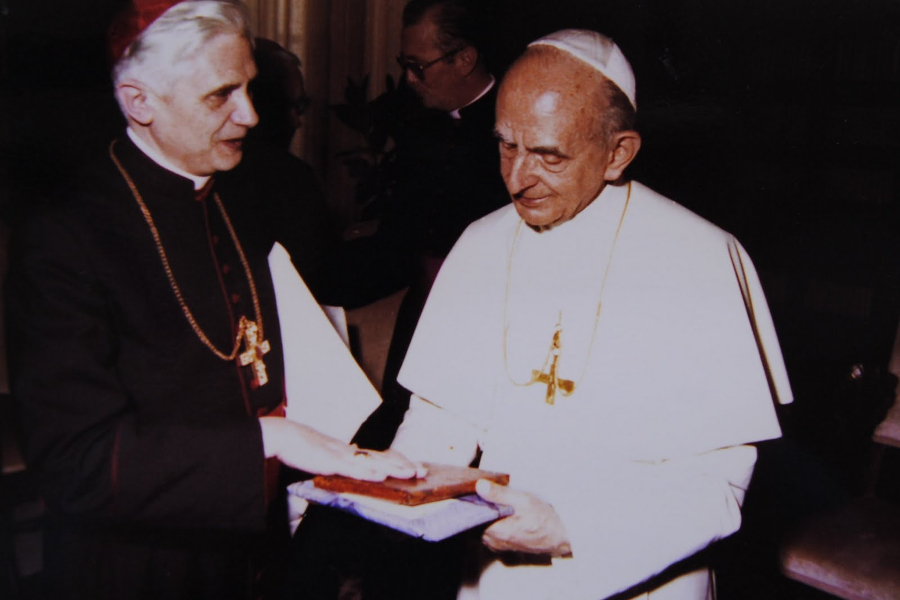
Cardinal Joseph Ratzinger with Pope Paul VI. Jornal O Bom Católico via Wikimedia (CC BY 2.0).
Coworker of the truth
After earning a doctorate, Ratzinger began teaching, and his reputation as a theologian grew. Cologne’s Cardinal Joseph Frings asked him to serve as a peritus, or adviser, at Vatican II, one of the major Catholic events of the 20th century.
He supported the reforming current at the ecumenical council and afterward received an invitation from the prominent progressive theologian Hans Küng to teach at the renowned University of Tübingen. But there he concluded that the Council’s reforms were being distorted by activists imbued with the revolutionary spirit of the late 1960s. “Anyone who wanted to remain a progressive in this context had to give up his integrity,” he said decades later.
He left Tübingen in 1969 to teach at the less prestigious University of Regensburg in his Bavarian homeland. That year, he made a radio broadcast in which he pondered the Church’s future.
“From the crisis of today,” he said, “the Church of tomorrow will emerge — a Church that has lost much. She will become small and will have to start afresh more or less from the beginning.”
But in the end, he predicted, “the church of faith” would remain. “It may well no longer be the dominant social power to the extent that she was until recently; but it will enjoy a fresh blossoming and be seen as Man’s home, where he will find life and hope beyond death,” he said.
In 1972, Ratzinger helped to found the influential theological journal Communio, with fellow theological luminaries Hans Urs von Balthasar and Henri de Lubac.
He was appointed Archbishop of Munich and Freising on May 28, 1977, at the relatively young age of 49. He took the motto “Cooperatores veritatis” (“Coworkers of the truth”), drawn from 3 John 8. He was made a cardinal a month after his episcopal ordination.
His tenure in Munich was overshadowed decades later by a report that accused him of mishandling four abuse cases. He denied claims that he had sought to cover up wrongdoing, but in a letter issued in 2022, he said: “I have had great responsibilities in the Catholic Church. All the greater is my pain for the abuses and the errors that occurred in those different places during the time of my mandate.”
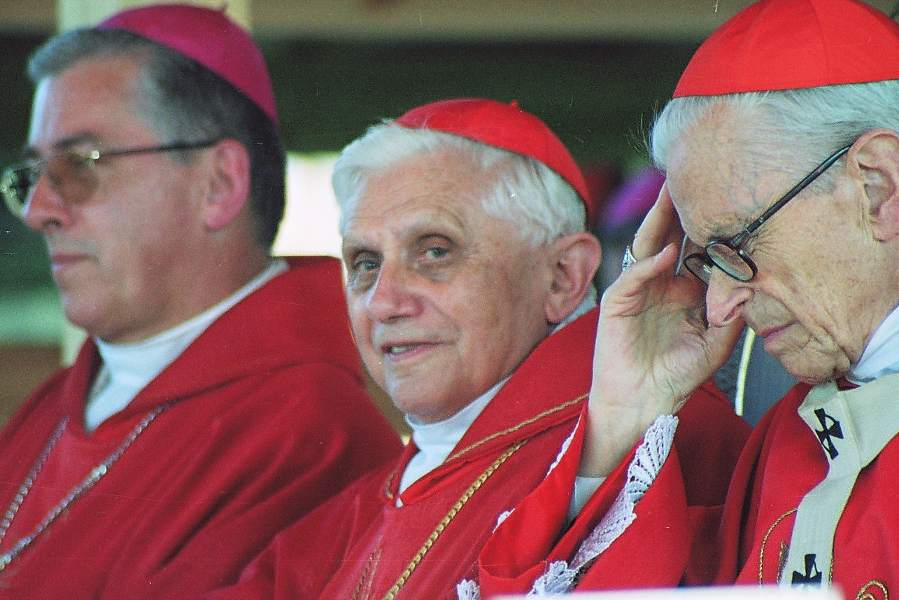
Cardinal Joseph Ratzinger in Szczepanów, Poland, on May 10, 2003. Muu-karhu via Wikimedia (CC BY 2.0).
Doctrinal defender
Pope John Paul II summoned Ratzinger to Rome in 1981 to serve as prefect of the Congregation for the Doctrine of the Faith. The Polish pope believed that the decades after Vatican II were marred by a theological free-for-all and encouraged the cardinal to help restore a sense of balance.
Ratzinger took action against prominent theologians he believed had departed from Catholic teaching, including the Brazilian liberation theologian Leonardo Boff, the Sri Lankan priest Tissa Balasuriya, and the Belgian Jesuit Jacques Dupuis.
These actions made him a controversial figure among Catholics on the Church’s progressive wing, who referred to him as the “Panzer Cardinal” and “God’s Rottweiler.” He complained that he was being cast as a bogeyman when he was only seeking to help simple believers recognize misleading accounts of the faith.
With John Paul II’s unflagging support, he tackled the Church’s most contested topics, from women priests to homosexuality. He also sought to present Catholic teaching in a positive light in his personal theological works and through his labor on the 1992 Catechism of the Catholic Church, a monumental guide to the faith.
After the turn of the millennium, he continued to serve as a theological lightning rod. In the year 2000, he signed the declaration Dominus Iesus, which affirmed that there is “a single Church of Christ, which subsists in the Catholic Church” — prompting criticism from Protestant leaders.
In 2001, Ratzinger convinced John Paul II to allow his Vatican congregation to investigate cases of clerical abuse worldwide. Once a week, he would read through dossiers on accused priests, a practice he referred to as “our Friday penance.” Between 2004 and 2014, 848 priests were laicized and 2,572 given other penalties.
In a 2004 lecture on Europe’s Christian roots, Ratzinger invoked the historian Arnold Toynbee’s idea of “creative minorities” who help to revitalize civilizations. “Christian believers should look upon themselves as just such a creative minority, and help Europe to reclaim what is best in its heritage and to therefore place itself at the service of all humankind,” he said.
In light of his age and bouts of ill health, he tried to resign several times, but continued to work as the Vatican’s doctrinal enforcer until John Paul II’s death in 2005.
Ratzinger presided at the Polish pope’s funeral, before a television audience of more than 2 billion. In his role as dean of the College of Cardinals, he preached to the world’s cardinals before they entered the conclave to elect John Paul II’s successor. He warned them that “having a clear faith based on the Creed of the Church is often labeled as fundamentalism,” while a “dictatorship of relativism” was being built “that does not recognize anything as definitive and whose ultimate goal consists solely of one’s own ego and desires.”
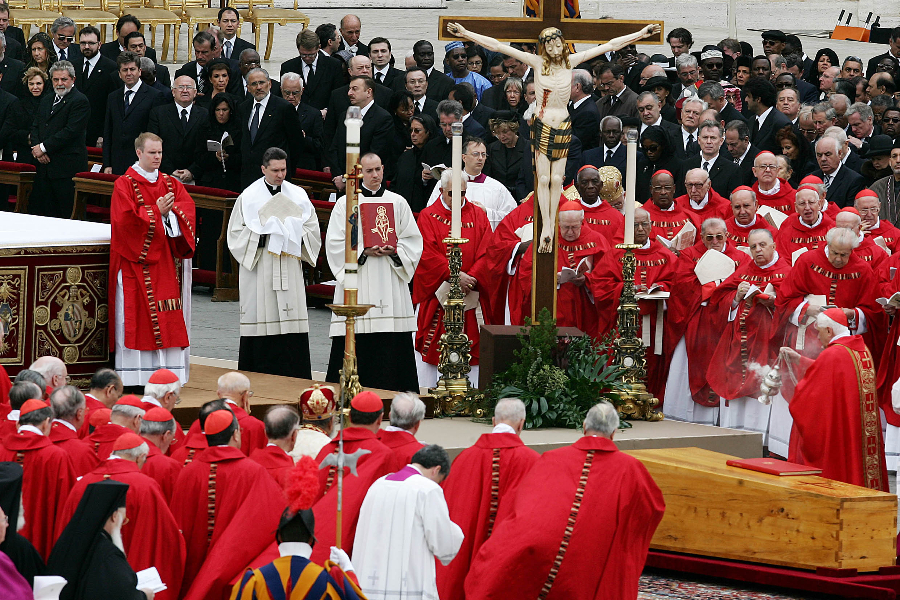
Cardinal Joseph Ratzinger presides at the funeral of Pope John Paul II on April 8, 2005. Ricardo Stuckert/PR - Agência Brasil via Wikimedia (CC BY 3.0 br).
The Church is alive
After four ballots, he was elected pope on April 19, 2005, at the age of 78. He chose the name Benedict XVI in honor of Benedict XV, who “guided the Church through the turbulent times of the First World War,” and St. Benedict, “a fundamental point of reference for the unity of Europe.”
At his installation Mass, he appeared to acknowledge the forces arrayed against him, asking for prayers “that I may not flee for fear of the wolves.” But he also struck a hopeful note, saying that in his predecessor’s last days, “it became wonderfully evident to us that the Church is alive. And the Church is young.”
“She holds within herself the future of the world and therefore shows each of us the way towards the future,” he said.
His almost eight-year pontificate was marked by a series of crises.
The most challenging and extended was the abuse crisis. Just two months after his election, he imposed restrictions on Fr. Marcial Maciel, the powerful founder of the Legionaries of Christ, who appeared to have been protected by figures at the Vatican despite evidence of his depravity.
The global media repeatedly accused Benedict XVI of having covered up abuse as an archbishop in Germany and a prefect in Rome — claims firmly rejected by his supporters.
He met abuse survivors during his foreign visits and sent a landmark letter to Irish Catholics in 2010, acknowledging that some abuse survivors “find it difficult even to enter the doors of a church after all that has occurred.”
Another crisis occurred in 2006, when he gave an address at the University of Regensberg in Germany in which he cited a Byzantine emperor who told a Muslim interlocutor that Mohammed had brought into the world “things only evil and inhuman, such as his command to spread by the sword the faith he preached.”
Benedict noted that the emperor delivered the words with “a brusqueness that we find unacceptable,” but his speech was reported around the world as if he had endorsed the remark. Muslims erupted in protest from Jordan to Indonesia.
Two months later, he made a conciliatory visit to Turkey, pausing for a moment of reflection alongside an Islamic cleric in Istanbul’s Blue Mosque.
In 2009, he sparked a another crisis when he lifted the excommunications of four bishops belonging to the Society of St. Pius (SSPX), the breakaway group founded by Archbishop Marcel Lefebvre. The move coincided with an interview in which one of the four, Bishop Richard Williamson, denied the Holocaust. Benedict wrote an apologetic letter to the world’s bishops, noting that he had been told “that consulting the information available on the internet would have made it possible to perceive the problem early on.”
As pope, he made far-reaching decisions on the liturgy, ecumenism, and Vatican finances.
His 2007 motu proprio Summorum Pontificum acknowledged priests’ right to offer Mass using the Roman Missal of 1962, which is in Latin. He defined the new and old versions of the Roman Missal as the “ordinary” and “extraordinary” forms of the Roman Rite, expressing the hope that they would be “mutually enriching.”
In his 2009 apostolic constitution Anglicanorum coetibus, he established personal ordinariates enabling groups of Anglicans to enter into full communion with Rome while preserving elements of their patrimony.
In 2010, he attempted to shed light on the Vatican’s notoriously opaque finances with the creation of a watchdog body, the Financial Information Authority. His efforts at reform were undermined by a series of leaked documents in what came to be known as the “Vati-Leaks” scandal, which led to the jailing of his butler.
Despite his advanced age, he made trips to countries including Australia, Brazil, and Benin. In 2008, he undertook a six-day visit to the United States, addressing the United Nations General Assembly, praying at Ground Zero, and visiting the White House.
He beatified more than 800 people, including Cardinal John Henry Newman, canonized 45 others, and proclaimed St. Hildegard of Bingen and St. John of Avila Doctors of the Church.
He published three encyclicals: Deus caritas est, on love; Spe salvi, on hope; and Caritas in Veritate, on charity. His fourth, Lumen fidei, was left unfinished and completed by his successor Pope Francis.
Throughout his pontificate, he stressed the continuity of the Catholic faith. Speaking to Vatican officials in 2005, he criticized those who interpreted Vatican II in terms of “discontinuity and rupture,” arguing that it should be understood instead with a “hermeneutic of reform” that did not imply “a split between the pre-conciliar Church and the post-conciliar Church.”
Benedict XVI resigned on Feb. 11, 2013, announcing the dramatic break with centuries of tradition in Latin to an audience of shocked cardinals. He told them that “both strength of mind and body” were necessary to govern the Church, but that strength had “deteriorated in me to the extent that I have had to recognize my incapacity to adequately fulfill the ministry entrusted to me.”
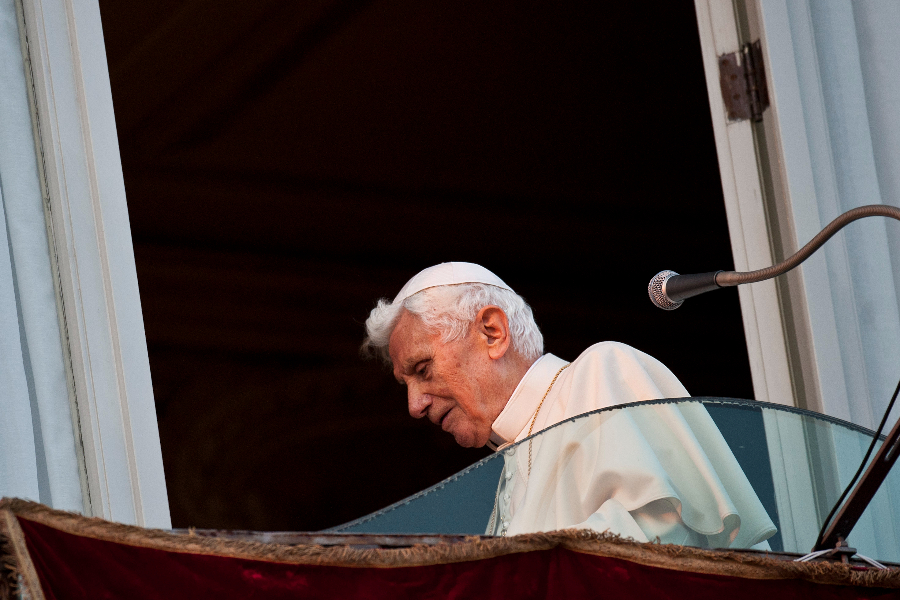
His resignation took effect on Feb. 28, 2013, when he departed Vatican City by helicopter. Arriving at the papal summer residence of Castel Gandolfo, he described himself as “simply a pilgrim who is starting the last stage of his pilgrimage on Earth.”
“Let us go ahead together with the Lord for the good of the Church and of the world,” he said, before departing into retirement.
Benedict XVI adopted the title “pope emeritus” and continued to wear white — choices that critics said might lead Catholics to think he was still pope. He settled in a new home, the Mater Ecclesiae Monastery in the Vatican Gardens. He was 85 years old and not expected to live long, though the Vatican had not indicated a terminal illness. But over the next 10 years, he remained active.
His first public appearance after his resignation came in February 2014, at Pope Francis’ first consistory for the creation of new cardinals. Months later, he was present at the canonization of John Paul II and John XXIII.
In retirement, he continued his long collaboration with the journalist Peter Seewald. Together, they produced the 2016 book-length interview “Last Testament,” their fourth after “Salt of the Earth” (1997), “God and the World” (2002), and “Light of the World” (2010). They also worked together on a multi-volume biography “Benedict XVI: A Life,” published in German in 2020.
He occasionally generated controversy in retirement, contributing in 2019 to a book supporting clerical celibacy amid a debate about a relaxation of the discipline in the Amazon region. In an essay published in the same year, he was accused of blaming clerical abuse on the sexual revolution of the 1960s. But he insisted that his point was that the crisis was caused by a turning away from God.
Catholics around the world continued to cherish the German pope in his retirement. On his 95th birthday, thousands of people sent messages via a website dedicated to his work.
His longtime personal secretary Archbishop Georg Gänswein confided that Benedict himself was surprised by his longevity, recalling that he once said: “I would never have believed that the last stretch of the journey that would take me from the Mater Ecclesiae Monastery to the gates of heaven with St. Peter would be so long.”
Benedict XVI was born on April 16, 1927. He died on Dec. 31, 2022, aged 95.
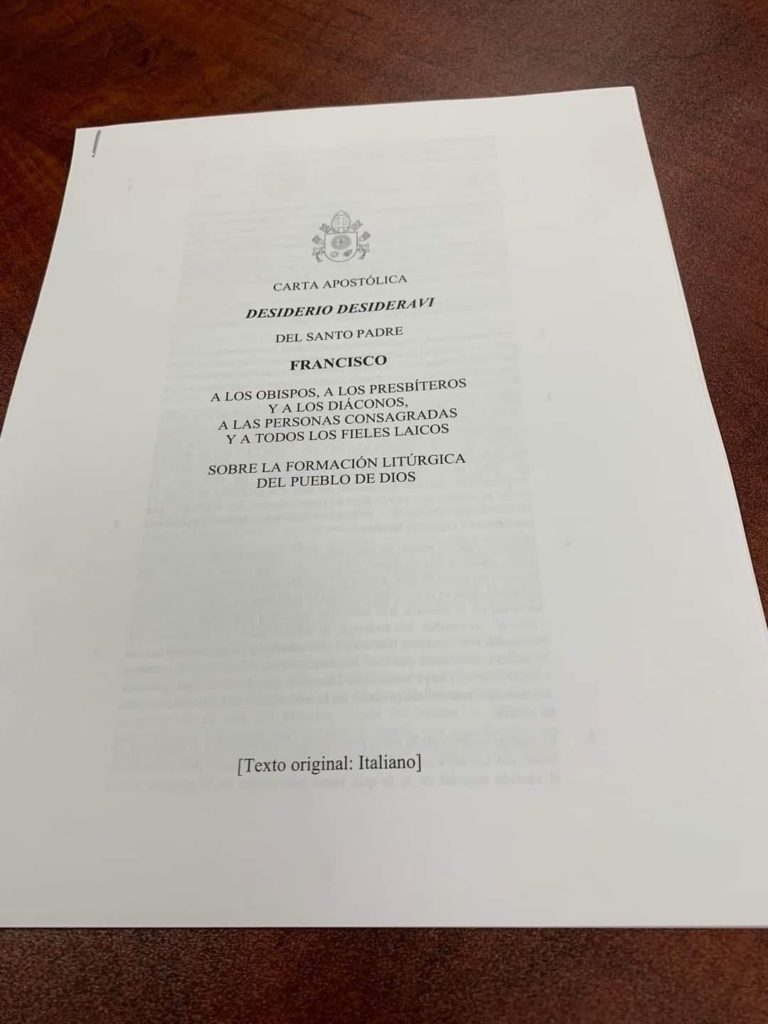
An urgent meeting of the newly-elected Committee of Pro Tridentina (Malta) discussed the latest document issued by Pope Francis, namely Desiderio Desideravi. It is our understanding that based upon p. 61 of this document, the Tridentine Mass currently being celebrated at the Jesuit Church in Valletta / St. Paul Church, Valletta might soon not be allowed anymore. The reason being that it is a Diocesan Mass. Thankfully, the previous Committee of Pro Tridentina (Malta) has ensured that Tridentine Mass can continue to be celebrated by Fr Anthony, outside diocesan restrictions. still, it is painful for us to read such a document, the latest in a series of attacks targeting Pope Emeritus Benedict XVI.
Following is the afore-mentioned p. 61 of Desiderio Desideravi:
61. In this letter I have wanted simply to share some reflections which most certainly do not exhaust the immense treasure of the celebration of the holy mysteries. I ask all the bishops, priests, and deacons, the formators in seminaries, the instructors in theological faculties and schools of theology, and all catechists to help the holy people of God to draw from what is the first wellspring of Christian spirituality. We are called continually to rediscover the richness of the general principles exposed in the first numbers of Sacrosanctum Concilium, grasping the intimate bond between this first of the Council’s constitutions and all the others. For this reason we cannot go back to that ritual form which the Council fathers, cum Petro et sub Petro, felt the need to reform, approving, under the guidance of the Holy Spirit and following their conscience as pastors, the principles from which was born the reform. The holy pontiffs St. Paul VI and St. John Paul II, approving the reformed liturgical books ex decreto Sacrosancti OEcumenici Concilii Vaticani II, have guaranteed the fidelity of the reform of the Council. For this reason I wrote Traditionis custodes, so that the Church may lift up, in the variety of so many languages, one and the same prayer capable of expressing her unity.[23 Cf. Paulus VI, Constitutio apostolica Missale Romanum (3 Aprilis 1969) in AAS 61 (1969) 222.]
In the current terrible situation in Europe, these words from Benedict XVI during an Angelus in July 2009 are very appropriate:
"It is written in Genesis that the blood of Abel killed by his brother Cain calls to God from the earth. Unfortunately, today as yesterday, this cry has not ceased as human blood continues to flow because of violence, injustice and hatred. When will men learn that life is sacred and belongs only to God?" "The Blood of Christ is the pledge of God’s faithful love for humankind. By gazing at the wounds of the crucified Christ each man, even in conditions of abject moral poverty, can say: ‘God has not abandoned me, He loves me, He gave his life for me’, and thus rediscover hope".
2011: Instruction Universae Ecclesiae. Its main effect: overrides the bishops, who are the main problem. But this and the motu proprio re-taken back by the current holder of the Office.
This Blog is pleased to announce that some details of Pope Francis' visit to Malta next year are being made available below to our readers. It is however important to stress that although a draft programme has been made available to us, it is our belief that such details are best left to the Church and Government to publish when they deem appropriate.
Our source in the Vatican confirmed that the dates - although preferable to the Holy See to coincide with the feast of St. Paul's Shipwreck in Malta - depend to a large extent on the general elections due to be held in Malta in 2022.
It is the wish of the current Pontiff to visit churches that were not visited in past Papal visits to Malta by John Paul II and Benedict XVI.
However, the choices being currently considered, namely those of the churches of Fgura (Madonna tal-Karmnu) and Naxxar (Santwarju Ġesù Ħniena Divina - San Pawl tat-Tarġa) seem to be problematic from a logistics point of view. Still, according to our source, the Pope wants to visit churches that architecturally reflect Vatican Council II and Mercy.
Also, the current pandemic seems to preclude large mass gatherings. Therefore, Open Mass in Floriana is currently being excluded. However, consideration is being given to Ta' Qali National Stadium, due to seating possibilities.
For the rest, the visit to Gozo is still to be confirmed although Cardinal Mario Grech is pushing hard for it to be included. A migrants centre is also included in the visit.
Murdered British Pro-Life Catholic Politician David Amess Remembered for Building Bridges With the Holy See
Sir David Amess was always 'working on issues to strengthen ties,’ says former British ambassador to the Holy See Francis Campbell.
(T-L) David Amess with Pope Francis in 2015. (T-R) Sir David Amess on the far left next to Lord Alton with St. Teresa of Calcutta 1988. (B-L) Meeting with Cardinal Burke in 2015. (B-R) Sir David Amess meeting Benedict during the first visit of the All Party Parliamentary Group on the Holy See, March 2006. (photo: Courtesy photos / www.davidamess.co.uk/Right to Life UK/APPG)
VATICAN CITY — Sir David Amess, who was tragically killed on Friday in a knife attack in England, was a committed pro-life British politician whose death has also shocked many in Rome where he is well remembered for his timely work to improve U.K.-Holy See relations.
The 69-year-old devout Catholic father of five and one of Britain’s longest-serving parliamentarians made frequent visits to the Vatican as founder and chairman of the All-Party Parliamentary Group on the Holy See.
The group, which he created in 2006 at a time when the Foreign and Commonwealth Office planned to cut back and possibly even close its embassy to the Holy See, is made up of politicians of different faiths and backgrounds. It was the first such parliamentary group in the world and continues to this day.
The group is especially credited with helping to pave the way for Pope Benedict XVI’s state visit to Britain in 2010, and in particular Benedict’s historic address to both Houses of Parliament in Westminster Hall. It then helped secure a return visit of British government ministers to the Vatican the following year.
Cardinal Vincent Nichols of Westminster recalled this in his tribute on Friday, saying the British Conservative politician fostered “this mutually respectful relationship” between the U.K. and the Holy See through meetings with Cardinal Pietro Parolin, the Vatican Secretary of State, and other Catholic leaders.
“His contribution,” the cardinal said, “is both esteemed and will be sorely missed.”
Francis Campbell, who worked closely with Amess as Britain’s ambassador to the Holy See from 2005 to 2011, told the Register that “he did so much to help build ties and one of his proudest moments was to see Pope Benedict.” He added that Amess was “a great builder of relationships across parliament and was so supportive of [Benedict XVI’s] visit.”
“David was such a kind and generous person who gave so much,” Campbell said. “He was so jovial and engaged, always building bridges and working on issues to strengthen ties. His loss will be greatly felt.”
Defender of Life and the Persecuted
Meeting him in Rome in 2007, Amess told me he was a “born optimist” and that he remained positive that legislation in favor of human embryo research and abortion could be defeated. He believed this despite proponents greatly outnumbering the opposition and the fact that Gordon Brown, no friend to the pro-life cause, had just become Prime Minister.
In that interview, Amess revealed his pro-life conviction and determination to defend the voiceless in politics, lamenting how there had been “less and less interest in terms of the sanctity of life.”
“From my point of view, I cannot see why anyone comes into parliament unless they recognize that life is all-important,” Amess said. “We, as parliamentarians, have our own concepts on the way we wish to create an environment in which people live, but life itself should be everything that motivates us.”
He went on to say that he remained “puzzled why a number of parliamentarians still cannot accept that life is sacred and that it’s up to the ‘mother of all parliaments’ to protect life in law.”
Catherine Robinson, spokesperson for Right To Life UK, said Amess was a “passionate and dedicated patron of our charity” and “a pro-life champion” (see his pro-life voting record here).
“Since he was elected in 1983, he always, where possible, used his position as an MP to stand up for the vulnerable, including championing initiatives to introduce more protections for unborn babies and more support for women facing crisis pregnancies,” Robinson said.
He also voted against assisted suicide, telling fellow parliamentarians in a 2015 debate on the subject: “We all came into politics to help improve people’s lives. I, along with all colleagues, want to assist people to live, so I urge the House to reject this bill.”
Amess’ commitment to religious liberty and his defense of persecuted Christians were also remembered. Fiona Bruce, Prime Minister Boris Johnson’s special envoy for religious freedom, said he “was always faithfully pro-life and faithfully pro family. A dear man with a humble manner and a gentle humor which built friendships across the House. The phrase ‘will be sorely missed’ can be overused, but not with reference to David.”
Neville Kyrke-Smith, national director of Aid to the Church in Need UK, said Amess regularly attended their events and “did much to speak up for the needs of persecuted Christians and others.”
“His death is an attack against parliamentary democracy in this country but more importantly, is a devastating blow to his wife and children and all who knew and respected him and his achievements,” he said.
‘Indescribably Sad’
The Catholic pro-life peer Lord David Alton, a longstanding friend and parliamentary colleague of Amess, said he heard the news “with profound sorrow” and recalled that just a few weeks earlier, they shared a platform at the launch of Amess’ book Ayes & Ears documenting his political career spanning nearly 40 years.
“Typically of David, the proceeds of the book were dedicated to three charities: Endometriosis UK, Prost8 and the Leigh-based Music Man Project,” he said.
“Notwithstanding all the good in the world, we still have the capacity to do truly evil things,” Lord Alton added. “This horrific attack has not only robbed David of his life, but its reverberations will have devastating consequences for his family and loved ones. My thoughts are with Julia and their children. May he now rest in peace.”
Another close parliamentary friend and colleague, Ann Widdecombe, told the Register: “David was a faithful servant of the Lord and a huge source of inspiration to so many colleagues.” A godmother to one of Amess’ children, Widdecombe added: “He will be achingly missed.”
Sir Christian Sweeting, a friend of Amess within the Conservative Party, told the Register, “David was always smiling, he was full of kindness, humor and unstinting in his compassion for others, especially the disadvantaged and the voiceless.
“It’s indescribably sad that he should fall victim to such a misguided and brutal act. He will be remembered as a great Parliamentarian and as a tremendous humanitarian. My deepest sympathies and prayers are with his family and those who loved and knew him.”
Original source: https://www.ncregister.com/news/murdered-british-pro-life-catholic-politician-david-amess-remembered-for-building-bridges-with-the-holy-see
Farewell fellow pro-life and animal rights champion!