Tuesday, January 4, 2011

"Basta con la messa creativa, in chiesa silenzio e preghiera"


di Andrea Tornielli

Il Prefetto del culto divino, Canizares, spiega il rinnovamento voluto dal Papa: "Nella liturgia più spazio all’adorazione e musica adeguata". "La riforma del Vaticano II è stata applicata troppo in fretta"

La liturgia cattolica vive «una certa crisi» e Benedetto XVI vuole dar vita a un nuovo movimento liturgico, che ripor­ti più sacralità e silenzio nella messa, e più attenzione alla bel­lezza nel canto, nella musica e nell'arte sacra.Il cardinale Anto­nio Cañizares Llovera, 65 anni, Prefetto della Congregazione del culto divino, che quando era vescovo in Spagna veniva chia­mato «il piccolo Ratzinger», è l'uomo al quale il Papa ha affida­to questo compito. In questa in­tervista al Giornale , il «mini­stro » della liturgia di Benedetto XVI rivela e spiega programmi e progetti.


Da cardinale, Joseph Ratzin­ger aveva lamentato una cer­ta fretta nella riforma liturgi­ca postconciliare. Qual è il suo giudizio?


La riforma liturgica è stata re­alizzata con molta fretta. C'era­no ottime intenzioni e il deside­rio di applicare il Vaticano II. Ma c'è stata precipitazione. Non si è dato tempo e spazio suf­ficiente per accogliere e interio­rizzare gli insegnamenti del Concilio, di colpo si è cambiato il modo di celebrare. Ricordo be­ne la mentalità allora diffusa: bi­sognava cambiare, creare qual­cosa di nuovo. Quello che aveva­mo ricevuto, la tradizione, era vi­sta come un ostacolo. La rifor­ma è stata intesa come opera umana, molti pensavano che la Chiesa fosse opera delle nostre mani, invece che di Dio. Il rinno­vamento liturgico è stato visto come una ricerca di laboratorio, frutto dell'immaginazione e del­la creatività, la parola magica di allora.


Da cardinale Ratzinger ave­va auspicato una «riforma della riforma» liturgica, paro­le oggi impronunciabili persi­no in Vaticano. Appare però evidente che Benedetto XVI la desideri. Può parlarcene?


Non so se si possa, o se con­venga, parlare di "riforma della riforma". Quello che vedo asso­lutamente necessario e urgen­te, secondo ciò che desidera il Papa, è dar vita a un nuovo, chia­ro e vigoroso movimento liturgi­co in tutta la Chiesa. Perché, co­me­spiega Benedetto XVI nel pri­mo volume della sua Opera Om­nia , nel rapporto con la liturgia si decide il destino della fede e della Chiesa. Cristo è presente nella Chiesa attraverso i sacra­menti. Dio è il soggetto della li­turgia, non noi. La liturgia non è un'azione dell'uomo,ma è azio­ne di Dio.


Il Papa più che con le decisio­ni calate dall'alto, parla con l'esempio: come leggere i cambiamenti da lui introdot­ti nelle celebrazioni papali?


Innanzitutto non deve esser­ci alcun dubbio sulla bontà del rinnovamento liturgico conci­liare, che ha portato grandi be­nefici nella vita della Chiesa, co­me la partecipazione più co­sciente e attiva dei fedeli e la pre­senza arricchita della Sacra Scrittura. Ma oltre a questi e altri benefici, non sono mancate del­le ombre, emerse negli anni suc­cessivi al Vaticano II: la liturgia, questo è un fatto, è stata "ferita" da deformazioni arbitrarie, pro­vocate anche dalla secolarizza­zione che purtroppo colpisce pure all'interno della Chiesa. Di conseguenza, in tante celebra­zioni, non si pone più al centro Dio,ma l'uomo e il suo protago­nismo, la sua azione creativa, il ruolo principale dato all'assem­blea. Il rinnovamento concilia­re è stato inteso come una rottu­ra e non come sviluppo organi­co della tradizione. Dobbiamo ravvivare lo spirito della liturgia e per questo sono significativi i gesti introdotti nelle liturgie del Papa: l'orientamento dell'azio­ne liturgica, la croce al centro dell'altare, la comunione in gi­nocchio, il canto gregoriano, lo spazio per il silenzio, la bellezza nell'arte sacra.È anche necessa­ri­o e urgente promuovere l'ado­razione eucaristica: di fronte al­la presenza reale del Signore non si può che stare in adorazio­ne.

Quando si parla di un recupe­ro della dimensione del sa­cro c'è sempre chi presenta tutto questo come un sempli­ce ritorno al passato, frutto di nostalgia. Come rispon­de?


La perdita del senso del sa­cro, del Mistero, di Dio, è una delle perdite più gravi di conse­guenze per un vero umanesi­mo. Chi pensa che ravvivare, re­cuperare e rafforzare lo spirito della liturgia, e la verità della ce­lebrazione, sia un semplice ritor­no a un passato superato, igno­ra la verità delle cose. Porre la li­turgia al centro della vita della Chiesa non è affatto nostalgico, ma al contrario è la garanzia di essere in cammino verso il futu­ro .


Come giudica lo stato della li­turgia cattolica nel mondo?


Di fronte al rischio della routi­ne, di fronte ad alcune confusio­ni, alla povertà e alla banalità del canto e della musica sacra, si può dire che vi sia una certa cri­si.Per questo è urgente un nuo­vo movimento liturgico. Bene­detto XVI indicando l'esempio di san Francesco d'Assisi, molto devoto al Santissimo Sacramen­to, ha spiegato che il vero rifor­matore è qualcuno che obbedi­sce alla fede: non si muove in modo arbitrario e non si arroga alcuna discrezionalità sul rito. Non è il padrone ma il custode del tesoro istituito dal Signore e consegnato a noi. Il Papa chiede dunque alla nostra Congrega­zione di promuovere un rinno­vamento conforme al Vaticano II, in sintonia con la tradizione liturgica della Chiesa, senza di­menticare la norma conciliare che prescrive di non introdurre innovazioni se non quando lo ri­ch­ieda una vera e accertata utili­tà per la Chiesa, con l'avverten­za che le nuove forme, in ogni caso, devono scaturire organica­mente da quelle già esistenti.


Che cosa intendete fare co­me Congregazione?


Dobbiamo considerare il rin­novamento liturgico secondo l'ermeneutica della continuità nella riforma indicata da Bene­detto XVI per leggere il Concilio. E per far questo bisogna supera­re la tendenza a "congelare" lo stato attuale della riforma po­stconciliare, in un modo che non rende giustizia allo svilup­po organico della liturgia della Chiesa. Stiamo tentando di por­tare avanti un grande impegno nella formazione di sacerdoti, seminaristi, consacrati e fedeli laici, per favorire la comprensio­ne del ver­o significato delle cele­brazioni della Chiesa.


Ciò richie­de un'adeguata e ampia istruzio­ne, vigilanza e fedeltà nei riti e un'autentica educazione per vi­verli pienamente. Questo impe­gn­o sarà accompagnato dalla re­visione e dall'aggiornamento dei testi introduttivi alle diverse celebrazioni ( prenotanda ). Sia­mo anche coscienti che dare im­pulso a questo movimento non sarà possibile senza un rinnova­mento della pastorale dell'ini­ziazione cristiana.


Una prospettiva che andreb­be applicata anche all'arte e alla musica...


Il nuovo movimento liturgi­co dovrà far scoprire la bellezza della liturgia. Perciò apriremo una nuova sezione della nostra Congregazione dedicata ad "Ar­te e musica sacra" al servizio del­la liturgia. Ciò ci porterà a offrire quanto prima criteri e orienta­menti per l'arte, il canto e la mu­sica sacri. Come pure pensiamo di offrire prima possibile criteri e orientamenti per la predicazio­ne.

Nelle chiese spariscono gli in­ginocchiatoi, la messa talvol­ta è ancora uno spazio aperto alla creatività, si tagliano per­sino le parti più sacre del ca­none: come invertire questa tendenza?


La vigilanza della Chiesa è fondamentale e non deve esse­re considerata come qualcosa di inquisitorio o repressivo, ma un servizio. In ogni caso dobbia­mo rendere tutti coscienti del­l'esigenza, non solo dei diritti dei fedeli, ma anche del "diritto di Dio".


Esiste anche il rischio oppo­sto, cioè quello di credere che la sacralità della liturgia dipenda dalla ricchezza dei paramenti: una posizione frutto di estetismo che sem­bra ignorare il cuore della li­turgia...


La bellezza è fondamentale, ma è qualcosa di ben diverso da un'estetismo vuoto, formalista e sterile, nel quale invece talvol­ta si cade. Esiste il rischio di cre­dere che la bellezza e la sacralità del liturgia dipendano dalla ric­chezza o dall'antichità dei para­menti. Ci vuole una buona for­mazione e una buona catechesi basata sul Catechismo della Chiesa cattolica, evitando an­che il rischio opposto, quello della banalizzazione, e agendo con decisione ed energia quan­do si ricorre a usanze che hanno avuto il loro senso nel passato ma oggi non ce l'hanno o non aiutano in alcun modo la verità della celebrazione.


Può dare qualche indicazio­ne concreta su che cosa po­trebbe cambiare nella litur­gia?


Più che pensare a cambia­menti, dobbiamo impegnarci nel ravvivare e promuovere un nuovo movimento liturgico, se­guendo l'insegnamento di Bene­detto XVI, e ravvivare il senso del sacro e del Mistero, metten­do Dio al centro di tutto. Dobbia­mo dare impulso all'adorazio­ne eucaristica, rinnovare e mi­gliorare il canto liturgico, colti­vare il silenzio, dare più spazio alla meditazione. Da questo sca­turiranno i cambiamenti...».

Wednesday, December 29, 2010

Letter from Pontifical Commission "Ecclesia Dei" to FIUV


Members and supporters of Pro Tridentina (Malta) will be pleased to hear that a letter has been received by FIUV's Executive President from the Secretary of the Pontifical Commission Ecclesia Dei, Monsignor Guido Pozzo, about the report submitted to the Commission on the third anniversary of Summorum Pontificum. Pro Tridentina (Malta) contributed to this report. The report was well received in Rome.

Monday, December 27, 2010

Tridentine Mass 31 December 2010

On behalf of the organisers, Pro Tridentina (Malta) would like to invite you to join in thanksgiving to the Lord at the end of the year, during a Sung Mass in the Extraordinary Form of the Roman Rite. Mass to be held in Saint Theresa Church, Cospicua, starting at 10:30 (31 December).

Friday, December 24, 2010

Blessed Christmas


Amabilissimi fratres,


magna cum benevolentia salutem plurimama mittimus vobis!


In hac Domini Nativitatis solemnitate, Deus pater et creator noster, qui ex Beata Maria Virgine nasci dignatus est, concedat vobis gaudium spei, salutis, sui amoris atque misericordiae erga vos.


Deiparae Mariae sanctique Joseph intercessio vobiscum sit per cunctum annum venturum, ut feliciter, pie ac in Altissimi gratia agatis!


Godwin Xuereb

Saturday, December 4, 2010

Report on the Third Anniversary of the Motu Proprio Summorum Pontificum


Malta (in the public part) was mentioned twice, both are positive for us if we build up on them:

"There has been some small growth in England and Wales, in France, in Ireland, Malta, Poland, and Spain, due, in most part, to energetic lay people who will not be deterred." (p.10 my emphasis)

"In Malta the outlook is very positive. It is particularly encouraging that many lay persons are very young and therefore the future of the Extraordinary Form of the Mass in Malta looks bright, notwithstanding the lack of cooperation by the local church hierarchy." (p. 14 my emphasis)

Wednesday, November 24, 2010

Blog under Construction

In a way, this photo is symbolic of the work that Pro Tridentina (Malta) will be facing in the months and years to come to ensure that what is a Catholic's right to have the Tridentine Mass will be ensured in Malta and Gozo. Unfortunately, this is an uphill struggle but one day this right will become a reality and Maltese and Gozitans will be able to benefit from its spiritual fruits.

Godwin Xuereb

Sunday, November 14, 2010

An important clarification from Ecclesia Dei (in Italian)

Il motu proprio Summorum Pontificum di S.S. Benedetto XVI dà facoltà a tutti i sacerdoti cattolici di rito latino, siano essi secolari o religiosi di celebrare nella forma extraordinaria del rito romano in tutto l’Orbe cattolico, usando il Messale di Giovanni XXIII ed. 1962, senza aver bisogno di alcun permesso né della Sede Apostolica né dell’Ordinario (cf. S.P. art. 2). Dare la licenza di celebrare in una parrocchia o in una rettoria spetta rispettivamente al Parroco o al Rettore (cf. S.P. art. 5 §3 e §5). Se la chiesa non avesse un Rettore designato, spetta al parroco del territorio, dove è ubicata la chiesa, dare la suddetta licenza. Il Motu Proprio all’art. 5 §3 stabilisce altresì che ai fedeli e ai sacerdoti che chiedono la celebrazione secondo il Messale del b. Giovanni XXIII, il parroco permetta le celebrazioni in questa forma extraordinaria anche in circostanze particolari. Trattandosi di una Santa Messa a conclusione di un convegno, si può legittimamente considerare una “circostanza particolare”, a condizione però che il sacerdote celebrante sia idoneo alla celebrazione e non giuridicamente impedito (cf. S.P. art. 5 §4).

Friday, October 29, 2010

Tridentine Mass 1 and 2 November 2010


IMPORTANT NOTICE


A solemn High Tridentine Mass will be celebrated on November 1st marking the Feast of All Saints and again on November 2nd marking the feast of All Souls. Mass will be begin at 10:30 AM at St. Andrews Parish Church (L-Ibrag).


The mass is not organised by Pro Tridentina (Malta) but by several people from this parish. But, needless to say, we wholeheartedly support these initiatives.


Feel free to invite friends along.


In Domino,


Godwin

Wednesday, October 27, 2010

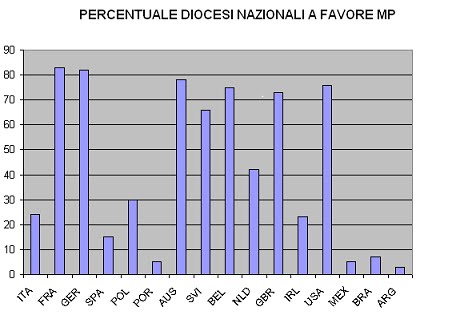
Gli effetti del motu proprio nelle diocesi del mondo


Da Rorate caeli (e relativi commenti) prendiamo questo conteggio redatto da Peter Karl Perkins inerente l'estensione delle Messe tridentine per effetto del motu proprio. Sono computate a parte quelle della Fraternità San Pio X, per meglio enucleare l'avanzata tradizionale per il solo effetto del motu proprio (la FSSPX, ovviamente, non aveva bisogno di attendere la liberalizzazione, che pur ha nobilmente richiesto a vantaggio di tutta l'ecumene, per impiantare nuovi centri di Messa).
Il primo numero accanto al nome di ogni paese si riferisce al 2005, all'inizio di questo pontificato, ed indica le diocesi che a quella data avevano una Messa tridentina almeno ogni domenica e festa di precetto. Si tratta quindi delle messe concesse in applicazione dei vecchi indulti del 1984 e 1988, quando l'arbitrio episcopale era sovrano (oggi lo è ancora, ma non più di diritto, solo di fatto). La seconda cifra recensisce invece la situazione delle diocesi 'virtuose' al 2010 (eventualmente tra parentesi con la specificazione di dati intermedi).
Si ripete: i numeri che seguono indicano il numero di diocesi (con almeno una, a volte più, Messe ogni domenica e festa di precetto), non il numero totale di Messe, che è ovviamente superiore (sia perché in molte diocesi vi sono più Messe, sia perché non si considerano ai fini del computo le Messe con intervallo maggiore di quello settimanale o tenute solo in giorni feriali). Indichiamo quando possibile anche il totale delle Messe 'regolari' e quelle della FSSPX (sempre considerando solo quelle che si celebrano almeno ogni domenica e festa di precetto).
Italia: 15, (41 nel 2008), 52 diocesi (più che triplicate, ma pur sempre meno di un quarto del totale). Totale diocesi esistenti: 214.
Totale Messe: 81 + Totale Messe FSSPX: 15.
Francia: 65 (74 nel 2008), 78 diocesi. Totale diocesi esistenti: 93.
Totale Messe: 201 + Totale Messe FSSPX: 215
Germania: 10, 23 diocesi. Totale diocesi esistenti: 28.
Totale Messe: 54 + Totale Messe FSSPX: 64
Spagna: 3, 11 diocesi. Totale diocesi: 69
Totale Messe: 16 + Totale Messe FSSPX: 4
Polonia: 6, 12 diocesi. Totale diocesi: 40
Totale Messe: 16 + Totale Messe FSSPX: 12
Portogallo: 0, 1 diocesi. Totale diocesi: 20
Totale Messe: 2 + Totale Messe FSSPX: 2
Austria: 5, 7 diocesi. Totale diocesi: 9
Totale Messe: 13 + Totale Messe FSSPX: 11
Svizzera: 3, 4 diocesi. Totale diocesi: 6
Totale Messe: 29 + Totale Messe FSSPX: 40
Belgio: 5, 6 diocesi. Totale diocesi: 8
Totale Messe: 15 + Totale Messe FSSPX: 6
Olanda: 1, 3 (incremento ma con perdita di Rotterdam, l'unica del 2005). Totale diocesi: 7
Totale Messe: 5 + Totale Messe FSSPX: 2.
Lussemburgo: 0, 1. Totale diocesi: 1
Totale Messe: 1. Totale Messe FSSPX: 0
Liechtenstein: 0, 1. Totale diocesi: 1
Totale Messe: 1. Totale Messe FSSPX: 0
Inghilterra e Galles: 9, 19. Totale diocesi: 22
Totale Messe: 38 + Totale Messe FSSPX: 18.
Scozia: 2, 3 diocesi. Totale diocesi: 8.
Totale Messe: 3 + Totale Messe FSSPX: 3
Irlanda: 4, 6 diocesi. Totale diocesi: 26
Totale Messe: 6 + Totale Messe FSSPX: 6
Filippine: 5, 7. Totale diocesi 86.
Australia: 10, 11 diocesi.
Nuova Zelanda: 2, 5. Totale diocesi: 6
U.S.A.: 112, 149 (significativo il numero di Messe già concesso dai vescovi ai tempi dell'indulto, segno dell'assenza in molti presuli americani della chiusura ideologica che affligge la maggior parte dei loro colleghi nel resto del mondo). Totale diocesi: 195
Totale Messe: 358 + Totale Messe FSSPX: 116.
Canada: 11, 14 diocesi. Totale diocesi: 71.
Totale Messe: 28 + Totale Messe FSSPX: 18
Messico: 1, 5 diocesi. Totale diocesi: 94.
Totale Messe: 11 + Totale Messe FSSPX: 11
Brasile: 7, 21 diocesi (triplicazione non comparabile con alcun altro paese latinoamericano). Totale diocesi: 272
Argentina: 2, 2 (accanita ostruzione del card. Bergoglio e complici) diocesi. Totale diocesi: 72
Colombia: 1, 2 diocesi
Peru: 1, 2 diocesi
Sud Africa: 0, 1 diocesi
Gabon: 1, 2 (grazie all'I.C.R.S.S.) diocesi
Ungheria: 1, 3 diocesi. Totale diocesi: 12.
Totale Messe: 3. Totale Messe FSSPX: 0
Repubblica Ceca: 1, 4 diocesi (Olomouc aggiunta questa settimana). Totale diocesi: 8
Totale Messe: 7 + Totale Messe FSSPX: 1 (a Brno).
Slovacchia: 0, 1 diocesi. Totale diocesi 6.
Totale Messe: 1. Totale Messe FSSPX: 0
Lituania: 0, 1 diocesi. Totale diocesi: 8
Totale Messe: 1 + Totale Messe FSSPX: 2
Svezia: 0, 1 diocesi. Totale diocesi: 1
Totale Messe: 2. Totale Messe FSSPX: 0
Enrico

Monday, October 25, 2010

The Case for the Extraordinary Form of the Mass (3)


Tuesday, 17th July 2007


Liturgy in Latin (2)


Charlò-Carmel Camilleri, O.Carm. Balluta.


In reply to Angelo Micallef's concerns (July 10) about the Apostolic Letter Summorum Pontificum that allows for wider celebration of the "old" Roman Missal, it has to be clarified that Pope Benedict's directives permit the use of the Roman Missal promulgated by Blessed Pope John XXIII in 1962.


Claims on the supposed "rift" and "distance between us and those of the Jewish faith", which will spring forth as a consequence of the use of this "old Latin liturgy" (July 6) are unfounded inasmuch as in 1959, Pope John XXIII removed from the "old" missal the notorious phrase concerning Jews and used in the prayer of the faithful on Good Friday. Still, even in the post-Vatican II rite, Catholics, on Good Friday, pray among others, for Jews, for those who do not embrace any faith and for people who embrace other religious beliefs.


The Pope himself explained the motivation behind this allowance, saying among others that: i) the 1962 missal "was never juridically abrogated and, consequently, in principle, was always permitted"; ii) that there is still in the Roman Catholic Communion "a good number of people who remained strongly attached to this usage of the Roman Rite". After Vatican II the "old rite" did not remain in use only by the Society of St Pius X, founded by Archbishop Marcel Lefebvre and who was excommunicated on reasons that "were at a deeper level" other than his "fidelity to the old missal".


There is no reason for anybody to "feel further distanced from the faith" because of this issue. For a priest to celebrate Mass in the "old rite" there should be a community of Catholics who ask for it. No one is obliged to do so. The Pope is only allowing those who wish, to do so.


Motivated by "charity and pastoral prudence", the Pope's invitation is to "generously open our hearts and make room for everything that the faith itself allows". Considering that even after Vatican II, there are still religious orders who have their proper liturgical norms and rites, which differ from the the Roman Rite, this is no strange move. Even Catholic communities in full communion with the Pope, like the Greek Catholics and the Archdiocese of Milan, still use their own liturgical rites! So, there should be nothing strange about this allowance and about having two forms of the Roman Rite.


I interpret it is another practical move by the present Pope to promote unity in diversity in the Catholic Church itself, breaching the ever-present rift between "traditionalists" and "liberalists" attempting to foster between them mutual understanding. During the Mass for the inauguration of his pontificate in April 24, 2005 the Pope explicitly expressed his commitment to unity in the following words: "Lord, remember your promise. Grant that we may be one flock and one shepherd! Do not allow your net to be torn, help us to be servants of unity!"


Godwin Xuereb, Pro Tridentina (Malta) President's comment: short bio from the Carmelite Order's website. Fr. Charlò-Carmel, of the Maltese Carmelite Province, was born on 24 March 1975. He entered the Order in 1992, and did his noviciate in Pisa (Italy). On 25 July 1994 he made his simple profession and on 30 September 1997 made his solemn profession. He was ordained to the priesthood on 3 August 2001. Between 1994 and 2000 he attended the State University of Malta from where he graduated in Philosophy, History of Art and Theology. In 2002, he also obtained his Master’s degree in Pastoral theology from the same university. His thesis is entitled: Carmel: A Spirituality of Beauty. These last few years he has been master of novices and director of postulants and students in the Maltese Carmelite Province. In 2004 he obtained a Diploma in Formation Studies (CIFS) at the Pontifical Gregorian University and in 2007 obtained a Doctorate in Spiritual Theology from the same university. His Doctoral Thesis is entitled: Union with God as Transformation in Beauty. A Literary-Spiritual Analysis of the Colloquies of Santa Maria Maddalena de' Pazzi (1566 - 1607). At present he lives at the Carmelite Priory in Balluta, Malta. He is author of various articles and books on theology and spirituality.

The Case for the Extraordinary Form of the Mass (2)


Tuesday, 17th July 2007


Liturgy in Latin (1)


Edric Micallef Figallo, Nadur.


Angelo Micallef (Mass in Latin, July 10) has expressed doubts on the recent Summorum Pontificum, the latest much awaited motu proprio issued by Pope Benedict XVI. Like him, I am a young layman and a Catholic faithful.


Mr Micallef apparently implies that he thinks the question of the liturgy is a mere question of language. However, the question goes far beyond the usage or not of Latin.


In relation to Jewish-Catholic relations it should be noted that the Vatican has already provided satisfactory explanations unless one is most paranoid. The modality of Catholic liturgy and doctrine is the prerogative of the Catholic Magisterium and is not to be determined by anyone of other faiths or thought streams. Such a prerogative is a true act of insolent intolerance and nothing more. Why not eliminate the Gospels as offensive to Jewish notions of monotheism and the Messiah?


Pope John Paul II working against Latin in the liturgy or in anything else is the product of Mr Micallef's imagination. The Vatican has never pushed for the de facto disuse of Latin, and especially it did not seek the same de iure. Cardinal Dario Castrillón Hoyos, a senior figure in the question, has recently stated on Il Giornale that what Pope Benedict XVI recently publicised was also planned by Pope John Paul II.


It is very significant to note that the Pope in the past stated that while the Church positively sought to reapproach Protestants and Orthodox, some took a negative attitude towards traditionalist Catholics. Perhaps this is something that Mr Micallef should consider since if there were ever any disgruntled Catholics whose faithfulness to doctrine was not based on progressive do-it-yourself notions or the latest socio-political trends, these are so-called traditionalist Catholics many of whom are in communion with Rome. More preposterous is preferring to heed the views of those who don't even profess themselves as Catholic Christians in the first place, as Mr Micallef seems to imply.


The motu proprio is indeed a charitable act bestowing hope on many faithful. Complaints on this motu proprio are irrational as greater rights have been granted to all, and not lesser to anyone. Choice has been amplified, no one has been limited ecclesiastically and many have been reapproached. Those who distance themselves from the Church due to this do so because they want to distance others from the Church for no sound doctrinal reason but on mere whims.

Important to consider is the exponential growth of traditional Catholic faithful within the Catholic fold in a growing age of secularisation in the western world. This is contrasted with a contrary trend in more lukewarm or merely cultural Catholics. This is quite indicative.


Concluding, I pray for and thank Pope Benedict XVI for his veritable charitable act for all the Church and I hope that our national bishops will implement appropriate solutions in due time.


Godwin Xuereb, Pro Tridentina (Malta) President's comment: Mr. Micallef Figallo is Pro Tridentina (Malta)'s Secretary. A well-written reaction to the original post by Angelo Micallef on the Times of Malta.

The Case for the Extraordinary Form of the Mass (1)


Monday, 23rd July 2007


On the road to Salvation


Fr Brendan Mark Gatt, Mosta.


The new Apostolic Letter, Summorum Pontificum, has indeed made it easier to use the 1962 Missal. However, as Pope Benedict notes, it should also highlight the innate beauty and greatness of the "modern" Roman Missal, since it is "a twofold use of one and the same rite", rather than a case of two rites.


Consequently, readers like Angelo Micallef (Mass In Latin, July 10) need not worry about the re-introduction of the 1962 Missal. It is not as though from September 14 onwards all Masses will be celebrated in Latin. No priest or group of faithful can impose the Latin Missal upon a congregation. One reason is practical: as Mr Micallef points out, few people nowadays (and precious few priests, I would add) understand Latin.


The Pope demands that those seeking Latin celebrations possess enough formation in liturgy and Latin to participate fruitfully. Otherwise we risk playing with the Mass.


Another reason is juridical: although the older Missal was never abrogated, it has now been clarified that its status is "extraordinary", whereas the 1970 Missal remains the ordinary one.

Mr Micallef refers to a Pope whom we honour and hail as a saint, probably Blessed John XXIII. Yet, the claim that he "worked tirelessly to reduce the importance of Latin" is a bit of a caricature and has nothing to do with his greatness. Pope John (who did much to bring the Church in step with the times) is only indirectly responsible for the liturgical reform: he died soon after the inauguration of Vatican Council II. Ironically, we owe the very Missal being facilitated by Summorum Pontificum to him, since it was published in 1962 under his authority.


Rather, it was Pope Paul VI (unfairly labelled by some nostalgics as "weapon of Mass destruction") who sought to make the liturgy more accessible to a people sadly no longer conversant with Latin. A tragic side effect to this renewal was the whole gamut of abuse which crept in under its cover: from general apathy, to priests who thoughtlessly modify liturgical texts (thus disrespecting both liturgy and faithful); from hosts with chocolate chips or raisins added to them (to liven them up, presumably), to Masses interrupted halfway through for a barbecue (ostensibly to emphasise the meal aspect). And, finally, the pièce de résistance: a Halloween Mass in costume, featuring an extraordinary minister distributing Communion, dressed as a devil! No wonder some disgruntled Catholics feel that the liturgy has been debased.


The Church's history is painfully littered with relatively small misunderstandings that became long-lasting divisions. Hence, our seeking for reconciliation must extend on many fronts. The "lifting of the veil" applies above all to us. It demands humility and generosity, both internally (extending the olive branch to all dissenters, be they Lefebvrites or liberals) and externally (a will to share our spiritual riches). The much-maligned prayer for the Jews must be viewed in this light: a tribute to the Chosen People, and a prayer that those who first received the promise of salvation may understand that it has indeed been fulfilled. I find that uplifting, not insulting.


Godwin Xuereb, Pro Tridentina (Malta) President's comment: a not so recent contribution, first published in the Times of Malta, but still valid as far as the situation in Malta is concerned. It shows what an uphill struggle people who are in favour of the Extraordinary Form of the Roman Rite face in Malta.


Thursday, October 21, 2010

Monsignor Domenico Bartolucci

di Rodolfo Vargas Rubio

Monsignor Domenico Bartolucci (Borgo San Lorenzo nella Toscana, 7 Luglio 1917), Maestro Perpetuo della Cappella Musicale Pontificia Sistina, compositore e Accademico di Santa Cecilia, riceverà anche lui il rosso capello dalle auguste mani di Sua Santità il Papa Benedetto XVI nell’annunziato concistoro di 20 novembre prossimo venturo. Anche se nel suo caso la sacra porpora sia puramente testimoniale (dato che il nuovo cardinale ha 93 anni e quindi non svolgerà nessun carico curiale ne parteciperà ad alcun eventuale conclave), si tratta comunque di una giusta ricompensa per tutto quello che lui ha fatto per la difesa della musica sacra, particolarmente nei più procellosi e difficili tempi della contestazione liturgica.